
An empty first aid bag supplier will send a price within a day. The trouble starts one step later, when three of those prices sit side by side and turn out not to describe the same object. One covers a bag in a polybag. Another covers a bag, a divider set and a printed logo. A third assumes a carton packed forty units deep. On one wholesale directory listing for empty first aid pouches, minimum order quantities run from 1 piece to 5,000, and unit prices from roughly US$0.25 to US$59.99. That spread is not a market inefficiency. It is what an unclosed quote looks like at scale.
This guide covers both formats, soft bags and rigid boxes, and approaches the empty first aid bag supplier decision as a specification problem before it becomes a negotiation problem.
Why an empty first aid bag supplier quote rarely compares
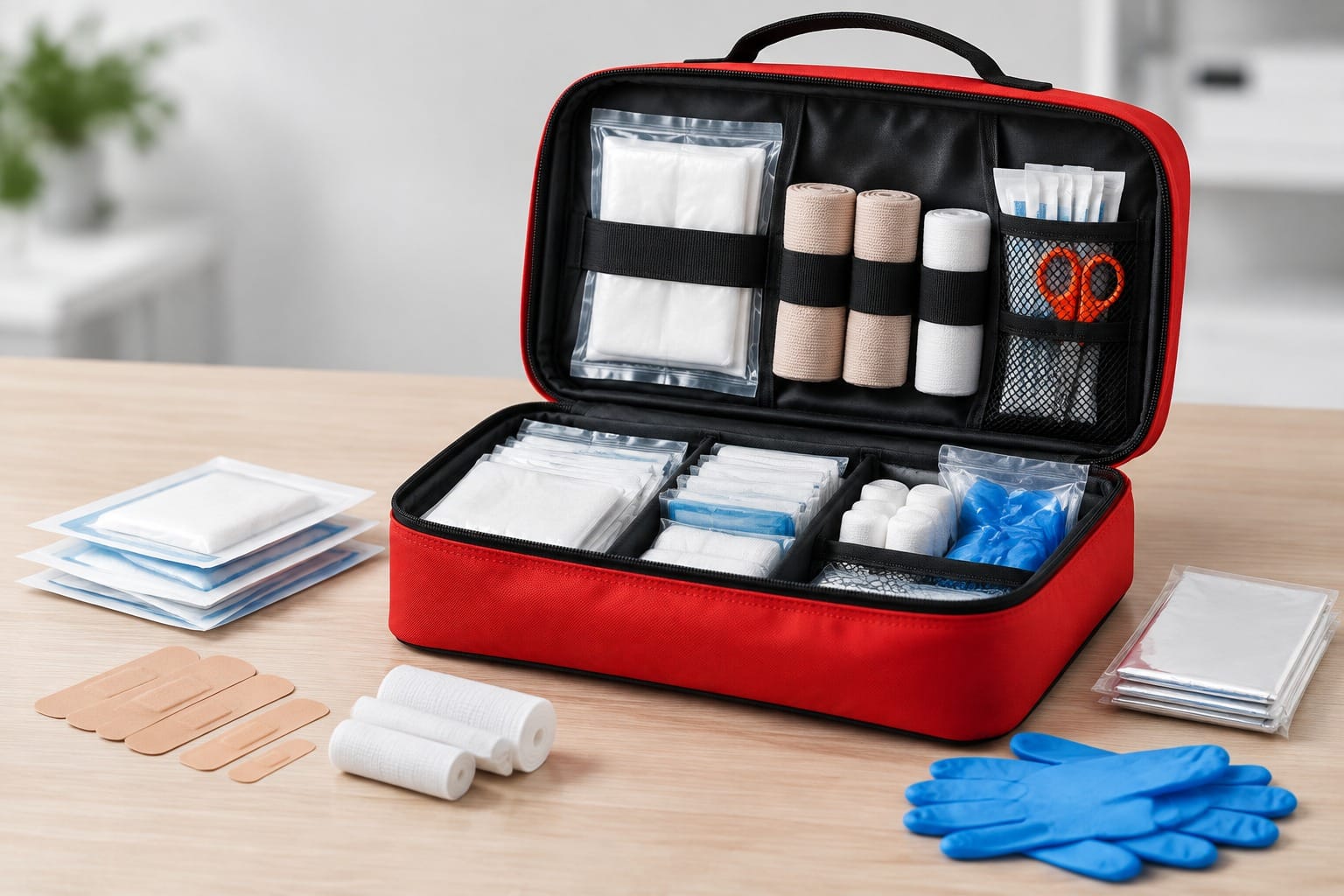
Three things differ between buyers who end up with a usable price comparison and buyers who end up with three numbers and no decision.
The first is the reference object. An empty bag has no contents list to anchor it, so the specification has to be built from the outside in. Fabric, dimensions, closure, interior layout, branding and packing all have to be stated, or the price attaches to whatever the factory assumed.
The second is that the same words cover different objects. “Empty first aid bag” spans a 0.25-dollar promotional pouch and a 59-dollar modular responder pack. Both are correctly described. Neither substitutes for the other.
The third is that size and weight move the landed cost, not just the unit price. A rigid box protects contents and stacks, but it also raises volumetric weight. A soft bag ships denser and conforms around its contents, but offers no crush resistance. Two quotes can differ by 20% before anyone discusses margin.
Buyers searching this category are already asking for structure rather than products. In our own search data the recurring phrases are things like “empty first aid bag customization options”, “empty first aid bag odm manufacturer” and “empty first aid bag producer” — all selection-stage language, all looking for a way to compare rather than a page to browse.
The six fields that have to be closed before a quote means anything
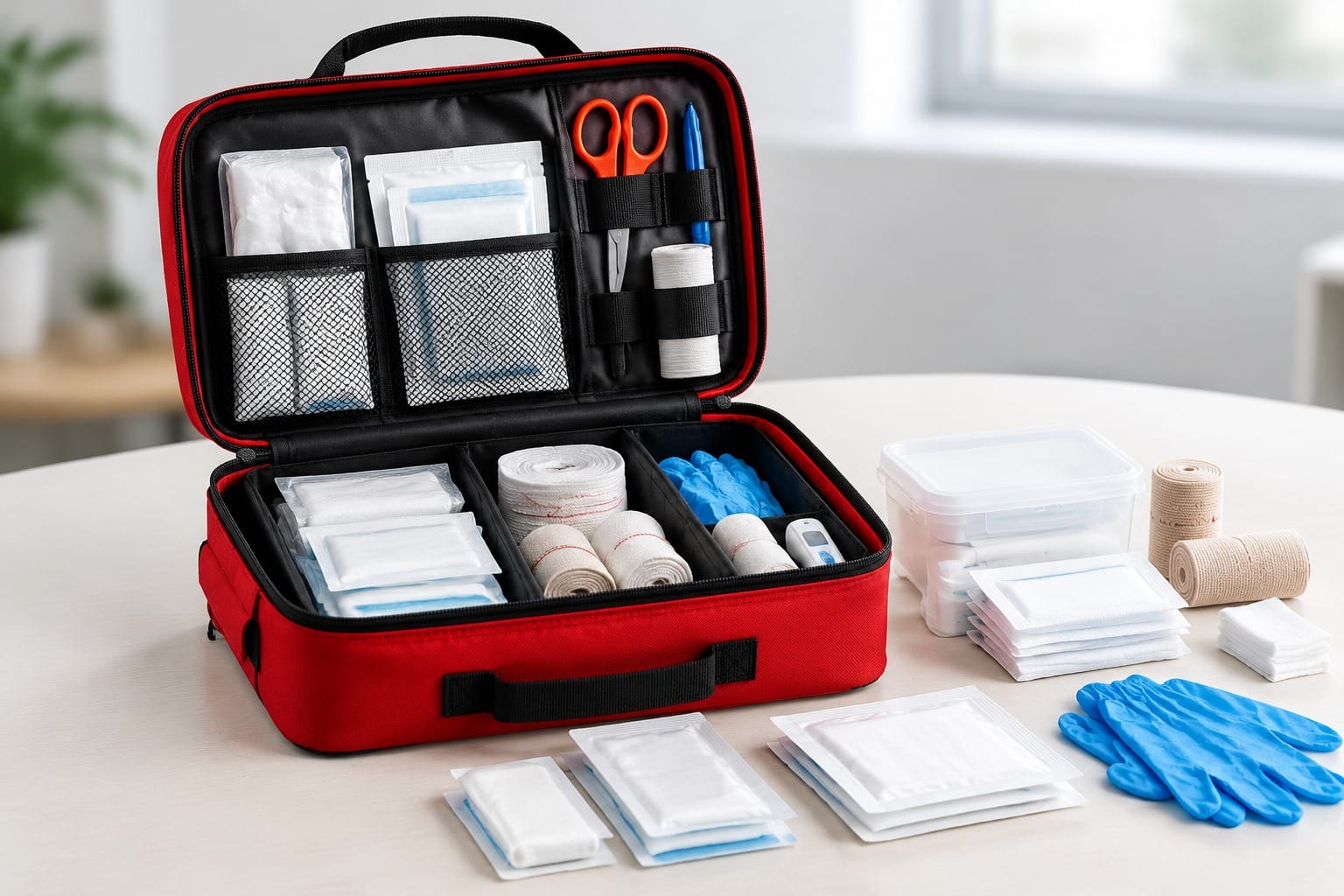
| Field | Why it decides comparability | What to ask for in writing |
|---|---|---|
| Format and finished dimensions | A sewn dimension and a finished dimension differ once the bag is loaded | External length, width and height, and whether that is cut size or finished size |
| Base material and construction | Polyester, nylon, canvas, EVA and PP differ in weight, abrasion resistance and price band | Fabric type and denier, coating, and the closure hardware (zipper type, buckle, hinge) |
| Interior configuration | Divider sets and elastic loops are frequently priced as options rather than included | Whether the divider set, mesh pocket and elastic loops are inside the unit price |
| Branding method | Printing, embroidery and heat transfer have different setup costs and minimums | Method, number of colours, placement, and whether a setup charge applies once or per run |
| Packing and carton specification | Freight is quoted on cartons, not on units | Units per polybag, units per carton, carton dimensions, gross weight |
| Commercial terms | A unit price without a delivery term and a lead time is not a quotation | MOQ per SKU, sample lead time, production lead time in working days, payment split, delivery term |
An empty first aid bag supplier who returns all six fields has handed you a comparable document. Fill those six and the comparison becomes arithmetic. Leave one open and every difference between the quotes is ambiguous, because you cannot tell whether you are looking at a price difference or a specification difference.
The delivery term line deserves its own note. The international commercial terms published by the International Chamber of Commerce determine where risk and cost transfer between seller and buyer. Two quotes at the same unit price can be several percent apart in landed cost once the term differs, and a quote that leaves the term implied has not committed to either.
Bag or box: what the format decision changes
Format is decided before material, and it is decided by where the kit will live. The empty first aid bag supplier conversation should therefore start here rather than with price.
| Format | Strengths | Costs to expect | Fits |
|---|---|---|---|
| Soft bag (polyester, nylon, canvas) | Ships dense, conforms around contents, low unit cost, easy to print | No crush protection, harder to keep clean, dimension tolerance wider | IFAK and MOLLE-mounted pouches, vehicle bags, waist and hand-carry kits |
| EVA or hard-shell case | Holds shape, protects instruments, wipes clean | Volumetric weight, mould cost at some quantities | Training kits, instrument-heavy kits, vehicle and field cases |
| Rigid box (PP, ABS, aluminium) | Stackable, wall-mountable, protects against compression | Heaviest per unit, freight sensitive, larger carton | Workplace and facility kits, wall-mounted stations, cabinet systems |
Two practical consequences follow. A workplace programme that will be inspected against destination requirements usually needs a box or a wall-mountable system rather than a bag, because the requirement is about accessibility and contents control rather than portability. The UK position stated by the Health and Safety Executive is one such regime, and other markets legislate their own. Where the kit contains a regulated medical device, documentation duties also attach to whoever places it on the market, and the United States quality system regulation is an example of how far those duties reach into manufacturing records.
The second consequence is that an empty bag order and an equipped kit order should not be compared on unit price at all. They sit at different points in the bill of materials.
How to run the first comparison pass in one hour
The pass below assumes no empty first aid bag supplier has been visited and no sample has arrived. It produces a shortlist and a request, not a decision.
- Fix the specification sheet first, using the six fields above, and version it. Every quote is then measured against a document rather than against memory.
- Send the same sheet to every factory in the same message, asking for a quote against revision 1 and listing any field that cannot be confirmed.
- Record which fields came back blank. A supplier who returns five of six fields filled in is further along than one who returns a single unit price with a confident tone.
- Normalise the packing lines into a common unit, usually cost per 1,000 units landed at your port, so carton differences stop distorting the comparison.
- Request one physical sample of the empty format before samples of artwork or branding. Format, dimensions and closure are the fields that cannot be judged from a photograph.
- Score the responses, not the suppliers’ reputations, using a weighted sheet so the criteria and the weights are fixed before the answers arrive. Our own supplier scorecard model for distributors and resellers sets out one way to weight them.
An hour is enough for one pass because the work is reading, not negotiating. Negotiation before the specification is closed tends to produce a discount on an object nobody has defined, which is why the sheet comes before the empty first aid bag supplier shortlist.
Where empty bag sourcing goes wrong
- Treating MOQ as a supplier trait. MOQ is a property of a specific SKU, fabric and print method. A factory quoting 500 pcs on one bag may quote 2,000 on another with a coated finish.
- Comparing quotes that exclude different things. Divider sets, logo setup and inner trays are the three most common inclusions to check, because each is easy to price separately and easy to leave out.
- Reading one lead time. A page that states 20–35 days in one block, 28–40 days in another and a quantity-banded table elsewhere is giving three different commitments rather than one wide estimate. Ask for a single production figure in working days, in writing.
- Skipping the carton. Packing decisions change freight more often than fabric decisions do at low volumes, because container fill is decided by carton geometry. An empty first aid bag supplier who answers carton questions without being pushed is usually working from a real packing line.
- Assuming an empty bag removes the documentation question. It changes the question rather than removing it. An empty bag carries fewer product-level duties than an equipped kit, but the destination market may still regulate how the kit is presented once your buyer fills it.
FAQ
What is the minimum order quantity for an empty first aid bag?
It depends on the SKU rather than on the supplier. Across wholesale listings for nominally similar empty pouches, MOQs observed range from a single piece to 5,000, with 500 pcs appearing most often. Stock styles carry the lowest minimums because no tooling is involved; a custom size, a specific coating or a new print layout raises it. Ask for the MOQ per SKU in writing rather than a general figure for the factory.
Should I buy an empty bag or a fully equipped kit?
Buy an empty bag when you control the contents list yourself, when you are filling locally, or when your destination market makes a locally sourced contents list simpler. Buy an equipped kit when you want one supplier accountable for the whole configuration. An empty bag gives you more control over the contents and less coordination overhead with the bag factory, but it moves the contents sourcing work onto you.
How do I compare prices when the packing differs?
Convert every quote to a single unit: cost per 1,000 units landed at your port, using the carton dimensions and gross weight the supplier provides. That normalises units per carton, carton volume and freight basis in one step. Once normalised, a lower unit price frequently turns out to be the more expensive option because it arrives in a carton shape that fills a container badly.
What should the specification sheet contain at minimum?
Six lines: format and finished dimensions; base material and closure hardware; interior configuration including whether dividers are included; branding method with colour count; packing and carton specification; and commercial terms covering MOQ, sample and production lead times, payment split and delivery term. Add a revision number and a date. A sheet without a revision number cannot be referenced later when a reorder has to match the first shipment.
Does an empty bag need a different sample process?
Yes, and it matters more than with an equipped kit. With an equipped kit you can inspect a contents list item by item, which gives the sample a checklist. An empty bag has no such list, so the sample has to be checked against the six specification fields: measure the finished dimensions against the sheet, verify the closure type, count the divider set, and confirm the fabric against the stated denier. Sample-based validation before production is the step that catches specification drift.
How many suppliers should I quote at once?
Three is usually enough for a first pass. Fewer than three and you cannot separate a market price from one factory’s pricing, and more than three multiplies the specification-reading work without improving the comparison. If all three return an incomplete field list, the problem is your sheet rather than the market, so tighten the request and run the pass again.
Closing
An empty first aid bag supplier is not hard to find. A comparable quote is the scarce item, and it is scarce because nobody closes the specification.
Start with the six fields, version the sheet, and read every quote as an answer to that sheet rather than a message from a factory. The format decision then sits where it belongs: in the use case, not in the inbox. For the surrounding decisions, the emergency first aid kits and bags guide covers how an equipped configuration is planned, and the bag formats comparison works through waist, case and backpack options for outdoor programmes.
If you are ordering an empty format to fill yourself, the emergency medical bags range shows the formats we hold, and the logo branding methods guide covers how printing and embroidery decisions affect minimums. Buyers who need the quote structure itself can start from the first aid supplies RFQ template, and anyone planning the second order should read the rules on keeping components identical across repeat orders.
Our own MOQ starts at 1,000 pcs, with sample-based validation before production and a feasibility review wherever the configuration is not yet fixed. In our catalogue data the category hubs, not the individual product pages, carry most of the search impressions, which is why a supplier’s hub pages are usually the faster read when you are comparing capability rather than a single SKU.
The same split between stocked kits and empty formats shapes how a public sector first aid products tender divides its lots, because kits and empty bags are normally evaluated on separate criteria and awarded separately.
A retailer assembling its own range often begins from an empty format, and the specification notes on home first aid kit contents cover what to agree before the case is chosen.