

A buyer signs off on a carton that looks reasonable in a photograph, then discovers six weeks later that it sits 40 mm proud of the pallet footprint. The pallet count goes up, the container fills before the volume does, and nobody can explain the gap because every dimension was checked individually.
A first aid export packaging carton is a freight decision before it is a print decision. Its outer dimensions decide how many units share a pallet layer, the layer count decides the pallet height, and the pallet height decides what a 40-foot high-cube actually carries. Get the carton right and the rest is arithmetic. Get it wrong and the correction arrives as freight cost.
This guide works through the sequence in the order it should be decided: carton size against pallet footprint, pallet count against container capacity, stack height against compression, and the wood and marking requirements that a cross-border shipment adds on top.
Why Does the Carton Decision Come Before the Quotation?

Because every downstream figure in a quotation is derived from it, and because changing it later invalidates the earlier figures. A first aid export packaging carton that changes after quotation changes every dependent number with it.
Follow the chain once:
- Carton outer dimensions determine units per pallet layer.
- Units per layer multiplied by layers gives cartons per pallet.
- Cartons per pallet multiplied by pallets per container gives shipment volume.
- Shipment volume divided by order quantity gives the number of containers, and therefore the freight.
- Freight per unit is what the buyer actually compares.
A 20 mm change at step one can move step five by a visible margin on a multi-container order. That is why an export packaging specification sheet should be frozen at quotation stage rather than at shipment stage. Buyers who fix the carton late are usually comparing quotations built on different assumptions without realising it.
What Does First Aid Export Packaging Carton Specification Actually Contain?
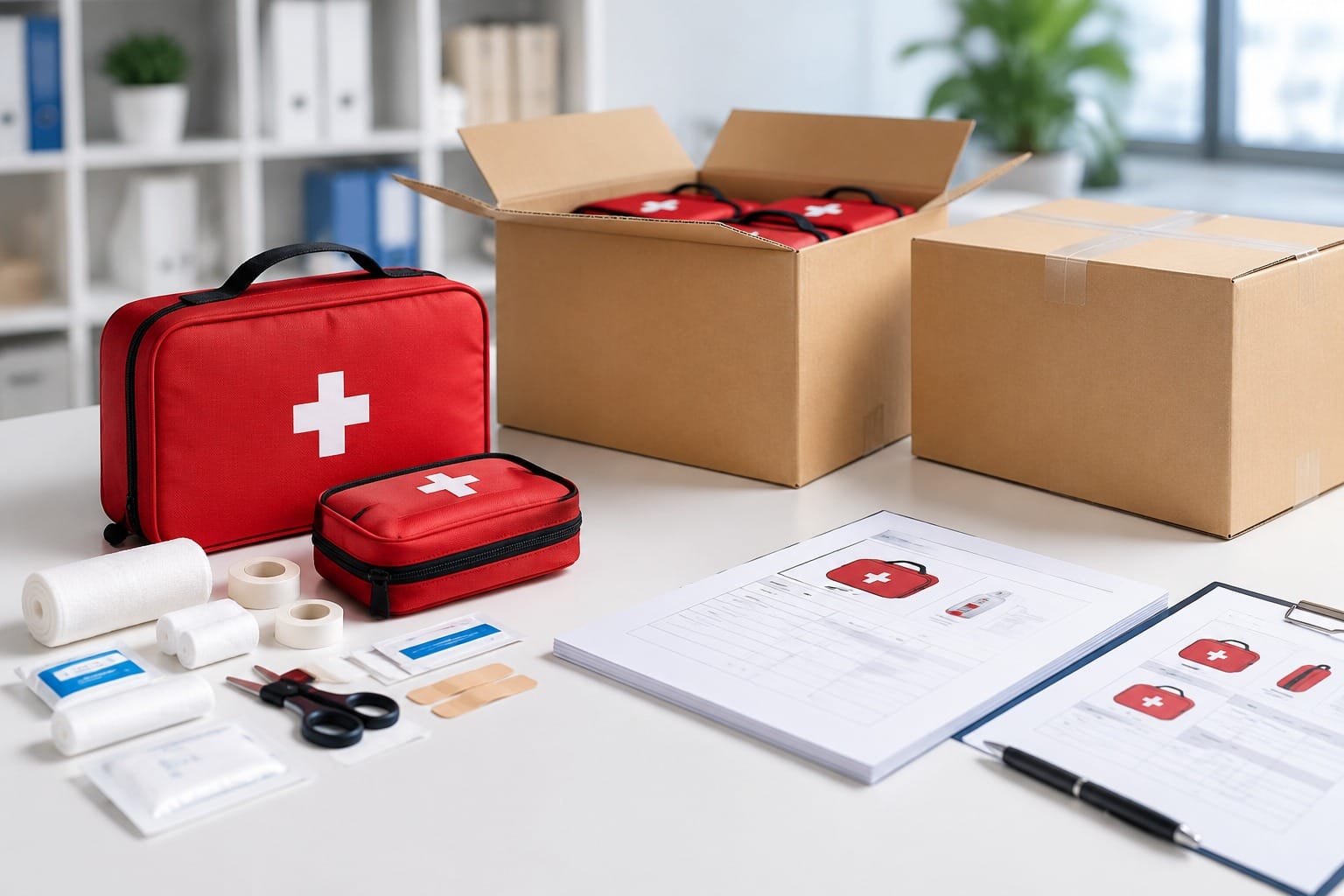
The specification for a first aid export packaging carton carries six fields, and omitting any one of them leaves the factory to choose on the buyer’s behalf.
| Field | What it fixes | Typical failure when omitted |
|---|---|---|
| Outer dimensions (L × W × H, mm) | Units per pallet layer | Carton overhangs the pallet footprint |
| Board grade and construction | Compression strength | Boxes collapse in the lower layers |
| Gross weight per carton | Manual handling and stacking limits | Loader stacks by height, not by weight |
| Units and packaging per carton | Pickability at destination | Mixed inner packs, slower receiving |
| Internal protection | Breakage and scuffing in transit | Damaged printed cartons refused at intake |
| Marking and pictograms | Handling and identification | Wrong side stacked, carton unidentifiable |
For medical consumables, two of these deserve more attention than they usually get. Gross weight per carton is often capped by what a warehouse worker can lift alone, and that cap frequently binds before the container weight limit does. Internal protection matters because a crushed outer carton can still contain intact product while being rejected at intake on appearance alone.
If the finished kit is a box-based case or supply box format, the carton can be sized tightly around a rigid item. If it is a soft bag or fold-out format, the carton must absorb more variation, because soft goods compress differently depending on how they are loaded.
How Many Cartons Fit on a Pallet, and How Many Pallets in a Container?
This is arithmetic, and it starts from the pallet, not the carton. That single reversal is the governing principle of first aid export packaging carton sizing, and it is the step most buyers take in the other order.
The EUR pallet (EPAL 1) measures 1200 × 800 × 144 mm and weighs about 25 kg, with a working load of 1500 kg in normal use and a stated limit of 5500 kg for the bottom pallet on a solid, level floor. Those figures come from the EPAL load-carrier specification. A carton measuring 400 × 300 mm fits eight per layer on that footprint with no overhang. A carton measuring 450 × 300 mm fits five, and leaves 150 mm of the pallet length unused.
Container capacity then sets the practical ceiling. Published carrier figures for a standard dry container give an internal length of 5 898 mm on a 20-foot unit and 12 032 mm on a 40-foot unit, a common internal width of 2 352 mm, a door height of 2 280 mm on both, and a door height of 2 585 mm on the 40-foot high-cube. Nominal cargo capacity is 33.2 m³ for the 20-foot, 67.7 m³ for the 40-foot and 76.4 m³ for the high-cube, with maximum cargo weights of roughly 28 300 kg, 28 870 kg and 28 690 kg respectively. The Maersk container specification publishes these values and is a reasonable reference point for a buyer’s own calculation.
Two consequences follow from reading those numbers together. First, the door height is the binding constraint on a 20-foot container, not the internal height, so a pallet that is 2 400 mm tall will not enter even though the container is tall enough inside. Second, the container will usually run out of volume before it runs out of payload when the cargo is bulky and light, which is the usual shape of a first aid kit shipment. That is the price of a carton whose height was chosen for the product rather than for the pallet layer.
How High Can You Stack Before the Box Fails?
Higher than the container door is not the question. The question is how much compression the bottom carton can take after a month at sea. Stack height is also the half of first aid export packaging carton design that pays for itself twice, once in freight and once in claims.
Corrugated board loses strength as its moisture content rises. A widely cited rule of thumb puts the loss at roughly 8% of compression strength for every 1% increase in moisture content, and it is worth knowing that this figure holds only close to a standard condition of 23 °C and 50% relative humidity, within roughly ±4% equilibrium moisture. The published study behind that figure is explicit about that scope. Applying it far outside that condition is not supported by the source.
Two laboratory frameworks are used to check whether a packed load survives the journey. ASTM D4169 sets out a fixed sequence of distribution tests for a shipping unit, and the standard notes that it does not replace an existing material specification or a pre-shipment test programme. ISTA 3E covers unitised loads of similar products shipped as a full load, tests the palletised load itself, replaces free-fall with impact and edge-drop events, and states in its own overview that conditions such as humidity and pressure are not covered. Both documents are accessible for a buyer who wants to specify a test rather than assume one: see the ASTM D4169 scope and the ISTA 3E overview.
Put together, those three sources give a workable engineering position: calculate the stack from board strength, discount for the humidity the route will produce, and do not assume a laboratory sequence has covered that humidity unless the specification says so.
What Does Wood Packaging Require Across Borders?
Many destinations require wood packaging to carry a mark showing it has been processed to a phytosanitary standard, and the requirement applies to pallets and dunnage alike. Wood sits directly underneath the first aid export packaging carton, so its marking status belongs in the same shipment file as the carton specification.
The relevant international standard is ISPM 15, published by the IPPC, which is available at the IPPC publication page. Its marking system is compact: the IPPC symbol, a two-letter country code, a producer registration number, and a two-letter code for the process applied. For the heat-based code, the minimum condition is 56 °C for at least 30 minutes. Processed wood products such as plywood, particle board and veneer fall outside the standard, and there is an exemption for solid wood 6 mm or thinner. The standard also states plainly that it does not provide continuing protection against re-infestation after processing.
Three practical points follow. The mark must be legible on the finished pallet, not only on the raw timber. Damage to a marked block during handling can invalidate the mark without anyone noticing. And because the standard does not cover re-infestation, storage conditions between loading and shipment still matter. A buyer specifying wood should confirm who arranges the marking and who holds the registration number, because that allocation is what determines who pays when a container is refused.
What Must Be Marked on Each Carton?
Shipping marks do two jobs: they let a warehouse identify the carton without opening it, and they tell a handler how to move it.
ISO 780 covers the second job. It specifies the pictorial marking used on distribution packages to indicate handling requirements, and the standard’s current edition is listed at the ISO 780 catalogue page. The pictograms matter because they cross language boundaries in a way that text does not, which is exactly the situation on a container that changes hands several times.
The identification side is usually a buyer-defined mark set, and the minimum useful version carries the purchase order reference, the carton number within the shipment, the product or SKU reference, and the quantity. Two details are commonly missed. The carton number should be expressed as n of total, not as a bare number, so a damaged carton can be identified at intake. And the mark set should specify the language, because a receiving team cannot act on a marking in a script it does not read.
Consistency between the carton mark, the packing list and the commercial invoice is what makes an intake check fast. When those three disagree, the delay lands at the destination warehouse, not at the port, which is usually the more expensive place to resolve it.
FAQ
Should the carton be sized to the product or to the pallet?
To the pallet, wherever the product allows it. A carton dimension that divides evenly into 1200 × 800 mm produces a full pallet layer with no overhang and no wasted footprint, and that single decision propagates through pallet count, container loading and freight per unit. Sizing to the product first is common because it is the dimension the factory already has, but it is the origin of most wasted container volume. If the product cannot be arranged into a modular carton, the alternative is a carton that leaves deliberate, symmetrical space rather than an awkward strip along one edge.
Does a heavier board always load better?
Only up to the point where the weight limits bind. A heavier board raises compression strength and adds freight weight, and the trade is worth checking rather than assuming. Two other limits usually arrive first: the maximum gross weight a single carton can carry for safe manual handling, and the maximum cargo weight the container permits. Buyers should state all three limits in the specification, because a factory optimising for strength alone will not know where the buyer’s warehouse stops accepting weight.
Who arranges the wood packaging mark?
That depends on the contract, which is exactly why it should be written down. The mark is applied by a registered producer in the export country, so the supplier is normally the party in a position to arrange it, while the importer is the party that faces the consequence if a container is refused at destination. Buyers should confirm two things in writing before the first shipment: who holds the registration number, and who absorbs the cost of replacing packaging that fails inspection. Putting that in the specification costs a line and removes a common dispute.
How do I calculate cartons per container before the order?
Build the figure from four inputs: carton outer dimensions, units per pallet layer, layers per pallet, and pallets per container. Then check the result against the carrier’s published internal dimensions and door height rather than against the nominal volume alone, because the door is what the pallet has to pass through. Read the arithmetic as a ceiling, not a promise, and leave headroom for pallet height variation, loading tolerance and the space a forklift needs. A buyer who sends that calculation with the RFQ usually gets a quotation that can be compared directly against another supplier’s.
Does an export carton specification differ for air freight?
Usually, yes, and in ways that matter. Air freight is charged on volumetric weight, so a carton that is bulky and light is penalised far more heavily than it would be at sea, and palletisation on an air pallet follows different footprints from an ocean pallet. Cartons intended for air often gain from being denser and smaller, even at some cost in board grade, because the freight saving exceeds the packaging saving. The practical approach is to decide the transport mode first and then specify first aid export packaging carton dimensions against that mode rather than specifying once and using it for both.
What goes wrong most often in a first export shipment?
Three things recur. The carton passes the pallet footprint in one direction but not the other, so the pallet is not square. The stack height is set from the container door without allowing for the pallet’s own 144 mm, so the load has to be reworked at the warehouse. And the marking set is defined late, after the cartons are printed, which turns a cheap print line into a reprint. Each of these is avoidable by fixing the carton, the pallet and the mark set at quotation stage and holding them through production. Our B2B first aid procurement guide sets out how that sequence fits into a full sourcing cycle.
Where Packing Sits in the Sourcing Sequence
First aid export packaging carton configuration is the point where a product decision becomes a logistics decision. It is decided once, early, and then it quietly governs the freight, the handling and the intake check for every shipment that follows.
Buyers who want a quotation they can compare should send the carton dimensions, the pallet format, the stack height and the transport mode together. Suppliers who receive those four inputs quote a shipment. Suppliers who receive a photograph quote a hope. For the surrounding steps, our notes on shipping methods for first aid supplies and on Incoterms for first aid orders cover how the mode and the delivery term change what the buyer pays for.
Carton dimensions decide pallet count, and the same packed dimensions decide what a courier can bill, as this sample fee and courier cost breakdown explains.
Carton geometry is fixed early because it drives the pallet plan, and this look at the order amendment window explains what a late carton change actually reopens.