
A first aid products tender is usually lost before anyone opens the price envelope. The notice looks like a shopping list. It is actually a two-stage filter, and price only matters in the second stage. Suppliers who bid on the list instead of the filter spend weeks assembling a response that is rejected on a document they never read.
Two questions decide most outcomes. Is this tender open to a supplier like us at all? And which lot are we actually competing in? Both are answerable from the published notice. Neither is answered by the product list at the end of it.
What a first aid products tender actually decides

Public procurement is only partly open to international bidding. The rules that open it are specific, and they are narrower than most suppliers assume.
The WTO Agreement on Government Procurement is a plurilateral agreement, which means not all WTO members are parties to it. As published by the WTO, it has 22 parties comprising 49 WTO members. The agreement requires open, fair and transparent conditions of competition, and its parties have opened procurement worth more than US$ 1.7 trillion annually to international competition.
The critical limit sits in the coverage schedules. Only procurement carried out by covered entities, for listed goods, above specified threshold values, is covered. A notice can be published, be genuine, and still be closed to a supplier outside the relevant coverage. That is why the first question in a first aid products tender is about eligibility, not about capability.
The second structural point follows from the first. Government procurement sits outside the WTO’s multilateral trade agreements, so the GPA is a treaty in its own right, administered by a Committee on Government Procurement and enforced through domestic review and dispute settlement. A supplier’s practical remedy therefore lives in the buyer’s national review process, not in an international one.
Lots decide which competition you are entering
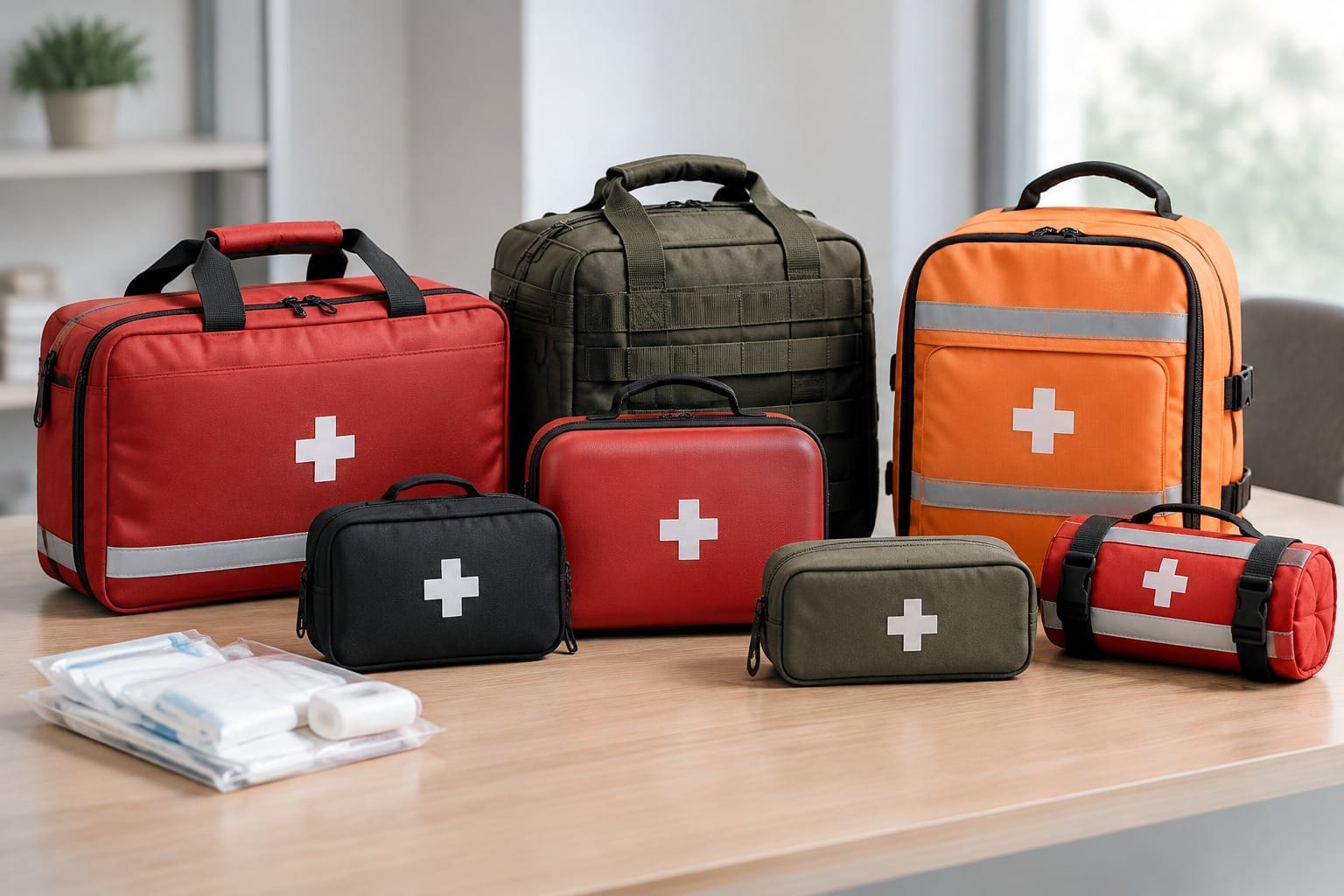
Most notices are divided into lots. A lot is a separately evaluated package, often with its own value, its own award criteria and its own winner. Two lots in the same notice can be different businesses.
This matters directly in our category, because pre-packed kits and empty bags are not the same product to a procurement team. A first aid products tender for stocked kits asks about contents, expiry management and configuration control. A tender for empty bags and cases asks about fabric, colour, hardware and print. Our own catalogue holds them as separate lines for the same reason, and a bidder should never assume one lot’s terms carry into the other.
The classification codes tell you more than the lot titles do. In the European Union, the Common Procurement Vocabulary establishes a single classification system for public procurement. Its use has been mandatory in the EU since 1 February 2006. The main vocabulary is a tree of codes of up to nine digits: two digits for the division, three for the group, four for the class, five for the category, with the final digits adding precision inside the category and a ninth digit verifying the previous ones. A supplementary vocabulary adds qualitative detail.
Read the codes before you read the specification. A code near the division level describes a broad family. A code five digits deep describes a narrow one. The same notice can carry both, which means the buyer has not finished deciding what they want.
Where the notice is published changes what you can find
Publication is decentralised, and this is an operational problem rather than a legal one. Miss the portal, miss the tender.
In the United Kingdom, the Find a Tender service is an e-notification service used to post and view public sector procurement notices. It is free to use and replaced the role of Tenders Electronic Daily for UK procurements. It does not replace everything: it works alongside Contracts Finder, MOD Defence Contracts Online, Public Contracts Scotland, Sell2Wales and eTendersNI, and EU opportunities are still accessed through OJEU and TED.
For a supplier, that means maintaining registrations in several places, each with its own alert settings and its own document formats. Two practical habits reduce the load. Register once per portal and set alerts on the classification codes rather than on keywords, because codes are stable and keyword alerts are not. Then keep the master document file in one folder, dated, so that a notice requiring a current copy can be answered the same day it appears.
The document gate comes before the price
Eligibility is evidenced on paper. A first aid products tender usually fails a bid on a missing or expired document rather than on a weak price, and the requested documents are broadly similar across markets even when the names differ.
| Document | What it evidences | Typical failure point |
|---|---|---|
| Business licence and registration | Legal capacity to contract in the buyer’s market | Scope of business does not name the product family |
| Product registration or licence by class | Market authorisation for the devices being supplied | Class of the actual SKU is higher than the class held |
| Quality management certification | A maintained system, where the notice names a standard | Certificate expires before the contract end date |
| Credit-record clearance | No exclusion on integrity or tax grounds | Search result not submitted as a dated printout |
| Similar-project track record | Delivered comparable supply before | Contract references do not show quantity or destination |
| Product documentation by SKU | Configuration, materials and handling data for each item | One document for a family instead of per SKU |
| Certificate of origin | Origin of goods for import clearance | Issued after the deadline instead of before |
| Physical sample | The actual item, not a photograph | Sample arrives after the submission window closes |
We supply documentation per SKU, and our position on destination-market requirements is deliberate: compliance for the importing market stays with the buyer, who can confirm what their own authorities require. A first aid products tender is the moment that division of labour becomes visible, because the notice will ask for a specific document, in a specific form, by a specific date. Suppliers who cannot produce it are excluded regardless of price.
Award method tells you whether price is a lever
Two award methods dominate, and they lead to opposite bidding strategies.
| Award method | How the winner is chosen | What it rewards | Where it hurts |
|---|---|---|---|
| Lowest compliant bid | The lowest-priced bid that passes the gate | Cost discipline and a clean file | Suppliers who quote before reading the gate |
| Weighted scoring | Price combined with quality, service and lead time | Verified capability and delivery record | Suppliers with no evidence for the non-price criteria |
| Framework call-off | A place on the framework first, then competition per call-off | Registration and readiness | Suppliers who expect a volume from the framework itself |
The first two rows are frequently confused. Under lowest compliant bid, compliance is a gate and price is the ranking, so a supplier with a strong technical file and a high price loses. Under weighted scoring, price is only one column, so a supplier with a good price and no evidence behind the other columns also loses. The notice states which applies. Read it before deciding how much effort to invest.
How frameworks change the volume assumption
A framework agreement establishes terms and pricing for a period, and buyers call off against it as needs arise. This is where suppliers most often misread the opportunity.
A framework is not an order. It is admission to a shorter list. Being accepted means the work of bidding has been done once instead of many times, but it does not commit the buyer to any volume. Reading a framework award as a booking leads to capacity being reserved against demand that has not arrived.
For a supplier with a low entry quantity, that distinction is workable. Our own production minimum starts at 1,000 pieces, which is a normal call-off scale rather than a factory-run scale. The real constraint in a framework is not the minimum quantity. It is whether the supplier can hold a specification stable across several call-offs over four years without the component list drifting. A catalogue of 216 routes, 190 of them product pages and 26 of them category hubs, is not a marketing asset in this context. It is a documentation schedule that has to stay consistent for the life of the agreement.
A bid/no-bid checklist
Work through this before committing time to a first aid products tender:
- Confirm the procurement is covered for your entity type and that the value exceeds the applicable threshold.
- Identify every lot, and check whether your product family sits in one lot or is split across two.
- Decode the classification codes in the title and the lot descriptions, and note the depth of each code.
- Check the award method, then decide whether your file is strong enough for that method.
- List the documents requested, and mark each one as held, obtainable, or not obtainable in time.
- Check whether a physical sample is required, and when it must physically arrive.
- Read the warranty and delivery terms, and convert them into a production schedule.
- Confirm whether the framework award carries any committed volume, and plan capacity accordingly.
If two or more items are unobtainable before the deadline, the honest answer is no-bid. That is a decision, not a failure, and it protects both the bid team and the buyer’s evaluation timeline.
FAQ
Does a published first aid products tender mean foreign suppliers can bid?
Not necessarily. Publication and eligibility are separate. Coverage under the WTO Agreement on Government Procurement depends on three things at once: whether the buying entity is covered, whether the goods are listed in the relevant schedule, and whether the contract value exceeds the specified threshold. A notice can be authentic and complete while remaining outside the coverage that would open it to a supplier from another market. The notice itself usually states the eligibility conditions, and suppliers should read those conditions as the first screening test rather than assuming that a public advertisement means open access.
How do I know which lot a first aid products tender covers?
Read the lot descriptions and the classification codes together, not the lot titles alone. Lot titles are written for the buyer’s internal structure and often use wording that does not match the trade’s vocabulary. The classification code is more reliable because it is drawn from a standardised tree, and its depth tells you how narrowly the buyer has defined the purchase. Where a notice mixes a broad division-level code with a narrower category-level code, the buyer has not finished specifying, and that is worth a clarification question before the enquiry deadline rather than after submission.
Which documents should be ready before a first aid products tender closes?
Assume that every document must exist in dated, current form before the submission window closes, because most notices read the submission date as the test rather than the award date. In practice that means a business licence covering the relevant product family, product documentation supplied per SKU rather than per family, evidence of a maintained quality system where a standard is named, a credit-record search result submitted as a printed or dated record, and contract references that show quantity and destination. Certificates that expire before the contract end date are a common reason for rejection.
Why does a framework agreement include no committed volume?
A framework sets the terms under which future purchases may be made, so the buyer keeps the right to decide whether and when to buy. The buyer’s obligation is procedural, not commercial: they must run the call-off correctly, but they are not obliged to place a minimum quantity. That is why framework notices commonly state that there is no commitment of business. For a supplier, the value of a framework is the reduced bidding overhead across many call-offs, and capacity should be planned against expected call-off patterns rather than against the framework’s headline value.
Can a supplier bid on kits and empty bags in one tender?
Often yes, but the two should be prepared as separate bids with separate documentation, because they are normally separate lots with separate award criteria and separate winners. Stocked kits are evaluated on contents, configuration control and expiry management. Empty bags and cases are evaluated on material, construction, hardware and print. Our own catalogue holds them as distinct product lines for the same reason. If the notice allows bids on multiple lots, prepare each on its own terms, and do not carry a specification or a price structure across from one to the other.
Public sector work rewards preparation more than persuasion. If you are assembling the document set for the first time, the compliance checklist we use for supplier RFQs is a workable starting point, and the sourcing guide for empty first aid kit bags and boxes covers the lot where bag and case specifications do most of the work. For the procurement mechanics that sit behind a notice, see our B2B first aid procurement guide. Suppliers preparing a response can review standard kit configurations and the wider product catalogue to check which family each lot maps to.