
Two home first aid kit contents lists can carry the same number of pieces and still be different products. One is built to pass a price threshold. The other is built to stay saleable on a shelf for two years. The buyer who reads the two as equivalent usually discovers the difference after the first reorder, when the components no longer match the artwork on the carton.
For a distributor or reseller, the contents list is a specification. It decides landed cost, shelf life, packaging claims and whether the second order can be supplied identically to the first. Reading it as a shopping list leaves all four open.
What home first aid kit contents mean to a buyer
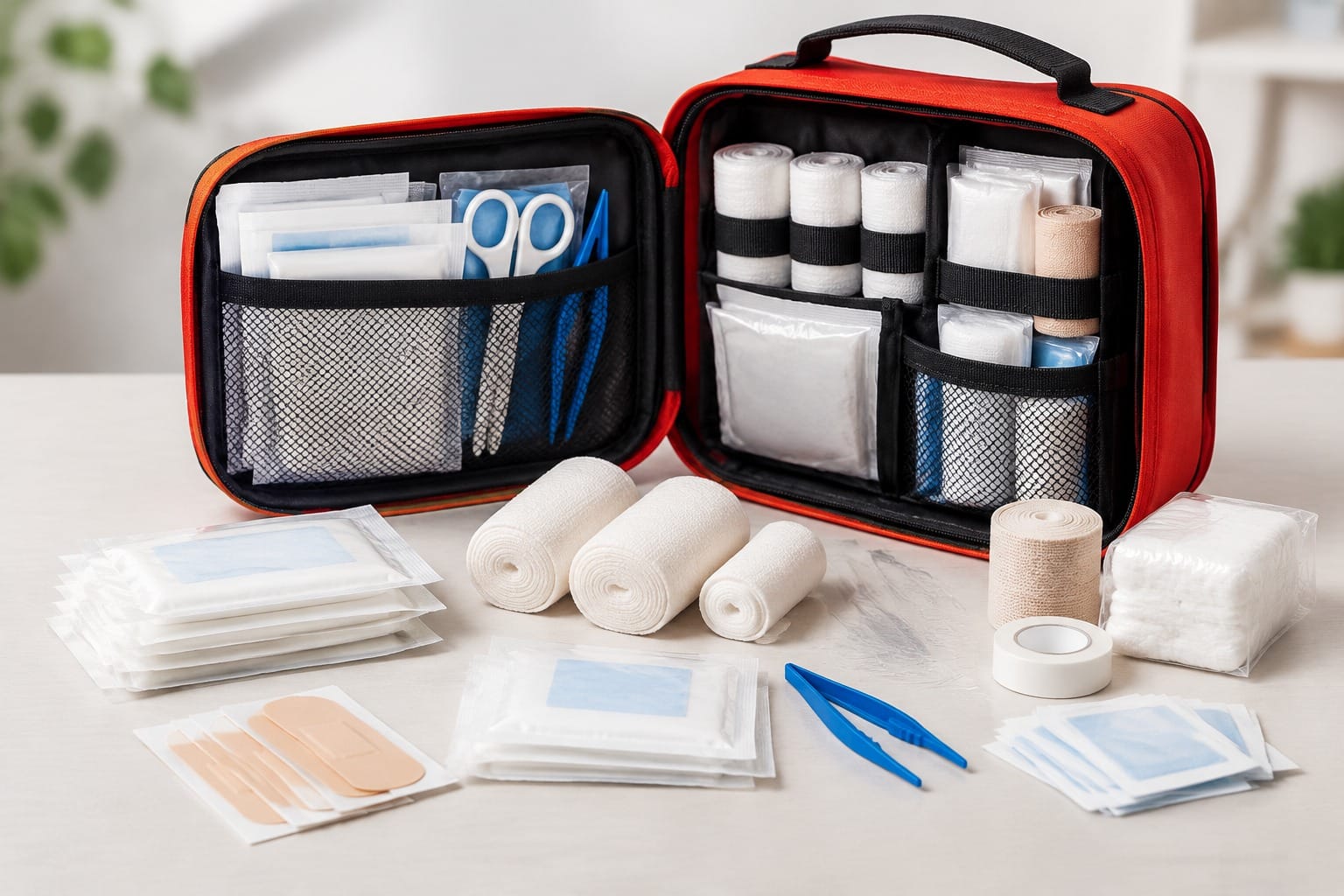
A consumer reads the list to check whether a specific item is present. A buyer reads it to check something else: whether the configuration is stable enough to sell twice.
The reference lists used in practice are clear about the scope. The MedlinePlus medical encyclopedia, published by the United States National Library of Medicine, sets out a home first aid kit as bandages and dressings, home health equipment, and medicines for cuts and injuries. It then adds two statements that matter commercially. Supplies are only basic, and more may be included depending on the setting. It also instructs the reader to check the kit regularly and replace anything that is running low or has expired. The MedlinePlus first aid kit entry is a useful baseline because it separates what belongs in a kit from how long the kit stays usable.
The WHO emergency and critical care overview supplies the other half of the argument. It states that many proven health interventions are time dependent. That is the commercial case for a home kit that is complete at the point of use rather than almost complete. Whether the kit sits in a cupboard or on a retail shelf, the contents have to be there before the moment they are needed.
Public health authorities do not read the list as universal. Guangzhou’s health, emergency management and fire services authorities published a recommended household medical emergency pack in 2025 with a basic pack and an extended pack, and the two differ in what they add rather than in what they repeat. The Guangzhou household emergency pack list is worth reading as an example of how a market’s expectations are set locally, and why a supplier should never assume one market’s list transfers to another.
The piece count is a merchandising number
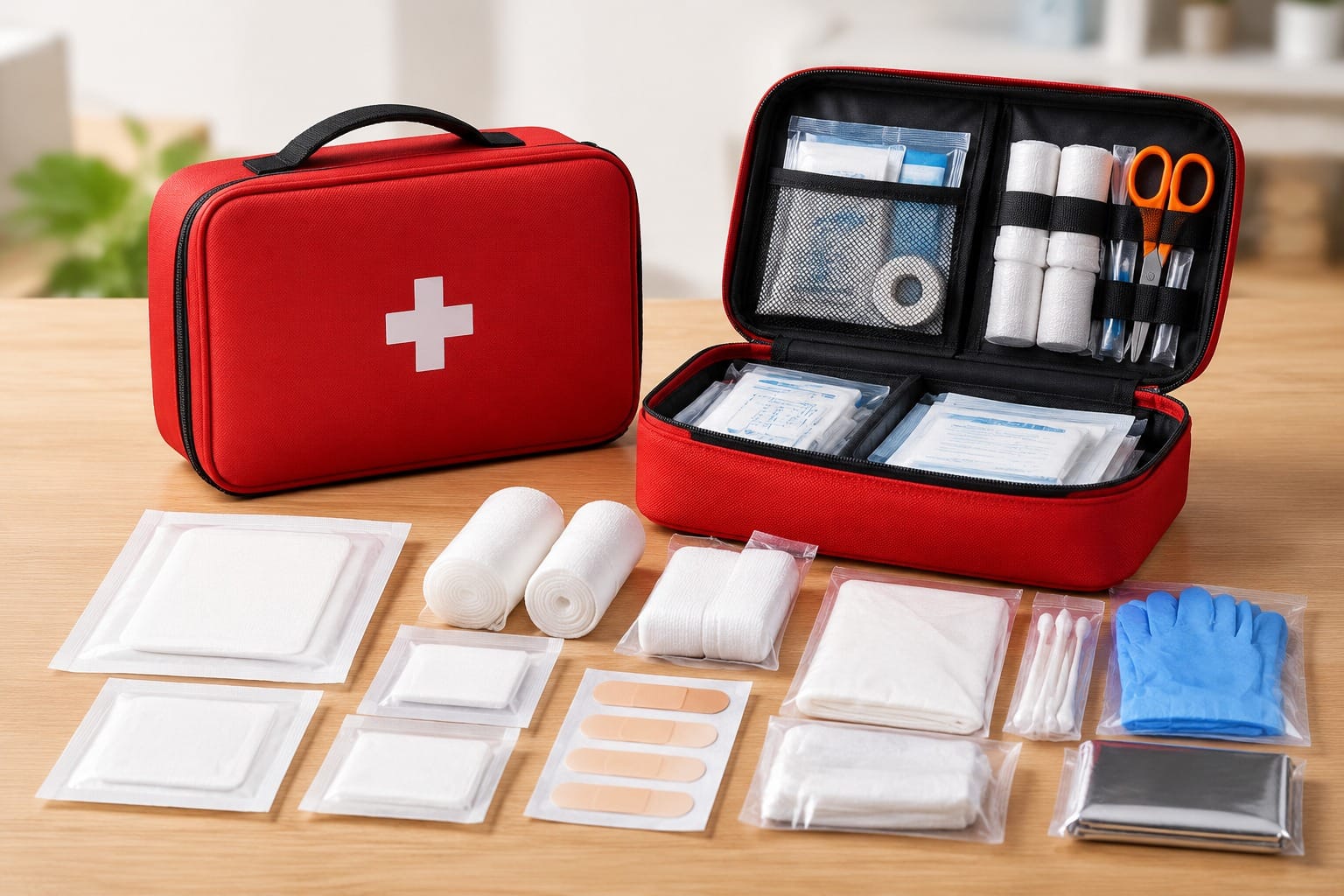
Piece count sells. It is also the least useful specification on the carton.
A kit described as 64 pieces is usually dominated by adhesive plasters and swabs. A kit described as 40 pieces may hold a wound dressing, a triangular bandage and a resuscitation barrier, which change what the kit can be used for. The count is a shelf-facing metric. It answers a shopper’s question, not a procurement question.
Buyers comparing quotes should normalise before comparing price:
- Count the items by functional group, not in total.
- Record the size and quantity of every wound dressing, since dressings dominate usable coverage.
- Note whether gloves, a barrier device and a first aid leaflet are included or optional.
- Separate single-use items from durable tools such as scissors and tweezers, because the two have different replacement cycles.
- Check whether the item count excludes packaging and the case itself, which is the usual convention but not a universal one.
Two suppliers quoting the same unit price can differ by a third in usable content once those five points are worked through. A home first aid kit contents list that survives this comparison is the one worth putting on a purchase order.
Shelf life sets the working life of the kit
A kit is only usable for as long as its shortest-lived component. That single rule decides more about retail economics than any element of the contents list.
Sterile dressings, antiseptic wipes and any liquid or gel item carry their own dating. A kit assembled today with three years on the case and eighteen months on one internal component has an eighteen-month working life for practical purposes, because a retailer cannot sell a box whose contents are close to their date. The MedlinePlus guidance to replace anything running low or expired is written for a household, but it describes exactly the rotation problem a distribution channel has to manage.
Three practical consequences follow for a home first aid kit contents specification:
- Dating should be checked item by item, not accepted as a kit-level figure. Ask for the earliest date across all components, in writing.
- Assembly date matters as much as shelf life. A kit built to a long shelf life but assembled from older stock arrives with less remaining time than the artwork suggests.
- Rotation policy belongs in the purchase contract. Who absorbs expired stock, and whether the supplier will exchange short-dated items, is a commercial term rather than a quality question.
For resellers, this is the point where a cheaper kit stops being cheaper. Expired stock is a write-off, and a write-off on a low-margin line costs more than the original price gap.
Keeping the second order identical
Repeat orders are where a home first aid kit contents list is tested. The first shipment can be controlled by inspecting a sample. The fifth shipment can only be controlled by a written specification that both sides still hold.
Configuration drift usually arrives through substitution. A dressing size is discontinued. A wipe supplier changes its pack count. A case colour runs short and a near-match is sent. Each change is small and each one alters the product a retailer has already listed under a fixed description and barcode.
Suppliers who manage this well do three things. They freeze the contents list as a versioned document with a date. They record component changes against the version rather than against the order. And they confirm in writing before shipment when any substitution is proposed, so the buyer can accept it, adjust the listing or refuse it. Our own position is that documentation is provided per SKU, and that confirming destination-market requirements stays with the buyer. That division works only when the specification is written down on both sides.
The alternative is familiar. The reorder arrives, the carton looks the same, and the contents have quietly moved. By then the retailer has already made the shelf decision on the old specification.
A content specification table for retail buyers
The table below is a working structure, not a fixed recipe. It maps each content group to the buyer decision it drives, so that a quotation can be normalised line by line.
| Content group | Typical items | Buyer decision it drives | What to fix in writing |
|---|---|---|---|
| Wound coverage | Adhesive dressings in assorted sizes, sterile gauze pads, non-adherent dressing | Whether the kit covers the common cut or graze without a second purchase | Sizes, counts and sterility of each line |
| Fixation | Conforming bandage, elastic bandage, microporous tape | Whether dressings stay in place during use | Widths and roll lengths |
| Support and immobilisation | Triangular bandage, finger splints | Whether the kit handles a sling or a finger injury | Dimensions and material |
| Cleansing | Antiseptic wipes or solution, saline wound wipes, eyewash | Whether the kit can be used before clinical care begins | Format, count and alcohol-free status where relevant |
| Barrier and protection | Gloves, resuscitation barrier, face mask | Whether the user is protected while helping | Glove sizes and whether the barrier has a valve |
| Tools | Scissors, tweezers, safety pins | Whether the kit is reusable beyond consumables | Steel grade, blade type and size |
| Reference and case | First aid leaflet, storage case with compartments | Whether the product meets local retail presentation norms | Language of the leaflet and case labelling |
| Documentation | Component list, dating per item, origin paperwork | Whether the kit can be listed and imported without a later dispute | Who confirms destination-market requirements, and by when |
Two of those rows decide most disputes. Cleansing formats vary by market expectation, and documentation ownership is the row that suppliers most often leave unstated. Our own production minimum starts at 1,000 pieces, which is enough to fix a specification properly and small enough to run a market test before committing to a full programme. A catalogue of 216 routes, 190 of them product pages and 26 of them category hubs, is not a merchandising count in this context. It is the documentation schedule that has to stay consistent for every kit built from those components.
FAQ
How many items should a home first aid kit contain?
There is no agreed minimum, which is why the piece count misleads. The MedlinePlus list is organised by function rather than by number, covering wound coverage, support, cleansing, barrier protection, tools and medicines. A kit with fewer pieces can serve more situations than a larger one if the pieces are the right ones. Buyers should agree a functional scope first, then count the items needed to deliver it. The count that appears on retail packaging is a merchandising figure, and it should be fitted to the scope rather than used to define it.
Which home first aid kit contents shorten shelf life most?
Liquids, gels and anything sterile carry the tightest dating, so antiseptic formats, saline and sterilised dressings usually set the limit for the whole kit. Textile items and metal tools generally last longer. The practical test is to ask for the earliest expiry date across all components rather than a kit-level shelf life, because the earliest date is what a retailer can actually sell against. When a supplier quotes a two-year kit, the useful question is which component sets that two years and what the figures are for the rest.
Do home first aid kit contents vary by destination market?
They can, and the differences are usually in scope rather than in basics. The Guangzhou authorities published a recommended household pack in two versions, a basic pack and an extended pack, which shows that a public authority may set expectations beyond the classic dressing-and-bandage list. Other markets place different emphasis on labelling language, packaging claims and which components need documentation. This is why we hold that the buyer confirms destination-market requirements, and why the contents specification should note who is responsible for that check.
How do I compare two quotations with different contents?
Convert both to the same structure before looking at price. Group items by function, record sizes and counts for each dressing, separate consumables from durable tools, and note whether gloves, a barrier device and a leaflet are included. Discrepancies in dressing sizes and glove inclusion explain most of the price gap between apparently similar kits. Once both quotations are on one structure, the difference in usable content becomes visible, and the comparison is about specification rather than about the number printed on the carton.
Can a home kit specification be changed after the first order?
It can, but the change has to be versioned rather than informal. Most configuration drift starts as a substitution that seems minor at the time, such as a dressing size going out of production or a wipe pack count changing. Each substitution alters the product a retailer has already listed. The workable arrangement is a dated contents version, changes recorded against that version, and written confirmation before shipment whenever a substitution is proposed, so the buyer can accept it, adjust the listing or refuse it before the carton is sealed.
A home first aid kit contents list is the document that decides whether a retail line can be repeated. Distributors building one from scratch can start from the B2B sourcing guide for emergency first aid kits and bags, which sets out how kits and bags are specified together. For workplace variants of the same problem, the workplace first aid kit configuration checklist applies the same logic to a different setting. Where the issue is drift rather than a first build, the notes on keeping first aid kit components identical across repeat orders cover the substitution problem directly. Buyers assembling a full range can review standard kit configurations alongside the wider product catalogue.