
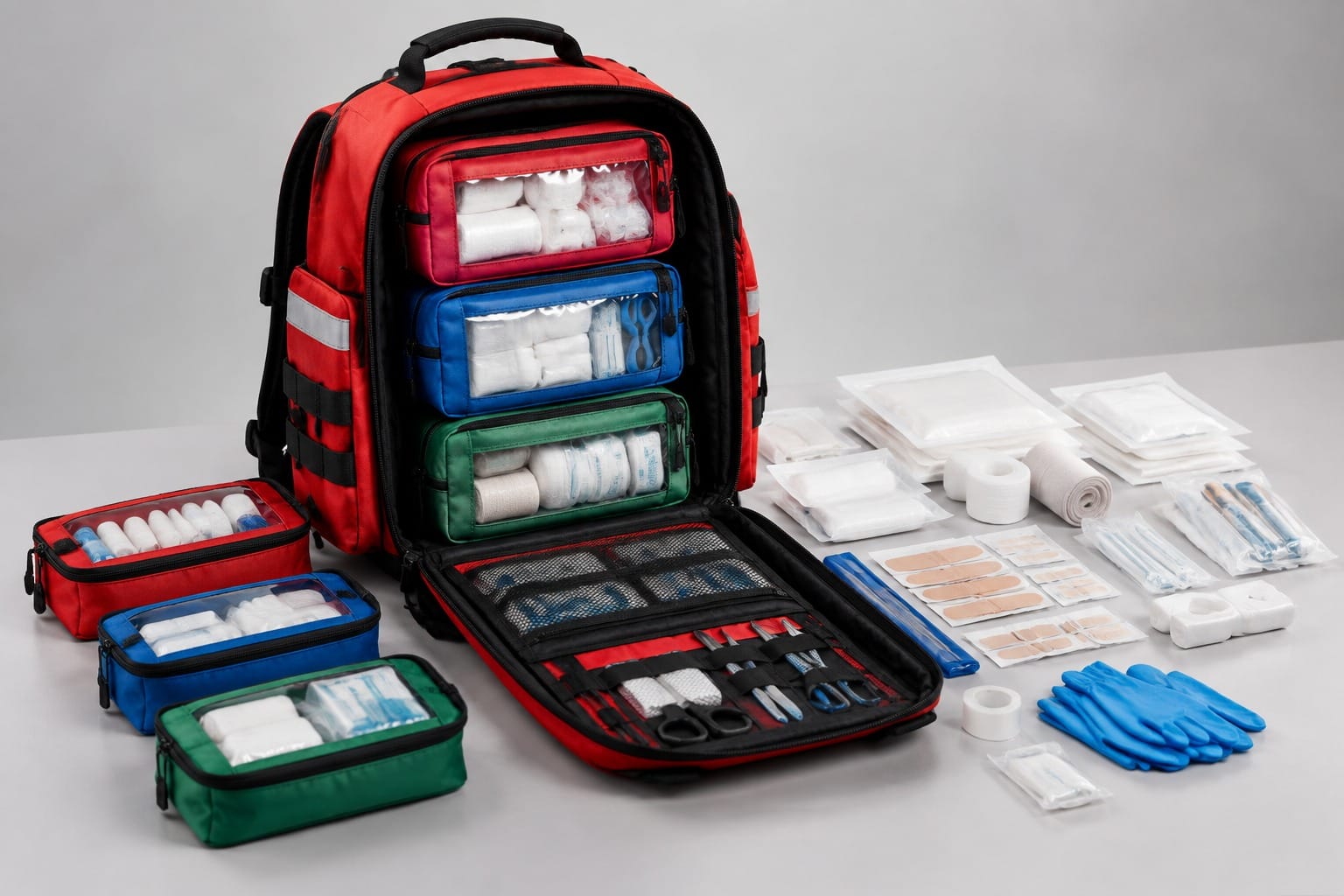
Ninety children in a nursery share one kit. A secondary campus of twelve hundred holds eleven, and still fails its own audit. The gap between those two buildings is almost never the contents. It is whether anyone wrote down which kit lives where, who opens it, and how a used item is replaced before the next session begins.
Published guidance on school first aid kit contents tends to be short and fixed. The UK guidance for schools, early years and further education sets out an HSE-suggested minimum container of eight item types, plus a shorter travelling kit for off-site activity. That is a floor rather than a specification. Two schools with identical school first aid kit contents lists still need different orders, because the number of kits, the container format and the checking routine are decided by the building and the timetable, not by the item list.
This article sets out the sequence a distributor or a group purchasing team should work through: provision map first, container second, contents third, replacement last. UneedAid’s B2B sourcing guide for emergency kits and bags covers the product range itself; this article deals with school and childcare planning.
Why contents are the last decision, not the first
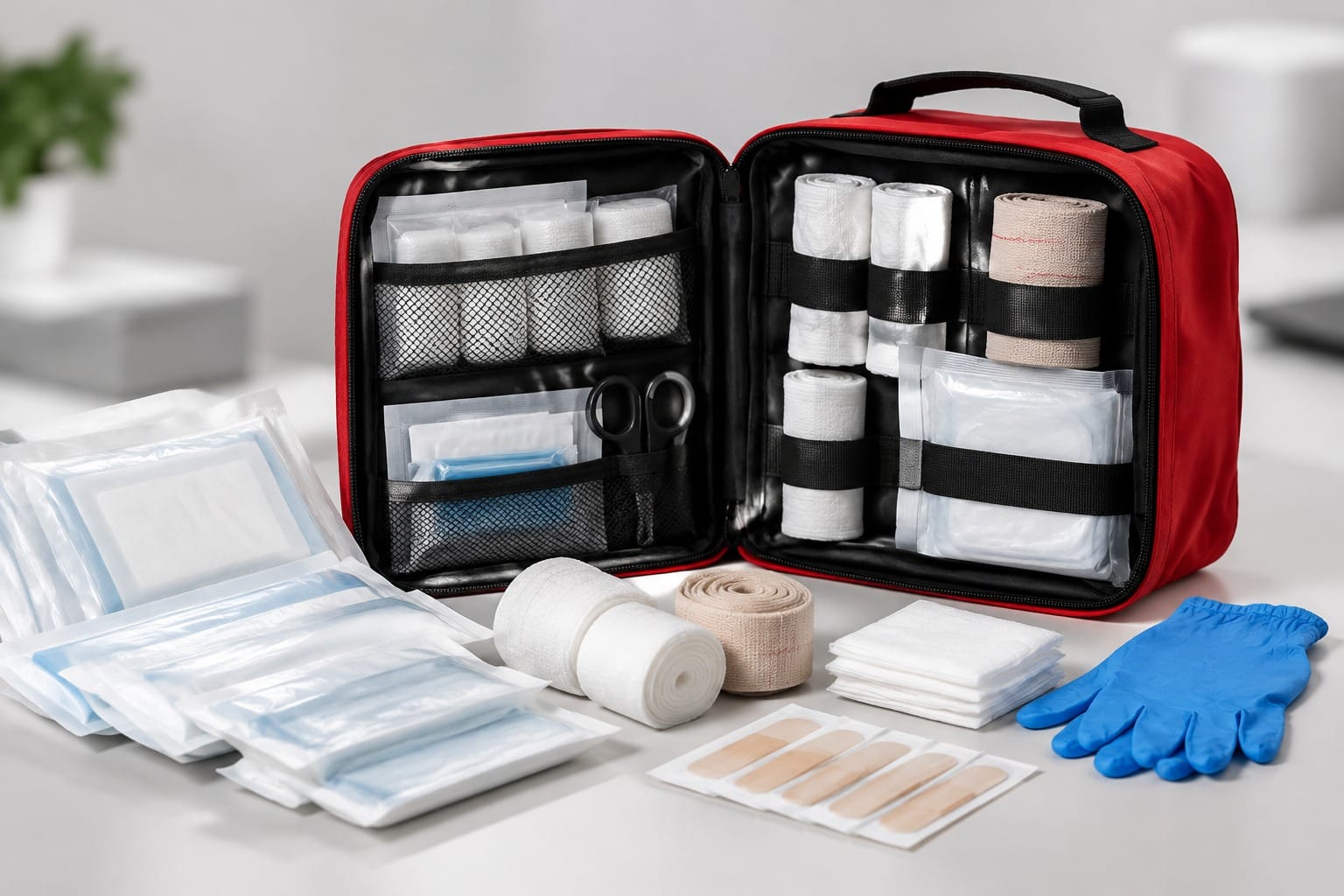
Most school first aid kit contents enquiries arrive phrased as a contents question. They are usually a provision question wearing a contents costume.
A single-site workplace has one answer to “where is the kit”. A school does not. It has classrooms, corridors, a sports field, a dining hall, a bus, and a fixture list that moves children between all of them on the same day. Each of those locations raises its own question about what has to be within reach and how quickly.
The four decisions below constrain each other in order. Reversing them produces a school first aid kit contents specification that answers the item list and fails the building.
| Decision | What it settles | What it depends on |
|---|---|---|
| Provision map | How many kits, and where each one lives | Site layout, activity types, distance from the health office |
| Container | Fixed box, portable bag or both | Whether the kit stays in place or travels with a class |
| Contents and quantity | Which item list applies, at what volumes | The market’s published guidance and the age range served |
| Check and replace | How the site stays complete over time | Who owns the check, and how expiry is screened |
A buyer who starts at the third row spends the first order on the wrong number of kits and the second order on the right number, which is the most common shape of a school re-order.
What published guidance says about school first aid kit contents
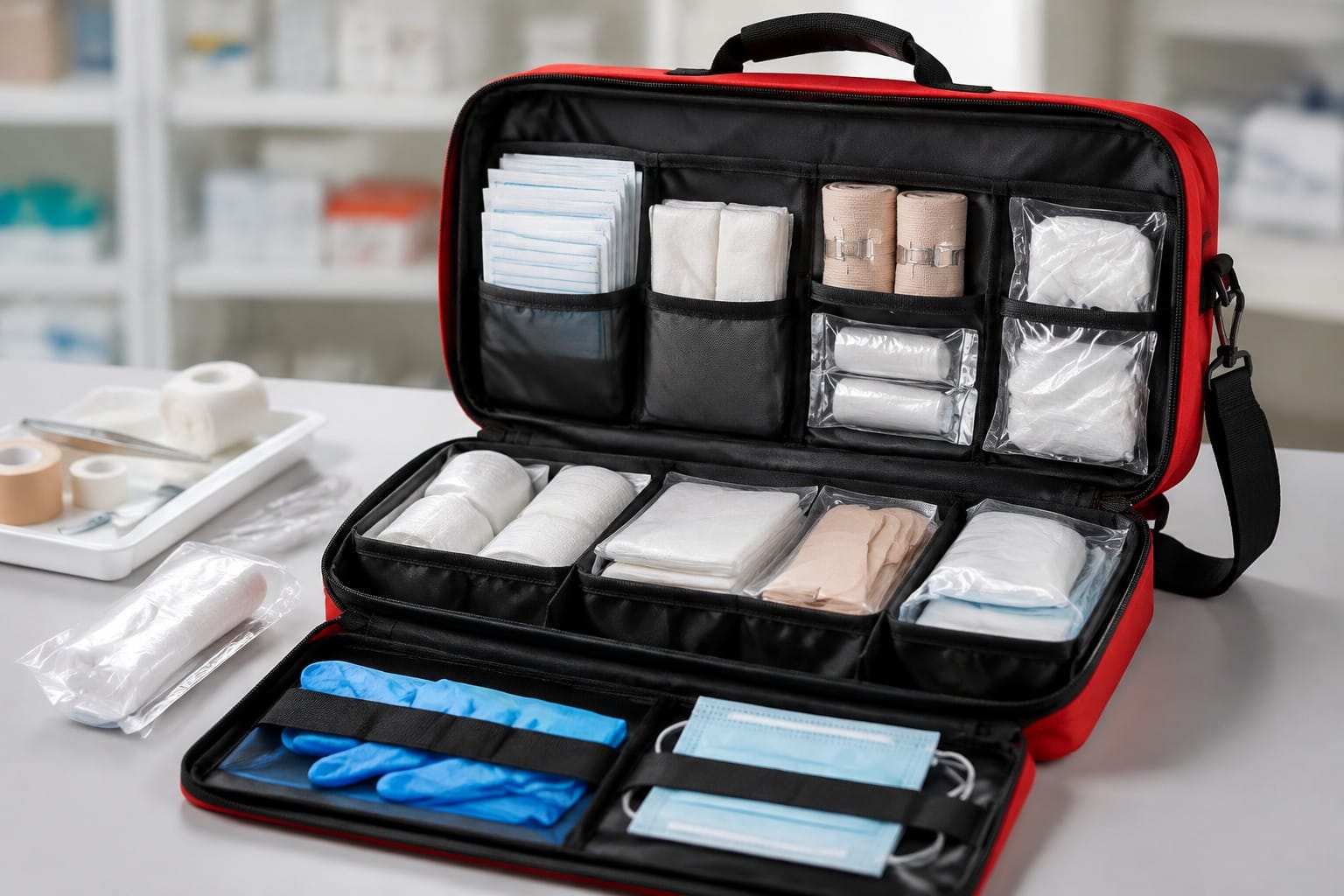
Guidance exists, it is public, and it differs by market. What the documents have in common is that every list is presented as a minimum, and every one of them says the real school first aid kit contents should follow a needs assessment.
For a school or college container in the UK, the HSE-suggested minimum where no special risk has been identified is:
- A leaflet giving general advice on first aid
- Twenty individually wrapped sterile adhesive dressings in assorted sizes
- Two sterile eye pads
- Two individually wrapped triangular bandages, preferably sterile
- Six safety pins
- Six medium-sized individually wrapped sterile unmedicated wound dressings
- Two large sterile individually wrapped unmedicated wound dressings
- Three pairs of disposable gloves
The same document gives separate minima for travelling containers, which are shorter, and for the first aid box carried on minibuses and larger passenger vehicles under UK transport regulations, which is a different list resting on a different legal basis. The underlying employer duty sits in regulation 3 of the Health and Safety (First-Aid) Regulations 1981, which requires provision that is adequate and appropriate in the circumstances; the HSE first aid guidance is where schools and their advisers read how that duty is applied.
Three things follow, and they matter commercially.
- These lists are floors. The guidance states plainly that a container should hold at least the HSE-suggested minimum and that the list is only a guide. A school first aid kit contents specification built exactly to the floor is defensible and unremarkable.
- Activity changes the list before headcount does. A school with a swimming programme, a workshop or a field site has a different risk profile from an exam hall, and the guidance points those risks at the needs assessment rather than at a larger version of the same kit.
- Medication does not belong in the container. The guidance is explicit that medication should not be kept in a first aid container, and that giving tablets or medicines is not part of first aid. Schools manage pupil medication through a separate route. A supplier that bundles tablets into a school kit creates a compliance problem for the buyer rather than a convenience.
The workplace kit configuration checklist covers the general case of building a contents list to a requirement. Schools add a second variable that workplaces handle differently: the kit has to be reachable by children and by adults whose job is supervision, in buildings the supplier will never see.
Building the provision map
The provision map is the document that says how many kits exist and where they are. For schools it is usually one page, and it is what turns a school first aid kit contents list into something a specific building can actually use.
Two structural facts shape it.
The site is not one place. Guidance for schools is consistent in requiring at least one fully stocked container per site as a minimum, and then names the cases that need more: large or split-level buildings, distant sports fields and playgrounds, other higher-risk areas, and off-site activities. A single-registration school can justify six containers without any of them being redundant.
Distance, not headcount, drives the number. A thousand pupils in one building next to a health office is a very different provision problem from three hundred pupils spread across four buildings, two of which are a five-minute walk from the office. The second school needs more kits and lighter kits. Buying by pupil count produces the wrong answer in both directions.
A working provision map separates locations into three bands.
| Band | Typical locations | What the kit has to do |
|---|---|---|
| Fixed | Health office, main reception, science and design workshops | Stay in place, hold the fullest legal minimum, be visible and signed |
| Distributed | Classrooms, dining hall, staff room, sports hall | Hold a short list for immediate use, then hand over to the health office |
| Mobile | Excursions, yard duty, sports fixtures, transport | Travel with a named adult, be light enough to carry all day |
The mobile band is where schools most often under-buy. A portable kit that only exists in the health office is not a portable kit. Guidance in more than one jurisdiction sets excursion and yard-duty provision out as a requirement separate from the building kit, and its contents depend on the number of participants, the nature of the activity and the location rather than on the school’s total roll. The Victorian education department’s portable first aid kits policy is a clear published example of that split.
Container format follows location
Once the map exists, format becomes mechanical. The question stops being “which kit” and becomes “does this one stay or travel”.
| Provision band | Usual format | What drives it |
|---|---|---|
| Health office and reception | Rigid case or wall-mounted box | Volume, visibility, a stable place on a wall or shelf |
| Workshop, science lab, sports hall | Wall-mounted box with a short list | Fixed mounting near the point of risk, checked on a routine |
| Classroom | Compact box or pouch | Shelf or cupboard storage, restocked from the medical room |
| Excursion, yard duty, fixtures | Shoulder bag, waist bag or compact backpack | Carried by one named adult for the whole session |
| Transport | Case or box secured in the vehicle | Presence, condition and access are the things a check looks at |
Two practical points sit behind that table.
A fixed supply box earns its place where the kit is never meant to move. It survives being knocked, it holds a full contents list without the contents shifting, and it can be mounted where an adult will actually see it. A kit that is expected to be found in an emergency by someone who has never opened it should look like what it is.
A portable bag for field and off-site use earns its place where the kit leaves the building. The deciding dimensions are different: weight when loaded, whether the opening holds wide with cold hands, and whether a contents list is readable in daylight without unpacking the bag. These are the same three tests that apply to portable versus fixed kit formats in general, applied to a timetable rather than a worksite.
Many multi-building schools end up buying both, and buying both from a single bag and box range is what keeps school first aid kit contents compatible across the site. Compatible lists are what make a central restock routine possible.
The arithmetic of a multi-site order
School orders look large and are structurally awkward, because the total quantity is high while each individual line is small.
An order for a four-building campus is not one order for N kits. It is three lines that behave differently:
- Containers, one per mapped location, plus a small number held as direct replacements for damaged or lost units.
- Consumables, chosen by band. A classroom kit consumes dressings steadily. A mobile kit consumes them in bursts and mostly needs sealing and restocking after each trip.
- Spares of the short-life items, held centrally so that a used item is replaced the same week rather than at the next annual audit.
That split matters more than the total number, because the three lines have different re-order intervals. A site that buys everything in one movement ends up with a shelf of items expiring together, which converts a stock purchase into a disposal event.
Our kit programmes start at 1,000 pieces, and the tier structure means a consolidated campus order generally sits in a different bracket from a series of small top-ups. Consolidation is not free, because consumables age whether or not a site is open. The MOQ and quantity tier framework sets out how a supplier divides those tiers; the school-side decision is how many of them are worth taking given the academic calendar.
Sample-based validation belongs inside this arithmetic rather than after it. Our standard practice is to validate a sample before bulk production, and for a school order that is the point at which the map gets tested against reality: whether the box clears the shelf it will sit on, whether the mounted bracket holds above a sink, whether the contents card is legible at the distance a supervisor stands from it. A format chosen from a catalogue image is the most reliable way to buy a second set of containers in the same year.
The part that fails: checking, restocking and expiry
School kit failures are rarely supply failures. They surface as missing items and out-of-date stock at an inspection, which means the failure happened months earlier and nobody saw it.
Guidance is unusually direct here. A school’s first aid procedures should identify the named person responsible for examining the contents of the containers; kits should be checked frequently and restocked as soon as possible after use; and items should be discarded safely once the expiry date has passed. Those are three obligations, and each one needs a mechanism rather than an intention.
Three mechanisms cover most of it, and the site’s owner should name which one applies before the first container is mounted.
- A restock pack matched to each kit code. When a consumable is used, the replacement is a pre-made pack rather than a decision. This removes the step where an adult has to work out what was in the bag.
- A check attached to something that already happens. Fire drills, site inspections and equipment servicing are already on a calendar with a named owner. A kit check that rides on an existing routine survives staff changes; a standalone kit check usually does not.
- A written substitution rule. At a repeat order, an unavailable item will be swapped for something unless the rule says otherwise. Agreeing that components stay identical across orders, and recording any approved change, is what prevents an audit from discovering that two hundred kits no longer match their own specification. This is the same discipline that keeps repeat kit orders consistent over time on the supply side.
Documentation follows the same logic. A file holding one contents list per kit code, one provision map per site, and a record of any substitution travels intact between head office, a new site manager and an inspector. UneedAid supplies documentation by SKU and coordinates the export file set, while confirming that a specification satisfies a given destination market remains the buyer’s decision and sits with the school’s own advisers.
The RFQ checklist for kit orders is the practical place to fix all of this into one document before a supplier quotes, because a provision map that is written down is the only version that survives a change of staff.
FAQ
What should a school first aid kit contents list include as a minimum?
Start from the published minimum for the market, then adjust for the activity. In the UK, the HSE-suggested minimum container holds eight item types: a first aid advice leaflet, twenty assorted sterile adhesive dressings, two sterile eye pads, two triangular bandages, six safety pins, six medium and two large sterile unmedicated wound dressings, and three pairs of disposable gloves. Schools in other markets work to their own published lists. That list is the floor for a fixed site kit; build the field kit from a shorter list, because the mobile kit is carried rather than stored.
Who should be responsible for checking a school first aid kit?
Published guidance expects the school’s own first aid procedures to name who examines the contents of the containers. In practice that is either the person with medical responsibility on site or a designated first aider, and the appointment needs to be written into the procedures rather than agreed verbally. The check works better when it is attached to a routine that already has a calendar entry and an owner. A widely spread site may need more than one named person, because a single appointment across four buildings usually means three of them are checked rarely.
Do schools need a different kit for every classroom?
No. A classroom does not need the same list as the health office. Classrooms are usually served well by a compact kit holding a short list for immediate use, with the fuller provision held centrally. The exception is a room with a specific risk attached to the activity, such as a science laboratory, a design workshop or a kitchen, where guidance points towards higher provision at the point of risk. The provision map should show both: which rooms hold their own kit, and where the full kit lives relative to them.
How many first aid kits should one school site have?
At least one fully stocked container per site is the usual stated minimum, and additional containers are expected for large or split-level buildings, distant sports fields and playgrounds, other higher-risk areas, and off-site activities. The number a school actually needs depends on the distance between the rooms children use and the central provision, not on the roll count. A compact campus of a thousand pupils can be well served by fewer kits than a three-building school of three hundred where the buildings are separated.
Should school kits include medication?
No. Guidance is explicit that medication should not be kept in a first aid container, and that administering tablets or medicines is not part of first aid provision. Pupil medication is managed through a separate route with its own records and consents, as the New York State guidance on emergency health care in schools sets out for its own districts. A supplier that bundles tablets into a school kit adds an administrative problem rather than value, and the item should come out of the specification before the order is placed.
How often should school first aid supplies be replaced?
Two triggers matter, and they run on different clocks. Expiry is the first: guidance expects items to be discarded safely once their expiry date has passed, which means the shelf life of the shortest-dated item sets the replacement interval for that line. Use is the second: a kit should be restocked as soon as possible after use, and the quickest way to make that happen is a restock pack that requires no judgement. Sites that set both triggers and record them alongside the provision map tend to stop discovering gaps at inspection time.
Where school planning meets the rest of the programme
A school first aid kit contents list is only as good as the map behind it. The programme around it is a compressed version of everything else in B2B first aid supply: a requirement set by published guidance, a format set by where the kit has to be reached, a quantity set by the site rather than the roll, and a maintenance obligation that outlives the order.
The order worth working through is fixed. Build the provision map, choose the container per band, then size the contents, then decide how the site stays complete. Schools that work in that sequence tend to buy once. The school that reverses it buys a container set, discovers it cannot service the field, and buys again.