
Two suppliers quote the same 100-piece kit. One returns $6.80 per set, the other $11.40. Neither number is wrong. The first scoped a 600D polyester bag, a plastic buckle and 60 adhesive plasters. The second scoped a tarpaulin bag, a metal zipper, 90 plasters and a foil blanket. You compared two prices for two different products.
An emergency first aid kit RFQ is the document that stops that. It closes the bag, the contents, the order quantity, the sample terms and the price structure before anyone quotes, so that every response describes the same kit. Skip those closures and you do not get a price comparison. You get four shopping lists.
Why kit quotes stop being comparable
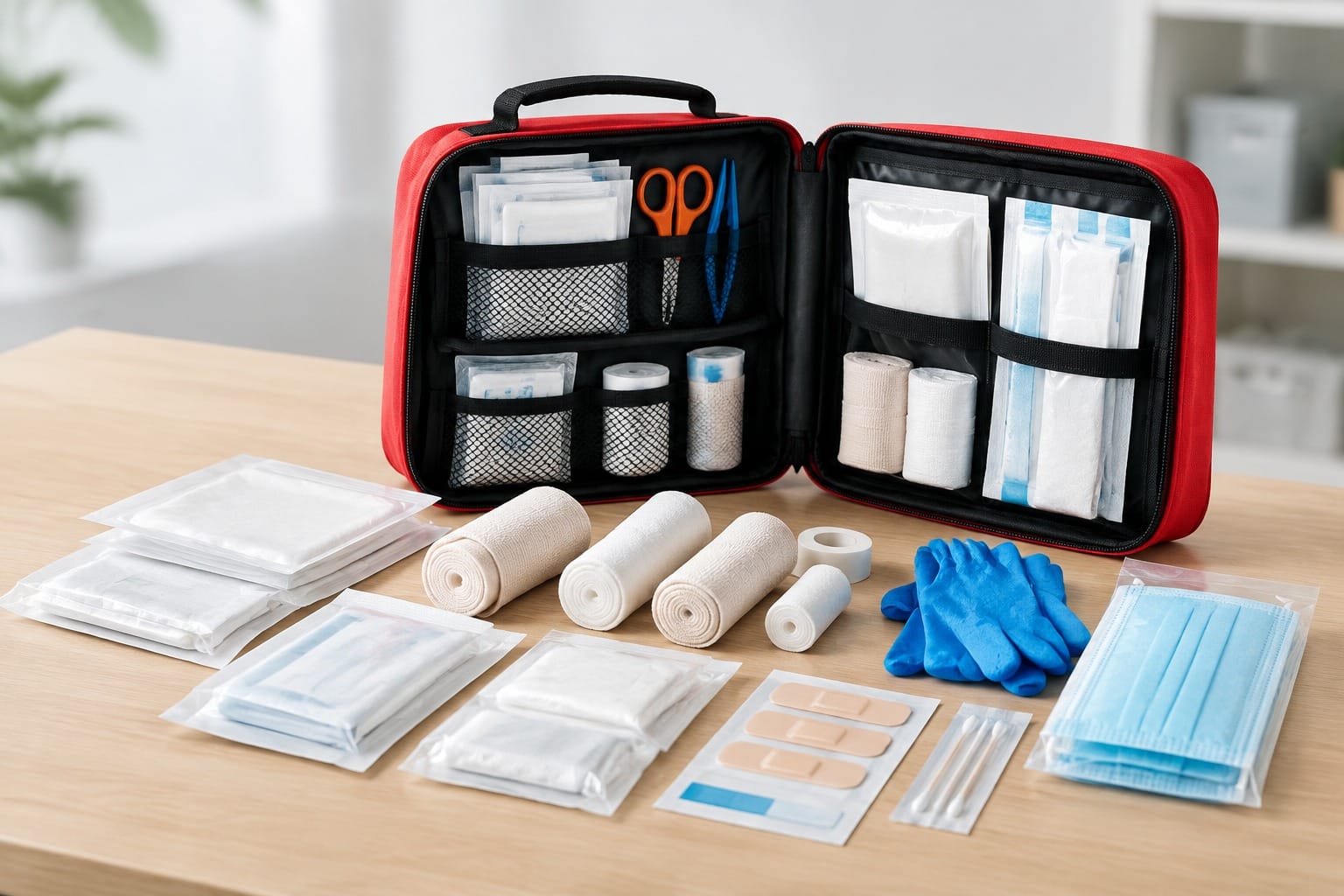
A kit is a bill of materials inside a container. Unit cost is the sum of component costs multiplied by quantities, plus the bag, plus assembly labour, plus retail packaging, plus margin. Four of those inputs stay invisible in a quote unless your document pins them down first.
The failure is quiet. A supplier reading “assorted adhesive plasters” picks a count that protects their margin, usually 20 to 40 pieces on a 100-piece kit. Another supplier reads the same words and quotes 60. Both responses are accurate to what you wrote. The prices then differ by more than a third. That is the whole job of an emergency first aid kit RFQ: closing the bill of materials before anyone puts a number next to it.
| Variable | If you leave it open | What it moves |
|---|---|---|
| Bag or case format | Supplier picks material, thickness and closure | 15-40% of total kit cost |
| Contents line items | Piece counts and item sizes drift between quotes | Largest single swing |
| Order quantity | MOQ floor and tier land wherever the supplier prefers | 20-40% per unit below 500 sets |
| Sample and freight terms | Cost, timeline and refund terms get quoted differently | Comparison breaks outright |
| Incoterm | FOB, CIF and DAP are three different prices | 5-15% on landed cost |
None of this is exotic. It is the ordinary difference between quotes you can line up side by side and quotes you cannot. The rest of this page walks through the eight lines an emergency first aid kit RFQ needs, in the order a supplier reads them.
The emergency first aid kit RFQ checklist: eight lines to write
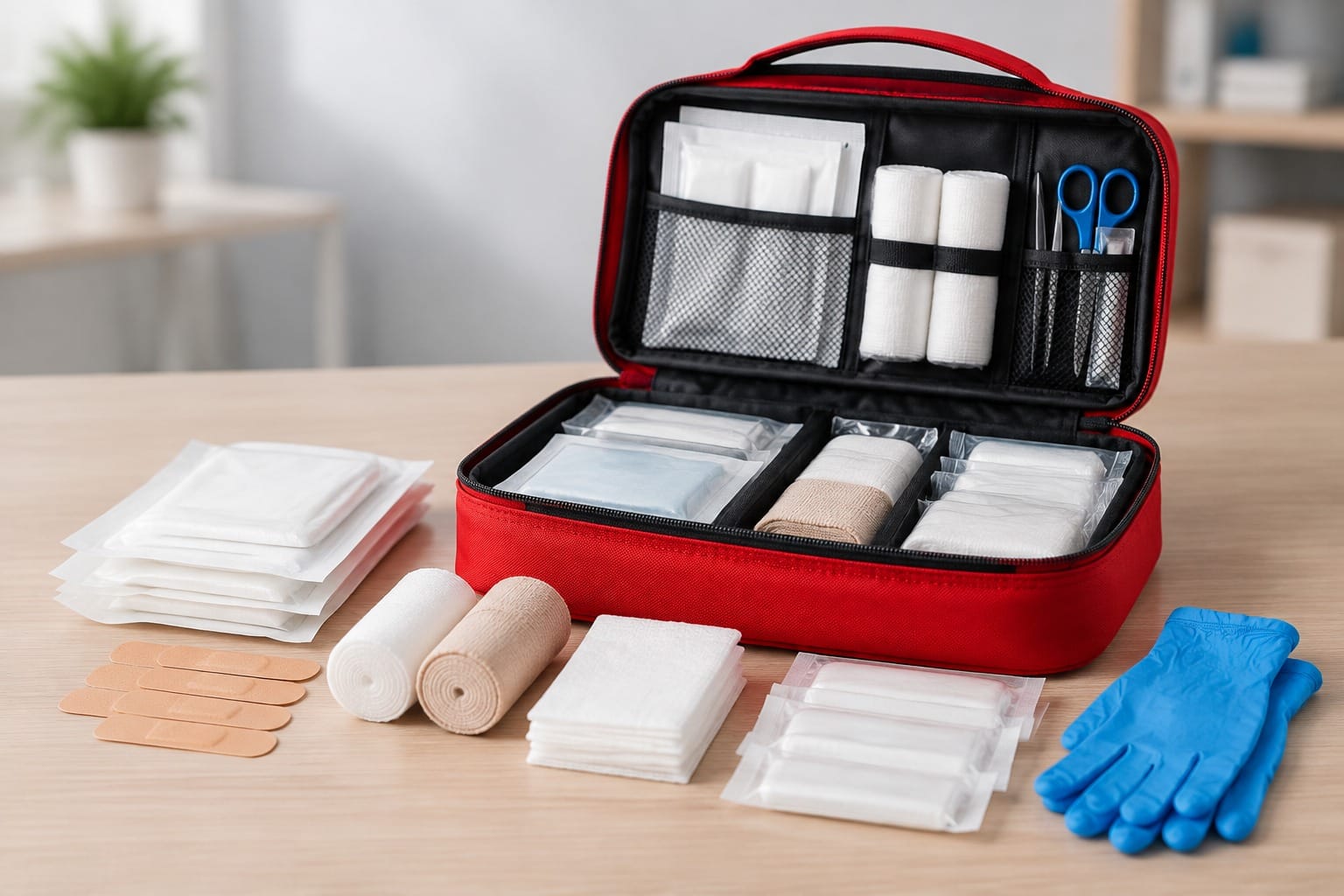
Send these eight lines to every supplier on the same day. Each one takes a decision out of the supplier’s hands and puts it back in your specification.
- Container — format (bag, box or hard case), outer dimensions, material and grade, closure type, and whether mounting hardware is in scope.
- Contents list — every item named, with piece count, item size and unit of measure per kit.
- Sterility status — for each consumable, whether it is sterile and whether it is single-use.
- Minimum remaining shelf life — the floor at the moment of delivery, not the moment of production.
- Labelling — what appears on the kit label, on inner item labels, and on the shipping carton.
- Quantity and price tiers — MOQ, tier breakpoints, currency, and what the unit price includes.
- Sample terms — sample type, sample cost, freight responsibility, and the approval window.
- Declarations — the written statements you require before an award is made.
The same eight lines work for a stocked kit and for an empty bag programme. The contents line simply becomes “no consumables, bag supplied flat-packed” and the shelf-life line drops out.
Once every supplier answers the same eight lines, scoring the responses side by side is the step that converts a set of quotes into an award decision.
That scoring sheet needs comparable inputs, and the first aid supplies RFQ template is the document that produces them: one delivered cost per kit, with every charge that sat outside the headline price on its own line.
Bag and case: the line buyers leave vague
“Standard first aid bag” is not a specification. A supplier can answer it with a 210D polyester pouch that tears at the seam or a tarpaulin bag that survives a truck bed. Both are OEM and both are quoted as compliant.
The container line of an emergency first aid kit RFQ should name four fields: material and denier, outer dimensions in centimetres, closure type, and logo area in millimetres. Add the mounting requirement if the kit hangs on a wall or a vehicle panel. The bag is typically 15 to 40 percent of a kit’s cost, so leaving it open to interpretation quietly moves the number you are trying to compare.
Customisation on the container also escalates unevenly. Supplier listings commonly allow outer-bag logo printing at the base kit quantity, but push logo printing on inner item labels to a much larger run because each inner label needs its own print setup. An emergency first aid kit RFQ that asks for both should expect the supplier to split the two into separate quantity requirements, which is why sourcing agents now advise buyers to quote the outer and inner marking separately. This is the same discipline that applies to writing a custom medical bag specification sheet: name the fields, or accept whatever the factory fills in.
Contents list: writing it so suppliers quote line by line
A quote is only comparable when the same line items sit on the same row. That means the contents section of your emergency first aid kit RFQ has to be a table, not a paragraph.
Four fields per row:
- Item and size — “adhesive plaster, 19 mm x 72 mm”, not “plasters”.
- Piece count per kit — a number the supplier must price, not a range.
- Unit of measure — per piece, per pair, per packet, per roll.
- Sterility and packaging — individually wrapped, sterile or non-sterile.
Ask suppliers to return the contents table with a unit price on every row. When quotes arrive, you compare row against row and the differences become visible. Without that table you are back to comparing totals and guessing.
Kit composition is also where regulatory context enters. Workplaces in the United States sit under a general obligation to make first aid supplies available, set out in 29 CFR 1910.151, while contents-class standards such as ANSI/ISEA Z308.1 are the reference many buyers use to size a workplace kit. Your RFQ should state which reference your programme is built around, because a kit designed for general workplace injuries and a kit designed for higher-risk environments do not carry the same piece count. If you already run a mixed range, the component continuity rules that keep repeat orders identical are worth reading next, because the contents table you write today becomes the baseline every reorder is measured against.
MOQ, price tiers and quantity
Quantity is the line where a quote can look cheaper and land more expensive. Ask for tiers, not a single number.
| Tier | What to ask for | Why it changes the answer |
|---|---|---|
| Below MOQ | Whether the supplier will quote at all | Suppliers commonly add 20-40% to unit cost below 500 sets |
| Opening tier | Unit price at the stated MOQ | This is the number most quotes show |
| Mid tier | Unit price at roughly double MOQ | Assembly labour amortises fast |
| Programme tier | Unit price at annual volume, split over shipments | Needs a fixed price validity window |
Published supplier floors give a sense of the scale. Full-kit OEM listings commonly open around 1,000 sets, with inner-label customisation pushing the requirement considerably higher; kit-specific listings from other factories quote 3,000 sets as their floor. Read those as market examples, not as terms. Get your own tier sheet, then check what each unit price includes: consumables only, kit assembly, retail packaging, export carton, and marking.
Set the delivery term in the same line. FOB, CIF and DAP prices cannot be compared against each other, and the ICC’s Incoterms 2020 reference is the version buyers should name explicitly. If your order ships by air or sea and you have not yet settled the cost split, the express, air and sea comparison for first aid supply orders lays out where the differences land.
Sample protocol: one decision, three samples
Samples exist to close the specification, not to decorate a desk. Name three in the emergency first aid kit RFQ and say what each one decides.
- Studio sample — a catalogued kit or a mock-up. Confirms format and print placement. Fast, cheap, and not evidence of production quality.
- Pre-production sample — built with the components and the bag your quote specifies. This is the sample you approve.
- Sealed reference sample — the approved unit, signed and dated by both sides, held by the supplier and by you.
Sample costing rules vary more than buyers expect. A common supplier term is free samples below a small declared value with freight collected on the buyer’s courier account, refunded from the first order. Another is a sample charge credited against the first production run. Write the rule you want into the RFQ and let suppliers accept or push back, rather than discovering the term after award.
The sample also fixes your acceptance criteria. Photograph the approved unit, record the piece count per row of the contents table, and keep the sealed unit unopened. On a reorder months later, that sealed sample is the only document that settles whether the kit changed.
Verifying what a supplier declares
An emergency first aid kit RFQ can ask a supplier to declare facts. It cannot make those facts true, so the declaration line needs a verification step attached to it.
For each regulated field, ask for three things: a written statement naming the standard or route the supplier is claiming, a supporting document, and the issuing body’s own register or published route so you can check the claim yourself. Where the destination market regulates kits as medical devices, the buyer’s own route is published by the market authority, for example the European Commission’s medical device pages. The supplier’s claim and the authority’s route are two different documents, and the second one is the one that holds.
Keep the verification in your purchase file. Re-check it when the producing site changes, when a component changes supplier, and on each new annual order. A declaration collected once and never revisited is a document, not a control.
FAQ
What should an emergency first aid kit RFQ include?
Eight lines: container specification, contents table with piece counts, sterility status per item, minimum remaining shelf life at delivery, labelling fields, quantity with price tiers, sample terms, and the declarations you require. On top of those, name your delivery term and currency. A response that answers all eight can be placed next to another response and compared row by row, which is the only reason to issue an RFQ in the first place.
How detailed should the contents list be?
Detailed enough that two suppliers reading it cannot picture different kits. Name each item with its size, give a single piece count rather than a range, state the unit of measure, and say whether the item is sterile and individually wrapped. Then ask for a unit price on every row. If a row reads “assorted plasters”, every answer you receive will be a different product and the comparison collapses at that row.
What MOQ should a first order aim for?
Start at the supplier’s stated floor and ask for two tiers above it. Published floors for full kits commonly sit between 1,000 and 3,000 sets, and unit cost below roughly 500 sets can rise by 20 to 40 percent because setup and assembly labour stop amortising. If your launch volume is below the floor, quote a smaller kit with fewer lines rather than a cut-down version of the full contents list, and plan a second order against the tier.
Should samples be free?
Sometimes, and the term is worth writing into the RFQ rather than assuming. Common supplier terms include free samples under a small declared value with freight collected on the buyer’s account and refunded from the first order, or a sample charge credited against the first production run. Whichever you ask for, specify which sample type is covered and how many units, because a catalogued mock-up and a pre-production kit built to your contents table are not the same cost to produce.
What most often makes a kit quote non-comparable?
An open bag specification and an open contents count, in that order. The bag moves 15 to 40 percent of kit cost, and an unnumbered contents line lets each supplier choose a different piece count for the same words. Add a missing Incoterm and the two prices are finally not prices for the same delivery at all. Fixing those three lines before you issue the document removes most of the spread you would otherwise spend a week chasing.
Closing
The document does the comparing for you. Write the eight lines once, issue the same version to every supplier, and ask for the contents table back with a unit price on each row. Every later decision, from tier selection to reorder, inherits the baseline you set here.
For the wider view of how kit formats, use cases and buying channels fit together, start from the B2B guide to emergency first aid kits and bags. If your programme runs across several sites and you are still choosing between a fixed unit and a portable one, the wall-mounted box versus portable bag comparison covers the format decision. Buyers who also need to settle paperwork before award will find the importer’s technical file responsibilities and first aid supplier payment terms useful companions to this checklist.
Stocked kits, empty bags and refill programmes are all listed under first aid kits if you want to see the formats side by side.