
A distributor opens a document folder for a first aid kit and finds one safety data sheet attached to the whole product. That single file describes a mixture. The kit is a container holding articles, consumables and one or more chemical-based items, each with a different information profile. This is why safety data sheet first aid products sourcing rarely ends with one download.
The practical answer is to work from a component map. List every item in the bill of materials, mark which ones are chemical-based, then match each of those to a sheet supplied in the language of the destination market. The sheet for a kit is not a kit-level document; it belongs to a specific formulation inside the kit. Building that map is what safety data sheet first aid products sourcing actually consists of.
Once that map exists, the document set becomes checkable. Buyers can see which items still lack a sheet, whether a revision is current, and whether the language matches the market where the goods will be placed. UneedAid’s first aid product compliance documents guide places this sheet alongside the rest of the file set, and this article narrows into the sheet itself.
Start with a chemical test, not a category test. A safety data sheet is built around substances and mixtures, so the question for each component is whether it is one, and whether it is classified as hazardous.
A worked component map for a typical kit:
| Component group | Likely to carry a sheet | Why | What the buyer should request |
|---|---|---|---|
| Antiseptic wipes, alcohol pads, cleaning swabs | Yes | The active liquid is a mixture, and it may be classified | Sheet per formulation, not per wipe size |
| Liquid antiseptics, saline bottles, irrigation solutions | Yes, when classified or PBT | Bottled liquids have a definable composition | Sheet naming the exact product code and pack size |
| Adhesive bandages, gauze, dressings, tapes | Usually no | These are articles rather than preparations | Written confirmation that no sheet applies, so the gap is documented |
| Tourniquets, scissors, tweezers, splints | Usually no | Metal or polymer articles | Same written confirmation |
| Thermal packs, instant cold or heat packs | Depends on contents | Some formulations are classified; others are not | Ask which formulation is quoted before assuming |
| Batteries or powered devices | Separate rules apply | Transport rules differ from chemical classification | A data sheet or test summary, plus transport classification |
| Bags, boxes and cartons | No | Packaging articles | Nothing required beyond specification |
The pattern is that the ambiguous lines are the ones that carry a small amount of liquid. Buyers who ask for a sheet “for the kit” often receive the sheet for one wipe item and assume the rest are covered.
Two practical points follow. First, a classification question is a question about a specific product code and formulation, so a generic sheet from a supplier’s library is weak evidence. Second, an item that carries no sheet still needs recording, because the buyer cannot otherwise show that the question was asked and answered.
Health and Safety Authority guidance in Ireland explains that the safety data sheet is the primary means of communicating hazard information on chemicals, and that the supplier of a substance or a mixture requiring a sheet is responsible for its contents. That is the point of contact for a buyer: the party placing the formulation on the market, not an intermediary.

European practice sets the sheet at sixteen headings, defined in REACH Annex II as amended by Commission Regulation (EU) 2020/878. The format applied from 1 January 2021, and the transition period for legacy-format sheets ended on 31 December 2022, so older files are a dated signal rather than a neutral variation.
For safety data sheet first aid products, the sixteen headings do not carry equal weight. Four of them do most of the work in a first aid sourcing file.
| Section | What it contains | Where it feeds the buyer’s file |
|---|---|---|
| 1. Identification | Product identifier, supplier details, emergency contact | Traceability: matches the sheet to a product code and a pack size |
| 2. Hazards identification | Classification, signal word, pictograms, hazard and precautionary statements | Consistency check against the product label |
| 3. Composition | Hazardous components above concentration thresholds, with identifiers | Explains why a formulation is classified at all |
| 14. Transport information | UN number, proper shipping name, hazard class, packing group | Connects the component to the transport documents |
| 15. Regulatory information | Regulation specific to the substance or mixture | Shows which framework the supplier applied |
The most useful cross-check in that table is between sections 2 and the physical label. Label elements and the classification in section 2 must agree, so a mismatch is a concrete defect a buyer can raise without needing a chemist. If the label carries a pictogram that section 2 does not describe, the pair cannot both be current.
For safety data sheet first aid products, section 14 also deserves attention, because a first aid kit ships as a consignment of multiple items rather than as one chemical. Transport classification for components and transport classification for the assembled kit are separate exercises, and both belong in the file. Buyers sending kits by air should note that IATA publishes the Dangerous Goods Regulations as the reference manual for air shipments and places classification responsibility on the shipper.
Language is the third check. Northern Ireland’s Health and Safety Executive notes that a sheet should be supplied in an official language of the member state where the product is placed on the market, and adds that a system requiring customers to download it from a website is not considered appropriate. A buyer distributing into several markets therefore needs the sheet in each relevant language, delivered rather than merely hosted.
Acceptance of safety data sheet first aid products should be a checklist rather than an impression. Six checks cover most of the risk.
A document set also needs an owner. Under the responsibility split that governs this file, the importer’s documentation responsibilities sit with the party placing the goods on the market. UneedAid supplies documentation by SKU and coordinates the export file set, while the buyer remains responsible for confirming that the set satisfies destination-market requirements. That division should be written into the order rather than assumed.
Revisions are the other half of acceptance. A sheet has no fixed review interval, but it must be updated when new hazard information appears or when a regulatory decision changes the picture. A buyer who files a sheet without recording the revision has no way to detect a silent replacement later.
A first aid range grows in two directions at once. New SKUs add components, and new markets add languages and frameworks. Without a naming rule, the document set drifts.
A workable convention for safety data sheet first aid products has three parts:
Two triggers should reopen the file automatically. The first is any change to a formulation, a supplier, or a component substitution; a substitution that looks commercially identical may carry a different classification. The second is a new destination market, because language and framework both change with the market even when the product does not.
Sample-based validation gives buyers a natural checkpoint. When a sample is approved before bulk production, the component map can be verified against the physical item at the same time. Asking for the sheet at that moment costs nothing extra, whereas asking after the container has sailed usually costs a shipment.
Small orders have the same requirement. Our standard kit programmes start at 1,000 pieces, and the document obligation does not scale down with quantity. Buyers testing a market with a pilot quantity should confirm the document set for the pilot items before the balance is released.
Where a component change is proposed for a repeat order, the substitution belongs in the change-control record together with the question of whether the document set changes with it. Component continuity and documentation continuity are the same task viewed from two angles, which is why both appear in the same compliance checklist used for supplier RFQs.
The sheet is one document in a family, and buyers get better results by treating the family as a set rather than collecting files one request at a time.
| Document | Who usually issues it | What it answers |
|---|---|---|
| Safety data sheet | Supplier of the substance or mixture | What the chemical is, how it is classified, how it ships |
| Product specification | Manufacturer | What the item is made of, dimensions, pack quantity |
| Label artwork | Buyer, with supplier review | What the user sees, in which language |
| Transport documents | Shipper and forwarder | How the consignment is declared |
| Test or inspection record | Testing party or inspecting body | Whether a stated property was verified |
Reading the table across rather than down shows the real check: the same product code should appear in every row. Where an identifier differs between the sheet and the specification, the buyer has found a traceability gap before it becomes a customs or marketplace question.
Documentation practice also affects commercial terms. A buyer who requires the set before shipment should say so in the order, because the supplier needs to prepare it inside the production schedule rather than after the container is booked. The production lead time framework for custom first aid orders lists export documents as a named stage for exactly this reason.
It depends on what is inside. A sheet is prepared for a substance or a mixture, so a kit usually needs one for each chemical-based item rather than one for the kit as a whole. Articles such as bandages, dressings, scissors and bags normally fall outside that requirement. The reliable approach is a component map that lists every item, marks which ones are chemical-based, and records a written confirmation for the items where no sheet applies. Describing the kit as a single documentation object is the most common error in safety data sheet first aid products files.
The supplier of the substance or the mixture requiring it. Regulatory guidance in Europe places the initial duty on the first supplier of the substance onto the market, and states that suppliers of a substance or mixture requiring a sheet are responsible for its contents. For a buyer, that means the sheet should be traceable to the party that actually formulated or imported the item, not to a trader who simply forwarded a file.
Buyers should not rely on a link. Guidance in the United Kingdom notes that a system requiring customers to obtain a sheet from a website or an online catalogue is not considered appropriate, and that a sheet should be provided free of charge before or at the time of first delivery. For a distributor building a file for several markets, a hosted page also makes revision control harder, because the content can change without the buyer being notified.
There is no fixed review interval, but specified events trigger a revision. These include new hazard information, new information affecting risk management measures, and regulatory decisions such as a granted or refused authorisation or an imposed restriction. A buyer cannot predict the timing, so the practical control is to record the revision date and the source, and to require notification when a supplied document changes.
Raise it as a schedule risk before the cargo is booked, not after. Export documents sit on the critical path alongside production, and a missing sheet for one component can hold an entire consignment. The most economical fix is to confirm the component map during sample validation, when the product is still in the factory and a replacement or an additional document can still be prepared without delaying a sailing.
A component map, a language check and a revision record turn safety data sheet first aid products sourcing from a chase into a routine. The sheet itself is issued by the party that makes or imports the formulation, but the buyer owns the decision about which items need one, which market each file serves, and whether the set is still current when the next order ships.
Most exporters begin a restricted items first aid kit export from the wrong end. They inventory the components, decide which ones look hazardous, and then try to build a declaration out of the answers. The regulations start somewhere else. A first aid kit is itself a named entry in the dangerous goods lists, and that entry is what a carrier reads first.
A second distinction decides more shipments than the first. Transport classification is class-based and broadly harmonised between air, sea and inland regimes. Market restriction is per-country and per-item, and it does not follow the classes at all. An article can be correctly classified, correctly packed and correctly declared, and still be refused at destination. A restricted items first aid kit export therefore needs two separate answers, not one.
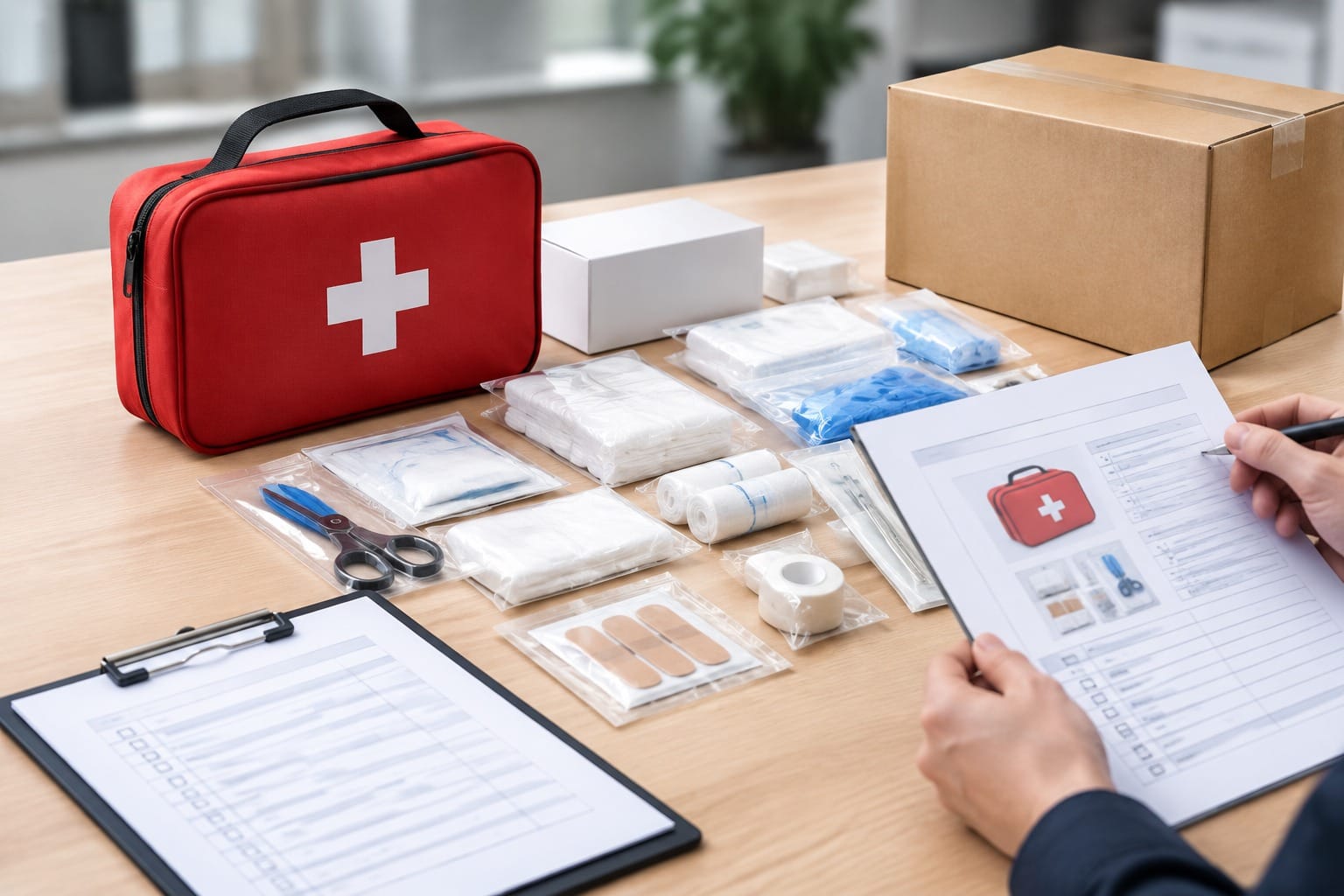
A kit can travel as a single line on a declaration because a dedicated entry exists for it: UN 3316, whose proper shipping name is CHEMICAL KIT or FIRST AID KIT. It sits in Class 9, miscellaneous dangerous substances and articles, under classification code M11, and no packing group is assigned to it. The entry allows a kit holding several small regulated components to be handled as one article rather than as a list of separate declarations.
| Regime | Instrument | Entry as published | Quantity ceiling |
|---|---|---|---|
| Air | IATA Dangerous Goods Regulations | UN 3316, Class 9, packing instruction 960 | 10 kg net per package, permitted on passenger and cargo aircraft |
| Air, excepted quantity | IATA DGR, packing instruction Y960 | UN 3316 as an excepted quantity | 1 kg per package |
| Road and rail | ADR and RID | UN 3316, packing instruction P901, special provisions 251, 340 and 671 | Carriage in bulk and in tanks is not permitted |
| United States | 49 CFR 172.101 Hazardous Materials Table | UN 3316, label 9, emergency response guide 171 | Governed by the packing group and quantity columns of the entry |
Three details in that table change how an order is packed. The air ceiling of 10 kg net is stated per package and not per shipment, so a large order can be split across several boxes and still sit under one declaration. Bulk and tank carriage is expressly refused for this entry, which means the kit entry never becomes a loose-fill option. And the mixed loading rule attached to the entry prohibits loading it with Class 1 explosives other than division 1.4S, or with the self-reactive and organic peroxide entries named in the same provision, which matters whenever a container is consolidated. The IATA dangerous goods regulations are the reference for the air row, and the entry appears in the United States hazardous materials table under the same number.
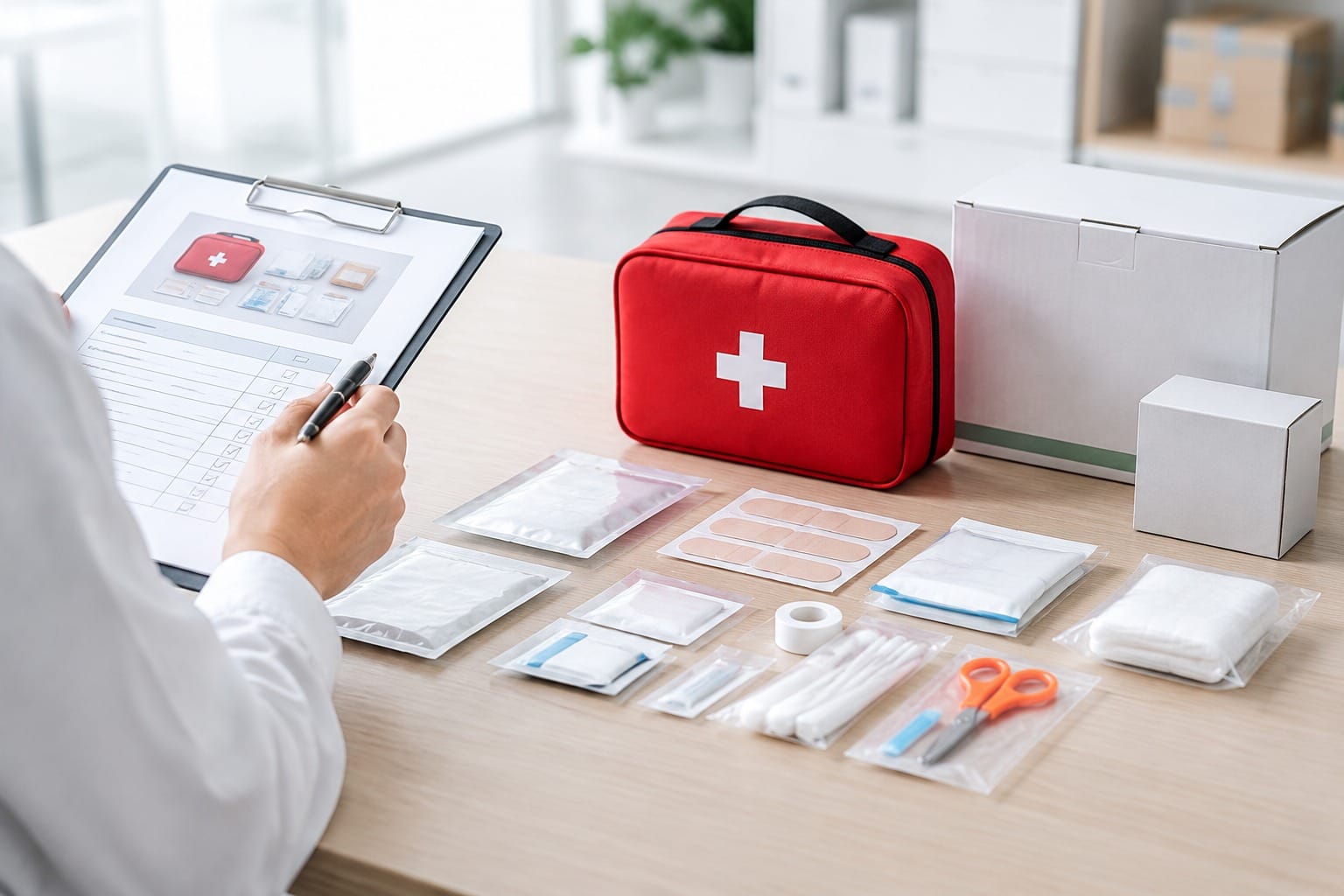
A restricted items first aid kit export is decided by the component list rather than by the kit label. The kit entry does not make the components disappear. It changes what has to be declared, not what has to be contained. Each component still belongs to its own class, and the component list is what tells you whether the kit entry applies at all.
| Component | Class | Entry as published | What triggers it |
|---|---|---|---|
| Alcohol-based disinfectant, free liquid | 3, flammable liquids | — | Alcohol content above the published threshold |
| Alcohol wipes and pads | 4.1, flammable solids | UN 3175 | Alcohol carried in a solid substrate rather than free |
| Aerosol sprays, including burn care and disinfectant sprays | 2, gases | UN 1950 | A pressurised container |
| Lithium cells offered on their own | 9, miscellaneous | UN 3480 | Cells shipped outside equipment |
| Lithium cells packed with or contained in equipment | 9, miscellaneous | UN 3481 | Cells inside or alongside a device |
| Oxygen cylinders | 2, gases | — | Contents held under pressure |
| Mercury thermometers | 8, corrosives | — | Mercury inside a manufactured article |
| Fire extinguishers | 2, gases | — | Stored pressure |
| Used dressings, used sharps and clinical waste | 6.2, infectious substances | — | Contamination, not the article itself |
Two rows in that table are the ones buyers miss. Wipes are the first. An alcohol wipe reads as a solid article and is classified as one, under UN 3175 in Class 4.1, which is a different class from the liquid it contains. The second is used material. A dressing or a syringe is unregulated when new and becomes a Class 6.2 infectious substance once it has been used, which is why clinical waste is refused outright by most postal operators for international destinations. A published dangerous goods list from a logistics operator shows the same split, classifying a complete first aid kit under Class 9 while listing used surgical needles under Class 6.
A third category deserves a check rather than an assumption. Instant cold packs and similar chemically activated devices appear in medical supply lists as potential oxidisers or organic peroxides, and the only dependable way to settle the question is to read the classification in the safety data sheet rather than infer it from the product name. The dangerous goods list published by a global logistics operator is a useful cross-check because it names the class against the everyday item name.
The most consequential decision in a restricted items first aid kit export is not which class applies. It is how much of each item sits in each inner package. Quantity provisions remove documentation, not hazard.
| Tier | How it is reached | What it removes | What it never removes |
|---|---|---|---|
| Excepted quantity | Packing instruction Y960, at or below 1 kg per package for UN 3316 | Hazard labels and the full shipper’s declaration, leaving minimal marking | Correct classification, packaging integrity and training |
| Limited quantity | Special provision 251 in the ADR and RID entries | The full declaration regime, in favour of a reduced marking set | The classification and the packaging specification |
| Small-package relief for wipes | Published trade practice at or below 1 kg per inner package and 30 kg per carton | The packaging certificate requirement for that configuration | The dangerous goods classification itself |
| Aerosol concession | Valve cap fitted, at or below 500 ml per item, no more than two aerosols per package | Standard freight handling, in favour of a consumer commodity label | Correct labelling and the staffed-counter acceptance step |
Read the last column before the third. Every relief tier is a reduction in paperwork attached to a condition about packaging. Step outside the condition and the tier no longer applies, which restores the full set. This is also why a specification change late in an order is a compliance event rather than a cosmetic one.
The paperwork is mostly a consequence of the classification rather than a separate task. Four documents do the work.
Responsibility for the declaration in a restricted items first aid kit export sits with the shipper, not the forwarder. A forwarder accepts, checks and carries a shipment; it does not certify a classification it did not make. Published penalty ranges reflect that allocation. Aviation compliance guidance cites figures in the region of US$50,000 per violation under FAA and EASA enforcement, while other published guides cite ceilings up to US$500,000 with criminal exposure for wilful violations. The figures differ by authority, so confirm the exposure that governs your route instead of relying on a single published maximum.
One training requirement is easy to overlook. Shipper-side dangerous goods training is time-limited, with recurrent training published on a 24-month cycle. A declaration signed by a colleague whose qualification has lapsed is a declaration signed outside the regime.
Classification and market restriction are separate questions, and the second one is not answered by the first.
Transport classification is harmonised to a useful degree. The ICAO technical instructions and the IATA regulations govern air carriage, the IMDG Code published by the International Maritime Organization governs sea carriage, and the ADR, RID and ADN instruments govern inland carriage in the markets that adopt them. A UN number means the same thing across all of them, which is what makes a kit entry portable between modes. That portability is the part of a restricted items first aid kit export the regimes agree on.
Market restriction is not harmonised at all. The same article can be permitted domestically and refused internationally, and the line is often drawn by transport mode rather than by hazard. Published postal restrictions from a national operator show the pattern plainly: personal care and medicinal aerosols accepted for domestic mail but refused for international destinations, alcoholic liquids between 24 and 70 per cent by volume accepted domestically and refused internationally, and lithium cells offered on their own refused in both directions. None of those outcomes is a classification question. They are destination and route decisions taken above the classes.
Nothing in the declaration covers that second layer, which is why a restricted items first aid kit export cannot be closed out by a declaration alone. Import licensing, labelling language, registration duties and item-level prohibitions sit with the importer, and they are worth settling before an order is confirmed rather than after it has been produced.
Five patterns account for most refused shipments in a restricted items first aid kit export, and none of them is exotic.
Six items close the loop on a restricted items first aid kit export, and the order in which they are settled matters less than settling all of them before production.
UneedAid supplies the component list by SKU and the item-level documents a declaration is built from, and where a specification line or a classification question is not yet settled we say so and route the question back to you rather than filling the gap with an assumption. Confirm the position for your own destination market rather than relying on any supplier’s summary of it. Our guide to compliance documents for first aid products sets out which paper belongs to which class of evidence, the responsibility matrix for first aid import requirements shows where the importer’s duties begin, and the shipping methods guide for first aid supplies covers how mode selection interacts with carrier acceptance.
A kit containing regulated components is declared under a dedicated entry, UN 3316, in Class 9. A kit containing nothing classified is not. The outcome turns on the component list and on the quantity held in each inner package, not on the kit being a medical product. Read the safety data sheet for every component before deciding which way it falls.
UN 3316 is the entry whose proper shipping name is chemical kit or first aid kit. It lets a kit holding several small regulated components travel as a single declared article, with its own packing instruction and quantity ceiling. For air carriage the packing instruction is 960 and the ceiling is 10 kilograms net per package, on both passenger and cargo aircraft.
Wipes carrying alcohol are classified as a flammable solid under UN 3175 in Class 4.1, which is a different class from the free liquid they contain. Published trade practice applies small-package relief where the inner package stays at or below 1 kilogram and the carton at or below 30 kilograms. Confirm the classification on the sheet for the specific wipe being shipped.
The shipper signs it, not the forwarder. A forwarder accepts, checks and carries the shipment, but the declaration is the shipper’s own statement that the goods are correctly classified, packed, marked and described. Because it is a legal declaration, the person who signs it should also hold current dangerous goods training for the role.
A device with a lithium cell brings Class 9 into the kit on its own terms. Cells offered outside equipment sit under a different entry from cells packed with or contained in equipment, and the outcome differs again by aircraft type and by operator. Handle the cell as a separate classification question and settle it before the kit configuration is frozen.
The kit is the unit of declaration and the component list is the unit of classification. Keeping those two apart is what makes the paperwork tractable, because it turns a forty-item inventory into one entry plus a short list of exceptions.
Then comes the second question, which has nothing to do with classes. Whether the destination will admit the shipment is answered by that market and not by the declaration, and the answer should arrive before the order is produced. Write the component list, collect the sheets, name the route, and confirm the destination position in writing. The declaration is the last step, and it is the easy one.
Two more references are worth pairing with this one. The guide to verifying a supplier’s certification claims covers how to check a document rather than accept it, and the labelling and language requirements guide covers the paperwork that belongs to the destination rather than to the carrier. Buyers assembling a supplier shortlist will also find the supplier compliance checklist useful, because it asks for the same item-level sheets this article builds a declaration from.
Our own MOQ starts at 1,000 pcs, with sample-based validation before production and a feasibility review wherever a specification line is not yet fixed.
Transport restrictions and tariff classification are separate questions, and a kit can raise both at once. The HS code basics for first aid products cover the customs side of that pair.
A supplier sends eleven scanned PDFs in one folder and calls it the compliance pack. Two are certificates for a management system, three are test reports without a product name on them, one is a declaration signed by a trading company rather than a manufacturer, and the rest are unclear. A first aid supplier compliance checklist exists to prevent that folder, because it names each document before anything is sent.
The checklist does not judge whether a supplier is compliant. It does something narrower and more useful: it pairs every document with the question that document can answer, and with the register or issuer that can confirm it. A document that cannot be confirmed is not evidence. It is a file.
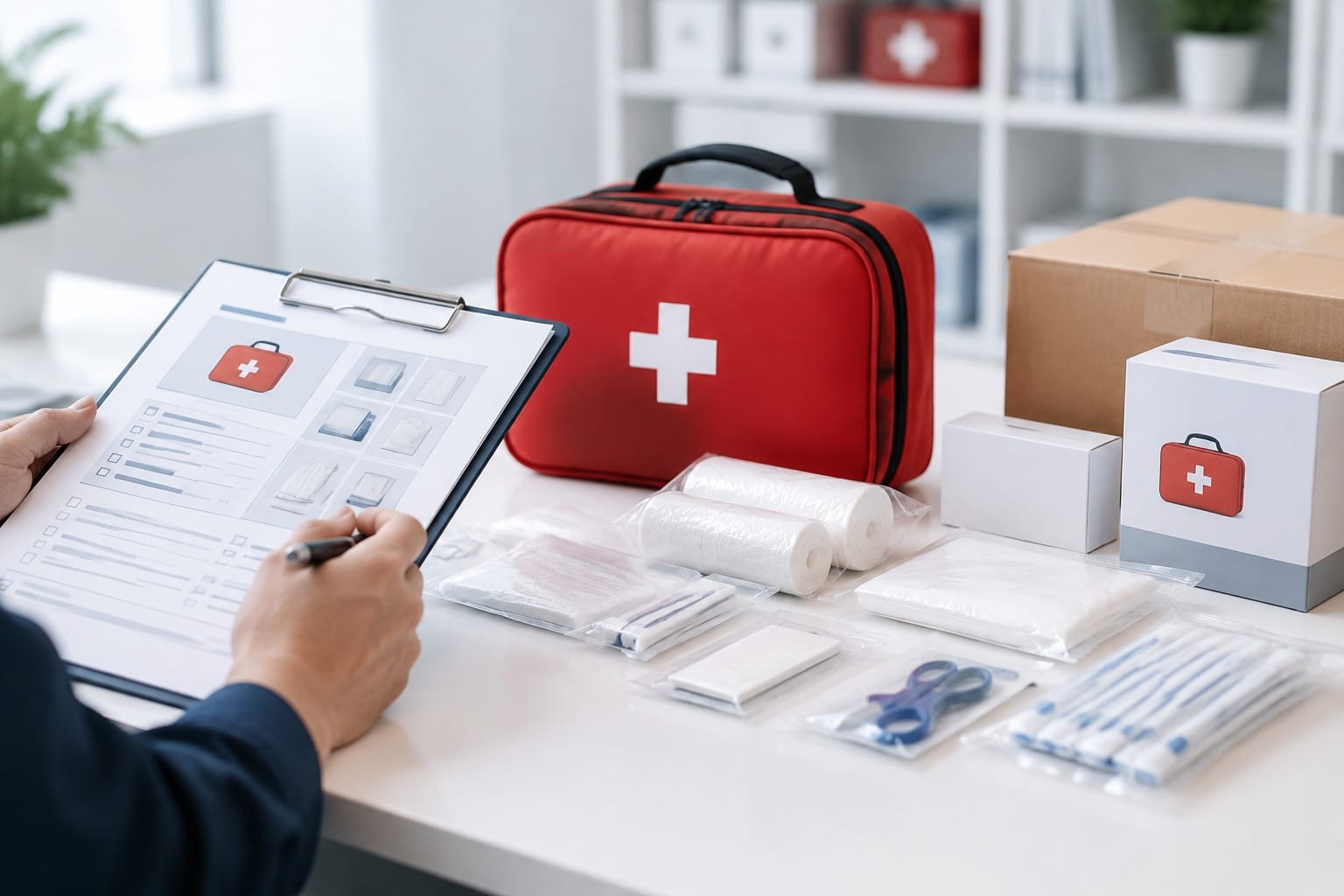
Three clarifications prevent the most common uses of a checklist going wrong.
The order of those three points matters. Buyers who start with the third and skip the second collect impressive paperwork that later turns out to describe a different factory.
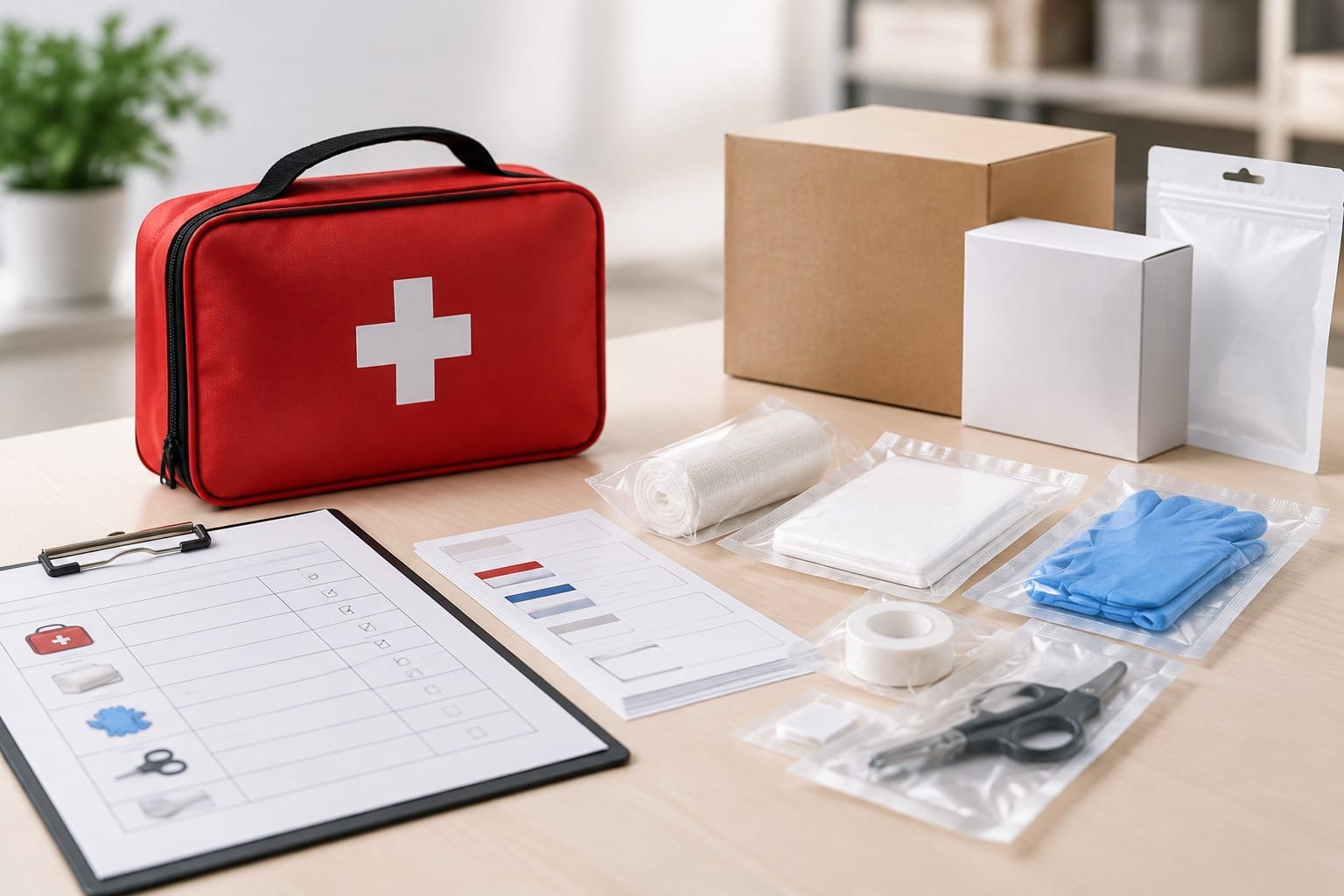
Every document on a first aid supplier compliance checklist belongs to one of three classes. The class tells you the reach of the document, which is usually where a supplier folder overstates its case.
| Class | Scope | Typical documents | The question it can answer |
|---|---|---|---|
| System | The organisation and its processes | Quality management system certificate with scope and site, audit report naming its issuer | Can this organisation control a production process to a written standard |
| Product | One device family or model | Declaration of conformity, test reports per standard, risk-management file summary, label and instructions, UDI assignment | Does this product meet the named requirements, as declared by the responsible party |
| Transaction | One order or one production lot | Batch record or certificate of analysis, sterility release document, certificate of origin, pre-shipment inspection report | Does this specific shipment match what was ordered |
The classes are not interchangeable, and that is the point. A system document never proves a product’s status, and a transaction document never proves a system. A folder that answers all three classes is a folder that has covered the ground.
The most repeated substitution in supplier folders is a management-system certificate offered as evidence about a product. It is worth stating plainly what that document does and does not do.
A quality-management certificate describes how an organisation runs its processes. It says nothing about whether a particular kit, dressing or bag meets the requirements that apply where you intend to sell it. The procurement guidance published by the Swiss medical devices authority puts the distinction directly: certificates that relate to standards are not EU certificates and do not prove that a medical device is compliant. That sentence is the reason a first aid supplier compliance checklist keeps the system class and the product class on separate rows.
Product-level declarations carry their own limit. A declaration of conformity is the responsible party’s own statement. It is meaningful because it is signed and because it names the requirements it claims to meet, and it is checkable because the requirements it names can be read. It is not a third-party verdict.
The verification column is what turns the checklist into a control. Each row names who can confirm the document, and what the confirmation looks like in practice.
| Row | Who can confirm it | What the check looks like |
|---|---|---|
| System certificate | The certification body, or the register it publishes | Confirm the certificate number, the legal entity, the site, the scope and the validity dates directly with the issuer |
| Notified body involvement | The European Commission’s NANDO information system | Search the four-digit number that appears after the CE mark; check that the notification is active and that its legislation tab lists the regulation named on the certificate |
| Certificate and device registration in the EU | EUDAMED | Look up the economic operator, the device and the certificate record; check the certificate’s status rather than its existence |
| Declarations and test reports | The party that signed, plus the standard named inside | Read the producing site and the covered product family against your order, not just the title page |
| Batch and release documents | The manufacturer, at shipment | Match the lot or batch identifier to the identifier on the goods and on the packing list |
Two habits make the third column work. Ask for the scope page as well as the cover page, because scope is where the limits live. And contact the issuer using the contact details you looked up yourself rather than the ones printed on the copy you were sent. The European Commission’s overview of the EUDAMED database explains which modules are open and what a buyer can look up directly, and the NANDO database is the register to search when a certificate names a notified body.
A certificate can cover every device a manufacturer makes, a single device family, or a single batch of one product. Buyers who only read the title page routinely assume the widest reading. The Swissmedic procurement guidance makes the same note about the range a certificate may cover, and it is the reason the checklist needs a scope line rather than a checkbox.
Four fields do most of that work:
Add a fifth row for anything the supplier declines to answer, so disagreement is recorded rather than smoothed over.
A single list creates a predictable problem: documents that cannot exist at bid stage get requested at bid stage, and the answers arrive vague. Split the checklist into two stages and the responses get sharper.
| Stage | Rows to request |
|---|---|
| Bid stage | System certificate with scope, product declaration, test reports mapped to the offered model, label and instructions set, registration or listing evidence where the market requires it, manufacturer authorisation for the party quoting |
| Shipment stage | Batch or lot record, release document, inspection report, packing documentation, certificate of origin, and any legalisation or market-specific document named in the contract |
State the split in the RFQ itself. Suppliers answer a two-stage list more completely than a single long one, because no row is asking for a document that cannot exist yet. The document structure used in the RFQ template for first aid supplies follows the same two-stage logic, with the compliance column carrying the supplier’s own exceptional status against each row.
A checklist is a buyer-side control, and its limits should be written into it. It cannot decide which regulatory route applies to your product in your market, because that route is set by the market authority and depends on the product’s classification rather than on the documents a supplier holds. For the European Union, that classification question sits with the framework the European Commission describes for medical devices, and the obligations that fall on each party in the supply chain follow from it.
For kit orders, one row deserves its own entry, because a single component can change the declaration, as explained in this [restricted items first aid kit export guide](https://uneedaid.com/restricted-items-first-aid-kits-export/).
It cannot move responsibility either. Where an order crosses a border, duties and obligations are assigned to the actors in the chain — manufacturer, authorised representative, importer, distributor — and each of them carries its own record-keeping and verification duties. A buyer who wants the underlying structure can follow the technical file responsibilities held by importers.
Destination markets outside the EU have their own frameworks. The United States quality system expectations for devices are set out in 21 CFR Part 820, which a buyer or a US-based partner reads directly rather than through a supplier summary.
The correct conclusion from a completed checklist is modest and specific: for this order, this scope, these documents were requested, these were confirmed at source, and these remain declared but unconfirmed. Record it that way in the purchase file, because that record is what makes the next order faster.
Start with the two that scope everything else: the system certificate with its scope page, and the product-level declaration. Those two establish who is responsible and which product family the file covers. Only then request the supporting test reports, because a test report is only useful once you know which model and which production site it belongs to. A first aid supplier compliance checklist built in that order avoids re-requesting the same files twice.
No, and the distinction is worth keeping sharp. A management-system certificate describes how an organisation runs its processes; it does not describe a product’s status in any market. Even a current certificate for the correct site leaves the product question open. The first aid supplier compliance checklist handles this by keeping system rows and product rows separate, so a supplier cannot answer the product column with a system document.
Read four fields: the legal entity, the manufacturing site, the product family or code, and the validity window. Compare the entity to the party that will appear on your invoice, and the site to the location that will produce the order. If the document lists covered devices, check whether your model appears. Where a certificate covers a batch rather than a family, that is a narrower reading than most buyers assume, and it should be recorded as such.
Bid-stage rows exist so that pricing decisions are not made blind, so a partial answer at bid stage is acceptable only if the supplier names which rows it is deferring and why. A supplier that defers product-level documents but returns the system and commercial rows still gives you something to compare. Deferring everything until after a purchase order removes the checklist’s purpose, because the row that would have changed the decision arrives too late.
Record it as unanswered rather than as absent. The two are different facts and they lead to different actions: unanswered means the supplier was asked and did not reply, while absent means the document does not exist for that scope. Keep the status per row, keep the date of each confirmation, and re-check the rows that depend on a site, an owner or a component when any of those changes.
A first aid supplier compliance checklist is worth keeping as a standing document rather than rebuilding it per order. The rows stay, the answers change, and the confirmation dates tell you which rows have gone stale.
The surrounding documents are already covered elsewhere. For the lines that make supplier quotes comparable before any file is exchanged, the emergency first aid kit RFQ checklist sets out the eight that matter. For the buying process the checklist sits inside, from brief to release, the B2B first aid procurement guide places document control at the qualification gate. Where several suppliers are being considered at once, comparing them on verifiable evidence sorts declarations by what can be confirmed.
Public buyers commonly request the same document set, but under a formal notice the submission date is the test rather than the award date, so a current copy has to exist before the window closes. The public sector tender process for first aid products sets out how this checklist overlaps with a tender document gate.
First aid importer documentation fails for one repeated reason: the buying team assumes the file that sits with the factory is the file that satisfies the market. It is not. The technical file is assembled and held by the manufacturer. The importer holds a different set of obligations, and those obligations are checked against documents the importer may never have seen.
This guide separates the two sides of that split. It covers what the technical file is, what an importer has to verify before a device goes on the market, the document request list worth sending to a supplier, and how registration systems fit in.
Three questions decide whether a shipment can lawfully be placed on a market, and none of them is answered by the price list.
Buyers who answer those three questions before the deposit usually avoid the failure mode where goods arrive, the customs file clears, and the market-surveillance question appears months later, which is the gap most first aid importer documentation reviews are opened to close.
Technical documentation is the manufacturer’s artefact. It describes the device, its design and manufacture, how it meets the applicable safety and performance requirements, how risks were managed, and the labelling that follows from all of it. It is the evidence base the manufacturer maintains and updates. A buyer does not receive it with a shipment and should not expect to.
What the importer holds is narrower and specific. Under Article 13 of Regulation (EU) 2017/745, importers keep a copy of the EU declaration of conformity and, where applicable, a copy of any relevant certificate, for the retention period the regulation sets. That is the document pair an authority asks for first. The wider technical file stays upstream.
Reading those two obligations as one is the single most common misconception in first aid importer documentation. A supplier who says “we have the technical file” is answering a different question from “do I, as importer, hold what I am required to hold”.
The verification duty is explicit and itemised. Article 13 requires an importer, before placing a device on the market, to verify that the device bears the required marking and that the manufacturer has drawn up the EU declaration of conformity; that the manufacturer is identified and has designated an authorised representative where the regulation requires one; that the device is labelled as the regulation requires and comes with the instructions for use; and that a UDI has been assigned where applicable.
If a verification step fails, the regulation is unambiguous: the importer must not place the device on the market until it is brought into conformity, and must inform the manufacturer and the authorised representative. Where a serious risk or a falsified device is suspected, the competent authority of the member state where the importer is established has to be told as well.
The importer also has to put its own identity on the goods. Article 13 requires the importer’s name, registered trade name or mark, and registered place of business to appear on the device, its packaging, or an accompanying document, and any additional label must not obscure the information the manufacturer provided.
Before quoting, send the supplier a written first aid importer documentation request. It is more efficient than discovering the gap after the goods are packed.
Notice what is not on that first aid importer documentation list: the technical file itself. Asking for it usually produces either silence or a summary, because it is not a shipping document.
The list is worth pairing with a verification route on every line: the document checklist used in a first aid supplier RFQ names each file alongside the register or issuer that can confirm it.
A catalogue is not a single product, and first aid importer documentation that covers “first aid kits” in general will not survive a review that picks one line item. Documents have to be traceable to the exact item that ships.
That problem scales faster than most buyers expect. Our catalogue runs to 190 product pages grouped under 26 category hubs, and a single order often mixes kit configurations, refill consumables and bag formats that sit in different categories. Each of those can carry different labelling, different instruction sheets and a different position in the manufacturer’s technical documentation. Consolidating them into one order is a commercial decision; keeping the paperwork per SKU is a separate one that has to be made deliberately.
This is also where the responsibility boundary we work to matters. Documents are issued per SKU, and the confirmation that those documents satisfy a given destination market stays with the buyer. We do not and cannot make that determination for an importer’s market.
Registration has moved from a paper exercise to a database exercise, and the EU shows how far that has gone. EUDAMED, the European Database on Medical Devices, is structured around six modules. As of 28 May 2026, four of them became mandatory to use: actor registration, UDI and device registration, notified bodies and certificates, and market surveillance.
That date was not arbitrary. Commission Decision (EU) 2025/2371 was published in the Official Journal on 27 November 2025, and under the transitional provisions of Regulation (EU) 2024/1860 that publication started a six-month transition period ending on 28 May 2026. The remaining two modules, covering vigilance and post-market surveillance, and clinical investigations and performance studies, are still under development.
For an importer the practical consequence is sequencing. Actor registration produces the registration number an economic operator is identified by, and device-level registration sits on top of it. Registration that is done late does not stop goods moving, but it does leave the importer unable to show the traceability the system exists to provide.
The first order is the easy one, because everything is new and nothing has drifted. The failures appear on the fifth, and first aid importer documentation is usually where they surface.
Documents get revised. A label gains a line, an instruction sheet is reissued in a second language, a certificate is replaced. Unless the importer has a register that records which revision it holds for which SKU, there is no way to know whether the file in the drawer still describes the goods on the shelf. Article 13 also places complaint handling and record-keeping duties on the importer, which means non-conforming units, returns and withdrawals have to be logged and forwarded upstream rather than absorbed locally.
The habit that prevents most of this is unglamorous: record the version of every document against the SKU and the shipment it arrived with, and re-request on a schedule rather than when a problem appears.
| Question | Manufacturer side | Importer side |
|---|---|---|
| Who compiles the technical documentation | Yes, and maintains it | No access needed by default |
| Who holds the declaration of conformity | Authors it | Keeps a copy for the retention period |
| Who adds details to the label | Provides the base label | Adds importer details without obscuring it |
| Who registers in the database | Registers as manufacturer | Registers as importer for the devices it places |
| Who confirms the destination market is satisfied | Supplies the documents | Confirms the market requirement and holds the record |
No. Under the EU framework the importer keeps a copy of the declaration of conformity and, where applicable, any relevant certificate. The broader technical documentation is the manufacturer’s to compile and maintain. Asking a supplier to hand over the complete technical file usually misunderstands the duty, and a supplier who offers it without qualification is worth questioning.
Under the EU regulation the importer is the person or company established in the Union that places a device from a third country on the Union market. The status follows the act of placing on the market rather than the size of the business. If a buyer outside the Union resells into the EU, someone established in the Union still has to hold the importer role.
They are separate roles with separate duties, and the official guidance on Articles 13 and 14 handles them as such. One legal entity can hold more than one role in a given structure, but each set of obligations still applies in full and has to be documented. Assuming the representative automatically covers the importer duties is a recurring error.
The regulation requires the importer not to place the device on the market until it is brought into conformity, and to inform the manufacturer and the authorised representative. If a serious risk or a falsified device is suspected, the competent authority of the member state where the importer is established must also be informed. The duty is to stop rather than to proceed with a note.
Set a review interval rather than waiting for a problem, and re-check whenever a SKU changes material, packaging, labelling or supplier. Certificates and declarations carry issue dates and revisions, and a document set that was correct at the first shipment can be stale within a year. Recording the version you hold against the SKU makes that review mechanical.
The first aid importer documentation pattern that holds up is straightforward. The manufacturer compiles and maintains the technical documentation and issues the declaration and certificates. The importer verifies the specific points the regulation lists, adds its own details to the goods, registers in the market’s system where one exists, and keeps the records that prove it did. The buyer confirms what the destination market requires in the first place.
Buyers building the wider picture can start from the responsibility matrix for first aid import requirements, which maps roles across markets, then read the compliance document guide for the document set itself. Two companion pieces cover adjacent checks: verifying a supplier’s product document status and labelling and language requirements.
Nothing in this article states the status of any UneedAid product in any market. That determination depends on the destination, the specific SKU and the role of the buyer, and it belongs with the importer and its regulatory adviser.
Where a kit contains chemical-based components, the importer also has to hold and maintain the sheets attached to those components. This component safety data sheet guide explains the component map, the language requirement and the revision record.
A supplier sends a certificate PDF with the quote. It looks correct: an ISO 13485 heading, a recognizable certification body logo, dates that fall inside the current period. Then you notice the certificate names a device family, not the model you are buying. The document is real. It simply does not cover your order.
That gap is the reason to verify medical product certification at SKU level rather than at supplier level. A certificate attaches to a defined scope, and a scope statement is narrower than most buyers assume. The practical question is not “is this supplier certified” but “does this specific document cover this specific model, at this specific site, for this specific market, on this date”.
Answer that by working through four independent registers and documents, in order. Each one can fail on its own, and each failure invalidates a different part of the claim. The sequence below is the one to verify medical product certification against, because it separates what the company holds from what the product carries.

Most buyers verify the company and stop. The company-level check answers whether the manufacturer holds a quality management system certificate. It does not answer whether the certificate’s scope includes the product you are ordering, whether the certificate is currently in force, or whether the product carries its own market conformity evidence.
Registration alone is also easy to misread. FDA establishment registration means the facility is registered, not that a device has clearance. A European self-declaration covers lower-risk classes only; higher-risk devices need a notified body certificate. Reading either as a product-level approval leaves a gap that a customs officer, a distributor’s regulator, or a tender evaluator will eventually find.
The fix is a chain, and the chain is only as strong as its weakest link:
| Link | What it establishes | Where it fails |
|---|---|---|
| Legal identity of the manufacturer | The entity you contracted is the entity on the certificate | Certificates belonging to a different legal entity |
| Document scope by SKU | The certificate covers your model and site | Family-level or generic scope wording |
| Register confirmation | The certificate exists and is in force | Numbers that do not resolve |
| Product-level conformity | The specific model meets the target-market rules | Missing or mismatched declaration of conformity |
Work the chain in this order. A valid certificate number printed on the letterhead of a company that is not the legal manufacturer is still a problem for your order. For the wider document set this check sits inside, see how compliance documentation is mapped by SKU.

ISO 13485 is the quality management system standard for medical device manufacturers. It certifies that a manufacturing operation runs a controlled quality system. It does not certify that any individual product conforms to a product standard, and it does not certify market access in any jurisdiction.
Read four fields before accepting it:
Cross-check the certificate number against the certification body’s own register rather than trusting the PDF. A PDF is an image of a certificate. The register entry is the evidence.
For devices that require notified body involvement, the CE mark carries a four-digit identification number next to it. That number identifies the notified body, and it is verifiable.
Open the European Commission’s NANDO database and search the number. Confirm two things: that the body is designated under Regulation (EU) 2017/745, and that its designated scope covers your product category. A body authorized for one category cannot issue certificates for another. This single check catches the majority of invalid or misattributed CE claims, and it is the step that most often changes the answer when you verify medical product certification on a new supplier.
Two further checks belong here:
Under MDR, technical documentation retention obligations run for at least ten years for most devices and longer for implantables. Ask how long your supplier retains batch records, because that answer determines whether a traceability request in year four can be satisfied.
European device and certificate data is consolidating in EUDAMED, the European database on medical devices. Its modules are being brought into mandatory use in stages, so what you can check depends on the date.
| EUDAMED module | What a buyer can confirm | Timing note |
|---|---|---|
| Actor registration | Manufacturer and authorized representative registration, with an SRN | Already usable for operators who have registered |
| UDI / device registration | Device identification data, searchable by UDI-DI | New devices must be registered before placement from May 2026 |
| Certificates | Certificates issued by notified bodies, and their status | Certificates issued before May 2026 must be uploaded by May 2027 |
| Market surveillance | Recalls, safety notices and enforcement actions | Later phase |
Until every module is fully populated, use EUDAMED as one input rather than the single authority. Combine it with the notified body’s own register and the certificate document itself. Where the three agree, confidence is high. Where they disagree, stop and ask the supplier which record is authoritative. Working out which party carries which obligation is covered in destination-market import responsibilities.
For North American sourcing, the equivalent check is the FDA establishment registration and device listing. Request specific clearance numbers where a clearance is claimed, and confirm the registration is active. Registration status and product authorization are separate records; confirm both exist. Buyers who verify medical product certification in the US market usually keep these two records side by side for exactly this reason.
Scanned documents get edited. Logos get pasted onto fresh letterheads, dates get extended, and one manufacturer’s certificate number turns up on another company’s datasheet. Audit data reported in industry sourcing coverage indicates that a substantial share of “certified” suppliers fail unannounced third-party audits, which is why document review alone is insufficient. This is the scenario that makes it worth knowing how to verify medical product certification without relying on a supplier-supplied file.
When a supplier cannot produce original documents, scan these as structural signals rather than proof of intent:
For higher-value or repeat orders, arrange third-party inspection through an organization such as SGS or TÜV, and review batch records and pre-shipment inspection results. This costs money and it is the layer most buyers omit. It is also the layer that catches the packaging variant substitution that document review cannot see.
A first aid kit is usually an assembly, not a single device. A wall-mounted workplace kit may contain a tourniquet, adhesive dressings, a conforming bandage, an antiseptic wipe, scissors and a foil blanket. Each component can carry a different classification, a different manufacturer, and different documentation obligations.
The same logic applies to transport paperwork, and this [guide to restricted items in first aid kits for export](https://uneedaid.com/restricted-items-first-aid-kits-export/) shows which items in a kit carry a class at all.
Verification therefore has to be done per component, then mapped back to the finished kit SKU. To verify medical product certification for an assembled kit, work component by component before you look at the finished SKU as a whole:
| Kit component type | Typical documentation anchor | Common failure |
|---|---|---|
| Tourniquet, dressings, bandages | Manufacturer declaration plus test report by model | Certificate covers a different size or variant |
| Antiseptic or medicated items | Formulation and classification evidence for the target market | Ingredients not cleared in the destination market |
| Scissors, cases, non-medical hardware | General product conformity, not device rules | Classed as a device, inflating the document set |
| Outer bag or box | Packaging and labeling requirements | Labeling lacks the importer or representative details |
Build a component-to-document register for each kit SKU and keep it with the purchase order. When a component changes supplier, the register tells you exactly which documents must be refreshed before the kit ships. Without it, a substitution inside a kit can silently invalidate the compliance file for the whole SKU. Label wording is the other half of this file, and the labeling and language requirements by market set out what each destination expects on the pack.
Put the document request into the RFQ itself, with deadlines. Suppliers who hold genuine documentation produce it without resistance; hesitation is itself a data point.
Ask for the following, by model and by site:
State the acceptable response window in the RFQ. A supplier that cannot assemble the set within it has told you something useful before pricing is even discussed.
For kit-based orders, the outer format also affects what has to be labeled and documented. The differences between wall-mounted and portable kit configurations are a practical example: the same contents in a different housing can change both the label fields and the component register you need to maintain.
Run the same five checks every time, and record the outcome against the SKU rather than against the supplier:
Keep the result with the purchase order. When you verify medical product certification this way, the file answers a regulator’s question in minutes instead of weeks, and the answer is evidence rather than recollection. Buyers who need to apply the same discipline across a multi-line catalogue tend to build it into a standard document schedule rather than handling it order by order.
No. ISO 13485 certifies that the manufacturing operation runs a controlled quality management system. It says nothing about whether a specific model conforms to a product standard or meets the regulatory requirements of a destination market. You need the quality system certificate and the product-level evidence separately, plus a scope statement that names your product category.
Take the certificate number and search it in the issuing certification body’s own register, not the PDF. Confirm the holder name matches the legal manufacturer, the scope covers your product, and the expiry date is current. Then ask for the most recent surveillance audit summary, because a certificate depends on those audits being passed between recertifications.
The declaration of conformity is the manufacturer’s signed statement of responsibility, naming the model, intended purpose and applicable regulation. A test report is the laboratory evidence produced against a cited standard. The declaration is the commitment; the report is the support. A declaration without citable test reports behind it is a claim, not evidence.
Yes, and additional checks apply. Non-EU manufacturers need an authorized representative established in the EU, and that representative’s details should appear in the documentation. Verify the notified body in NANDO, check the certificate status and device registration in EUDAMED where the modules are populated, and confirm the representative’s appointment is current.
Re-verify before each large order and whenever a model, site or component supplier changes. Certificates have finite validity and depend on surveillance audits. Set a review date from the expiry date rather than the order date, and scan for any scope change to your SKU as a trigger for a fresh document set.
Stop the order and ask the supplier to explain. A number that does not resolve in the issuing body’s register means the certificate is not valid for your purposes, whatever the PDF looks like. Ask for the correct certificate and its register entry. If the supplier cannot provide a resolving number, log the claim as unverified and source elsewhere.
An export order can have the correct contents and still be held because the package shows the wrong local operator, omits a required language, or uses artwork from an earlier product revision. First aid product labeling requirements are destination-specific controls that connect the physical item to its manufacturer, market route, intended purpose, and traceability records.
For a B2B buyer, the practical approach is to create a label specification for every SKU and destination before approving a sample. List the required text, symbols, languages, responsible entities, identification fields, packaging levels, and approval records. This article is a procurement framework, not legal advice. The importer or other responsible local party must confirm current rules with the relevant authority and qualified advisers before production or sale.
“First aid product” is a commercial category that may include dressings, gloves, cold packs, scissors, eyewash, bags, boxes, and assembled kits. A product’s regulatory route can depend on its intended purpose, claims, materials, configuration, and destination. Two visually similar items may therefore need different label content.
The market route also changes the party named on the label. A manufacturer outside the destination may need a local importer, authorised representative, responsible person, sponsor, or another defined operator. Customs, ownership, logistics, and product-regulatory roles may be held by different entities. Do not copy an operator name from a previous shipment without checking the current route.
The first aid product compliance documents guide explains how to map each label revision to the product identity, evidence scope, and market conclusion. The destination-market responsibility matrix adds a role-by-role view for manufacturers, importers, distributors, and local representatives.
Create one controlled record per SKU, pack level, and destination. This is the core of a repeatable first aid product labeling requirements review. A useful specification contains the following fields:
| Label field | What to define | Verification question |
|---|---|---|
| Product identity | Product name, model, catalogue number, size, quantity and configuration | Does the label identify the exact ordered SKU? |
| Intended purpose and claims | Approved descriptive wording and prohibited claims | Do the words match the reviewed market route? |
| Manufacturer | Legal name and address, plus site details where required | Does this match the declaration and purchase records? |
| Local operator | Importer, representative, responsible person, sponsor or other role where required | Is the entity established and named for this territory? |
| Traceability | Lot, batch, serial, date code, UDI or other identifier when applicable | Can a supplied unit be linked to production and shipment records? |
| Dates and conditions | Expiry, manufacture date, storage, temperature or handling statements | Are dates and conditions supported by the product file? |
| Warnings and symbols | Destination-required warnings, precautions and standardized symbols | Has a qualified reviewer confirmed the symbols and wording? |
| Language set | Unit, package, instructions, inserts and carton languages | Does each sales channel receive the required language version? |
| Packaging levels | Unit, immediate package, sales pack, shipping carton and pallet marks | Are fields consistent at every level? |
Mark each field as required, not applicable with rationale, or open. A blank cell does not show whether a requirement was checked. Retain the reviewer, source, date, artwork revision, and approval status.
Language planning is more than translating a product name. It covers mandatory statements, warnings, instructions, storage conditions, responsible-operator details, symbols, and sometimes accompanying electronic or online information. These language controls are part of the first aid product labeling requirements review, and the required set can depend on the destination, user setting, product classification, and sales channel.
Use this workflow:
Machine translation can help create a draft, but it should not be treated as final evidence for a regulated label. Retain the source text, translation, reviewer comments, and approved artwork file. For private-label projects, identify whether the buyer or manufacturer owns each language revision and who authorizes a reprint.
Labels are often distributed across several physical levels. Review each level as a linked set rather than assuming the unit label covers the carton. This packaging-level comparison helps buyers document first aid product labeling requirements without losing traceability between the item and shipment.
| Level | Typical content | Common control |
|---|---|---|
| Individual item | Product identity, model, lot or date, warnings, manufacturer and local operator where required | Confirm print remains legible after handling and packing |
| Immediate package | Quantity, storage, instructions or symbols, traceability and language | Match the item and approved pack count |
| Sales package or kit | Complete kit identity, BOM or contents statement, use instructions and operator details | Compare with the frozen kit configuration |
| Master carton | SKU, quantity, lot, shipping marks, handling and destination information | Reconcile with invoice, packing list and purchase order |
| Pallet or outer mark | Shipment reference, cartons, handling and consignee details | Ensure marks do not conflict with customs records |
For a mixed first aid kit, maintain both a kit-level artwork file and component-level label records. The kit label should not be used to hide a missing identifier or language on an individual component when that component has its own requirements. Link the artwork revision to the BOM, assembly lot, and sample approval.
The examples below are orientation points. They do not replace a current product-specific review.
Regulation (EU) 2017/745 sets duties for manufacturers, authorised representatives, importers, and distributors of medical devices. Label and instructions requirements depend on the device and applicable route. Importers should verify the manufacturer and representative details, device identification, required information, and language rules before placing a product on the Union market. Consult the official EU Medical Device Regulation and current guidance for the exact device.
Great Britain and Northern Ireland do not share one unqualified label route. The MHRA describes registration and UK Responsible Person arrangements for relevant products in Great Britain, while Northern Ireland can involve different framework requirements. Record the territory explicitly, then confirm marking, operator details, instructions, and transition provisions with current MHRA guidance.
US label content depends on the product and its applicable FDA requirements. Registration or listing does not by itself establish that a product has been reviewed for every claim or route. Buyers should check identity, intended use, manufacturer details, warnings, instructions, and any applicable device-labeling or unique-identification requirements through the FDA device labeling guidance.
Canadian requirements vary with device class and activity. Confirm the product and establishment route, required label information, bilingual or other language expectations, and importer or distributor details against the current Medical Devices Regulations. Match any licence or establishment record to the exact manufacturer, identifier, and destination route.
The TGA’s device inclusion process and sponsor obligations create a local market interface for relevant products. Check the ARTG inclusion scope, manufacturer evidence, intended purpose, labeling, advertising, and post-market records through the TGA medical device inclusion process. Do not reuse a label approved for another market without an Australian route review.
Ask suppliers to provide a document schedule with the RFQ. It should show which label files are available, which fields are buyer-supplied, and which decisions remain open. Include the first aid product labeling requirements worksheet as an RFQ attachment so every quotation uses the same assumptions. The broader B2B first aid procurement guide shows how to connect this schedule with specifications, samples, inspection, and shipment controls.
| RFQ stage | Label deliverable | Buyer decision |
|---|---|---|
| Initial quotation | Proposed SKU, pack count, standard label and destination assumptions | Is the quote based on the correct product and market? |
| Sample review | Unit, package, kit, insert and carton artwork with language versions | Does the physical sample match the requested route? |
| Production release | Approved artwork revisions, BOM, print proof and change-control owner | Is production authorized for the defined SKU? |
| Pre-shipment | Batch or lot data, carton marks, packing list and released sample reference | Does the shipment match the approved files? |
| Repeat order | Delta statement for text, operator, language, component and packaging changes | Can the prior approval be reused, or is a new review needed? |
State acceptance criteria before files arrive. For example, require readable source files, exact model scope, controlled translations, named reviewers, and a physical proof for private-label printing. A phrase such as “all required labels included” is too vague to release an order.
Procurement teams can reduce rework by checking these failure modes:
When a gap appears, record the affected SKU, destination, revision, owner, decision gate, and due date. Hold production or shipment when the open item affects identity, operator information, required language, market access, or traceability.
Set review triggers for time, change, and events. Reopen the label record when a manufacturer, site, material, component, claim, pack count, operator, destination, language, symbol, or applicable rule changes. Also review after a complaint, authority notice, shipment hold, or failed inspection. This keeps first aid product labeling requirements current for repeat orders instead of relying on an old print file.
Keep superseded artwork with an effective date and purchase-order or batch references. “Same as last order” should start a delta check against the last approved BOM, label, evidence, and operator map. It is not evidence that no review is needed.
UneedAid supports factory-backed B2B sourcing for first aid kits, bags, supplies, and private-label projects. Feasibility, MOQ, available documentation, label fields, and language support depend on the defined product, customization, destination, and order type. Include the target markets, SKU or BOM list, language set, packaging levels, and required evidence in an RFQ so the route can be reviewed before production planning.
Not automatically. The destination may require one or more local languages for labels, instructions, warnings, or packaging. Confirm the exact language set for the product, territory, user setting, and channel. Record the source, translation, reviewer, approved artwork revision, and the first aid product labeling requirements conclusion used for release.
This can create a mismatch between the physical product, approved artwork, and market records. Agree the language workflow before sampling. If the buyer supplies translations, define who checks terminology, layout, operator details, symbols, and final print proof, and obtain written release before production.
No assumption is safe for a mixed kit. Components may have different identities, manufacturers, dates, warnings, and market routes. Keep a component-level map linked to the kit BOM and a separate kit-level label record. Review both layers against the destination’s first aid product labeling requirements before approving the packed sample.
No single certificate establishes every labeling requirement. Label review must connect the exact product, destination, operator, language, claims, symbols, and packaging level to current market rules and supporting evidence. A certificate can support one evidence question, but it does not replace the complete first aid product labeling requirements check.
Record it as an open item with an owner and release gate. Ask the responsible local operator or qualified adviser to confirm the requirement. Do not fill the gap with an assumed address, symbol, translation, or claim. Close the field only when the evidence and first aid product labeling requirements decision are documented.
Before approving a sample or shipment, confirm:
Label fields are approved against a commodity code as much as against a product name. Fixing the classification of a kit as a single item before artwork is released keeps the two records aligned.
A shipment is ready, but the label names the wrong local company and nobody can show who checked the market registration. This is where many cross-border projects stall. First aid import requirements are not one supplier checklist. They are a destination-specific allocation of duties among the manufacturer, importer, distributor, and any appointed local representative.
The practical answer is to build a responsibility matrix before quotation approval. Map every SKU to its intended purpose, classification, destination, legal operators, required evidence, label version, registration route, and release owner. Repeat the exercise for each market. This article provides a B2B procurement control framework, not legal or regulatory advice. Buyers should confirm current duties with the relevant authority and qualified local advisers.

The words “first aid product” describe a commercial category, not a universal regulatory classification. One shipment may contain adhesive dressings, gloves, scissors, instant cold packs, an empty bag, and an assembled kit. Those lines can follow different legal routes because their intended purposes, claims, materials, classifications, and market rules differ.
Start at SKU level. Record what the item is, what it is represented to do, who manufactures it, where it will be supplied, and whether it is sold alone or inside a kit. Then document the classification conclusion and the authority source used. A supplier certificate for one component does not establish the status of the other components or of the complete assortment.
Market structure also changes the role names. The European Union uses defined economic-operator concepts under Regulation (EU) 2017/745. Great Britain may require a UK Responsible Person for a manufacturer based outside the UK. Australia commonly places market-facing responsibilities on an Australian sponsor. United States and Canadian rules use their own importer, establishment, listing, licence, and reporting concepts. Similar commercial work can therefore sit under different legal roles.
The first aid compliance documents guide explains how to connect each conclusion to the exact SKU, evidence scope, label revision, and change record. Use that document map as the evidence layer beneath the responsibility matrix.

Commercial job titles are not enough. “Supplier,” “brand owner,” “agent,” and “wholesaler” may describe a business relationship without identifying the legal role created by a particular market route. The contract, label, registrations, invoices, and physical flow should tell the same story.
| Role | Core control question | Typical evidence to map | Boundary that needs confirmation |
|---|---|---|---|
| Manufacturer | Who is legally responsible for the product design, manufacture, and placing it under a name or mark? | Product identity, intended purpose, classification rationale, technical evidence, declarations, quality records, released labels | Contract manufacturing does not automatically transfer the legal manufacturer’s duties |
| Importer | Who first places or brings the product from outside the market into its supply chain under the applicable rules? | Importer identity, product and operator verification, registration or establishment records, label checks, complaint and traceability procedures | Customs importer, buyer, and regulatory importer may not always be the same entity |
| Distributor | Who makes the product available after it has entered the market? | Supplier and customer traceability, incoming checks, storage controls, complaint escalation, hold and withdrawal procedures | A distributor may acquire extra duties if it relabels, repackages, or supplies under its own name |
| Authorised representative or local representative | Who holds a written mandate to perform specified tasks for an overseas manufacturer? | Signed mandate, role scope, local address, registration support, authority correspondence, vigilance escalation | A representative is not a general substitute for every manufacturer or importer duty |
| Sponsor or market-specific local operator | Does the destination define another locally established party for market access and ongoing control? | Local application, listing or inclusion, manufacturer evidence, post-market records, change notifications | The role and terminology must be taken from that destination’s law |
This table is a starting framework. It does not assign a legal role by itself. A named party should accept the role in writing only after the product and route have been reviewed.
Build one row per SKU and destination combination. If the same product goes to five markets, it needs five market rows. If one kit contains twenty controlled component lines, the kit record should link to the component matrix rather than hide them under one description.
Use this eight-step process:
For procurement teams, the matrix should sit inside the B2B first aid procurement process. Supplier qualification, quotation, samples, inspection, shipping terms, and repeat-order controls all depend on the same product and role definitions.
The following worksheet separates who prepares a record from who verifies and releases it. Replace every generic role with the legal entity for the actual route. “Local specialist” means a qualified adviser selected by the buyer; it does not create a new regulatory role.
| Control point | Manufacturer | Importer or local market operator | Distributor | Representative or sponsor, where required | Release evidence |
|---|---|---|---|---|---|
| Product identity and intended purpose | Prepares controlled product description and claims | Confirms ordered identity matches the market route | Uses approved identity in downstream records | Checks consistency within assigned mandate or application | Approved SKU sheet and claim set |
| Classification and route | Supplies rationale and supporting product facts | Confirms destination conclusion with local review | Does not alter claims or route without assessment | Performs assigned submission or representation tasks | Dated classification memo and authority source |
| Technical and quality evidence | Maintains evidence within its legal scope | Verifies relevance to the ordered SKU and market | Retains records needed for its activities | Holds or accesses records specified by the market and mandate | Controlled evidence index |
| Registration, listing, licence, or inclusion | Provides manufacturer and product data | Completes applicable importer or establishment actions | Completes applicable distribution actions | Files or maintains local records where the role requires it | Current authority record and renewal owner |
| Label and instructions | Prepares product facts and controlled source artwork | Confirms local operator details, language, symbols, and market fields | Checks released product before supply | Confirms information connected to its role | Approved artwork set and physical sample |
| Customs and shipment records | Supplies accurate invoice, packing, origin, and product data | Reconciles customs entry with the approved product identity | Receives only released stock | Supports market documents within mandate | Shipment pack linked to purchase order |
| Storage and transport | Defines supported conditions where applicable | Maintains conditions while stock is under its control | Maintains conditions during downstream storage and delivery | Escalates issues that affect its assigned duties | Temperature or handling record where needed |
| Complaints and authority events | Investigates product and production issues | Captures, assesses, reports, and escalates as applicable | Forwards complaints and isolates affected stock | Coordinates authority communication within its mandate | Complaint, escalation, and action log |
| Traceability and retention | Links production lots to released records | Links imported lots to suppliers and customers | Maintains upstream and downstream traceability | Retains records required for its role | Lot ledger and retention schedule |
| Changes and renewals | Notifies product, site, evidence, and label changes | Assesses market impact before accepting change | Blocks unapproved downstream substitution | Updates mandates, applications, or records when required | Approved change assessment |
Add three status fields to every line: owner, due date, and release result. Use controlled values such as Open, Accepted, Not Applicable with Rationale, or Rejected. A blank cell cannot show whether a task was missed or reviewed.
These summaries show why one matrix cannot be copied unchanged between markets. They are orientation points, not a complete statement of current law.
The official EU Medical Device Regulation defines duties for manufacturers, authorised representatives, importers, and distributors. Articles 10, 11, 13, and 14 are useful starting points for role mapping. For example, the importer has specified verification and identification duties before placing a device from a third country on the Union market. The distributor also performs defined checks before making a device available.
Do not use an EU authorised representative as a generic replacement for the importer. Record the written mandate and the tasks assigned under the regulation. Also determine whether a component is within the MDR at all, which classification and conformity route applies, and whether another framework governs the item.
Naming the roles is only half of the matrix, because each row still needs the records behind it, and importer technical file responsibilities sets out which documents the importing entity must hold and review.
The MHRA’s guidance on regulating medical devices in the UK describes current Great Britain routes, registration, manufacturer duties, and the UK Responsible Person arrangement for manufacturers based outside the UK. Northern Ireland follows a different framework in important respects, so “UK” should not be used as a single unqualified destination field.
The matrix should identify the manufacturer, UK Responsible Person where applicable, importer, distributor, registration owner, and label information for the chosen territory. Confirm current marking and transition rules before artwork or stock release.
The FDA’s medical device importing guidance explains that imported devices must meet applicable FDA requirements before entry. Establishment registration, device listing, premarket requirements, labeling, quality-system controls, and import data can each need review depending on the device and activity.
Do not describe a foreign manufacturer’s US agent as the importer or as the party responsible for every compliance task. Map the foreign manufacturer, US agent, initial importer, consignee, filer, and any domestic distributor separately. Confirm which roles apply and how reporting, corrections, removals, complaints, and records are allocated.
Canada distinguishes product licensing and establishment licensing according to device class and activity. The binding framework is available in the Medical Devices Regulations. The manufacturer, importer, and distributor fields should be assessed against the actual device class, sale route, licence status, labeling, complaint handling, recalls, distribution records, and mandatory problem reporting requirements.
A licence number alone is not the complete first aid import requirements review. Match the licensed product or family, manufacturer, identifier, class, current status, and importing or distribution establishment to the ordered SKU and transaction.
The Therapeutic Goods Administration explains the medical device inclusion process. An Australian sponsor generally provides the local interface for inclusion in the Australian Register of Therapeutic Goods and has continuing responsibilities. Manufacturer evidence, intended purpose, classification, inclusion scope, labels, advertising, post-market duties, and change notifications still need product-specific review.
Do not rename the Australian sponsor as an authorised representative simply because the commercial team uses that phrase elsewhere. Put the destination’s actual role name and obligations in the matrix.
The RFQ should ask suppliers for product facts and available evidence, but it should not shift the buyer’s destination-market decision back to the supplier. State who reviews the evidence and who gives each release approval.
Transport classification sits on the supplier’s side of that line and market admission sits on yours, and this [breakdown of restricted items in first aid kit export](https://uneedaid.com/restricted-items-first-aid-kits-export/) shows where each duty attaches.
Include these items in the RFQ package:
The purchase order should reference the approved revisions rather than repeat vague phrases such as “all required certificates.” For a mixed sourcing project, use the UneedAid product category directory to organize the initial family list, then replace category descriptions with exact buyer SKUs and controlled specifications.
Verification should test the connection between the role, product, evidence, and physical shipment. A polished document is not useful when it names another manufacturer, model, material, site, or market.
Before release, check four layers:
Set renewal triggers instead of relying on an annual folder review alone. Reopen the relevant first aid import requirements row after a manufacturer, site, material, component, intended purpose, claim, label, local operator, registration, or legal change. Complaints, authority notices, shipment holds, and failed verification should also trigger review.
Keep earlier versions with clear status and effective dates. A repeat order needs a delta review against the last approved BOM, artwork, evidence, and operator map. “Same as last order” is a request to compare versions, not proof that nothing changed.
No universal allocation makes the manufacturer responsible for every local task. The manufacturer controls core product identity, intended purpose, technical evidence, and production records within the applicable framework. A destination may assign separate verification, registration, labeling, traceability, reporting, or post-market duties to an importer, distributor, representative, sponsor, or another local operator. Contracts can allocate operational work, but they cannot be assumed to erase statutory duties. Record both the legal duty and the person performing the work. A qualified local reviewer should confirm the final allocation for each SKU and destination.
Not necessarily. Customs, tax, logistics, ownership, and product-regulatory rules can define or use importer concepts differently. A freight forwarder or customs broker may submit entry data without accepting the product-regulatory role. A buyer may own the goods while another entity is named for a market-specific obligation. The first aid import requirements matrix should list the importer of record, customs filer, consignee, regulatory importer, and inventory owner in separate fields when those roles differ. Confirm each definition under the destination’s current rules and make the documents consistent with the chosen route.
Do not assume it does. An authorised or local representative normally acts under a defined written mandate, and the applicable framework specifies which tasks belong to that role. The importer and distributor may retain their own verification, identification, traceability, storage, complaint, or escalation duties. Review the mandate, product scope, territory, duration, termination terms, access to evidence, and authority-contact process. Then map duties line by line. Use the exact destination-market term because an EU authorised representative, UK Responsible Person, US agent, and Australian sponsor are not interchangeable roles.
It can provide the project-level view, but it should link to component-level rows. A complete kit may contain items with different manufacturers, classifications, registrations, labels, shelf-life controls, and evidence. The bag or box can also follow a different route from the contents. Record a kit-level BOM, assembly revision, kit label, responsible operators, and traceability rule. Then connect every controlled component to its own product and destination conclusion. Substituting one line can reopen only part of the matrix, but the effect on the kit label, claims, and registration scope still needs assessment.
There is no single interval for every product, record, and market. Set dates around licence renewals, document expiry, authority verification, repeat orders, supplier monitoring, and internal review policy. Event-based review is equally important. Reassess the matrix after changes to the product, manufacturer, site, material, source, intended purpose, claim, label, packaging, legal operator, or destination rule. Keep the reviewer, date, source, outcome, and next action in the record. This creates an auditable change trail and prevents an earlier conclusion from being reused after its assumptions have changed.
Responsibility for a claim is easier to assign once you can verify the certification status of each SKU against the issuing body’s own register.
Clear first aid import requirements start with one question: who must do what for this exact SKU in this exact market? Answer it before artwork and production release. Then connect each assigned task to current authority sources, controlled evidence, a named owner, and a dated decision.
A folder named “certificates” is not a compliance system. An importer may receive a declaration, test report, quality certificate, label proof, and product photo, yet still be unable to show which file applies to the ordered SKU. Reliable first aid product compliance documents must connect the product, destination market, legal role, version, and evidence scope.
This distinction matters for mixed first aid assortments. A complete kit can contain articles with different regulatory identities, manufacturers, labels, shelf-life controls, and market routes. The bag or box may also follow a different rule from the packed components. Importers and distributors therefore need a line-level document map rather than one general certificate for the whole project.
This guide provides a procurement framework for building that map. It is not legal or regulatory advice. Product status and operator duties depend on the destination, intended purpose, claims, classification, supply chain, and current law. Buyers should confirm each conclusion with qualified local specialists and the relevant authority.

The first question is not “Which certificate do we need?” It is “What exactly is this product in the target market, and who performs each legal role?” The answer may differ across adhesive dressings, gloves, barriers, cold packs, scissors, empty bags, and assembled kits.
Start with a controlled SKU register. Record the supplier SKU, buyer code, product name, intended purpose, claims, manufacturer, manufacturing site where relevant, destination, classification conclusion, and responsible operator. Add the commercial pack and label version planned for the shipment.
A line-level register prevents four common errors:
Buyers can use the UneedAid product category hub to define the families in a sourcing project. The category page is a planning aid, not proof of a product’s regulatory status. The final register must reflect the buyer’s actual SKU, claims, market, and supply arrangement.

A compliance file is a structured index of conclusions and supporting records. It should show what evidence was requested, received, reviewed, accepted, rejected, or left open. The file should also identify the reviewer and review date.
| Evidence layer | Core buyer record | Scope question | Typical control |
|---|---|---|---|
| Product identity | SKU, model, description, intended purpose and claims | Does the file name the ordered product? | Match product code, photo, specification and label |
| Market status | Classification and market-route conclusion | Which law and destination apply? | Record authority source, rationale and reviewer |
| Economic operators | Manufacturer, importer, sponsor, representative or distributor | Who holds each role for this shipment? | Verify legal names, addresses and mandates |
| Registration or listing | Device, establishment or sponsor record where required | Is the product and operator in scope? | Check current authority record and identifiers |
| Technical evidence | Declaration, test report, assessment or technical record | What model, material, site and standard are covered? | Review scope, revision, issuer and validity |
| Labeling | Unit label, package label, instructions and language files | Does the released artwork match the destination? | Approve controlled artwork and sample |
| Quality and traceability | Quality-system evidence, lot controls and change records | Can the supplied batch be linked to approved records? | Capture lot, date, supplier and revision |
| Shipment evidence | Invoice, packing list, origin and transport records | Do commercial records match the approved identity? | Reconcile quantities, codes and operator names |
Not every row applies to every item. A buyer should mark a field as not applicable only after documenting the reason. Blank cells hide uncertainty and make later reviews difficult.
The document index should use exact file names and revisions. “Test report received” is too broad. A stronger entry records the report number, issuer, issue date, model, material, tested standard, pages reviewed, conclusion, and unresolved limitations.
The same commercial participant can have different legal duties across markets. Titles such as supplier, exporter, importer, distributor, sponsor, and representative are not interchangeable. The contract should reflect the actual route used for the shipment.
In the European Union, Regulation (EU) 2017/745 assigns duties to manufacturers, authorised representatives, importers, and distributors. Article 13 requires importers to verify specified matters before placing a device on the market. Article 14 defines distributor verification duties. Buyers should consult the official EU Medical Device Regulation and current guidance for the product and role involved.
Those duties come with a defined document set for the party placing the goods on the market, and technical file and registration duties for importers explains how that set connects to the compliance index.
In the United States, establishment registration and device listing are separate from premarket authorization. They do not by themselves show that a device has been reviewed or cleared. The FDA explains the distinction on its Device Registration and Listing page. Importers should also verify labeling, quality-system, premarket, and reporting obligations that apply to the device.
In Great Britain, many medical devices must be registered with the MHRA before being placed on the market. Overseas manufacturers may need a UK Responsible Person. The MHRA registration guidance describes the current process and the information that must be kept up to date.
In Australia, the sponsor is generally responsible for the device’s market inclusion route and ongoing obligations. The TGA describes the medical device inclusion process, including application and evidence steps. The manufacturer’s evidence and the sponsor’s ARTG entry must be checked against the actual device and intended purpose.
Canada separates medical device licences and medical device establishment licences according to device class and activity. The binding requirements are set out in the Medical Devices Regulations. Buyers should confirm the class, licence route, establishment duties, labeling, and importer or distributor activities for each SKU.
These examples show why first aid product compliance documents cannot be copied from one destination-market folder into another without review.
Document review is a matching exercise. A file is useful only when its scope can be connected to the ordered product and responsible organization. A professional-looking PDF with no clear connection to the SKU should remain unresolved.
Check at least these scope fields:
Verify issuer records through the relevant authority, notified body, certification body, laboratory, or database when an official verification route exists. Do not rely only on a screenshot supplied by the seller. Save the verification date, query, result, and reviewer.
A declaration should be read together with its referenced product list and legislation. A test report should be read together with the tested sample description. A quality-system certificate should be read for the certified entity, site, activities, exclusions, and dates. None of these records automatically replaces product registration, labeling review, or technical evidence required by the destination.
Labeling is part of the released product, not a design task that ends when artwork looks acceptable. Retain the approved unit label, immediate package, sales package, instructions, insert, barcode file, and master-carton marks as applicable.
The review should compare label content with the approved product identity and market route. Common fields include the product name, model, manufacturer, responsible local operator, lot or serial information, date fields, storage conditions, warnings, symbols, language, quantity, and traceability identifiers. The required fields vary by product and destination.
For the United States, the FDA’s general device labeling requirements provide an official starting point. Other rules may apply to specific device types, unique device identification, or promotional claims. A buyer should not assume that a generic template is complete for every SKU.
Use a controlled artwork approval process:
For private-label projects, the OEM private-label first aid kit guide explains how artwork, BOM, sample, and bulk revisions should remain synchronized.
A mixed kit needs a product-level pack record and a component-level evidence map. The pack record identifies the container, complete BOM, assembly revision, label route, quantity, and responsible parties. The component map links each BOM line to its SKU, manufacturer, status conclusion, evidence, label, lot rule, and approved substitution status.
| Kit control | Record to retain | Failure the record prevents |
|---|---|---|
| Frozen BOM | Line number, SKU, quantity and revision | Silent component substitution |
| Component identity | Manufacturer, model, size and pack unit | Documents matched to the wrong item |
| Regulatory mapping | Destination, classification and role conclusion | One status assumed for the complete kit |
| Label set | Component, kit and carton artwork revisions | Old or conflicting operator details |
| Shelf-life rule | Component dates and kit-level rule | A short-dated component hidden in the kit |
| Assembly traceability | Assembly lot linked to component lots | Inability to investigate a batch issue |
| Change record | Reason, impact, evidence and approver | Unreviewed material or supplier change |
The kit’s total piece count is not enough. Two kits with the same count can use different component sizes, materials, manufacturers, expiry profiles, and evidence. Approval should follow the BOM revision and packed reference sample.
One document set is often missing from that folder, because it belongs to transport rather than to the product, and this [guide to restricted items in a first aid kit export](https://uneedaid.com/restricted-items-first-aid-kits-export/) explains when a kit is declared as one article and when its components break out.
The emergency first aid kits and bags sourcing guide provides the related framework for use case, container choice, layout, refill planning, and sample inspection.
Add a document schedule to the RFQ instead of requesting “all certificates.” The schedule should identify the file, scope, stage, format, and acceptance owner. This helps the supplier distinguish records needed for quotation, sample approval, production release, and shipment.
| RFQ stage | Document request | Buyer decision supported |
|---|---|---|
| Supplier screening | Legal entity, role, site scope and quality evidence | Can the organization support the proposed route? |
| Quotation | SKU register, status statement, available evidence index and deviations | Is the offer suitable for detailed review? |
| Sample | Specification, BOM, labels, evidence files and sample identity | Does the physical sample match the proposed records? |
| Production release | Approved revisions, open-item closure and change-control rule | Is the order authorized on a controlled basis? |
| Pre-shipment | Batch or lot data, inspection, packing and shipment documents | Does the shipment match the approved order? |
| Repeat order | Delta statement for product, supplier, site, labels and evidence | What changed since the previous approval? |
The B2B first aid procurement guide shows how this schedule fits with specifications, normalized quotations, samples, inspection, and repeat-order controls.
Define acceptance criteria before files arrive. For example, state that model lists must include the quoted SKU, scanned text must be readable, translations must be controlled, and expired records will not be accepted without a documented current route. The buyer should also identify which open items stop the order and which may be closed before production or shipment.
Compliance review is not a one-time upload. Products, suppliers, sites, labels, standards, laws, registrations, and evidence can change. Build a renewal and change process around the first aid product compliance documents index.
Use three triggers:
Each change notice should identify the original revision, proposed revision, affected SKU and quantity, reason, compliance impact, evidence needed, and approver. An email saying “same quality” is not a scope assessment.
Keep superseded files in an archive with clear status. Do not delete the record that supported an earlier shipment. The archive should show which version was active for each purchase order, production batch, and shipment.
The complete workflow can be managed through eight gates:
Assign an owner and dated decision to each gate. The owner may be in regulatory, quality, procurement, logistics, or local market operations. What matters is that the conclusion is visible and traceable.
This workflow turns first aid product compliance documents from a passive folder into a controlled procurement record. It also gives suppliers a clearer request and helps reviewers focus on real scope gaps.
No single mark should replace the importer review. For a product within the EU MDR, the importer must verify matters assigned to that role, and the applicable conformity route depends on the device and classification. Review the declaration, product identity, manufacturer, authorised representative where applicable, labeling, registration details, and supporting evidence. Also confirm that the ordered SKU and current revision are within scope.
No. The FDA states that registration and listing do not denote approval, clearance, or authorization. They are separate regulatory requirements. A buyer must identify the device’s applicable premarket route, exemptions, labeling duties, quality-system requirements, and importer obligations. Save the current listing or registration verification as one record within the larger first aid product compliance documents file, not as the sole acceptance basis.
Only when the scope can be demonstrated for every relevant component, which is uncommon for a mixed assortment. Each BOM line may have a different manufacturer, status, model list, label, shelf-life rule, and evidence route. Build a component matrix and link each file to the covered SKU. Then keep a separate kit-level record for the container, complete BOM, assembly, kit label, and traceability.
There is no universal interval for every record. Use expiry and renewal dates, repeat-order timing, destination-market requirements, supplier risk, and product changes to set the review schedule. Recheck immediately after a material, manufacturer, site, model, claim, label, or legal-role change. Authority notices, complaints, recalls, and verification failures should also trigger a documented review before further supply decisions.
Record the missing item, the reason given, the affected SKU, the required decision stage, and the risk owner. Confirm whether the file is legally required, commercially requested, or one possible form of evidence. Ask for a valid alternative only when a qualified reviewer accepts the equivalence. If the gap affects market access, product identity, labeling, or shipment release, keep the order blocked until the responsible reviewer closes it.
Before approving a sample or order, confirm that the file shows:
Regulators increasingly expect the compliance file to be verifiable line by line, so it is worth knowing how to verify medical product certification status by SKU before the file is assembled.
UneedAid supports international B2B buyers with specification, sample, packaging, and document coordination for first aid sourcing projects. Available files and routes depend on the product, customization, destination, and order structure. Send the destination markets, provisional SKU or BOM list, quantities, private-label scope, and required evidence fields in the RFQ so feasibility can be reviewed before production planning.
Component-level documentation follows its own logic, because a safety data sheet belongs to a formulation rather than to a finished kit. This safety data sheet guide for first aid kit components covers which items need a sheet and how to keep the set current across markets.
Tariff classification sits alongside those documents rather than outside them. The classification basics for assembled first aid kits explain why a kit is declared as one item instead of as a component list.