
A folder named “certificates” is not a compliance system. An importer may receive a declaration, test report, quality certificate, label proof, and product photo, yet still be unable to show which file applies to the ordered SKU. Reliable first aid product compliance documents must connect the product, destination market, legal role, version, and evidence scope.
This distinction matters for mixed first aid assortments. A complete kit can contain articles with different regulatory identities, manufacturers, labels, shelf-life controls, and market routes. The bag or box may also follow a different rule from the packed components. Importers and distributors therefore need a line-level document map rather than one general certificate for the whole project.
This guide provides a procurement framework for building that map. It is not legal or regulatory advice. Product status and operator duties depend on the destination, intended purpose, claims, classification, supply chain, and current law. Buyers should confirm each conclusion with qualified local specialists and the relevant authority.
Why first aid product compliance documents must be mapped by SKU

The first question is not “Which certificate do we need?” It is “What exactly is this product in the target market, and who performs each legal role?” The answer may differ across adhesive dressings, gloves, barriers, cold packs, scissors, empty bags, and assembled kits.
Start with a controlled SKU register. Record the supplier SKU, buyer code, product name, intended purpose, claims, manufacturer, manufacturing site where relevant, destination, classification conclusion, and responsible operator. Add the commercial pack and label version planned for the shipment.
A line-level register prevents four common errors:
- Applying a document for one component to another visually similar component.
- Assuming a complete kit has one status that automatically covers every packed item.
- Accepting a report whose model, material, site, or standard does not match the order.
- Reusing an old label or declaration after the product, manufacturer, or market route changes.
Buyers can use the UneedAid product category hub to define the families in a sourcing project. The category page is a planning aid, not proof of a product’s regulatory status. The final register must reflect the buyer’s actual SKU, claims, market, and supply arrangement.
What belongs in a first aid compliance file?
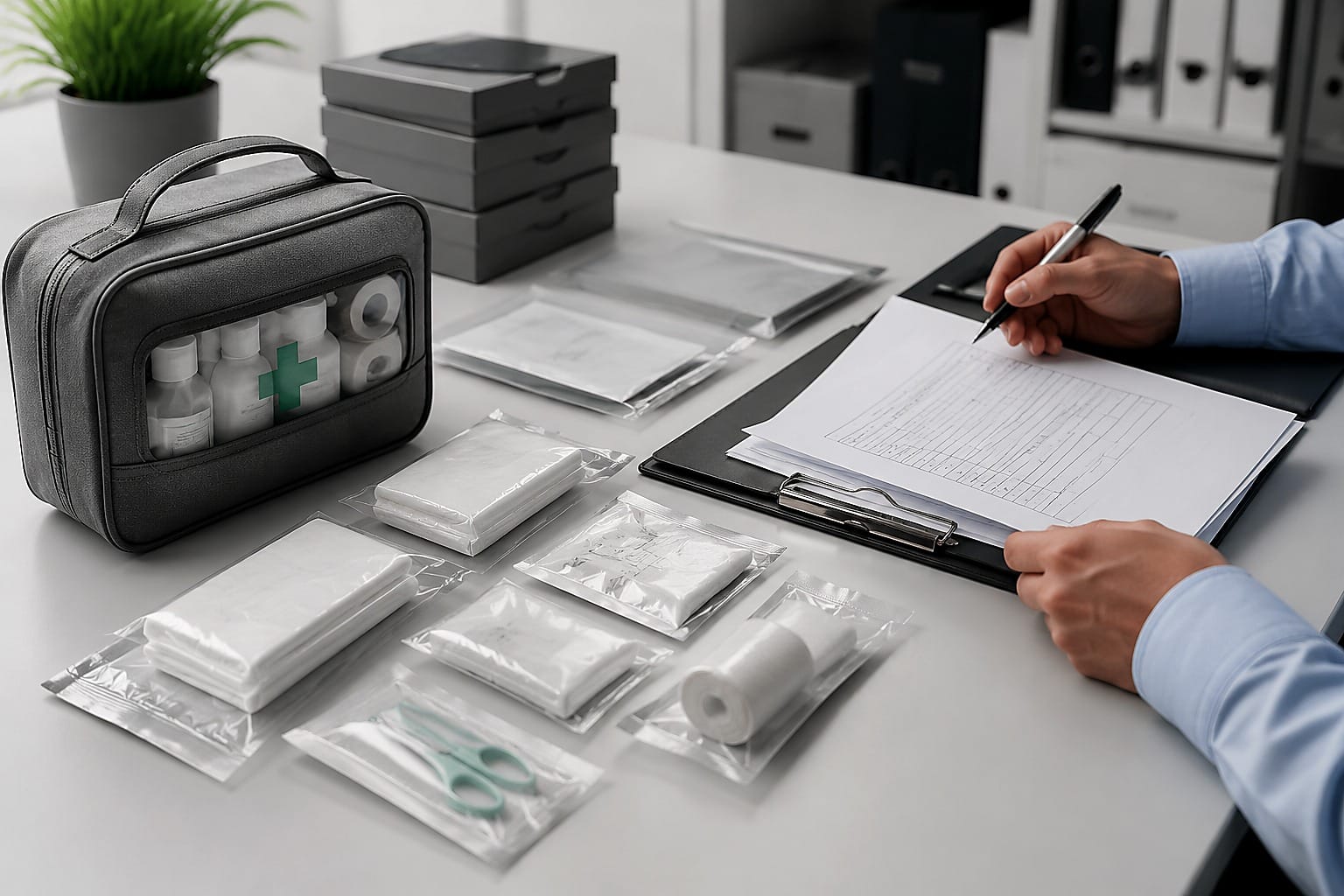
A compliance file is a structured index of conclusions and supporting records. It should show what evidence was requested, received, reviewed, accepted, rejected, or left open. The file should also identify the reviewer and review date.
| Evidence layer | Core buyer record | Scope question | Typical control |
|---|---|---|---|
| Product identity | SKU, model, description, intended purpose and claims | Does the file name the ordered product? | Match product code, photo, specification and label |
| Market status | Classification and market-route conclusion | Which law and destination apply? | Record authority source, rationale and reviewer |
| Economic operators | Manufacturer, importer, sponsor, representative or distributor | Who holds each role for this shipment? | Verify legal names, addresses and mandates |
| Registration or listing | Device, establishment or sponsor record where required | Is the product and operator in scope? | Check current authority record and identifiers |
| Technical evidence | Declaration, test report, assessment or technical record | What model, material, site and standard are covered? | Review scope, revision, issuer and validity |
| Labeling | Unit label, package label, instructions and language files | Does the released artwork match the destination? | Approve controlled artwork and sample |
| Quality and traceability | Quality-system evidence, lot controls and change records | Can the supplied batch be linked to approved records? | Capture lot, date, supplier and revision |
| Shipment evidence | Invoice, packing list, origin and transport records | Do commercial records match the approved identity? | Reconcile quantities, codes and operator names |
Not every row applies to every item. A buyer should mark a field as not applicable only after documenting the reason. Blank cells hide uncertainty and make later reviews difficult.
The document index should use exact file names and revisions. “Test report received” is too broad. A stronger entry records the report number, issuer, issue date, model, material, tested standard, pages reviewed, conclusion, and unresolved limitations.
How do major destination markets allocate responsibilities?
The same commercial participant can have different legal duties across markets. Titles such as supplier, exporter, importer, distributor, sponsor, and representative are not interchangeable. The contract should reflect the actual route used for the shipment.
In the European Union, Regulation (EU) 2017/745 assigns duties to manufacturers, authorised representatives, importers, and distributors. Article 13 requires importers to verify specified matters before placing a device on the market. Article 14 defines distributor verification duties. Buyers should consult the official EU Medical Device Regulation and current guidance for the product and role involved.
In the United States, establishment registration and device listing are separate from premarket authorization. They do not by themselves show that a device has been reviewed or cleared. The FDA explains the distinction on its Device Registration and Listing page. Importers should also verify labeling, quality-system, premarket, and reporting obligations that apply to the device.
In Great Britain, many medical devices must be registered with the MHRA before being placed on the market. Overseas manufacturers may need a UK Responsible Person. The MHRA registration guidance describes the current process and the information that must be kept up to date.
In Australia, the sponsor is generally responsible for the device’s market inclusion route and ongoing obligations. The TGA describes the medical device inclusion process, including application and evidence steps. The manufacturer’s evidence and the sponsor’s ARTG entry must be checked against the actual device and intended purpose.
Canada separates medical device licences and medical device establishment licences according to device class and activity. The binding requirements are set out in the Medical Devices Regulations. Buyers should confirm the class, licence route, establishment duties, labeling, and importer or distributor activities for each SKU.
These examples show why first aid product compliance documents cannot be copied from one destination-market folder into another without review.
How should buyers verify document scope?
Document review is a matching exercise. A file is useful only when its scope can be connected to the ordered product and responsible organization. A professional-looking PDF with no clear connection to the SKU should remain unresolved.
Check at least these scope fields:
- Legal holder name and address.
- Manufacturer and manufacturing site, when the document is site-specific.
- Product family, model, catalogue number, or other identifier.
- Intended purpose and claims.
- Materials, dimensions, variants, or configuration limitations.
- Destination market and regulatory framework.
- Standard edition, test method, or assessment route.
- Issuer, report number, issue date, expiry date, and current status.
- Annexes, schedules, or model lists referenced by the main document.
- Changes since the document was issued.
Verify issuer records through the relevant authority, notified body, certification body, laboratory, or database when an official verification route exists. Do not rely only on a screenshot supplied by the seller. Save the verification date, query, result, and reviewer.
A declaration should be read together with its referenced product list and legislation. A test report should be read together with the tested sample description. A quality-system certificate should be read for the certified entity, site, activities, exclusions, and dates. None of these records automatically replaces product registration, labeling review, or technical evidence required by the destination.
What labeling evidence should an importer retain?
Labeling is part of the released product, not a design task that ends when artwork looks acceptable. Retain the approved unit label, immediate package, sales package, instructions, insert, barcode file, and master-carton marks as applicable.
The review should compare label content with the approved product identity and market route. Common fields include the product name, model, manufacturer, responsible local operator, lot or serial information, date fields, storage conditions, warnings, symbols, language, quantity, and traceability identifiers. The required fields vary by product and destination.
For the United States, the FDA’s general device labeling requirements provide an official starting point. Other rules may apply to specific device types, unique device identification, or promotional claims. A buyer should not assume that a generic template is complete for every SKU.
Use a controlled artwork approval process:
- Link every artwork file to a SKU and revision.
- Identify the destination and language set.
- Separate supplier-provided facts from buyer marketing claims.
- Record the regulatory reviewer and approval date.
- Compare a physical sample with the released file.
- Block production when an unapproved change appears.
For private-label projects, the OEM private-label first aid kit guide explains how artwork, BOM, sample, and bulk revisions should remain synchronized.
How should mixed first aid kits be documented?
A mixed kit needs a product-level pack record and a component-level evidence map. The pack record identifies the container, complete BOM, assembly revision, label route, quantity, and responsible parties. The component map links each BOM line to its SKU, manufacturer, status conclusion, evidence, label, lot rule, and approved substitution status.
| Kit control | Record to retain | Failure the record prevents |
|---|---|---|
| Frozen BOM | Line number, SKU, quantity and revision | Silent component substitution |
| Component identity | Manufacturer, model, size and pack unit | Documents matched to the wrong item |
| Regulatory mapping | Destination, classification and role conclusion | One status assumed for the complete kit |
| Label set | Component, kit and carton artwork revisions | Old or conflicting operator details |
| Shelf-life rule | Component dates and kit-level rule | A short-dated component hidden in the kit |
| Assembly traceability | Assembly lot linked to component lots | Inability to investigate a batch issue |
| Change record | Reason, impact, evidence and approver | Unreviewed material or supplier change |
The kit’s total piece count is not enough. Two kits with the same count can use different component sizes, materials, manufacturers, expiry profiles, and evidence. Approval should follow the BOM revision and packed reference sample.
The emergency first aid kits and bags sourcing guide provides the related framework for use case, container choice, layout, refill planning, and sample inspection.
What should be requested in an RFQ document schedule?
Add a document schedule to the RFQ instead of requesting “all certificates.” The schedule should identify the file, scope, stage, format, and acceptance owner. This helps the supplier distinguish records needed for quotation, sample approval, production release, and shipment.
| RFQ stage | Document request | Buyer decision supported |
|---|---|---|
| Supplier screening | Legal entity, role, site scope and quality evidence | Can the organization support the proposed route? |
| Quotation | SKU register, status statement, available evidence index and deviations | Is the offer suitable for detailed review? |
| Sample | Specification, BOM, labels, evidence files and sample identity | Does the physical sample match the proposed records? |
| Production release | Approved revisions, open-item closure and change-control rule | Is the order authorized on a controlled basis? |
| Pre-shipment | Batch or lot data, inspection, packing and shipment documents | Does the shipment match the approved order? |
| Repeat order | Delta statement for product, supplier, site, labels and evidence | What changed since the previous approval? |
The B2B first aid procurement guide shows how this schedule fits with specifications, normalized quotations, samples, inspection, and repeat-order controls.
Define acceptance criteria before files arrive. For example, state that model lists must include the quoted SKU, scanned text must be readable, translations must be controlled, and expired records will not be accepted without a documented current route. The buyer should also identify which open items stop the order and which may be closed before production or shipment.
How should document changes and expiry be controlled?
Compliance review is not a one-time upload. Products, suppliers, sites, labels, standards, laws, registrations, and evidence can change. Build a renewal and change process around the first aid product compliance documents index.
Use three triggers:
- Time trigger: review records with expiry dates, renewal dates, or periodic verification needs.
- Change trigger: review a new material, model, site, manufacturer, claim, label, packaging route, or destination.
- Event trigger: review complaints, recalls, authority notices, test failures, shipping holds, or supplier ownership changes.
Each change notice should identify the original revision, proposed revision, affected SKU and quantity, reason, compliance impact, evidence needed, and approver. An email saying “same quality” is not a scope assessment.
Keep superseded files in an archive with clear status. Do not delete the record that supported an earlier shipment. The archive should show which version was active for each purchase order, production batch, and shipment.
A practical importer review workflow
The complete workflow can be managed through eight gates:
- Identity gate: lock the buyer code, supplier SKU, intended purpose, claims, destination, and pack route.
- Status gate: record the classification and market-route conclusion with authority sources.
- Role gate: name the manufacturer, importer, sponsor, representative, and distributor as applicable.
- Evidence gate: map every required file to the exact SKU, site, model, and market.
- Label gate: approve destination-specific unit, package, instruction, and carton files.
- Sample gate: compare the physical sample, BOM, artwork, and documents.
- Shipment gate: reconcile lots, quantities, packing, and commercial records with the approved revisions.
- Continuity gate: monitor expiry, changes, authority updates, and repeat-order deltas.
Assign an owner and dated decision to each gate. The owner may be in regulatory, quality, procurement, logistics, or local market operations. What matters is that the conclusion is visible and traceable.
This workflow turns first aid product compliance documents from a passive folder into a controlled procurement record. It also gives suppliers a clearer request and helps reviewers focus on real scope gaps.
FAQ about first aid product compliance documents
Is a CE mark enough for an importer to approve a first aid product?
No single mark should replace the importer review. For a product within the EU MDR, the importer must verify matters assigned to that role, and the applicable conformity route depends on the device and classification. Review the declaration, product identity, manufacturer, authorised representative where applicable, labeling, registration details, and supporting evidence. Also confirm that the ordered SKU and current revision are within scope.
Does FDA establishment registration mean a device is approved?
No. The FDA states that registration and listing do not denote approval, clearance, or authorization. They are separate regulatory requirements. A buyer must identify the device’s applicable premarket route, exemptions, labeling duties, quality-system requirements, and importer obligations. Save the current listing or registration verification as one record within the larger first aid product compliance documents file, not as the sole acceptance basis.
Can one document set cover every component in a first aid kit?
Only when the scope can be demonstrated for every relevant component, which is uncommon for a mixed assortment. Each BOM line may have a different manufacturer, status, model list, label, shelf-life rule, and evidence route. Build a component matrix and link each file to the covered SKU. Then keep a separate kit-level record for the container, complete BOM, assembly, kit label, and traceability.
How often should importers recheck compliance records?
There is no universal interval for every record. Use expiry and renewal dates, repeat-order timing, destination-market requirements, supplier risk, and product changes to set the review schedule. Recheck immediately after a material, manufacturer, site, model, claim, label, or legal-role change. Authority notices, complaints, recalls, and verification failures should also trigger a documented review before further supply decisions.
What should a buyer do when a supplier cannot provide a requested file?
Record the missing item, the reason given, the affected SKU, the required decision stage, and the risk owner. Confirm whether the file is legally required, commercially requested, or one possible form of evidence. Ask for a valid alternative only when a qualified reviewer accepts the equivalence. If the gap affects market access, product identity, labeling, or shipment release, keep the order blocked until the responsible reviewer closes it.
First aid product compliance documents checklist
Before approving a sample or order, confirm that the file shows:
- The exact SKU, model, manufacturer, destination, intended purpose, and claims.
- The applicable product status, classification, and market route.
- The legal entity performing each relevant economic-operator role.
- Registration, listing, licence, or inclusion evidence where applicable.
- Technical and quality evidence whose scope matches the ordered item.
- Approved labels, languages, instructions, and packaging revisions.
- A component-level map for mixed kits and a frozen BOM revision.
- Lot, shelf-life, assembly, inspection, and shipment traceability controls.
- Open gaps, reviewer decisions, dates, and renewal triggers.
- A change process for repeat orders and superseded files.
UneedAid supports international B2B buyers with specification, sample, packaging, and document coordination for first aid sourcing projects. Available files and routes depend on the product, customization, destination, and order structure. Send the destination markets, provisional SKU or BOM list, quantities, private-label scope, and required evidence fields in the RFQ so feasibility can be reviewed before production planning.