
A supplier sends eleven scanned PDFs in one folder and calls it the compliance pack. Two are certificates for a management system, three are test reports without a product name on them, one is a declaration signed by a trading company rather than a manufacturer, and the rest are unclear. A first aid supplier compliance checklist exists to prevent that folder, because it names each document before anything is sent.
The checklist does not judge whether a supplier is compliant. It does something narrower and more useful: it pairs every document with the question that document can answer, and with the register or issuer that can confirm it. A document that cannot be confirmed is not evidence. It is a file.
What a first aid supplier compliance checklist is, and what it is not
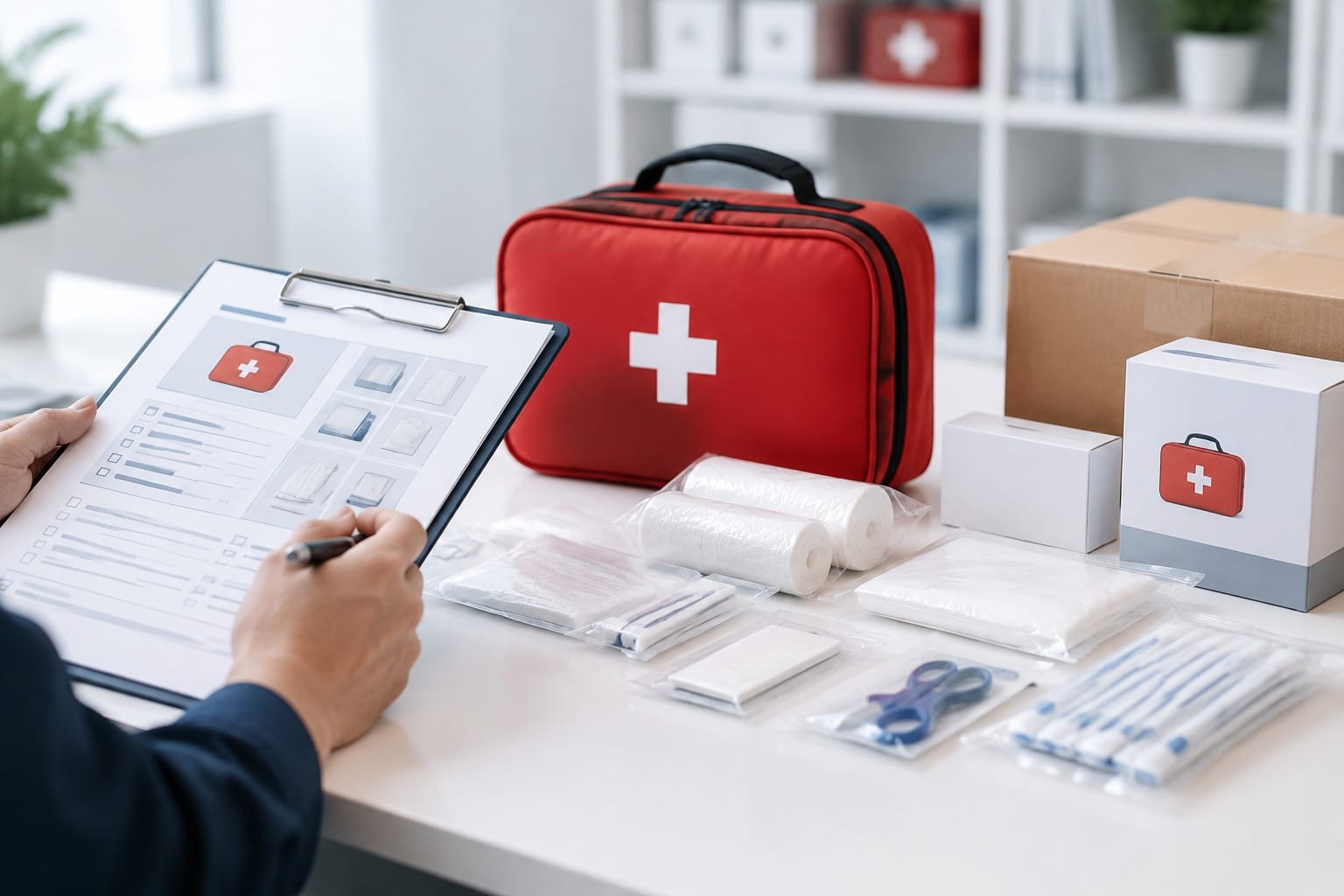
Three clarifications prevent the most common uses of a checklist going wrong.
- It records declarations, not conclusions. Every row asks a supplier to state something in writing and to attach the paper that supports it. Whether that statement holds for your destination market is a separate question answered by that market’s authority.
- It is scoped to a product and a site, not to a company. A document that names the wrong legal entity, the wrong production site, or a product family your order does not sit in does not cover the order, however current it looks.
- It has a verification step attached to every row. Without one, the checklist is a collection exercise. With one, it becomes a control.
The order of those three points matters. Buyers who start with the third and skip the second collect impressive paperwork that later turns out to describe a different factory.
Three evidence classes, and the question each one answers

Every document on a first aid supplier compliance checklist belongs to one of three classes. The class tells you the reach of the document, which is usually where a supplier folder overstates its case.
| Class | Scope | Typical documents | The question it can answer |
|---|---|---|---|
| System | The organisation and its processes | Quality management system certificate with scope and site, audit report naming its issuer | Can this organisation control a production process to a written standard |
| Product | One device family or model | Declaration of conformity, test reports per standard, risk-management file summary, label and instructions, UDI assignment | Does this product meet the named requirements, as declared by the responsible party |
| Transaction | One order or one production lot | Batch record or certificate of analysis, sterility release document, certificate of origin, pre-shipment inspection report | Does this specific shipment match what was ordered |
The classes are not interchangeable, and that is the point. A system document never proves a product’s status, and a transaction document never proves a system. A folder that answers all three classes is a folder that has covered the ground.
Why one class cannot stand in for another
The most repeated substitution in supplier folders is a management-system certificate offered as evidence about a product. It is worth stating plainly what that document does and does not do.
A quality-management certificate describes how an organisation runs its processes. It says nothing about whether a particular kit, dressing or bag meets the requirements that apply where you intend to sell it. The procurement guidance published by the Swiss medical devices authority puts the distinction directly: certificates that relate to standards are not EU certificates and do not prove that a medical device is compliant. That sentence is the reason a first aid supplier compliance checklist keeps the system class and the product class on separate rows.
Product-level declarations carry their own limit. A declaration of conformity is the responsible party’s own statement. It is meaningful because it is signed and because it names the requirements it claims to meet, and it is checkable because the requirements it names can be read. It is not a third-party verdict.
Where each document can actually be confirmed
The verification column is what turns the checklist into a control. Each row names who can confirm the document, and what the confirmation looks like in practice.
| Row | Who can confirm it | What the check looks like |
|---|---|---|
| System certificate | The certification body, or the register it publishes | Confirm the certificate number, the legal entity, the site, the scope and the validity dates directly with the issuer |
| Notified body involvement | The European Commission’s NANDO information system | Search the four-digit number that appears after the CE mark; check that the notification is active and that its legislation tab lists the regulation named on the certificate |
| Certificate and device registration in the EU | EUDAMED | Look up the economic operator, the device and the certificate record; check the certificate’s status rather than its existence |
| Declarations and test reports | The party that signed, plus the standard named inside | Read the producing site and the covered product family against your order, not just the title page |
| Batch and release documents | The manufacturer, at shipment | Match the lot or batch identifier to the identifier on the goods and on the packing list |
Two habits make the third column work. Ask for the scope page as well as the cover page, because scope is where the limits live. And contact the issuer using the contact details you looked up yourself rather than the ones printed on the copy you were sent. The European Commission’s overview of the EUDAMED database explains which modules are open and what a buyer can look up directly, and the NANDO database is the register to search when a certificate names a notified body.
Scope is where a document quietly fails
A certificate can cover every device a manufacturer makes, a single device family, or a single batch of one product. Buyers who only read the title page routinely assume the widest reading. The Swissmedic procurement guidance makes the same note about the range a certificate may cover, and it is the reason the checklist needs a scope line rather than a checkbox.
Four fields do most of that work:
- Legal entity. The name on the certificate has to match the party that will appear on the commercial invoice. A trading company’s name on a contract and a different manufacturer’s name on a certificate is normal, but the relationship between them has to be in writing.
- Site. Manufacturing address, not registered office. A certificate can cover one site and not the site that will produce your order.
- Product family or code. The closest thing to a scope check that a buyer can perform on a desk.
- Validity window. An expiry date on the document, plus a note on whether the certificate was issued under a regulation that is still the operative one.
Add a fifth row for anything the supplier declines to answer, so disagreement is recorded rather than smoothed over.
Bid-stage files and shipment-stage files are two lists
A single list creates a predictable problem: documents that cannot exist at bid stage get requested at bid stage, and the answers arrive vague. Split the checklist into two stages and the responses get sharper.
| Stage | Rows to request |
|---|---|
| Bid stage | System certificate with scope, product declaration, test reports mapped to the offered model, label and instructions set, registration or listing evidence where the market requires it, manufacturer authorisation for the party quoting |
| Shipment stage | Batch or lot record, release document, inspection report, packing documentation, certificate of origin, and any legalisation or market-specific document named in the contract |
State the split in the RFQ itself. Suppliers answer a two-stage list more completely than a single long one, because no row is asking for a document that cannot exist yet. The document structure used in the RFQ template for first aid supplies follows the same two-stage logic, with the compliance column carrying the supplier’s own exceptional status against each row.
What a first aid supplier compliance checklist cannot settle
A checklist is a buyer-side control, and its limits should be written into it. It cannot decide which regulatory route applies to your product in your market, because that route is set by the market authority and depends on the product’s classification rather than on the documents a supplier holds. For the European Union, that classification question sits with the framework the European Commission describes for medical devices, and the obligations that fall on each party in the supply chain follow from it.
For kit orders, one row deserves its own entry, because a single component can change the declaration, as explained in this [restricted items first aid kit export guide](https://uneedaid.com/restricted-items-first-aid-kits-export/).
It cannot move responsibility either. Where an order crosses a border, duties and obligations are assigned to the actors in the chain — manufacturer, authorised representative, importer, distributor — and each of them carries its own record-keeping and verification duties. A buyer who wants the underlying structure can follow the technical file responsibilities held by importers.
Destination markets outside the EU have their own frameworks. The United States quality system expectations for devices are set out in 21 CFR Part 820, which a buyer or a US-based partner reads directly rather than through a supplier summary.
The correct conclusion from a completed checklist is modest and specific: for this order, this scope, these documents were requested, these were confirmed at source, and these remain declared but unconfirmed. Record it that way in the purchase file, because that record is what makes the next order faster.
FAQ
Which documents should be requested first?
Start with the two that scope everything else: the system certificate with its scope page, and the product-level declaration. Those two establish who is responsible and which product family the file covers. Only then request the supporting test reports, because a test report is only useful once you know which model and which production site it belongs to. A first aid supplier compliance checklist built in that order avoids re-requesting the same files twice.
Is a quality management certificate enough on its own?
No, and the distinction is worth keeping sharp. A management-system certificate describes how an organisation runs its processes; it does not describe a product’s status in any market. Even a current certificate for the correct site leaves the product question open. The first aid supplier compliance checklist handles this by keeping system rows and product rows separate, so a supplier cannot answer the product column with a system document.
How do I check the scope of a certificate?
Read four fields: the legal entity, the manufacturing site, the product family or code, and the validity window. Compare the entity to the party that will appear on your invoice, and the site to the location that will produce the order. If the document lists covered devices, check whether your model appears. Where a certificate covers a batch rather than a family, that is a narrower reading than most buyers assume, and it should be recorded as such.
Can a supplier send the certificates later, after pricing?
Bid-stage rows exist so that pricing decisions are not made blind, so a partial answer at bid stage is acceptable only if the supplier names which rows it is deferring and why. A supplier that defers product-level documents but returns the system and commercial rows still gives you something to compare. Deferring everything until after a purchase order removes the checklist’s purpose, because the row that would have changed the decision arrives too late.
What should the checklist record when a document is missing?
Record it as unanswered rather than as absent. The two are different facts and they lead to different actions: unanswered means the supplier was asked and did not reply, while absent means the document does not exist for that scope. Keep the status per row, keep the date of each confirmation, and re-check the rows that depend on a site, an owner or a component when any of those changes.
Closing
A first aid supplier compliance checklist is worth keeping as a standing document rather than rebuilding it per order. The rows stay, the answers change, and the confirmation dates tell you which rows have gone stale.
The surrounding documents are already covered elsewhere. For the lines that make supplier quotes comparable before any file is exchanged, the emergency first aid kit RFQ checklist sets out the eight that matter. For the buying process the checklist sits inside, from brief to release, the B2B first aid procurement guide places document control at the qualification gate. Where several suppliers are being considered at once, comparing them on verifiable evidence sorts declarations by what can be confirmed.
Public buyers commonly request the same document set, but under a formal notice the submission date is the test rather than the award date, so a current copy has to exist before the window closes. The public sector tender process for first aid products sets out how this checklist overlaps with a tender document gate.