

A site office holds one kit. A steel-fixing crew works the north end of the plot until two in the morning, and the subcontractor list is rewritten every Monday. That kit passes its paperwork and still fails the site, because the night crew cannot reach it inside the minutes that matter.
A construction site first aid kit is a provisioning decision before it is a contents decision. Four questions get answered in order, and each one constrains the next:
- How many kits does this site need, and where does each one live?
- Which container format holds each of them?
- How are the contents sized to the work being done?
- Who keeps each kit complete between jobs?
Buyers who start at question three buy the container set twice. The B2B guide to emergency kits and bags covers the product range itself. This article is about the sequence a distributor or a main contractor works through before an order is placed.
What the rule requires, and what it leaves open
Construction work in the United States falls under 29 CFR 1926.50, which is a short regulation and unusually specific about two things.
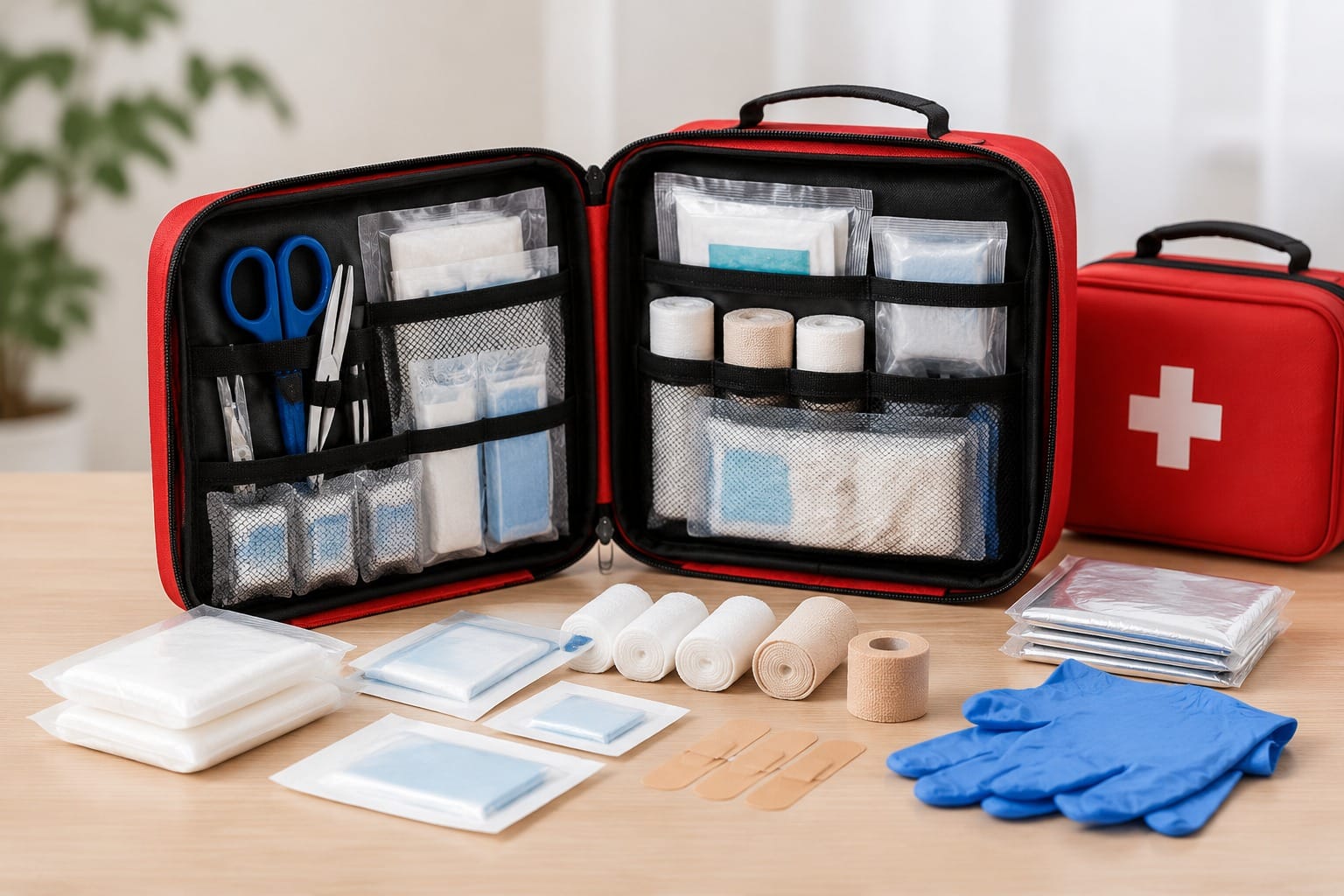
The first is the container. Paragraph (d)(2) requires the contents to sit in a weatherproof container with individual sealed packages for each type of item, and requires the employer to check the kit before it is sent out on each job and at least weekly on each job. The second is access. Paragraph (d)(1) requires first aid supplies to be easily accessible when required, and paragraph (c) puts a trained first aider on site only where no infirmary, clinic, hospital or physician is reasonably accessible in terms of time and distance.
Read those side by side and the split becomes clear. The regulation fixes the packaging standard and the checking rhythm. It does not fix how many kits a site needs, where they sit, or what goes in them beyond a baseline.
That gap is not an oversight. Appendix A to the section points to an American National Standard, ANSI Z308.1, as an example of minimum contents for a generic kit, then says the listed contents should be adequate for small work sites. For larger operations, or several operations running at the same location, it directs the employer to decide whether more kits are needed, whether additional types of equipment and supplies are needed, and whether the quantities inside them need to increase. The general industry counterpart, 29 CFR 1910.151, repeats the same structure.
Two more paragraphs are easy to miss and expensive to retrofit. Paragraph (g) requires suitable facilities for quick drenching or flushing of the eyes and body within the work area wherever people may be exposed to injurious corrosive materials. Paragraph (e) requires either transport equipment or a communication system for reaching an ambulance service.
Jurisdictions outside the United States set the same duty in different words. In the UK the employer obligation sits in regulation 3 of the Health and Safety (First-Aid) Regulations 1981, which requires provision that is adequate and appropriate in the circumstances. Nothing in it names a kit count either.
What this means commercially: a supplier can build to a published baseline, but the number of kits, the container format and the checking routine come from the buyer’s own site assessment. Confirming that a specification satisfies a particular destination market also stays with the buyer and its advisers. UneedAid supplies documentation by SKU and coordinates the export file set; it does not rule on another market’s requirement.
Sizing a construction site first aid kit: distance and shift pattern, not headcount
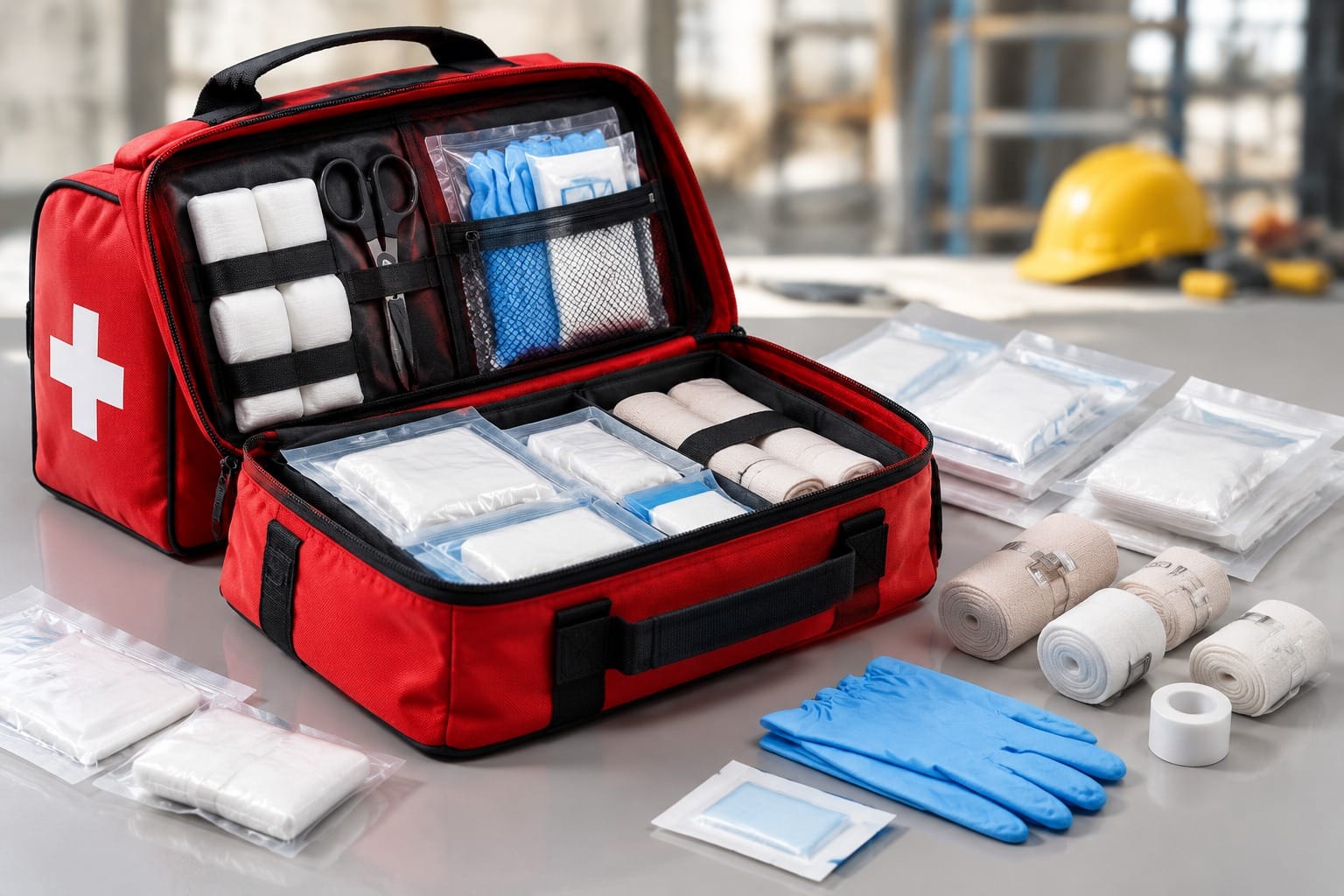
The instinct is to divide the workforce by a number and order that many kits. On a construction site that produces the wrong answer in both directions, and the reason is that a site is not one place for fourteen hours.
Four variables move the count, and none of them is total headcount.
Distance from the fixed point. A site office next to the welfare unit and the parking area is one location. A twenty-hectare plot with an active excavation, a Tower crane exclusion zone and a materials yard is five, even with the same crew count.
Shift and work-front spread. Day shift and night shift rarely occupy the same ground. If the kit lives where the day shift works, the night shift is provisioning from zero. This is the most common single failure in larger projects.
Subcontractor churn. A main contractor’s own crew is stable and knows the site. The trades arriving on rotation do not, and they will not ask. Kits need to be visible and self-explanatory at the point of work, not stored somewhere the new crew has to be told about.
Restricted-reach areas. Scaffold, formwork decks, deep trenches, confined spaces and top-of-structure work all raise the time to reach a kit even when the site is small in area.
A working provision map splits locations into four bands.
| Band | Typical locations | What the kit has to do | Usual format |
|---|---|---|---|
| Fixed welfare | Site office, welfare unit, canteen, first aid room | Hold the fullest list, be visible and signed, be checked on a fixed routine | Wall-mounted box or case-style box |
| Fixed work point | Temporary power stations, plant yards, lifting points, formwork decks | Sit at the risk rather than at the office | Wall-mounted box |
| Mobile with the crew | Walking supervisor, trade crew, hot works permit area | Travel with a named person for the whole shift | Hand-carry bag or compact backpack |
| Vehicle and remote | Site vehicles, security patrols, remote plant | Stay in the vehicle, survive weather and vibration | Case or secured box |
The mobile band is where projects under-buy most often. A portable kit that lives in the site office is not a portable kit. It is a second office kit with a handle.
Container format follows the work front
Once the map exists, format stops being a preference question. It becomes a question about whether the kit stays or travels.
| Format | Where it belongs | What decides it |
|---|---|---|
| Wall-mounted box | Fixed work points, welfare walls, plant rooms | A mounting surface, a fixed location, a weekly visual check |
| Case-style box | Site office, welfare unit, first aid room | Volume, shelf storage, a full contents list held in order |
| Hand-carry bag | Supervisor, trade crew, hot works area | Weight when loaded, one-hand opening, a readable contents card |
| Secured case in a vehicle | Site vehicles, patrols, remote plant | Weather, vibration, presence and condition at each check |
A wall-mounted emergency box earns its place where the kit is never meant to move. It survives being knocked, it holds a full list without the contents migrating, and it can be mounted where a person will actually see it. A kit that has to be found in a hurry by someone who has never opened it should look like what it is.
A case-style supply box suits the welfare unit, where volume matters more than mounting and the box is opened on a bench rather than from a wall.
A hand-carry bag covers the walking supervisor, who is the only person on some sites who is reliably everywhere. The three tests for that bag are the same ones that apply to portable and fixed kit formats in general: loaded weight, opening with cold hands, and whether the contents card can be read in daylight without unpacking it.
Sites with several bands usually end up buying from a single bag and box range, because compatible contents cards across formats are what make a central restock routine possible at all.
Why the weekly check shapes the construction site first aid kit
Paragraph (d)(2) is usually read as a packaging rule. Operationally it is a maintenance rule, and it changes the kit design more than any other line in the section.
Two obligations sit inside it: the kit is checked before being sent out on each job, and at least weekly on each job. A site running three jobs in a week with kits moving between them is checking constantly. Any kit design that turns a check into inventory counting will be skipped, and a skipped check is how a kit ends up passing its paperwork while missing its contents.
The consequence is that a construction kit should be built so its check is a visual scan.
Individual sealed packages for each type of item are what make that possible. A missing item leaves an empty slot that can be seen from the door. A kit with loose items inside an open box cannot be assessed without emptying it, so the check takes minutes rather than seconds, and it gets deferred to the end of the shift, where it does not happen.
A sealed package that has been opened is also the signal that the kit was used at all. Projects that rely on the user reporting a used item lose that report the moment the shift ends badly. Relying on the packaging to carry the signal removes the dependency on anyone remembering.
Three mechanisms keep the routine alive, and a site should name which one applies before the first box is mounted.
- A restock pack matched to each kit code. When an item is used, the replacement is a pre-made pack rather than a judgement call. This removes the step where someone has to work out what was in the slot.
- A check attached to something already scheduled. Lifting inspections, plant servicing and scaffold handovers already have a calendar entry and a named owner. A kit check riding on an existing routine survives a change of supervisor; a standalone one usually does not.
- A written substitution rule. At a repeat order, an item that is unavailable will be swapped unless the rule says otherwise. Agreeing that components stay identical across orders, and recording any approved change, is what stops a later audit finding that two hundred kits no longer match their own specification. The same discipline sits behind keeping repeat kit orders consistent over time on the supply side.
Sizing an order without wasting shelf life
Construction orders look large and are structurally awkward, because the total quantity is high while each line is small and the site is temporary.
An order for a five-location site is not one order for five kits. It is three lines that behave differently.
- Containers, one per mapped location, plus a few held as direct replacements for units damaged on site.
- Consumables, split by band. A welfare kit consumes steadily across a project. A crew bag consumes in bursts and mostly needs resealing and restocking after each incident.
- Short-life spares, held centrally so a used item is replaced the same week rather than at the next audit.
The split matters more than the total, because the three lines re-order on different intervals. A project that buys everything in one movement ends up with a shelf of items expiring together, which converts a stock purchase into a disposal event on a site that is about to be demobilised anyway.
Our kit programmes start at 1,000 pieces, and the tier structure means a consolidated multi-site order generally lands in a different bracket from a series of small top-ups. Consolidation is not free, because consumables age whether or not a site is open, and a project with a twelve-month programme and a three-month mobilisation should not buy both ends of it at once. The MOQ and quantity tier framework sets out how a supplier divides those tiers; the site-side decision is how many of them are worth taking.
Sample-based validation belongs inside that arithmetic rather than after it. Our standard practice is to validate a sample before bulk production, and for a construction order that is where the map gets tested against reality: whether the mounted box clears the container wall it will sit on, whether the bracket holds on a temporary surface, whether the contents card is legible from the distance a person stands when they are in a hurry. A format picked from a catalogue image is the most reliable way to buy a second set of containers in the same year.
The frozen list and the compounding kit
Two failure patterns repeat across construction projects, and both are visible before the order is placed.
The first is the frozen list. A kit specification gets signed off at mobilisation and never revisited, while the work moves from groundworks to steel erection to fit-out. Groundworks and fit-out carry different exposure: the first raises the value of eye protection and flushing provision, the second raises the volume of small wound items and dressings consumed per week. Appendix A points at exactly this by directing the employer to assess specific needs periodically and augment the kit accordingly, and it names incident logs and local emergency services as inputs to that assessment. On a construction site the equivalent inputs are the accident book, the near-miss log and the permit-to-work register.
The second is the compounding kit. Kits from other jurisdictions arrive with a contents list, and teams add to them rather than replace them. Eighteen months later the kit holds three generations of specification with no version control. The fix is administrative rather than physical: one contents list per kit code, one provision map per site, and a record of any approved substitution. That file travels intact between head office, a new site manager and an inspector.
The RFQ checklist for kit orders is the practical place to lock both patterns down before a supplier quotes. The workplace kit configuration checklist covers the general case of building a list to a requirement, and fleet and vehicle kit planning covers the mobile end that a construction map depends on. A provision map that is written down is the only version that survives a change of supervisor.
FAQ
How many construction site first aid kits does one site need?
Construction site first aid kit counts do not follow a headcount formula, and any supplier quoting one is guessing. Anchor the number to reachable locations instead: at least one kit in the welfare area, one at each fixed high-risk work point, one travelling with each crew that works away from the welfare area, and one in each site vehicle. Then test the result against two questions. Can a person at the far end of the site reach a kit within the minutes that matter on the shift they actually work? And does the night shift inherit a kit or start the shift without one? A twenty-hectare plot and a compact fit-out site with identical crew numbers rarely need the same answer.
What has to be in a construction site first aid kit?
Start from the baseline that applies to the destination market, then adjust for the work. Under the United States construction standard, first aid supplies must be easily accessible when required and the kit contents must sit in a weatherproof container with individual sealed packages for each type of item. The section’s Appendix A points to ANSI Z308.1 as an example of minimum contents for a generic kit, and says the listed contents should suit small work sites. Beyond that, the exposure on site decides the additions: where eyes or body may meet injurious corrosive materials, quick drenching or flushing provision is required within the work area.
How often must a construction site first aid kit be checked?
Under the United States construction standard, the kit is checked before being sent out on each job and at least weekly on each job, so that used items are replaced. That is a floor rather than a routine. A site running several jobs a week with kits moving between them is effectively checking before every movement. The practical target is a check that takes seconds: a kit built with sealed individual packages per item type can be assessed by looking for empty slots, while a kit with loose contents has to be emptied and recounted, which is the check that gets postponed.
Does a construction site need a trained first aider on site?
The United States construction standard requires a person on site with a valid first aid training certificate only in the absence of an infirmary, clinic, hospital or physician that is reasonably accessible in terms of time and distance to the worksite. That is a conditional requirement, not a universal one, and it turns on geography rather than headcount. Where the condition is met, the training must be verifiable by documentary evidence. The equipment obligation is separate and unconditional: it applies regardless of whether a trained person is on site, so a project cannot reason its way out of a kit by pointing at a nearby clinic.
When does a construction site need eyewash or drenching facilities?
The requirement attaches to exposure rather than to industry. Where the eyes or body of any person may be exposed to injurious corrosive materials, suitable facilities for quick drenching or flushing have to be provided within the work area for immediate use. On a construction site that usually means concrete admixtures and additives, formwork release agents, and the corrosive materials stored or decanted where they are used. Placement is the part sites get wrong: facilities that sit in the welfare unit are not within the work area. The practical question is whether a person who is splashed at the point of work can reach flushing provision without crossing the site.
What container should a construction site first aid kit use?
The container requirement is explicit for the United States construction sector: a weatherproof container with individual sealed packages for each type of item. Above that, format follows the provision band. A fixed work point needs a mounted, sealed box that survives being knocked. The welfare unit needs volume and shelf stability. A crew bag needs loaded weight, one-hand opening and a legible contents card. The three formats should share one contents list, because a site that restocks from a central point needs the cards to match across every format it holds.
Where construction provisioning sits in the wider programme
A construction site first aid kit answers a question that is really about the site, not about the kit. The regulation fixes the container, the packaging and the checking rhythm. Everything else comes from the provision map, the shift pattern and the work being done.
The order is fixed. Map the locations, choose a format per band, size the contents to the work, then decide how the site stays complete. Projects that work in that sequence tend to buy once and restock by pack. Projects that start at the contents list buy a container set, discover that the night crew cannot reach it, and buy again.
Fixed industrial buildings answer the same access question on a permanent floorplate, as covered in warehouse and logistics site first aid coverage.