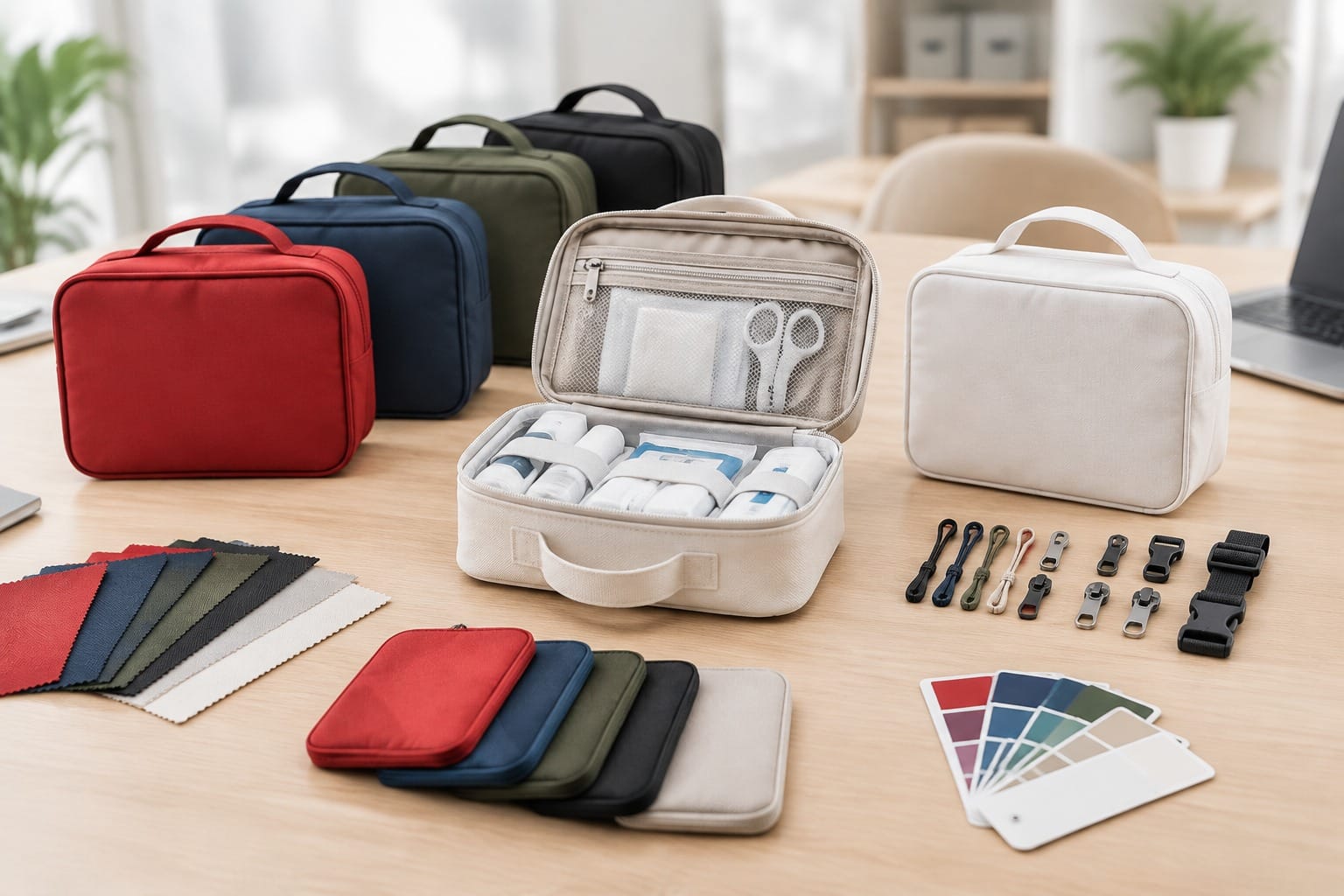
A carton arrives with the brand colour slightly off, the barcode sitting close to a fold, and a safety sentence half covered by a varnish band. Nothing is visibly broken, yet the shipment cannot go to the shelf. Custom first aid packaging printing is where private-label projects quietly lose time, because print is usually quoted as a single line while it actually depends on several separate decisions.
The short answer is to handle print as a controlled document rather than a request. Name the substrate and its finish, the print system, the colour reference, the dieline revision, the finished size and position of every element, the tolerance you will measure, and the sample that defines acceptance. Fix those before artwork release, and quotations from different suppliers start to describe the same thing.
This is the packaging layer of the same project file you use for the bag, case and contents. UneedAid’s OEM private-label first aid kit guide covers how sample, artwork and bulk records connect; this article narrows into the printed packaging itself, the point where a project file becomes a physical surface that custom first aid packaging printing has to reproduce.
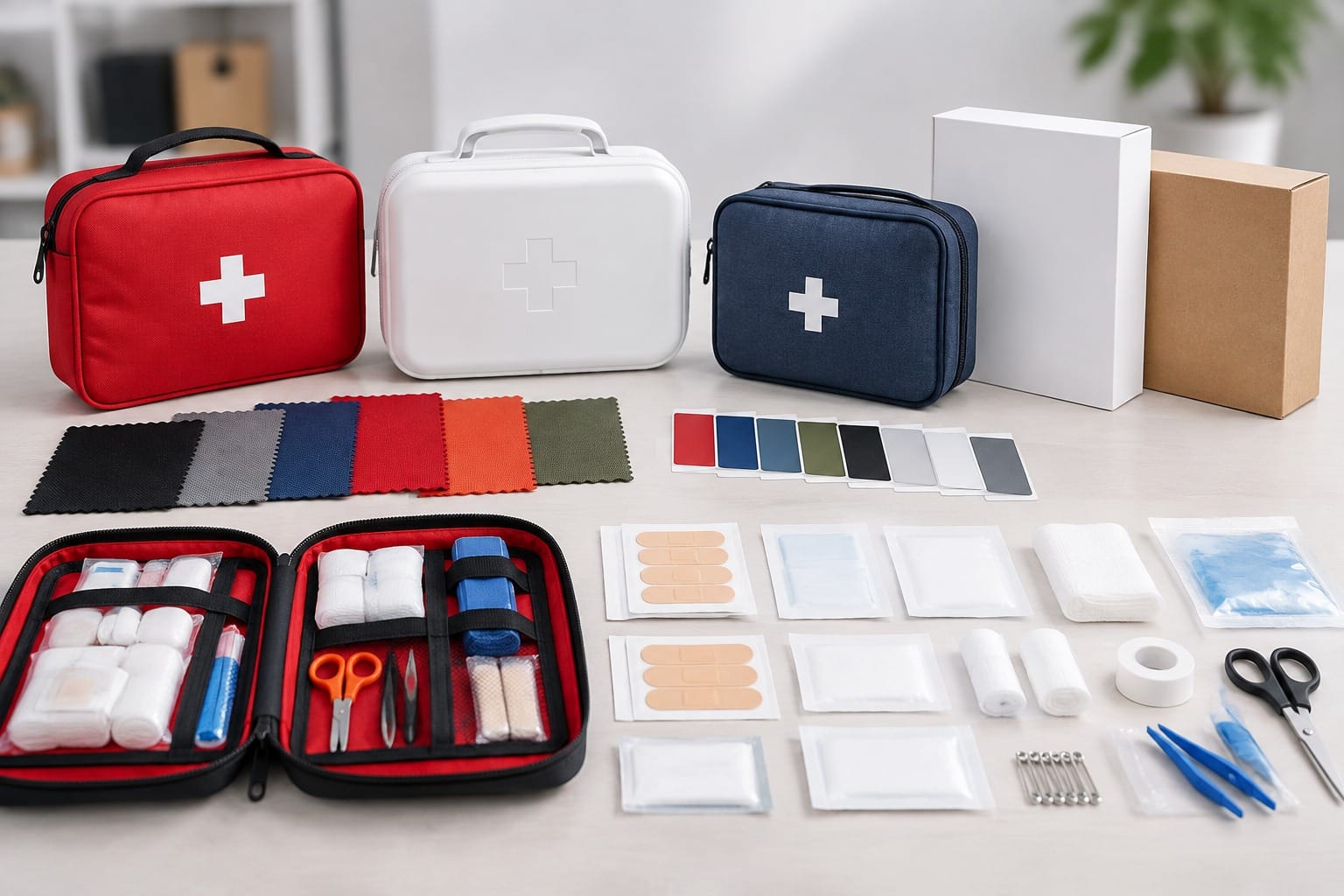
Start from the substrate, not from the artwork. Printing behaviour follows the material and its coating: coated paperboard, uncoated kraft, corrugated board, laminated film pouch, and moulded case surfaces each respond differently to ink, pressure and finishing. A supplier can print the same file on two boards and deliver two different results.
Use a fixed sequence, and keep the sequence in the project file:
Written as a list, the sequence looks obvious. Applied to a real order it is not, because items three and four tend to arrive late. A dieline is often generated by the printer after the buyer has already approved a flat artwork file, and a small shift in the glue flap can move the fold line straight through the brand mark.
The practical fix is to require the dieline before artwork sign-off, not after. When the buyer controls the dieline revision number, a packaging change becomes traceable instead of invisible.
Colour needs the same discipline. The International Color Consortium describes its purpose as promoting open, vendor-neutral, cross-platform colour management systems, and its profile specification was published as the international standard ISO 15076-1. An ICC profile is what lets a file, a proof and a press speak the same language. It does not make two substrates look identical, and it does not remove the need for a physical reference.
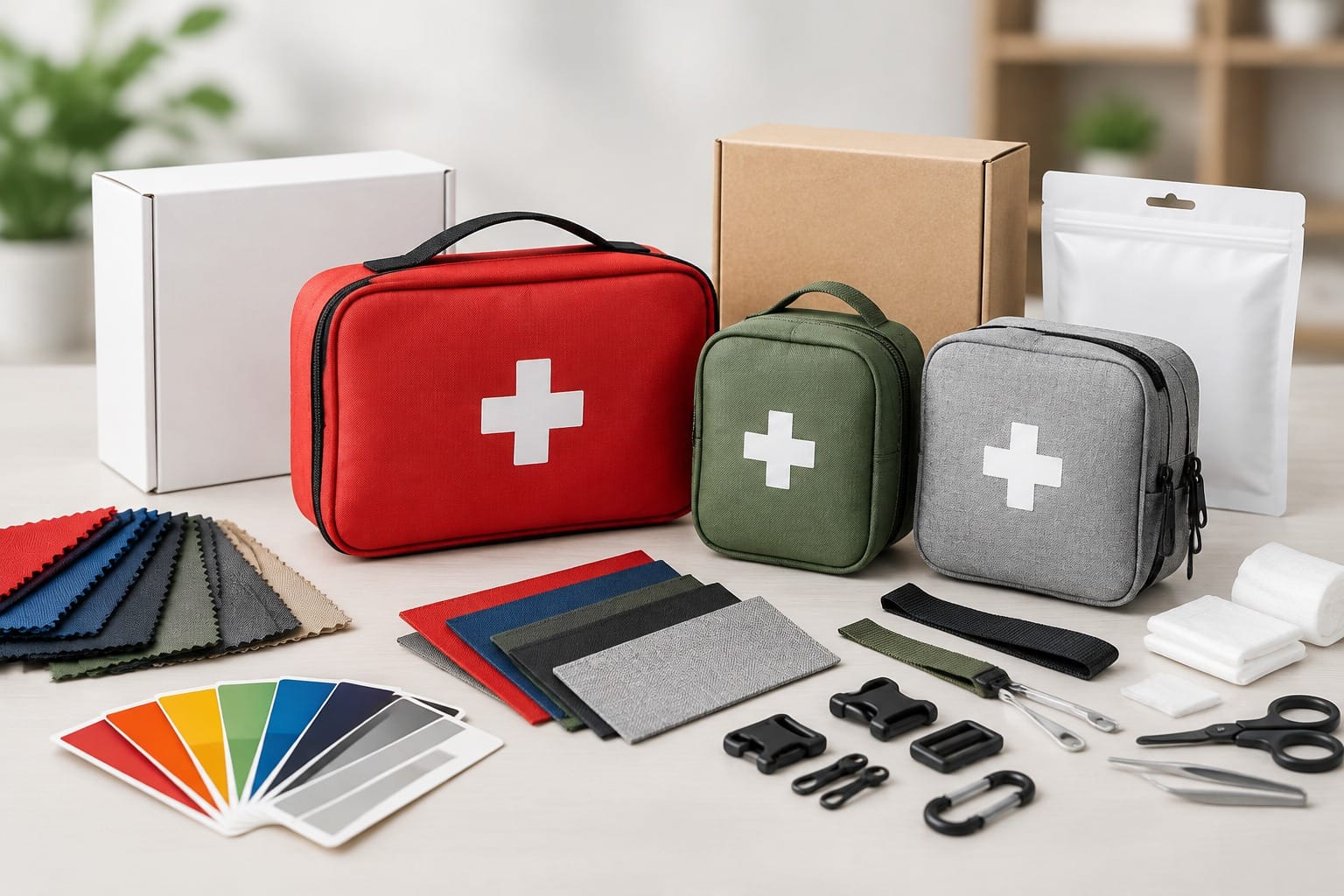
No single method covers every format. The table below is a sourcing comparison for buyer specification, not a production commitment. Feasibility depends on the quoted substrate, the equipment actually used, the artwork, the finishing line and the order quantity.
| Method | Typical fit | What it carries well | What the buyer must verify |
|---|---|---|---|
| Offset litho | Folding cartons, sleeves and inserts in paperboard | Fine text, small regulatory wording, photographic imagery, dense colour | Board grade and coating, plate and make-ready charges, colour bar and density control on the sheet |
| Flexographic | Corrugated shippers, kraft cartons, larger runs | Solid areas, larger marks, functional information across a big panel | Anilox and plate line screen, registration across flutes, ink coverage limits on kraft |
| Digital toner or inkjet | Short runs, labels, late-stage revisions, market variants | Versioning and variable data without a plate charge | Substrate qualification on the actual stock, toner or ink adhesion, colour drift across the run, cost curve against volume |
| Screen print | Pouch film, heavy card, rigid surfaces | Opaque solids, white and metallic effects, thicker ink film | Mesh count, ink system, curing window, opacity over the substrate colour |
| Foil stamping | Premium cartons and rigid case labels | Metallic or high-contrast accent lines and seals | Foil reference, die making, relief depth, coverage limits, adhesion at edges |
| Label on a plain blank | Trial volumes, multi-market shipments, audit trails | Information changes without reprinting the carton | Adhesive and face stock against the substrate, humidity and cold behaviour, whether the blank itself is acceptable to the buyer’s channel |
Two mistakes recur in this table. The first is asking for one price line called “printing”. Carton print, pouch print, label print and master carton print are different supply chains with different setup drivers. Quote them separately so cost movement stays readable, and ask every supplier to describe custom first aid packaging printing in those same four lines.
The second is approving a method from a photograph of a different container. Where the packaging is the visible retail surface, buyers can compare emergency medical bag formats and related packaging options alongside the printed carton, then ask which surfaces are actually printable on the format they intend to order.
Idealliance, now part of PRINTING United Alliance, maintains the G7 family of print production specifications, and G7 Master Facility certification is described as facility-level evidence of predictable, consistent colour delivery across print processes. A buyer can ask whether a nominated printer works to such a specification. The answer frames the conversation around process control on the press rather than one corrected file.
A print-ready file is a controlled file, not an exported image. Screenshots, resized logos and artwork rebuilt from a supplier template all create version risk. Send an artwork pack with a revision number and a named approver.
The pack should contain:
Pantone describes its systems as tools for selecting, communicating and matching colour. That is a communication benefit, not a visual identity promise. A named spot colour still lands differently on coated board, uncoated kraft and transparent film. Approve a physical reference and an allowed visual range rather than a single code.
Information elements deserve their own control because they change on a different rhythm from the brand mark. A contents statement, importer address, batch field, barcode and user instruction may each be governed by different rules in the destination market. Keeping them as separate elements means a later wording change does not reopen the brand artwork approval.
One naming rule saves a great deal of rework: never let two files share a name. Use product, format, market and revision in the file name itself, and keep the approved sample labelled with the same string. That habit is what keeps custom first aid packaging printing auditable across several market variants.
Print setup and kit MOQ are different constraints. Our standard kit programmes start at 1,000 pieces, yet a printed carton can carry its own plate, die, foil or make-ready charge that behaves independently of that number.
Ask the supplier to split the quotation into four lines:
| Cost line | What it covers | Why separating it matters |
|---|---|---|
| One-time setup | Plates, dies, screens, foil dies, colour matching, make-ready | Shows what a revision really costs later |
| Unit print | Ink, board or film consumption, press time per thousand | Makes volume tiers comparable |
| Custom component | A printed component with its own minimum, such as a branded insert card | Explains why a small order can breach a packaging minimum even when the kit itself does not |
| Sample and proof | Material, press proof, courier and any colour measurement | Prevents sample cost being hidden in the unit price |
With those four lines separated, buyers can see the real trade: a method with a higher plate charge but better press efficiency may win at volume and lose at trial quantity. A method with no setup charge may be the sensible path for a first market test, provided its appearance and durability match what the buyer promised the channel.
A second lever is artwork simplification. Reducing the number of spot colours, removing very fine reversed lines, or moving a long instruction sentence to an insert card can reduce both setup and rejection risk without changing the brand mark.
Content continuity is the third lever, and it is the one buyers under-specify. Define what counts as a change requiring a new sample: substrate grade, coating, ink system, foil, adhesive, press route, dieline revision, colour reference or print position. Then require written notice before the supplier substitutes any of them. A repeat order that looks identical is not proof the production route stayed identical.
Where a buyer pays for a plate, die or foil tool, the commercial record should state ownership, storage, retention period and what happens when the artwork changes. Setup charges and tool ownership are not the same thing.
“Inferior print quality” cannot be inspected. Divide the specification into categories a quality inspector can count.
| Defect category | Examples | Controlling record |
|---|---|---|
| Content | Wrong language panel, old artwork revision, missing element, wrong address | Approved artwork ID and revision |
| Colour | Off-target spot colour, weak opacity over the substrate, uneven density across the sheet | Colour reference, density targets and the approved physical sample |
| Position | Element outside the stated tolerance, crossing a crease or glue area, intruding into the barcode quiet zone | Dieline revision and dimensioned placement drawing |
| Registration | Misaligned colour layers, halo around fine text, broken thin reversed lines | Approved production sample and press control strip |
| Surface | Scuffing, set-off, pinholing, foil edge lift, adhesive bleed, uneven varnish band | Method-specific defect standard and finishing reference |
| Structural interaction | Print cracking at a fold, distortion over a glued flap, abrasion where the carton rubs in transit | Dieline, fold test and transit packing requirement |
| Data | Unreadable or out-of-tolerance barcode, missing batch field, wrong variable data | Barcode verification requirement and data file |
Two fields make the table usable. First, the tolerance value and the measuring method, including who performs the check and at which stage. Second, the disposition rule: which defects trigger rejection, which allow rework, and which the buyer may accept as a documented concession. Without a disposition rule, every minor variation becomes a negotiation.
Inspection timing matters as much as inspection criteria. Checks that happen only at final packing cannot catch a plate defect that has already run across the whole order. Ask for a first-off approval on the production press and a documented in-process check, then a final check on packed goods.
Numbering the components in the packaging structure also helps. When the carton, insert card, label, pouch and master carton each carry an identifier, a defect report points to one item rather than to the shipment. The private label first aid kit packaging options overview shows how those layers stack up in a typical configuration.
Printing turns a specification into a permanent statement on the product. That is why the printed panel is the riskiest part of the artwork pack, and why it should be reviewed against the buyer’s destination-market requirements rather than against the supplier’s template.
Three practical rules apply.
First, handle regulatory marks as buyer-supplied content. If a mark, code or statement is required in the destination market, the buyer should supply it with the authority for its use, and should record in writing who confirmed that it is appropriate for that market. UneedAid supplies documentation by SKU and coordinates the export file set, while the buyer remains responsible for confirming destination-market compliance.
Second, do not let a supplier template introduce a claim nobody approved. Templates often carry generic wording about the product category. Any sentence that describes a product property, performance or status should be traceable to an approved source document, or removed.
Third, keep brand artwork and compliance content in separate approval routes. A brand mark can be signed off by a marketing owner. A content statement, language panel or regulatory field usually needs the buyer’s regulatory or quality owner. Mixing them into one file means a marketing change can quietly alter a controlled statement.
The emblem question belongs here too. The International Committee of the Red Cross explains that the red cross, red crescent and red crystal are protected emblems under international and national law. A cross-shaped medical graphic is therefore not automatically available as a commercial brand element, and the symbol, its form and its authorised use should be confirmed before artwork is released for printing.
A dieline defines the physical structure: where the carton is cut, creased and glued, and therefore where the printable panels sit. Print-ready artwork defines what appears inside those panels. They must share a revision number and a coordinate system, or a fold can move through a printed element. Suppliers should confirm the dieline before artwork sign-off, not after, because a structural change made later invalidates placement approvals, tolerances and the approved sample.
A named colour reference is a communication tool. Substrate colour, coating absorbency, ink film thickness, press conditions, finishing and lighting all shift the result. Most projects work better with a measured target plus an allowed visual range, agreed on a physical reference. Two boards printed from the same ink can still differ enough to be visible side by side, so a single code should not be treated as the complete acceptance rule for printed packaging.
There is no universal number. Each additional spot colour normally adds a plate, a make-ready step and a registration risk, while process printing handles photographic content differently. The decision should follow the artwork rather than a target count: reduce colours when the design tolerates it, and keep a spot colour when brand recognition depends on it. Ask the printer which elements drive cost at the buyer’s order quantity, and check how the choice behaves across the whole printed range. Colour count is one of the few variables in custom first aid packaging printing that a buyer can change late without rebuilding the structure.
It depends on the channel and the promise made to it. Digital print and pressure-sensitive labels avoid plate and die charges, which suits trials and market variants, but the result may not match a large-run carton in surface feel and finish. Buyers can also start with a plain blank and a controlled label, then move to printed cartons once volume and design are stable. Ask for both routes quoted on the same format so the comparison is genuine.
Raise it as a change-control event rather than a quality complaint. Compare substrate grade, coating, ink system, colour reference, finishing, print position and dieline revision against the approved record, and ask the supplier to confirm in writing which inputs changed. If a controlled input changed, the sample should be re-approved before further production. Retaining the approved sample and its file record is what makes this comparison possible at all.
Controlled custom first aid packaging printing turns a packaging order from a description into a measurable record: substrate, dieline revision, colour reference, tolerance, sample identity and disposition rules. Buyers who lock those fields before artwork release spend less time arguing about a shipment and more time opening the next market. The next layer, brand marks on the bag or case itself, is covered in the custom first aid kit logo methods framework, so both surfaces stay under one revision history.
A custom first aid bag manufacturer will quote a price long before anyone has settled the three lines that decide what the bag actually is: fabric, colour and hardware. Fix those three and the sample arrives as specified. Skip them and the sample arrives correct in every respect except the one that mattered. The bag sags at the base. The shade reads wrong under warehouse lighting. The zip gives up somewhere in the first three hundred cycles.
This is the part of OEM bag work that sits upstream of price and lead time. It is also the part buyers most often hand to the factory, which is why two bags built to the same drawing can differ by a third in weight and by more than that in service life.
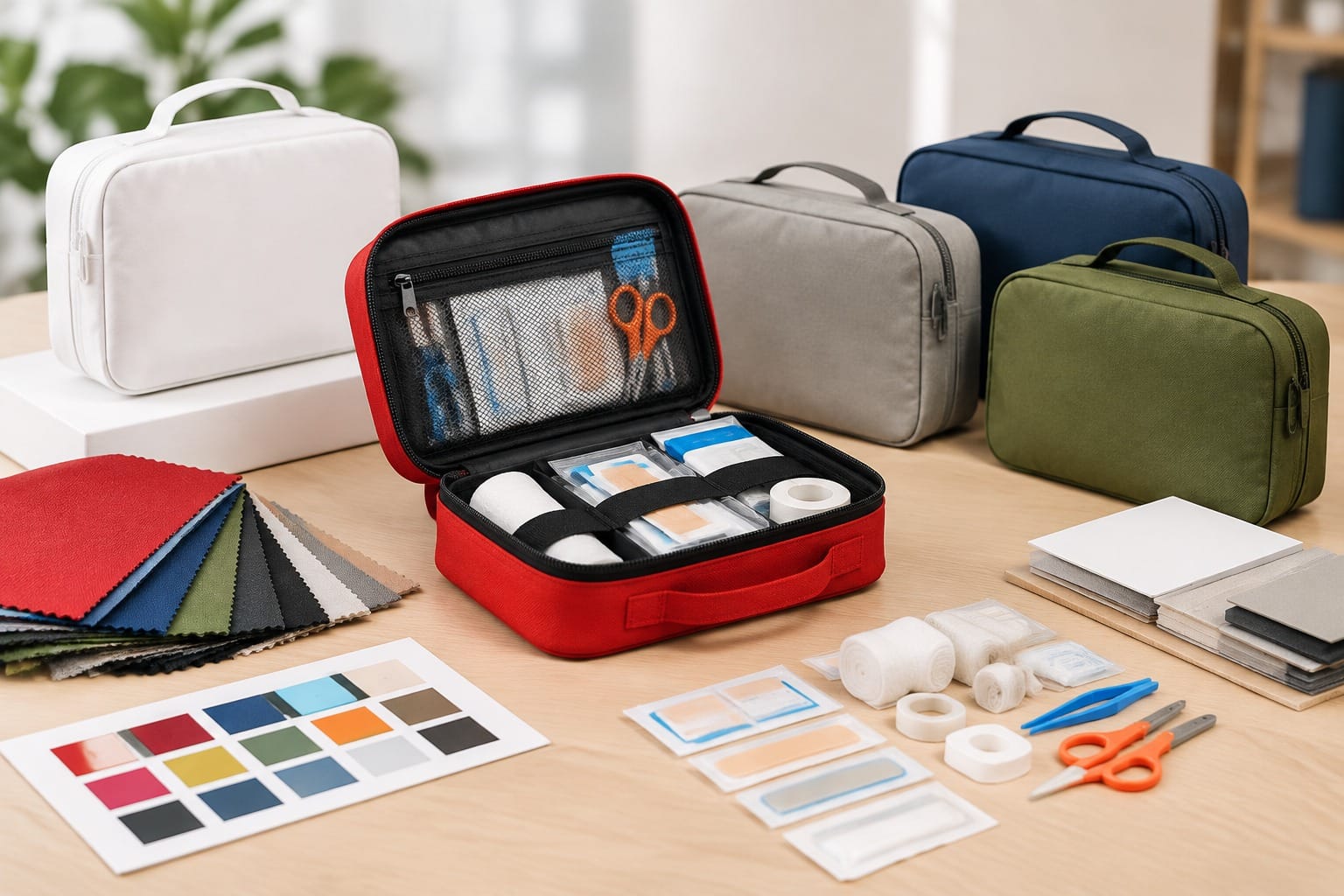
Three decisions come before a pattern is cut, and each one changes the others.
The first is the carrying format. A waist pouch, a hand-carry bag, a backpack and a fold-out all impose a different maximum panel size, and panel size decides how much reinforcement each seam needs.
The second is the load. A bag holding dressings and tape behaves nothing like a bag holding a rigid suction unit. Weight in kilos and the shape of the heaviest item determine whether the base needs a second layer.
The third is the environment. A bag wiped with disinfectant several times a day needs a coating and a seam finish that a bag living in a vehicle boot does not.
Write those three down and the fabric conversation gets short. Leave them implicit and the factory selects for the middle of the market, which is not the same thing as selecting for your programme.
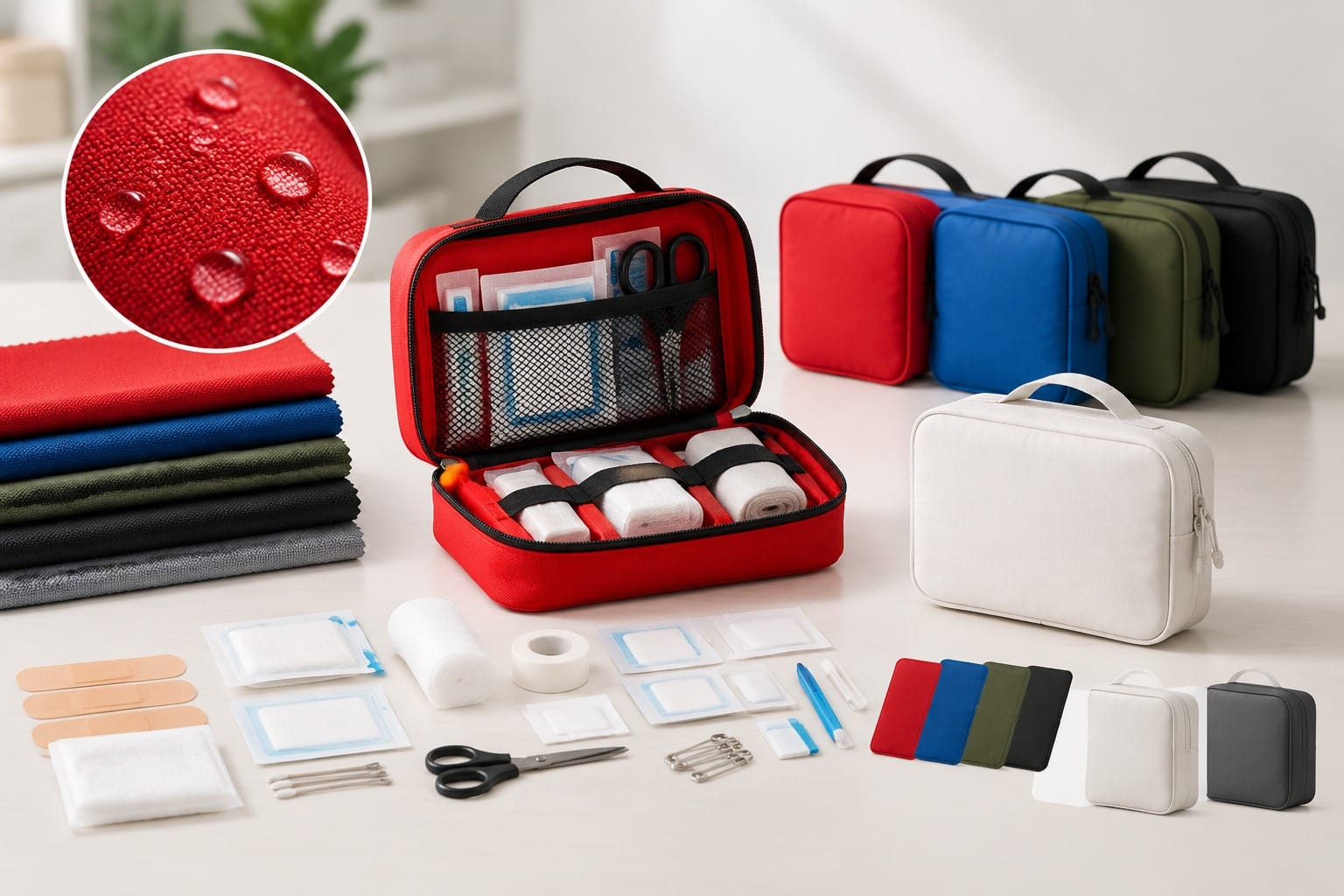
Denier measures the linear mass density of yarn, in grams per 9,000 metres. A higher number means a heavier yarn per unit length, not automatically a stronger bag, because weave and coating matter as much as the yarn does. Published material charts from bag factories list polyester Oxford from 210D to 1000D, nylon Oxford from 210D to 1680D, canvas by weight from 12 oz to 20 oz, and neoprene by thickness from 3 mm to 7 mm.
| Fabric | Common published specs | Typical published price band | Usually chosen for |
|---|---|---|---|
| Polyester Oxford | 210D / 420D / 600D / 840D / 1000D | about US$2–4 per yard | The default for general medical bags and first aid kits |
| Nylon Oxford | 210D / 420D / 840D / 1680D | about US$3–5 per yard | Abrasion resistance and a softer hand where the bag is carried often |
| Canvas | 12 oz / 14 oz / 16 oz / 20 oz | about US$3.50–6 per yard | Structured cases with a traditional look |
| Neoprene | 3 mm / 4 mm / 5 mm / 6 mm / 7 mm | about US$6–10 per yard | Padding around instruments and insulated compartments |
600D polyester is the most often quoted default in the listings we reviewed, and one supplier’s own material guide places medical bags in the 420D to 840D nylon Oxford band. Denier above 1000D usually signals a responder or trauma pack rather than a general kit bag. A custom first aid bag manufacturer quoting outside these bands without explanation deserves a follow-up question.
Two costs sit outside the fabric price. Coating raises cost per yard and changes how the bag behaves when wiped. Lining adds a second material, and choosing between PEVA and TPU moves both the usable temperature range and the resistance to repeated disinfection.
Neither line is visible in a photograph, which is why they get left out of the specification and then discovered at the sample stage.
Colour is where a specification and a production run separate most often. The cause is rarely a mistake in the artwork. It is usually one of three things.
A Pantone reference without a substrate. The same Pantone number printed on 600D polyester with a PU coating and on uncoated nylon will not match. Coating changes surface sheen, and sheen changes perceived saturation. State the substrate alongside the reference or the reference means little.
A tolerance that was never written down. Print and dye both drift between runs. What you need is not an exact match but an agreed range, expressed as a numeric tolerance on a colour measurement, plus a rule for what happens when a run lands at the edge of it.
A light source that was never agreed. A shade approved under office lighting can look different under daylight or under the lamps in a warehouse aisle. Agree the viewing condition at approval time.
One factory’s published inspection list names colour fastness to artificial light, tested to the ISO 105-B02 method, at grade 4 or above. Read that as one factory’s stated house standard rather than an industry floor, and ask every custom first aid bag manufacturer you shortlist to name their own figure in writing.
Dye-lot control is the practical safeguard. Ask whether the whole order will come from a single production run, and if it will not, ask how the split is managed. Two runs of the same colour can be visibly different side by side, and a distributor shipping to several customers will find out.
Hardware is the least expensive place to save money and the fastest place to lose a customer. Three components carry most of the risk. They are also the three a custom first aid bag manufacturer is most likely to swap without saying so.
Zips. A two-way zip gives access from either end, which matters on a bag opened under pressure. Slider quality decides the feel, and coil versus moulded teeth decides how the zip behaves when the bag is overfilled. One factory’s published inspection routine describes 5,000 open-and-close cycles as its durability check. Ask what cycle count applies to your bag rather than assuming that figure travels.
Load-bearing seams and webbing. Bar-tack stitching, binding tape and reinforced base panels are the three reinforcements worth specifying. One published routine describes a minimum 200 N pull force on load-bearing seams and a load test at 150 percent of intended weight held for 24 hours. Those are useful numbers to request, because they turn a vague promise about strength into a test you can ask for evidence of.
Handles and attachment points. A grab handle on a responder bag is a load path, not a decoration. Where the bag needs to mount on a vest, a wall bracket or a vehicle panel, the attachment system has to be chosen before the pattern is cut, not added afterwards.
Rip-away panels, MOLLE-compatible webbing, buckle and hook-and-loop closures and reflective trim all sit in this layer. Each adds cost, and each one is easy to promise and hard to verify from a sample photo.
The documentation duties that follow a finished bag are a separate matter from the fabric. Where a kit contains a regulated medical device, obligations attach to whoever places it on the market, and the EU framework for medical devices is one example of how far those duties reach. Confirm the position for your own destination rather than relying on a supplier’s summary of it.
Most general medical bags sit between 420D and 840D, and 600D polyester is the most commonly quoted default. Move above 1000D when the bag is carried into rough environments or holds heavy rigid contents. Move lower only when the bag is light, unlikely to be dragged, and cost is the deciding constraint. Denier is one input among several, so ask any custom first aid bag manufacturer for the weave and coating as well.
Specify a Pantone reference together with the substrate, agree a numeric colour tolerance, and name the viewing condition for approval. Then ask how the order will be split across production runs. If it must be split, agree in advance that the second run will be matched against a retained reference sample rather than against the previous run, which keeps drift from compounding order after order.
Published sample stages cluster around 6 to 10 days for a new pattern, with some factories offering a 3-day expedite on simple builds and others quoting a 7-day prototype from a sketch. Bulk production is more often quoted between 27 and 45 days. The number that matters is the one written against your specification revision, not a range printed on a website.
Ask any custom first aid bag manufacturer to name the zip type, the slider, the seam reinforcement, the attachment system and the load tests you want evidence for. A workable short list is a two-way zip, bar-tack stitching at load points, a reinforced base panel, and a documented seam strength figure. Adding cycle counts and load percentages turns each item into something a factory can be measured against.
Buy stock when the format already fits the contents and the only variable is the printed logo, because setup costs stay low and lead times are short. Go custom when the contents list or the mounting method drives the pattern. Custom only pays back when the volume supports the tooling, so count print setup fees and minimums as part of the volume calculation rather than as an afterthought.
Fabric, colour and hardware are the three lines that decide whether a bag is a container or a piece of equipment. They are also the three lines most often left to the factory, which is where specification drift begins.
Write them down, attach a revision number, and quote every candidate against that document. A custom first aid bag manufacturer who answers line by line is telling you how the production run will go. The pricing conversation then has something to be about. Our own guide to OEM private label first aid kit projects covers how a brand project runs from first sample to bulk order, and the custom medical bag specification sheet shows how to put the lines above into a document a factory can quote against.
Buyers comparing factories should read the OEM first aid kit supplier comparison method alongside the logo branding methods guide, since print method is usually where setup cost first appears. Anyone still settling the container should start from the empty first aid kit bags and boxes sourcing guide, and the emergency medical bags range shows the formats we produce.
Our own MOQ starts at 1,000 pcs, with sample-based validation before production and a feasibility review wherever a specification line is not yet fixed. Where a material or a component has not been confirmed for a given build, we say so and route the question back to you rather than filling the gap with an assumption.
Five factories, five quotes, and no way to line them up. One prices a 500-set run in 600D polyester, another in tarpaulin. One includes inner label printing, one prices it separately. One quotes FOB, one quotes DAP. Before you compare OEM first aid kit suppliers, decide what you are comparing.
A supplier comparison only works when every row can be answered from something you can hold. Three things qualify: a document, a physical artefact, or a public register. Anything else is narration, and narration should score zero rather than score high because it sounds confident. That single rule removes most of the noise from a normal shortlist.
Most shortlists get built from the same three inputs: a platform badge, a certification line in an email signature, and a reorder rate printed beside a star rating. None of the three is inspectable.
Platform verification commonly means the supplier completed a paid onboarding step. It does not mean anyone walked the production floor. Reorder rate and response time are usually computed by the platform from its own order flow, with no published formula, so a supplier showing 22% and one showing 30% are not showing you comparable numbers. Certification wording is the third case. A line reading “ISO 13485” describes a management system, not the run your order sits inside.
None of this makes a supplier dishonest. It makes the inputs unscored. A matrix that accepts unscored inputs becomes a ranking of sales departments, and the factory that answers email fastest tends to win.
To compare OEM first aid kit suppliers on something firmer, sort every claim into a tier first. Then score only what you can check.
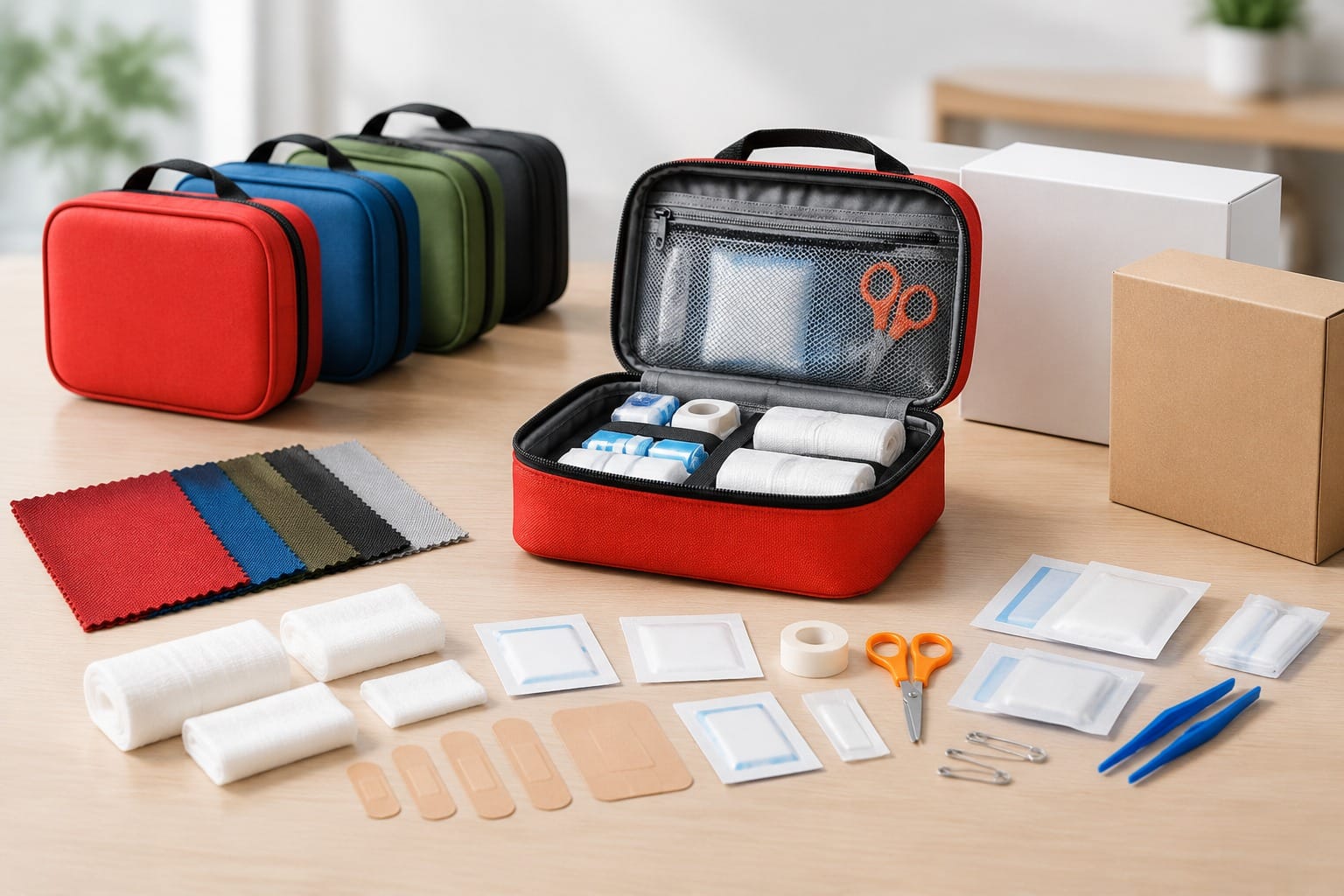
Every field on a quote belongs in one of three tiers. The tier decides whether it can move the decision.
The ladder matters because tier three is where sales effort concentrates. A supplier describing 2,000 stocked styles is describing a catalogue, and nobody outside the company can confirm the count. Put that sentence on a scoring row and you have scored the sentence, not the supplier.
Score each supplier from 0 to 5 on seven rows. Two rows are tier one, four are tier two, and one is a commercial row. Weight them before you open the quotes, not after — the weighting is what turns a set of answers into a reason to compare OEM first aid kit suppliers at all.
| Row | Tier | What earns a 5 | Weight |
|---|---|---|---|
| Regulatory route named | 1 | Supplier names the market and its published route; you verify it independently | 20% |
| Contents table returned line by line | 2 | Unit price on every row, piece counts as fixed numbers not ranges | 20% |
| Container specification closed | 2 | Material, denier, dimensions in cm, closure type, print method all fixed in writing | 15% |
| Sample and approval terms | 2 | Sample type named, cost and freight rule stated, approval window stated | 15% |
| Third-party audit report | 2 | Report names the issuing body and a date; you confirm it with that body | 10% |
| Traceability for consumables | 2 | Batch and expiry recording described in writing, not asserted verbally | 10% |
| Commercial terms | 3 | MOQ tiers, currency, delivery term and validity window | 10% |
Two scoring notes. A supplier can score 5 on the commercial row and still lose, because the row carries a tenth of the weight. And a tier-three row earns partial credit only when a tier-two document corroborates it — a delivery percentage is worth noting when an audit report or a reference order backs it, and worth nothing on its own.
Two of those rows depend on documents rather than on judgement, and the compliance checklist for a first aid supplier is where those documents are named and given a confirmation route.
When two suppliers land within a point of each other, the artefacts decide. There are two that matter for OEM kit work, and both are physical.
The pre-production sample. Order it from both suppliers in the same week, built from the components and the bag your specification names. Do not evaluate them weeks apart, because your own reference point drifts. Measure the bag against the dimensions in writing, count every contents line against the table you sent, and check the print method on the actual unit rather than the print method named on the quote. Keep the approved unit sealed, signed and dated by both sides.
The audit report. For a first order with a new supplier, a third-party audit turns four tier-two rows into one document. What makes it usable is the same standard as everything else on this page: it should name the issuing body, carry a date, and be confirmable. A report the supplier produced about itself is not tier two.
These two artefacts also tell you what to compare OEM first aid kit suppliers on when the quotes are otherwise identical. They rarely are identical once the sample is opened.
A scoring matrix ranks suppliers. It does not certify that a product meets a destination market’s requirements, and it should not be presented as if it does. Where the destination market regulates first aid kits as medical devices, the importer’s own route is published by the market authority, and that route governs regardless of how well a supplier scores. The European Commission’s medical devices pages and the CE marking rules for products placed on the EU market are the two starting points an EU-bound buyer should read before scoring anyone.
Delivery terms sit in the same category. A supplier quoting FOB and one quoting DAP are not quoting prices for the same thing, so the commercial row has to fix the term before the numbers are entered. The ICC’s Incoterms 2020 reference is the version to name explicitly in the RFQ.
Specification questions separate factories faster than price does, and this breakdown of fabric, colour and hardware decisions shows which answers to check.
Workplace kit contents are the third case. Where a programme is built around a contents-class reference, the reference belongs in the specification rather than in the comparison, because it constrains what suppliers may quote at all. United States workplaces, for example, sit under a general obligation to make first aid supplies available, set out in 29 CFR 1910.151.
Your own weightings carry the same caveat. They reflect your programme’s priorities, not an industry standard, so keep the sheet in the purchase file and re-run it on the next order. A supplier that scores well this year can lose the same rows next year when a component changes source.
If you already run a custom programme, the custom medical bag specification sheet is the document that fills the container row, and the logo branding methods for custom first aid kits covers the print-method field. Buyers running several brands at once also compare OEM first aid kit suppliers across two programmes in the same sheet, which is where the private label packaging options usually decide the split.
Format planning belongs in the same comparison. Most OEM kit programmes run on a small number of container formats, so the standard kit configurations hub and the multi-compartment first aid kit bag give you the container options to score against before you ask anyone to price them. Suppliers with a strong customisation service can support either format; the OEM and private label first aid kits guide covers how the two customisation routes differ.
You can, but you will usually decide on presentation rather than on evidence. Without a sheet, tier-three claims carry the same visual weight as tier-two documents, and the supplier with the polished deck wins rows it should not win. A seven-row matrix takes about an hour to build and one afternoon to fill in for five suppliers. It also gives you a written reason for the award, which is useful when a buyer or an auditor asks why a supplier was selected.
The contents table returned with a unit price on every line. It is the row most suppliers leave as prose, and it is the row that makes every other commercial number meaningful. When the same line items sit on the same rows across five quotes, price differences become explainable. When they do not, a lower total is simply a shorter contents list wearing a smaller number.
For a first order above a material value with a supplier you have not produced with, a third-party audit is the lowest-cost way to convert several unverifiable claims into one document. Below that threshold, a pre-production sample plus a written contents table usually carries the decision. The correction to remember is that an audit has a date. Re-checking it when the producing site or a component source changes is part of using it.
None on the score itself, and some on the shortlist. A supplier with a long trading history and a wide catalogue is likelier to survive a bad quarter, which matters for repeat orders and for component continuity. That is a reason to keep them in the shortlist and to ask a tier-two question about how they hold a component specification across orders. It is not a reason to award points for the number of years.
When one supplier leads on the two weighted rows that matter most to your programme and the artefacts agree with the paperwork. If two suppliers are still level after the sample and the audit, the tie is usually commercial, so decide it on MOQ tier and delivery term rather than on another round of questions. At that point the sample validation process for OEM kit projects is the step that closes the specification.
Compare OEM first aid kit suppliers with the same matrix twice, and the second run takes a fraction of the time. The sheet survives the order, the weights record why you chose, and the sealed sample becomes the baseline every reorder is measured against.
For the wider view of how customisation, contents and container choices fit together, start from the OEM and private label first aid kits guide. If you are issuing a document to several factories at once, the emergency first aid kit RFQ checklist covers the lines to close before anyone quotes.
The same matrix works one layer up, when you are choosing between finished kits rather than between factories. A first aid supplier scorecard built for distributors and resellers applies identical evidence rules to configuration closure, continuity and documentation handover.
A custom medical bag specifications sheet is not a product description. It is a controlled document that tells a factory what to build and tells you what to inspect when the fifth shipment lands. Buyers who skip it tend to receive a bag that matches the photograph and misses the brief. The fabric arrives at the wrong weight. A divider pattern has shifted 15mm. The logo sat perfectly on the sample and drifted on the reorder.
This guide sets out the seven fields that belong in custom medical bag specifications, the two fields buyers omit and then argue about, and the sequence that turns one approved sample into a repeatable order.
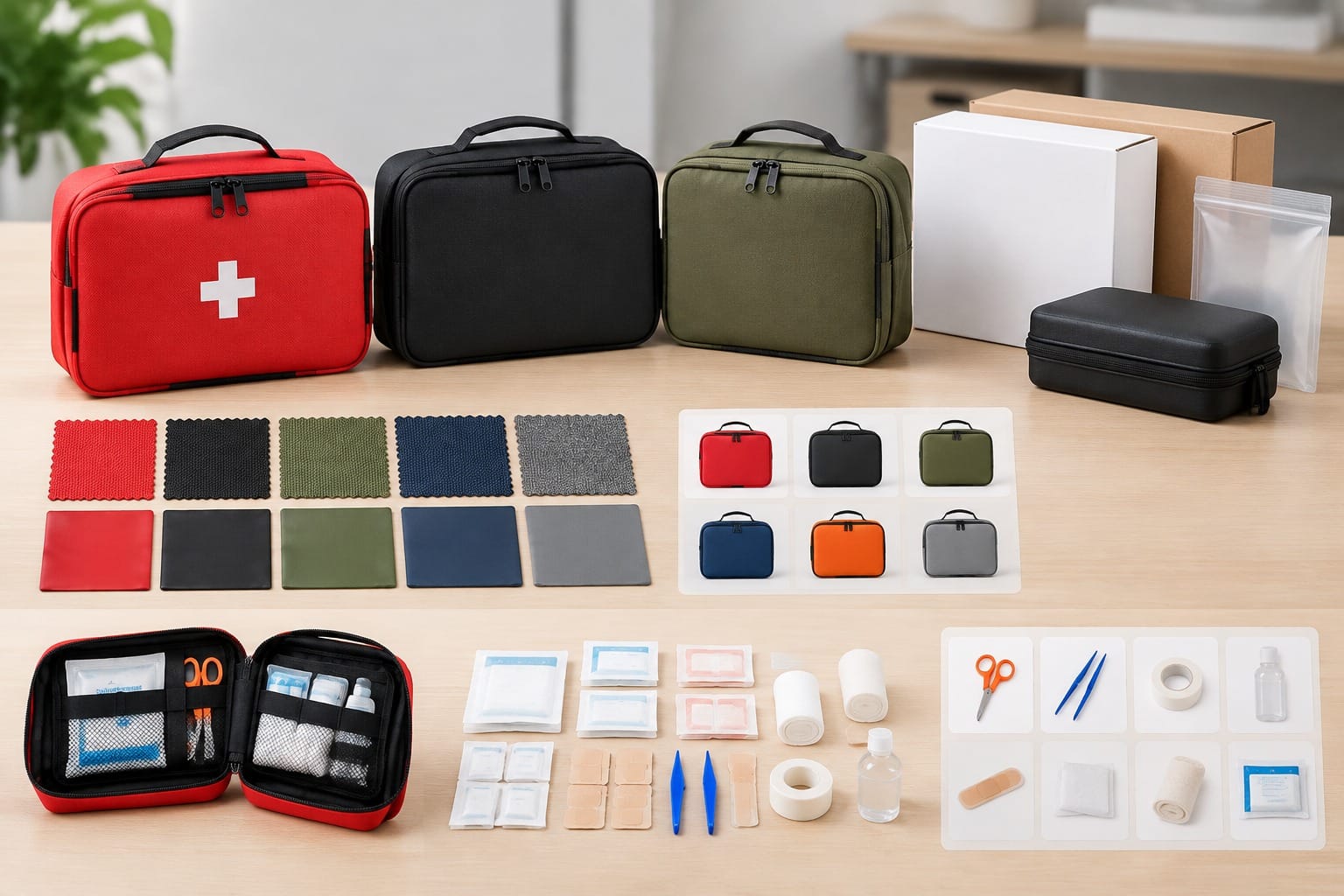
| Field | Why it belongs in the sheet | What goes wrong without it |
|---|---|---|
| Construction | Format, outer dimensions and a tolerance band | Sample fits, bulk does not |
| Materials | Fabric, coating, weight, lining and trim | Substituted material on the repeat run |
| Compartment map | Zones derived from the item list and access order | Contents shift, first-response items buried |
| Attachment system | Belt loop, strap geometry or MOLLE webbing | Bag cannot be mounted the way the buyer assumes |
| Label fields | ID window size and barcode area | Labels do not fit or scan |
| Packaging | Unit pack, carton quantity, carton marking | Mixed cartons, unusable shelf stock |
| Revision control | Version number, date, approver | No way to prove which version was built |
The table is deliberately dull. Dull is what makes it reusable. A specification sheet is read by people who were not in the original conversation, often eighteen months later, and it either answers their questions or it does not.
A second habit matters as much as the fields. Each field should carry one value and one unit, not a range of options. “Nylon or polyester” is not a specification. It is an invitation for someone else to decide.
Three of those lines, fabric and denier, colour control and hardware, carry most of the risk, and this manufacturing guide for custom first aid bags shows what to write against each.
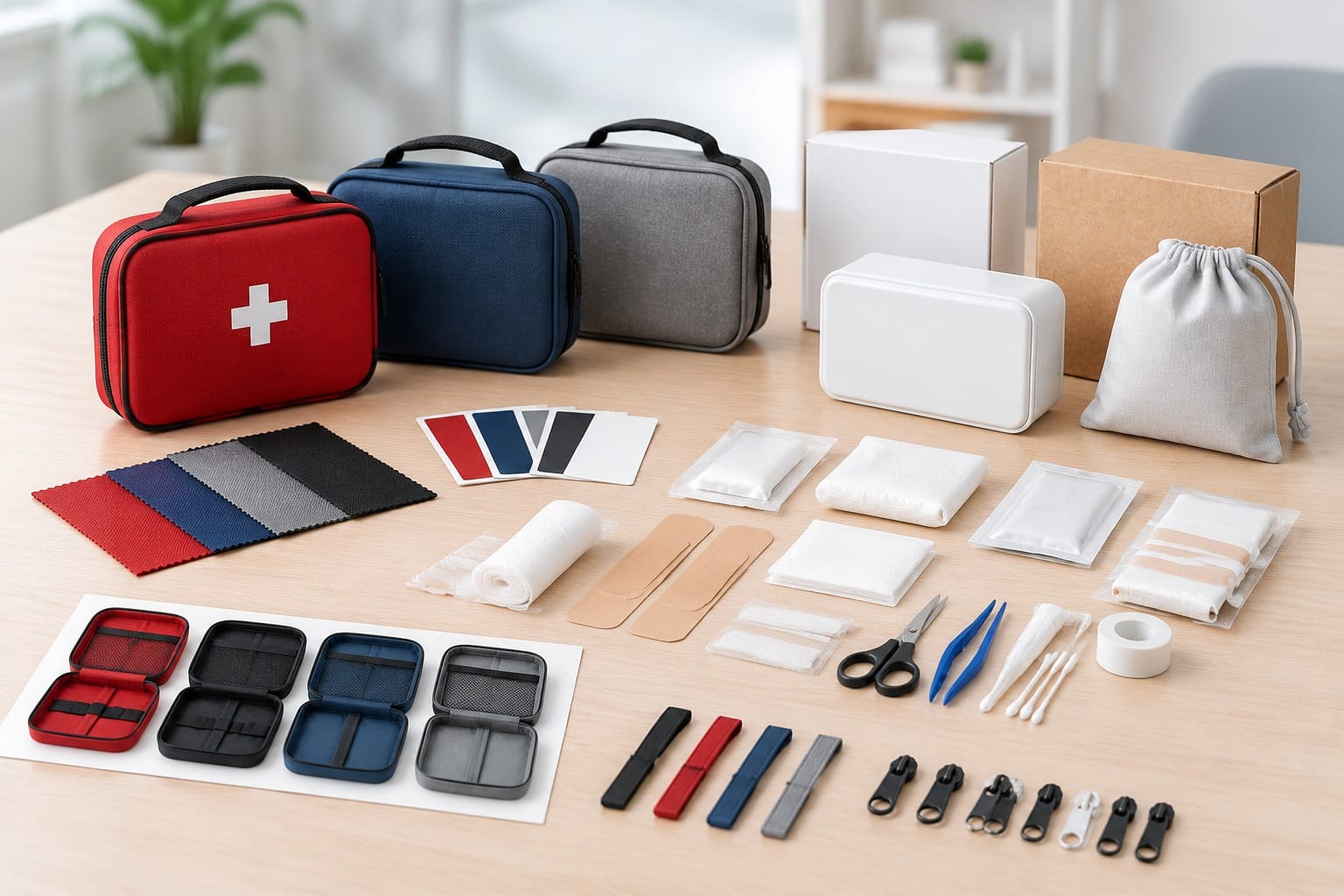
Most custom medical bag specifications start with fabric. Start with the item list instead, and work backwards.
The logic is simple. The bag exists to hold a known list of items in a known access order. Design the zones from that list, then choose the material that survives the layout and the cleaning routine. Suppliers who design from the item list backwards describe the same approach as kit mapping, and it shortens prototyping because the layout is settled before the fabric is argued about.
Put the map in the sheet as zones with an access priority attached. Rapid-access front, main compartment, identity area, and any insulated pocket. Then state what belongs in each zone and how many units of it. This is the part of the sheet that prevents the most common complaint after delivery. A bag can meet every dimensional requirement and still be unusable if the tourniquet sits behind the saline.
Attachment belongs on the same page. If a buyer expects the bag to hang from a rack or clip to a vest, the loop geometry and webbing pattern have to be written down. MOLLE webbing, for example, is a mounting standard rather than a decorative row of stitching, and its spacing is what determines whether a pouch attaches at all.
These are the two omissions that cause most repeat-order disputes. Both are cheap to add.
Tolerance bands. Buyers write dimensions as single numbers, as if a sewn bag could be built to the millimetre. It cannot. Fabric stretches, cutting tables drift, and seams consume material differently across batches. Tolerances exist because they are based on machine and tooling capability. The published guidance on healthcare product specifications groups dimensions and tolerances as one combined requirement, precisely because tolerances determine what tooling a factory needs. Write the band into the custom medical bag specifications sheet, and decide it while the sample is on the table rather than after three containers have shipped.
Revision references. A sheet without a version number cannot be audited. The convention in regulated manufacturing is a released specification: the buyer has signed off on one version and production is cleared against it. Any later edit starts a new revision with a new date. This is the mechanism that makes reorders comparable. Without it, a factory can change the lining weight in month nine and still be building to “the spec”.
Component continuity is a sourcing problem before it is a manufacturing problem. Two buyers can order the same bag and receive two different products, because each order was quoted against a different verbal brief.
A custom medical bag specifications sheet fixes this by making change visible. Any alteration to a material, a divider count or a logo placement becomes a numbered revision, and the buyer can decide whether to accept it. Suppliers usually reinforce this with pre-production checkpoints: material confirmation, in-process checks at load seams and layout assembly, and a final inspection against the same document.
Documents do the same work on the commercial side. A common expectation in export manufacturing is a pre-production document set that pairs the specification sheet with a design proof, a material confirmation, an approved sample record and stated inspection criteria. The phrase some suppliers use is blunt: no document, no production. For a buyer, the value is that the sheet becomes the reference during an inspection, so an argument about quality turns into a comparison against agreed text.
Our own production starts at 1,000 pieces per configuration, and documentation is issued by SKU. That combination pushes in one direction. Every configuration in a programme carries its own specification sheet and its own minimum, so a programme split across three bag sizes carries three sheets and three minimums. Writing the sheets properly is what stops those three versions from blending into one another.
The sheet is an output. Assembling the inputs first is what keeps it to one or two revisions instead of six.
Search data captured by our own reporting shows buyers querying for a supplier selection guide rather than a product listing. That is a useful signal. The people arriving at this stage of a sourcing project want a framework to compare suppliers with, and the input package above is the first artefact that framework produces.
Start with construction, materials, compartment map and revision control. Those four cover the failures that cannot be corrected downstream. Attachment, labelling and packaging can be marked as open items and closed before sampling, as long as the sheet says they are open. What matters is that every field is either specified or explicitly deferred. A blank field is read as “supplier’s choice”.
Detailed enough to reject a bad batch, loose enough that a normal production run passes. Start with the critical dimensions only: overall length, width, depth, and the internal pocket widths that hold fixed-size items. Ask the factory what its normal process capability is, then set the band around that. A band tighter than the machine capability turns into either a rejected good shipment or an unenforceable clause.
You can, and it saves time, but read it as a quotation document rather than a specification. Supplier templates are built to capture what the factory needs to price the job. They rarely prompt for tolerance bands or revision history, and those are exactly the fields that protect the buyer on the second and third order. Crossing two suppliers’ templates usually produces better custom medical bag specifications than accepting either one as written.
The sample is then invalidated for that change, so the change has to be re-validated. Practically that means a new revision number, a dated entry describing the change, and a decision on whether a revised sample is required or whether a written confirmation is enough. Load-bearing changes such as material, compartment count or attachment geometry normally need a physical sample. Cosmetic changes such as carton marking often do not.
Cover the bag, and cover the interface to the contents. The bag specification should state what has to fit where, but the component specification for each consumable belongs in its own document tied to the same SKU. Keeping them separate lets you change a bandage supplier without re-issuing the bag sheet. Keeping them cross-referenced stops the bag from being built for a content list that has already moved.
Read custom medical bag specifications as an operating document rather than a marketing description, and the whole project gets easier to control. Seven fields, one value each, a compartment map drawn from the item list, a tolerance band agreed while the sample is present, and a revision number on every copy.
Buyers building that structure for the first time usually start from the guide to OEM and private-label first aid kits, then narrow the housing format against the emergency medical bag directory or the hand-carry emergency bags range. Two companion pieces cover the details that sit on either side of the sheet: logo and branding methods for bags and cases for the marking fields, and sample validation for OEM bulk orders for the approval gate that follows.
The sample looks complete on a meeting table, but the zipper strains when the kit is loaded and two component labels do not match the buyer’s approved files. First aid kit sample validation is the controlled comparison of a physical sample against the agreed BOM, container specification, artwork, packing rules, and documented exceptions before an OEM buyer releases bulk production.
The sample should answer one practical question: can this exact, recorded configuration become the production reference? A visual approval alone cannot answer it. Buyers need line-by-line counts, functional checks, file revisions, photographs, exception decisions, and named approval authority. This process supports commercial control; it does not replace destination-market regulatory review or bulk inspection.
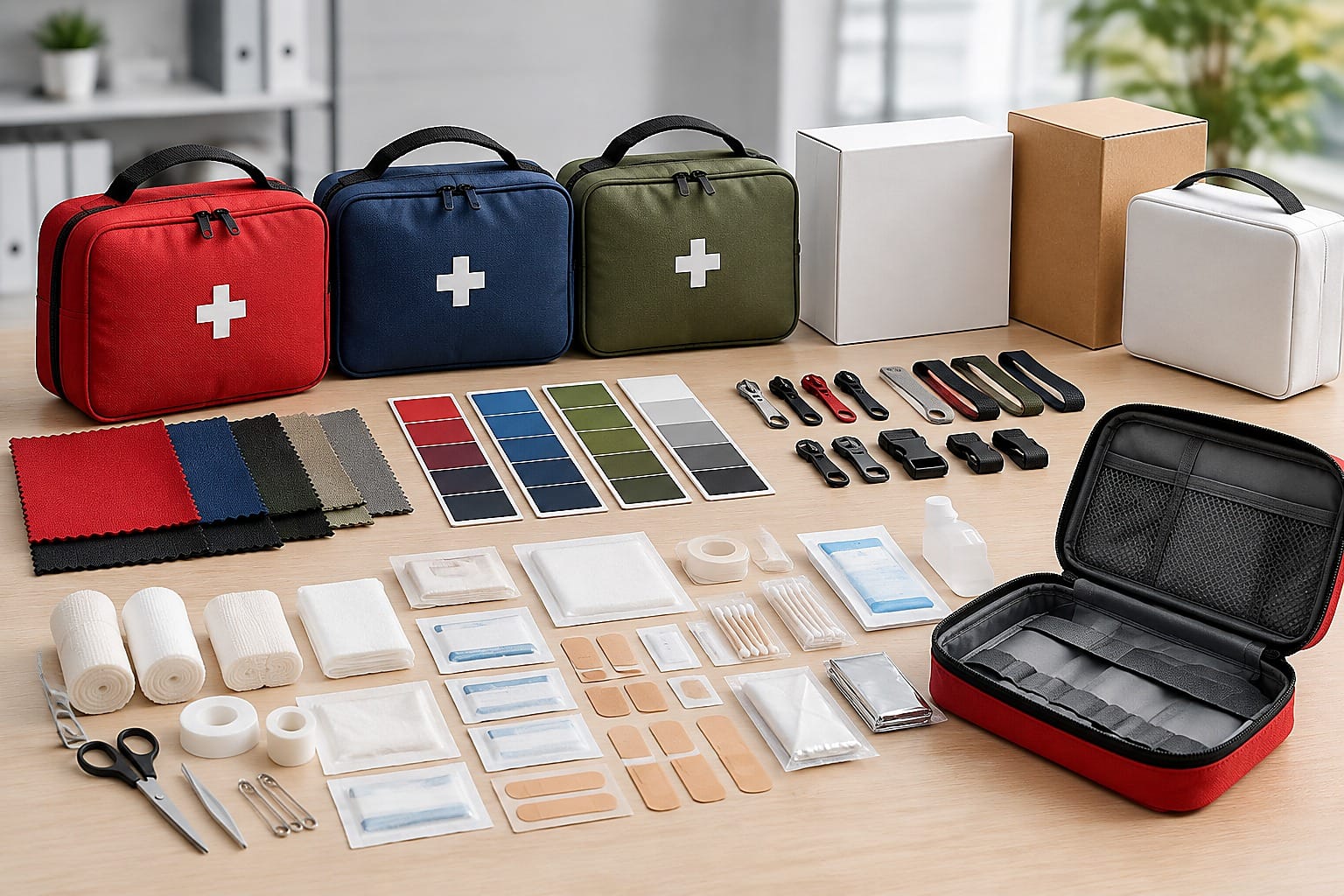
A sample cannot be checked against an unwritten expectation. Before inspection, the buyer and supplier should identify the records that define the proposed unit. At minimum, the review pack should contain the BOM revision, container specification, current artwork register, unit-packing instructions, master-carton proposal, and an exception list.
A sample can only be judged against a specification, and the fabric, colour and hardware guide for custom first aid bags is where those three lines get written down.
The BOM needs enough detail to distinguish similar components. Record a stable line number, supplier SKU or buyer code, description, size, quantity per kit, pack unit, label route, dated-field requirement where applicable, and substitution status. A photograph may help recognition, but it does not define a specification.
Prepare these inputs before opening the sample:
The broader OEM private-label project workflow explains how these records connect to quotation, bulk inspection, and repeat orders. Sample review is one release gate inside that workflow, not a substitute for the other controls.
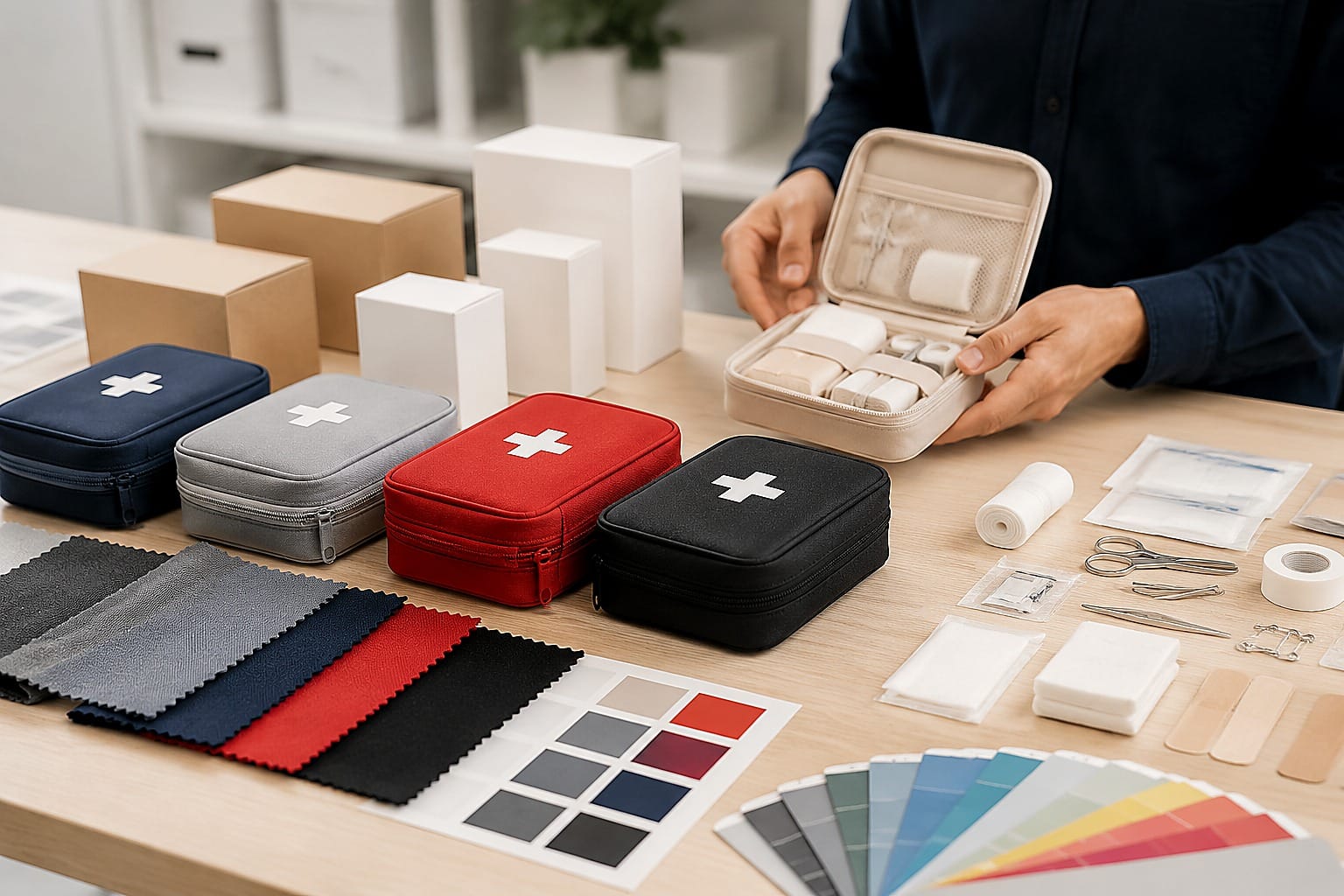
Buyers often use the word “sample” for items with different purposes. The approval record should name the stage because a print swatch cannot authorize a loaded kit, and a concept unit may contain deliberate placeholders.
| Sample stage | Main decision | What may remain open | Suitable approval result |
|---|---|---|---|
| Material or print swatch | Color, substrate, coating, or logo application | Kit structure, BOM, labels, and packing | Approve only the tested attribute |
| Empty-container sample | Dimensions, pockets, seams, closures, carrying method | Final contents and loaded fit | Approve container design with stated conditions |
| Concept loaded sample | General capacity, layout, access, and presentation | Some SKUs, artwork, or retail packing | Request revision or approve project direction |
| Pre-production reference | Proposed bulk configuration and packing | Only written, accepted exceptions | Release, conditional release, or reject |
The pre-production reference should resemble the proposed bulk unit closely enough to test counts, loaded fit, printed applications, labels, inserts, closure function, and packing. If a production component is unavailable for the sample, mark the substitute on the BOM and in the exception list. Do not rely on a verbal promise that it will change later.
Projects still choosing a baseline can compare standard first aid kit configurations before requesting custom changes. The page supports format discussion. The quoted specification and physical sample remain the evidence for the order under review.
Run the inspection in a fixed order. Start with identity and records, then verify contents, branding, function, and packing. This prevents a polished logo from distracting the reviewer from a wrong component or an unrecorded substitution.
Use the following first aid kit sample validation sequence:
For projects built around a custom bag, the logo and branding methods comparison can help buyers identify which physical applications need sample evidence. Digital artwork confirms content and placement, but the applied sample shows how the chosen process behaves on the actual material and shape.
A useful finding identifies the requirement, observed condition, evidence, decision, and next action. “Logo wrong” is too broad. A workable entry might state that artwork revision C was required, revision B appeared on the front panel, photograph 08 records the issue, and a new applied panel is required before release.
| Record field | What to enter | Why it matters |
|---|---|---|
| Finding ID | Stable number such as SV-012 | Keeps comments traceable across revisions |
| Requirement reference | BOM line, drawing, artwork ID, or packing clause | Connects the issue to agreed evidence |
| Observed condition | Specific count, dimension, mismatch, or function result | Removes subjective wording |
| Evidence | Photograph number, measurement, or file comparison | Lets both teams review the same fact |
| Classification | Critical project stop, major, minor, or observation as contractually defined | Supports consistent disposition |
| Disposition | Accept, rework, replace, clarify, or resample | Records the commercial decision |
| Owner and due date | Named buyer or supplier contact and date | Prevents open points from disappearing |
An exception is not automatically a defect. It may be a declared difference between the sample and the intended bulk unit. The buyer still needs to decide whether the difference is acceptable, whether documentary evidence is enough, and whether it changes fit, labeling, documents, cost, lead time, or inspection criteria.
Avoid signing a sample while unresolved points remain in scattered emails. Consolidate them into one exception register. If the buyer grants conditional release, state the conditions and the evidence required before assembly begins.
No. The approved sample defines a reference configuration; it does not demonstrate that every bulk unit matches it. Production introduces repeated assembly, printing, packing, and material-handling steps. The purchase agreement should separately define in-process checks, pre-shipment inspection, defect categories, sampling method, acceptance criteria, and required records.
ISO 2859-1 describes sampling procedures indexed by acceptance quality limit for lot-by-lot inspection. A citation alone does not choose an inspection level, sample size, or defect limit for a buyer. Those decisions must be defined for the order and its risks.
Private-label roles also require market-specific review. The US FDA’s page on who must register and list discusses activities that include manufacturing, repackaging, relabeling, and specification development. Buyers should map their actual products and activities to applicable requirements rather than assuming that supplier documents or sample approval settle their responsibilities.
Keep sample validation and compliance review connected but distinct. The sample record can verify that a specified label or document was supplied. Qualified market review determines whether the specified information and evidence are appropriate for the destination and commercial role.
The final record should be short enough to use and precise enough to audit. It needs a clear decision, not a folder of photographs without context. Both parties should be able to identify which physical unit and file set were approved months later.
Include these release fields:
A change after release should trigger an impact review. Compare the old and proposed SKU, attribute, artwork, or packing instruction. Record effects on labels, documents, fit, cost, timing, and inspection. Then decide whether approval by document, component sample, applied artwork sample, or a new loaded kit is proportionate.
Keep the first aid kit sample validation record with the purchase-order file so production, inspection, and repeat-order teams use the same approved baseline.
The same control should continue into repeat orders. First aid kit sample validation creates a baseline, while change records preserve that baseline without pretending components and materials will remain available indefinitely.
There is no universal quantity. The buyer needs enough units for the planned reviews without confusing different revisions. One unit may support an early capacity discussion, while separate buyer and supplier reference units can improve control after final approval. Additional units may be needed for packaging, transport, laboratory, customer, or tender checks when the project specifically requires them. State the purpose and custody of each sample before ordering. More samples do not correct an unclear BOM or approval process. A smaller set of clearly identified units, each tied to the same revision pack, is more useful than several untracked samples.
Video can close some visual questions, such as confirming a revised label position or showing the count of a simple component. It has limits. The buyer cannot directly measure dimensions, assess color under controlled conditions, operate closures, inspect print texture, repack the contents, or retain the unit as a future reference. Decide based on the finding and its effect. A low-impact clarification may need photographs or video, while container construction, loaded fit, material application, or several interacting changes may justify another physical sample. Record why the selected evidence was accepted.
Teams sometimes use “golden sample” to mean the final approved physical reference. The label itself has no value unless the unit is identified and connected to controlled records. Record the sample ID, BOM, container and artwork revisions, approved exceptions, date, photographs, approvers, and storage location. Seal or mark the reference in a way that prevents routine use or accidental component replacement. The purchase documents should state how the sample will be used during production and inspection. If a later approved change makes it obsolete, update its status and create a new reference rather than silently modifying it.
The buyer should assign someone with authority over the relevant decision. A brand reviewer may approve logo appearance but lack authority to approve component substitutions, destination labeling, commercial changes, or bulk release. Complex projects may need input from sourcing, quality, packaging, regulatory, and brand owners, followed by one named release authority. The supplier should acknowledge the same revision pack and exceptions. Define this responsibility in the project brief. Approval from an unnamed email account or messaging thread makes later disagreements harder to resolve, especially when several samples and artwork versions circulated at the same time.
First identify the governing requirement and determine whether the difference was an approved change, an accepted exception, or an unapproved deviation. Preserve photographs, measurements, labels, cartons, affected quantities, and lot information received with the shipment. Do not rely only on a side-by-side visual judgment. Review the purchase order, BOM, specifications, artwork, reference-sample record, change log, and inspection terms. The parties can then determine containment, rework, replacement, concession, or another contractual action. The appropriate response depends on the difference, product, market, quantity, agreement, and evidence, so one generic remedy should not be promised in advance.
First aid kit sample validation works when the physical unit and the project records tell the same story. Freeze the review pack, inspect in a repeatable order, record each exception, and issue a named release decision. That gives procurement and production teams a shared reference for bulk work while leaving bulk inspection and destination-market responsibility visible.
The sample is only evidence against something, so writing the bag specification sheet first gives the approval step a fixed reference instead of a verbal brief.
Sample review settles quality, not selection: the scoring matrix for comparing OEM first aid kit suppliers is what narrows a shortlist to the two factories worth sampling.
A private-label kit can have the right contents and still arrive as the wrong product if the packaging cannot hold the load, the label omits required information, or the logo process fails on the chosen surface. Private label first aid kit packaging should therefore be specified as a sourcing system: container format, substrate, closure, decoration, label data, packing configuration, sample approval, and export documentation are one connected decision.
The practical approach is to choose a packaging family first, map the physical and information requirements second, and release production only after a representative sample is checked. A logo-only instruction is too thin for a factory quotation. The supplier needs enough detail to confirm feasibility, tooling, setup costs, minimum order quantities, carton use, and any destination-market review the buyer must complete.

Packaging has four jobs in a B2B first aid project. It must protect the contents during storage and transport, make the assortment understandable to the intended user, present the buyer’s brand consistently, and provide controlled information for downstream sales and import review. Those jobs can pull in different directions. A rigid case may protect contents but add freight volume. A soft pouch may reduce cube but require better internal organization and seam checks.
Before asking for artwork, write a short packaging brief with these inputs:
This brief lets a supplier price the same object that the buyer intends to sell. It also gives the buyer a record against which substitutions can be reviewed. A packaging change that appears minor on a screen can alter the bill of materials, packed dimensions, or label area. That control is central to private label first aid kit packaging because the brand owner must approve the physical product, not only an artwork file.
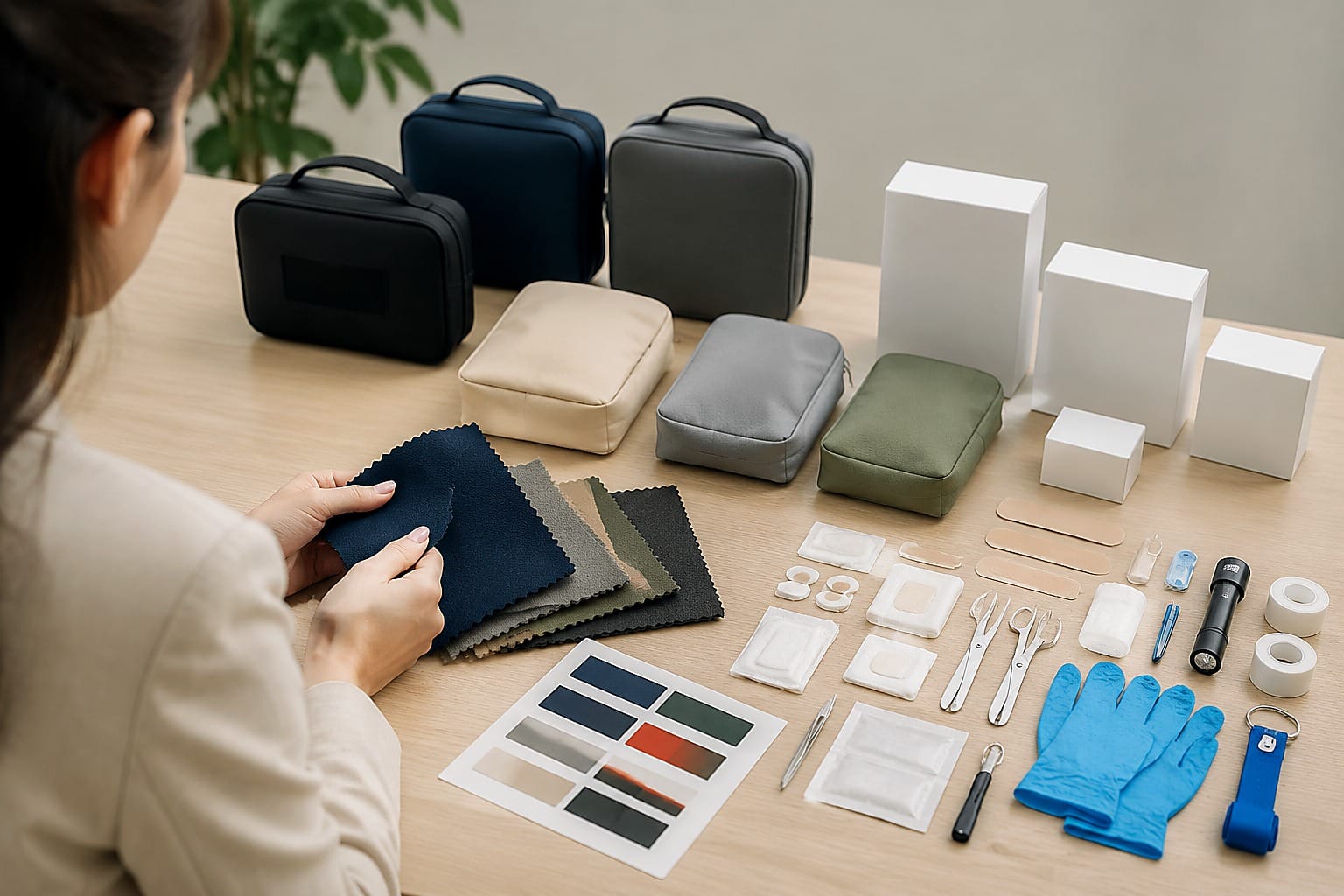
The format should follow the use case and refill pattern rather than the logo. Soft bags suit programs that value low empty weight and flexible storage. Hard cases provide a more defined shell and can protect components from compression. Folding cartons create a broad print area and efficient flat shipment, but the inner organization must prevent items from moving into a single pile. A hybrid approach can combine a branded carton with a reusable pouch.
| Format | Useful strengths | Questions to resolve before quoting | Typical branding routes |
|---|---|---|---|
| Soft pouch or bag | Low empty weight, flexible storage, multiple carry formats | Fabric, coating, seam access, zipper or hook-and-loop, loaded sag | Screen print, heat transfer, woven label, patch, embroidery |
| Rigid plastic or metal case | Defined protection, stackable shape, repeatable cavities | Wall thickness, hinge, latch, gasket, insert fit, tooling | Pad print, UV print, label, molded mark |
| Folding carton | Large printable panel and efficient flat shipment | Board grade, folding tolerance, internal tray, moisture exposure | Offset or digital print, label, spot finish where feasible |
| Hybrid pouch and carton | Reusable inner pack with retail presentation | Two-part BOM, fit between components, separate approval samples | Printed carton plus textile or plastic marking |
The equipped and customizable first aid kit category is a useful reference when comparing loaded formats. It does not replace a buyer-approved component list. Ask for the loaded dimensions and a sample because empty measurements cannot show whether the contents remain accessible or whether the closure is under strain.
Branding is a process choice tied to the substrate and artwork. Screen printing can suit simple, solid-color marks on a stable fabric panel. Heat transfer can carry finer details on compatible textiles, but the supplier should confirm the coating and the press conditions. Woven labels and patches create a separate badge that may be useful when the bag is reused across programs. Embroidery adds texture and thread but can reduce detail in small lettering. Rigid cases may need pad printing, UV printing, or a pressure-sensitive label instead.
The method should be written into the sample record with the artwork version, color reference, dimensions, position, and acceptable tolerance. Do not approve a digital mock-up alone. Inspect a physical sample after the actual decoration process. Check registration, fine text, contrast, edge lift, surface distortion, and how the mark sits beside seams, handles, zippers, hinges, or molded ribs. The earlier guide to custom first aid kit logo methods explains why the same artwork can behave differently on woven fabric, coated nylon, and rigid plastic.
For recurring orders, keep the approved mark as a controlled reference. Record the Pantone or other agreed color reference where applicable, but also record the physical sample ID. Color references do not describe every coating or fabric surface. A retained sample gives the factory and buyer a shared comparison point when a repeat order is reviewed.
Packaging information should be separated into brand content, product identification, and market-specific information. The importer or brand owner remains responsible for confirming which statements, symbols, languages, and registrations apply in each destination. A supplier can prepare artwork and provide technical evidence, but a factory quotation is not a regulatory determination.
At minimum, ask the supplier to reserve space for the information that the buyer has confirmed, such as:
GS1 explains the role of identification keys and barcode structures for products and logistics units in its standards library. The U.S. Food and Drug Administration also describes general device labeling responsibilities in its medical device labeling guidance. These are reference sources, not a conclusion that a particular kit is regulated in the same way in every market. Confirm the actual classification and label duties with the destination-market importer or qualified adviser.
The lowest-unit-price package can become the most expensive option after setup, tooling, inserts, color changes, and freight volume are included. Compare private label first aid kit packaging options on a landed-cost worksheet rather than unit price alone. Request a separate line for packaging material, decoration, insert or tray, assembly, sample charges, tooling, and master-carton packing.
Use this comparison sequence:
MOQ is often driven by the least flexible element, not the bag itself. A custom molded case, printed carton, woven label, or special zipper color may each have a different threshold. Ask the supplier to identify the binding MOQ and whether a stock component can be used for a pilot without changing the approved production specification. This is a frequent cost checkpoint in private label first aid kit packaging projects.
A packaging sample should represent the production process. A blank sample is useful for dimensions, but it cannot confirm print quality, label hierarchy, or packed fit. For private label first aid kit packaging, request a sequence that matches the project risk:
Record who approved each stage and what changed. If the loaded sample requires force to close, leaves liquid items unrestrained, hides a label, or creates a sharp contact point, pause the approval and request a correction. Keep photographs and measurements with the purchase specification. The private-label first aid kit sourcing guide provides a broader sample-to-bulk control structure that can be adapted to packaging-led projects.
There is no single flexible format for every channel. A soft pouch usually gives the buyer more freedom on pocket layout, carry options, and low-volume logo testing. A folding carton offers broad print coverage but depends on a reliable inner tray or pack order. A hybrid can separate retail presentation from reuse. Select the private label first aid kit packaging format after measuring the loaded components and stating the expected access and refill pattern. Then ask the supplier which existing structures can meet the brief without a new mold or an untested material combination.
Often, a stock bag, case, or carton can reduce setup time for a pilot, but the assumption must be written into the quote. Confirm that the stock structure has enough label area, the same loaded dimensions, and the closure or insert needed for the final configuration. Mark the pilot as a separate revision if the bulk package will use a custom structure. This prevents a pilot sample from becoming an accidental production reference with different materials, decoration, or packing behavior.
The number depends on the risk and the number of variables. At least one structural sample and one decorated, loaded sample are sensible starting points for a private-label kit. Add a carton or packing sample when freight cube, stacking, or shipping protection affects the commercial decision. If the project uses several bag sizes, languages, or decoration methods, approve a representative sample for each meaningful variant. List every sample ID and artwork revision on the purchase record.
The importer, brand owner, or designated compliance adviser should confirm the destination-market requirements. A supplier can identify available label fields, provide material and process information, and prepare artwork against buyer instructions. That support does not transfer the importer’s responsibility. Confirm product classification, language, symbols, responsible-party details, barcode rules, and any registration or documentation obligations before the final artwork is released for bulk production.
Include the loaded bill of materials, finished dimensions, container format, substrate, closure, decoration method, artwork files, label fields, carton data, quantity tiers, sample stages, inspection points, and shipment assumptions. Ask the supplier to mark each item as stock, modified stock, or new development. Request separate one-time and recurring charges. This makes quotes comparable and exposes the assumptions that can otherwise surface as a late change, new MOQ, or revised delivery window.
Printing is the layer of packaging that outlives the first shipment, because the carton, sleeve or insert stays with the buyer after the kit contents are consumed. A custom first aid packaging printing specification framework sets out the substrate, dieline revision, colour reference and tolerance fields that make two packaging quotations describe the same object.
A logo looks sharp on a digital proof, yet the bulk bags arrive with lost detail, weak contrast, or print crossing a seam. A custom first aid kit logo should be selected as a material-and-process decision, not added to an RFQ as a single line that says “print our logo.”
The practical answer is to match the method to the bag or case substrate, logo detail, print area, expected handling, order quantity, and replacement plan. Screen printing often suits simple artwork on accessible fabric panels. Heat transfer can carry finer or multicolor artwork on compatible materials. Embroidery and patches create a textile badge effect. Labels, pad printing, UV printing, or molded marks may suit rigid cases. Every choice still needs supplier feasibility review and an approved physical sample.
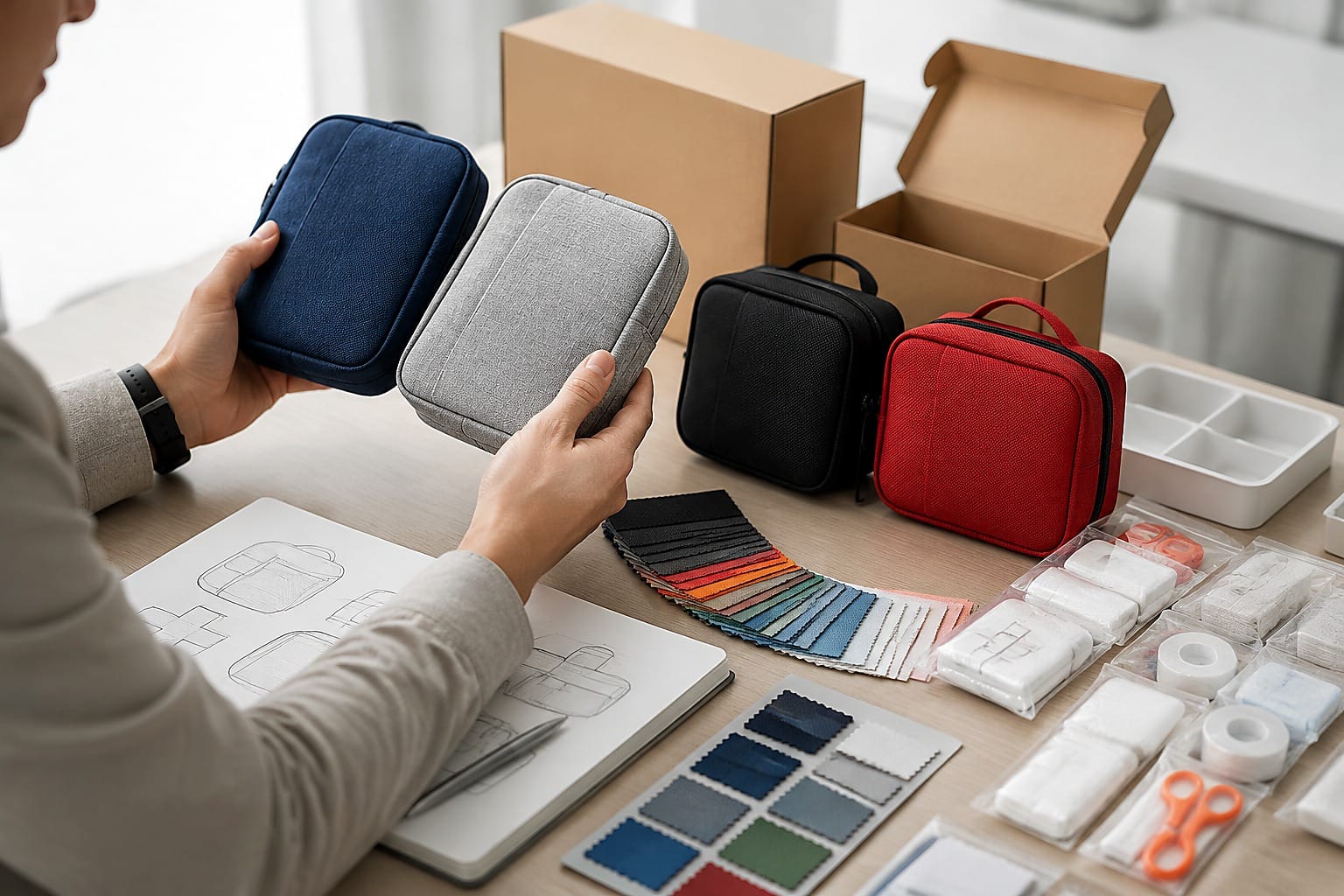
Start with the unbranded container specification. A printing method cannot correct a bag panel that is too textured, a case surface that is sharply curved, or a logo area interrupted by webbing and zippers. Ask the supplier to identify the actual substrate and coating at the proposed application point, not only the general bag material.
Use this seven-step decision sequence:
This sequence matters because the same logo can behave differently on woven polyester, coated nylon, molded plastic, painted metal, and a textured hard case. Even two visually similar red bags may use different coatings or surface finishes. The supplier should disclose those differences before artwork release.
For the wider sample-to-bulk process, use the OEM private-label first aid kit guide as the project control document. The logo method should connect to the same BOM, container specification, sample record, and change process.
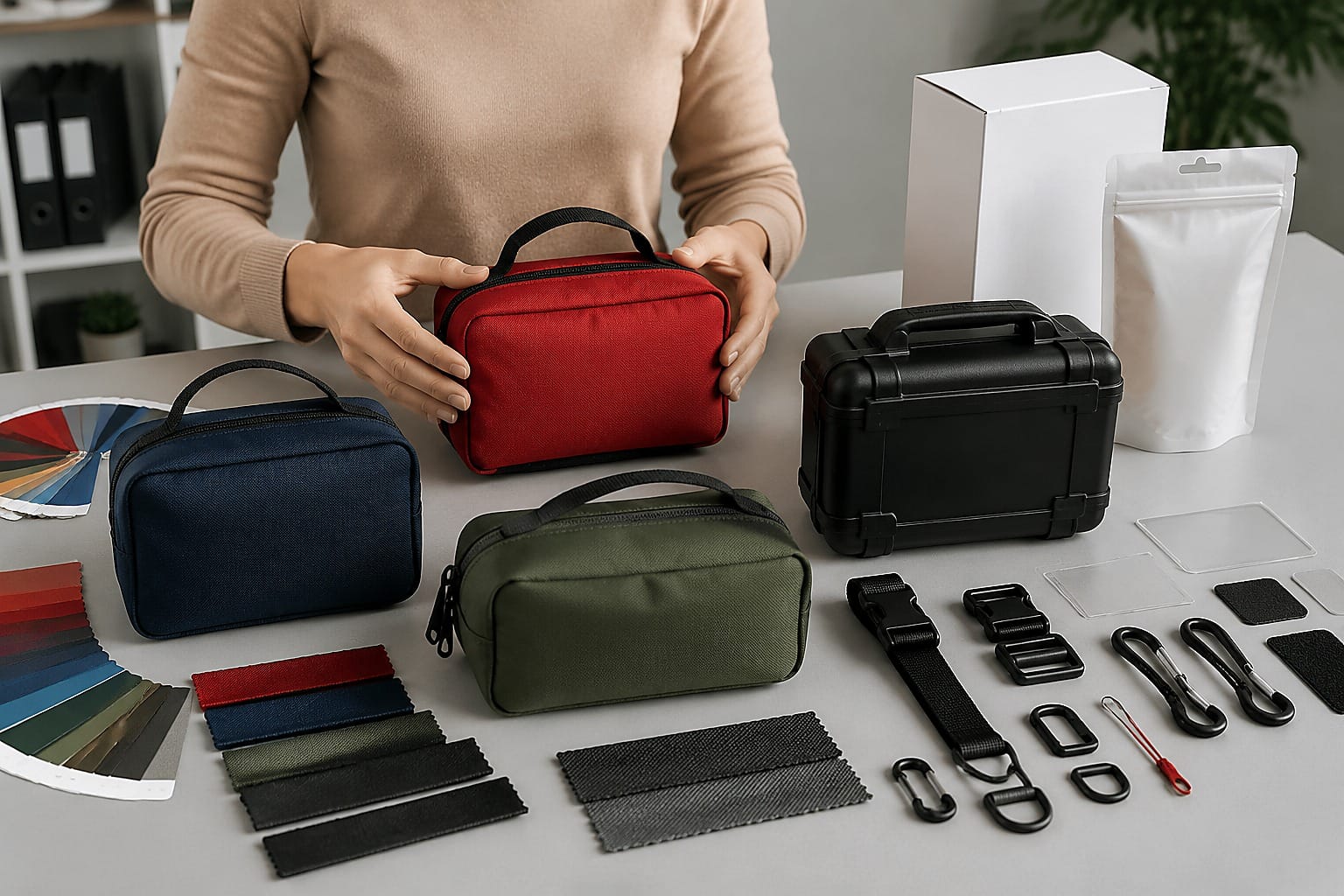
No method is universal. The following table is a sourcing comparison, not a production promise. Actual feasibility depends on the quoted material, coating, construction, equipment, artwork, and order quantity.
| Branding method | Typical starting use | Main advantages | Limits to verify | Sample evidence |
|---|---|---|---|---|
| Screen printing | Simple one-color or limited-color artwork on an accessible fabric panel | Direct application and economical repeat production where setup is spread across volume | Ink compatibility, textured weave, color opacity, registration, seams, panel access | Printed production-material panel or finished bag |
| Heat transfer | Fine detail, several colors, or variable graphics on compatible textile panels | Can reproduce detail without separate stitching around every element | Heat and pressure compatibility, film edge, cracking, peeling, gloss, coated-fabric change | Finished application after flex and rub checks |
| Embroidery | Bold marks on fabric panels with enough structure and clearance | Tactile textile appearance and no printed film surface | Small text, dense detail, backing visibility, panel stiffness, needle penetration, seam access | Finished panel showing front and reverse construction |
| Sewn woven or embroidered patch | Modular branding, stock bags, programs that may replace or revise a badge | Patch can be produced separately and attached to a standard container | Added thickness, border shape, stitch path, snag points, removal policy | Finished attached patch with dimensions and stitch specification |
| Molded rubber or plastic badge | Tactile multicolor badge on compatible soft bags or cases | Raised form and separate badge production | Tooling, attachment method, material disclosure, color tolerance, odor, edge lift | Finished badge attached by the proposed production method |
| Pressure-sensitive label | Shorter runs, serialized programs, or smooth rigid surfaces | Separate label production and easy information changes | Adhesive compatibility, texture, edge lift, temperature, moisture, cleaning, residue | Label on the actual case after conditioning and adhesion checks |
| Pad or direct digital printing | Small marks on rigid or mildly contoured case surfaces | Direct mark without a sewn textile component | Curvature, surface energy, texture, opacity, scratch resistance, fixture consistency | Printed production case from the proposed line |
| Embossed, debossed, or molded-in mark | Long-running molded case or component program | Integrated form with no separate printed layer | Tooling cost, limited color effect, mold ownership, revision cost, long-run commitment | Tool drawing, first article, and approved molded reference |
Screen printing is often the first quotation route for a simple custom first aid kit logo, but “screen print” is not a complete specification. Record the number of colors, finished dimensions, position tolerance, ink or print-system reference, background material, and approved sample. A white mark on red fabric may need a different production approach from a dark mark on a pale uncoated panel.
Heat transfer is useful when artwork has several colors or detail that would be difficult to separate cleanly. The buyer should still inspect the edge, surface feel, flexibility, and behavior on the exact coated or uncoated fabric. A successful transfer on a flat swatch does not prove that the production bag can be pressed safely beside padding, binding, or a zipper.
Embroidery works when the logo can tolerate thread-based simplification. Very small letters, narrow gaps, and color gradients may need artwork changes. Ask for the stitch area, thread colors, backing, reverse-side finish, and panel construction. Confirm that the logo does not make a pocket stiff or interfere with a lining, divider, or water-resistant construction claim.
Patches separate badge production from bag production. That can help a buyer use one base bag across several channels or languages. It also creates another controlled component. The RFQ should state whether the patch is permanently sewn, attached with hook-and-loop, or supplied separately, and whether removal is intended.
Rigid cases need their own review. A pressure-sensitive label may be practical for a trial program, while direct printing or a molded mark may fit a stable high-volume design. Surface texture, curves, mold-release residue, paint, and cleaning agents can affect the result. Ask the supplier to test the actual production surface.
Branding sits on top of a substrate, so the fabric and coating decision comes first, as set out in this custom first aid bag manufacturing guide.
Buyers can review emergency medical bag formats before fixing the logo area. Format selection comes first because pockets, folds, handles, and access panels determine where branding can be applied and inspected.
A screenshot or logo copied from a website is not a controlled print file. Supply an artwork pack with a revision number and a named approver. Adobe’s explanation of vector and raster files notes that vector graphics use mathematical equations and can be resized without the pixelation associated with raster images. That makes an approved vector master a useful starting point for scaling and color separation.
The artwork pack should contain:
Pantone describes its systems as tools for selecting, communicating, and matching color. A Pantone reference can improve communication, but it does not make every substrate or print process visually identical. Fabric texture, coating, ink film, thread, molded material, gloss, and lighting all influence appearance. Approve an allowed visual range or physical reference rather than treating one code as the complete acceptance rule.
Do not place operational content inside the brand artwork unless it is controlled as label content. A logo file, contents list, barcode, importer detail, product identifier, and language panel may follow different approval routes. Keeping them separate makes later address, barcode, or market-language changes easier to trace.
The International Committee of the Red Cross explains that the red cross, red crescent, and red crystal are protected emblems under international and national law. A buyer should not assume that a cross-shaped medical graphic is available for unrestricted commercial branding. Review the proposed symbol, color, jurisdiction, and authorized use before releasing artwork.
Define what the factory can measure. “Centered on the front” is ambiguous when a bag has a curved top, asymmetrical pockets, or a handle that changes the visible center.
A custom first aid kit logo placement record should state:
| Field | Example of a controlled entry |
|---|---|
| Application | Front upper pocket, outer face |
| Finished size | Width and height in millimeters |
| Position | Distances from named seam, edge, zipper, or molded datum |
| Orientation | Parallel to specified seam or case edge |
| Background | Named material, finish, and production color |
| Method | Screen print, transfer, embroidery, patch, label, or other approved route |
| Color | Named spot, process build, thread code, or approved physical reference |
| Tolerance | Buyer-approved dimensional and position range |
| Artwork | File name, ID, and revision |
| Reference | Approved swatch or finished-sample ID |
Place the mark where it remains visible during intended use but does not cover identification panels, inspection windows, instructions, reflective elements, attachment points, or closures. Check the bag both empty and loaded. A panel can bow after packing, which changes apparent alignment and may crease a transfer.
Ask the supplier to show the printable area before finalizing dimensions. Reducing the logo slightly may avoid a seam or zipper and produce a more consistent result. Enlarging it to fill every available millimeter can expose artwork to folds and abrasion.
Contrast also needs a physical review. A thin white line that looks clear on a screen may disappear into a coarse red weave. A dark logo may be unreadable on a black case under warehouse lighting. Approve the finished application from the expected viewing distance, not only a magnified proof.
If a barcode or scannable code shares the panel, control it separately. GS1 provides a barcode verification framework for checking identity data, while print and scan acceptance should follow the applicable barcode specification and the buyer’s system. Do not approve a scannable symbol from visual appearance alone.
A digital proof checks content and approximate placement. It cannot show ink opacity, adhesive behavior, thread construction, film edge, texture, or the effect of flexing a loaded bag. The approval sample should use the intended production material, color, construction, method, and artwork revision.
Use a documented test plan rather than the instruction “make it durable.” A practical sample review can include:
For textile color transfer, ISO 105-X12 specifies a method for determining textile color fastness to rubbing. Its scope should be checked before use because a test for textile color fastness is not automatically an acceptance test for every ink, transfer film, patch, or complete bag. Buyers should define the test specimen, conditioning, assessment, and pass criteria with the responsible quality team.
For some coatings on rigid substrates, ASTM D3359 describes tape-test methods for assessing coating adhesion to metallic substrates. It also states limitations. It should not be cited as a universal label, fabric, or bag test. Use a standard only when its scope fits the material and failure mode.
The custom first aid kit logo sample is part of the pre-production reference. If the supplier changes fabric, coating, ink system, transfer film, thread, adhesive, badge material, equipment route, or application location, the buyer should decide whether a new sample is required.
“Logo defect” is too broad for inspection. Divide failures into categories that can be counted and resolved.
| Defect category | Examples | Control record |
|---|---|---|
| Wrong content | Old logo, misspelling, missing element, unapproved symbol | Artwork ID and visual master |
| Wrong color | Incorrect color reference, poor opacity, unapproved thread | Color reference and accepted sample |
| Position or size | Outside the stated tolerance, rotated, crosses excluded area | Dimensioned placement drawing |
| Registration or detail | Misaligned colors, filled small gaps, broken thin lines | Approved production sample |
| Surface defect | Peeling edge, bubble, crack, scratch, ink skip, loose thread | Method-specific defect standard |
| Attachment defect | Missed stitches, exposed backing, lifted badge, loose patch | Attachment specification |
| Container damage | Scorching, coating change, distortion, puncture in restricted area | Container specification and sample |
The buyer should classify which defects require rejection, rework, or documented concession. That decision depends on the application, order, contract, and risk. A cosmetic position shift may be handled differently from the wrong brand file or an unauthorized emblem.
Inspection also needs a sampling approach. The Cluster C pillar explains how sample, artwork, and bulk inspection records fit together. The purchase order should name the controlling artwork and sample, define inspection timing, and state who can approve a deviation.
Avoid approving a sample with the note “bulk should be better.” Either approve the sample as the reference, reject it, or approve a clearly documented correction that will be verified before full production. Ambiguous approval moves unresolved work into the bulk order.
The finished kit MOQ may not be the logo MOQ. Screen preparation, transfer setup, embroidery programming, patch production, label conversion, molded-badge tooling, and case fixtures can each create a separate cost or quantity driver. Ask the supplier to separate one-time setup, unit application, custom-component MOQ, and sample charges.
For a lower-volume launch, buyers can compare these options:
Lowering the number of custom layers can reduce a genuine setup constraint. It should not remove artwork control, sample approval, or inspection criteria. A short run still needs a repeatable reference.
For reorders, require the supplier to confirm whether the substrate, coating, background color, print system, transfer film, thread, patch, adhesive, tooling, and application location remain unchanged. “Same logo” does not prove the production route is unchanged. Record any proposed change before materials are committed.
Tool ownership also belongs in the commercial record. If the buyer pays for screens, dies, embroidery files, molds, plates, or fixtures, state who owns them, where they are stored, how long they are retained, and what happens when artwork changes. Do not assume a setup charge automatically transfers ownership.
An RFQ should let suppliers quote equivalent branding scopes. Include a separate response line for each application rather than asking for one total “logo cost.”
| RFQ field | Buyer provides | Supplier confirms |
|---|---|---|
| Container | Model, material, color, construction, target quantity | Actual substrate at application point and feasibility |
| Artwork | Vector file, variants, color references, dimensions | Required file conversion or simplification |
| Placement | Dimensioned location and excluded areas | Printable area, fixture or access limits, tolerance proposal |
| Method | Preferred method or performance objective | Proposed process and material compatibility |
| Sample | Required quantity, tests, approval route | Sample cost, preparation factors, and production-process match |
| Commercial | Quantity tiers and reorder forecast | Setup, tooling, unit application, MOQ drivers, storage terms |
| Inspection | Defect categories and sampling request | In-process and final checks, records, deviation route |
| Continuity | Change-notice requirement | Controlled inputs and resampling triggers |
| Packing | Protection for printed or raised surfaces | Unit separation, abrasion prevention, carton arrangement |
Ask for alternatives when the preferred custom first aid kit logo method conflicts with the bag material or launch quantity. The response should explain the tradeoff. A lower setup option may have different edge, texture, color, or longevity characteristics. A higher-volume method may need tooling but reduce unit application work.
Keep branding separate from the kit contents quotation. This makes it easier to see whether cost changes come from the bag, logo, component BOM, retail packaging, or export packing. It also prevents a logo revision from silently changing the approved kit configuration.
Buyers preparing a supplier discussion can use UneedAid’s OEM and ODM project overview to identify the container, contents, branding, packaging, and sample layers that need separate confirmation. The final RFQ should still record the exact quoted method and production assumptions.
No. Screen printing depends on the actual textile, coating, texture, panel access, ink system, artwork, and production setup. A supplier should review the precise application area because a general material name such as polyester does not describe every weave or finish. Seams, padding, zippers, and pockets can also limit access or registration. Ask for a print on production material and, where construction may affect the result, a finished-bag sample. Record color, dimensions, position, and accepted appearance. Do not approve the method from a catalog photograph of a different bag.
The method name alone does not establish service life. Embroidery avoids a printed surface film, but thread, stitch density, backing, panel construction, abrasion, cleaning, and snag exposure still matter. Printing performance also varies by ink, transfer system, substrate, curing, and use conditions. Compare methods against a defined handling and inspection plan on the actual container. Embroidery may suit bold textile marks, while small lettering or gradients may need simplification. The approved sample and repeat-order controls are more useful than a general durability claim.
A PDF can confirm artwork content, approximate placement, and stated color references. It cannot reproduce every physical color result because screens, printers, fabric, ink, thread, gloss, texture, and lighting differ. Use the digital proof to approve geometry and file revision, then approve a physical swatch or finished application for appearance. Record the substrate, method, color reference, lighting or viewing conditions where important, and accepted sample ID. For repeat orders, compare the proposed materials and process with that reference before assuming the result will match.
There is no single answer. A standard container with a simple print, compatible transfer, or separately produced label or patch may reduce structural customization, but each option has different setup, attachment, appearance, and inspection needs. Ask the supplier to quote two or three defined alternatives using the same bag and artwork dimensions. Compare setup cost, unit cost, MOQ driver, sample route, lead-time factors, and reorder consistency. A low initial charge is not useful if the method cannot meet the approved material, placement, or handling requirements.
Repeat or reconfirm the sample when a change could affect appearance or attachment. Examples include a new fabric, coating, case resin, background color, ink, transfer film, thread, patch supplier, adhesive, tool, machine route, application position, artwork revision, or logo size. The buyer can decide whether a swatch, first article, or complete loaded sample is proportionate. Require written change notice before production. If nothing changed, retain evidence that the supplier reviewed the controlled inputs against the prior approved reference.
A controlled custom first aid kit logo specification links the container material, artwork, method, placement, sample, defects, commercial drivers, and change rules. Approve the physical result and keep its revision with the wider OEM project file. That gives the buyer and supplier one measurable reference from quotation through repeat orders.
Marking decisions depend on the housing they sit on, and the fields that lock a bag down in a specification sheet are what keep a logo placement stable from the sample through to the repeat order.
Branding is one of six fields that decide whether two quotes describe the same object. The empty first aid kit bag and box sourcing guide places it alongside dimensions, material, interior configuration, packing and commercial terms.
The mark on the bag or case is only one printed surface in a private-label project. The carton, sleeve, insert card and master carton are specified separately, and this custom first aid packaging printing methods guide covers that layer so both surfaces share one revision history.
A buyer approves a neat sample, places a bulk order, and later finds that component labels, pouch sizes, or carton marks no longer match the signed files. OEM private label first aid kits avoid this failure when the sample is treated as a controlled production reference, not a sales display.
The practical process is to define the market and use case, freeze a bill of materials, approve actual artwork and a loaded sample, and write the inspection and change rules before bulk assembly. This guide gives distributors, importers, resellers, and institutional sourcing teams a sample-to-bulk framework. It does not prescribe a universal kit content list or replace destination-market review.
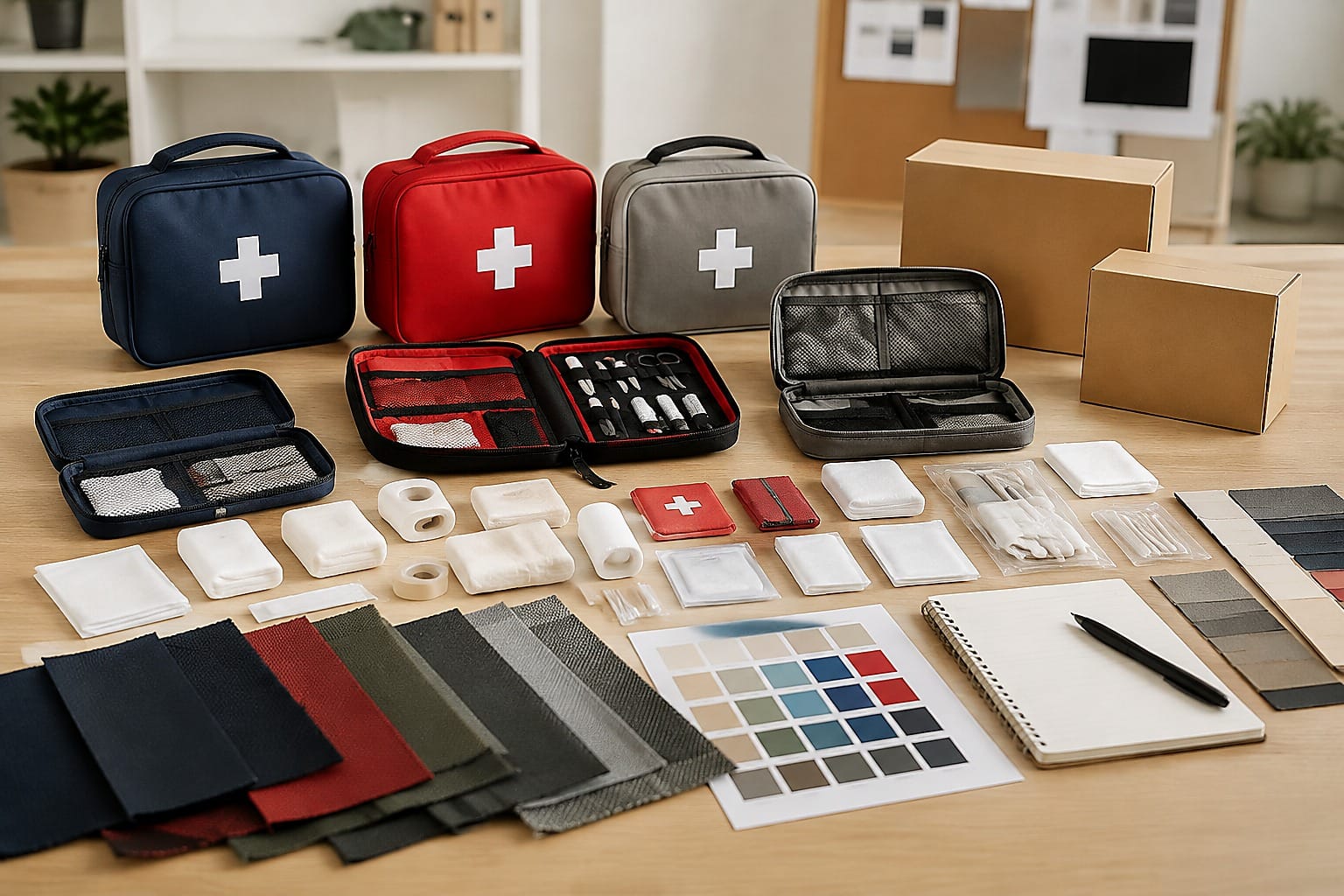
An OEM request needs more than a logo file and a target piece count. The supplier must know what is being customized, which decisions remain open, and which market receives the finished configuration. Otherwise, two quotations can appear comparable while using different bags, contents, label routes, and packing assumptions.
Start with eight project inputs:
This brief lets a supplier separate stock elements from custom work. A stock red bag with one printed logo is a different project from a custom-color backpack with new pockets, buyer-defined contents, multilingual labels, and retail packaging.
Buyers can use UneedAid’s OEM and ODM project overview to frame the first feasibility discussion. The final quotation still needs to identify the exact configuration, documents, customization limits, and buyer approvals.
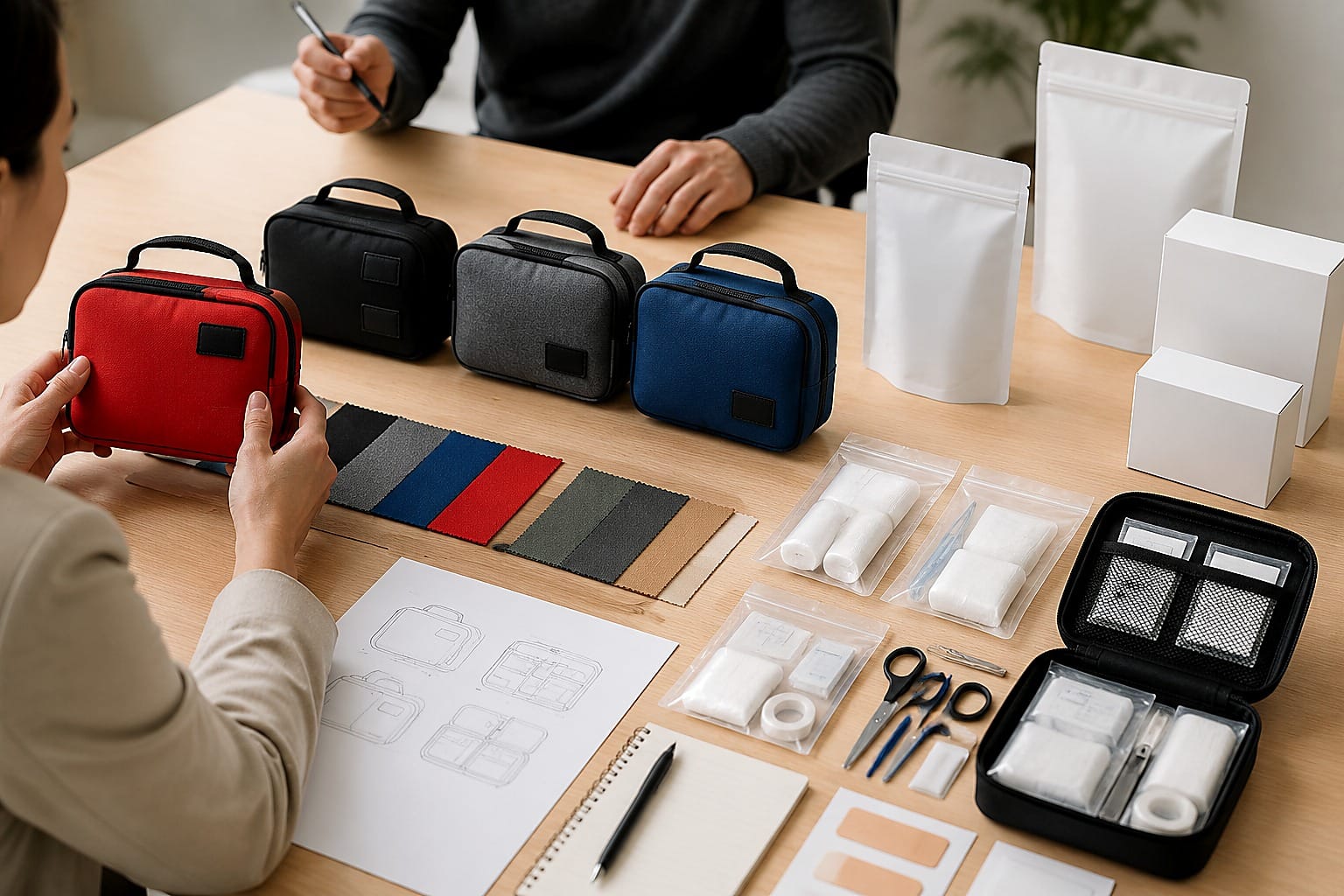
Customization has several layers. Approving them in the wrong order creates rework. A printed insert cannot be finalized if the BOM is still changing. A bag compartment map cannot be approved until the approximate component volume is known.
| Customization layer | Decision to freeze | Common dependency | Approval evidence |
|---|---|---|---|
| Kit concept | Use case, channel, destination, target quantity | Buyer program and market route | Written project brief |
| Contents | SKU, description, size, quantity, pack unit, substitution status | Availability and document review | BOM revision |
| Container | Format, material description, dimensions, color, internal layout | Loaded component volume | Loaded sample and specification |
| Branding | Logo method, print area, color reference, artwork position | Container material and print process | Artwork proof and physical sample |
| Unit packaging | Label, insert, barcode, language, seal, retail box | Final contents and market requirements | Approved artwork revision |
| Export packing | Unit count, carton size, carton mark, pallet request | Final packed unit dimensions | Packing specification |
The kit concept and provisional BOM should come first. The supplier can then assess whether an existing container fits or whether the bag or box needs structural changes. Branding and retail packaging follow after the configuration is stable enough to support accurate dimensions and label text.
For early format selection, compare standard kit configurations as baselines. A baseline shortens discussion, but it should not be presented as automatically suitable for every workplace, tender, channel, or jurisdiction.
The BOM is the central record for OEM private label first aid kits. Photos, piece counts, and product names are supporting material. They do not replace line-by-line specifications.
Each BOM line should contain a stable line number, buyer code or supplier SKU, product description, size, material or format where relevant, quantity per kit, pack unit, label route, lot or expiry field where applicable, document status, and substitution rule. If the item uses buyer artwork, add the artwork revision.
Use explicit status values such as approved, alternative proposed, document pending, sample pending, or unavailable. A blank cell is ambiguous. It may mean stock is unconfirmed, a document was not requested, or the supplier has not reviewed the line.
The BOM should also state how changes are handled:
This process matters because a visually similar component can have a different size, pack unit, label owner, shelf-life presentation, or supporting file. It may also change how the loaded kit closes or how many kits fit in a master carton.
A concept sample answers, “Is this direction workable?” A production reference sample answers, “Is this the configuration we authorize for bulk assembly?” Mixing those purposes is a frequent source of disagreement.
Fabric, colour and hardware are the three lines that decide whether the sample matches the bulk order, and this guide to custom first aid bag manufacturing works through each one before sampling starts.
| Sample stage | Main purpose | What may remain provisional | What the buyer records |
|---|---|---|---|
| Material or print swatch | Compare color, fabric, coating, or logo result | Container structure and contents | Swatch code, color reference, print method |
| Empty-container sample | Check shape, construction, pockets, closures, and carrying method | Final BOM and printed component labels | Model, dimensions, materials, construction comments |
| Concept loaded sample | Test capacity, layout, access, and overall presentation | Some components, artwork, and packing | Provisional BOM and exception list |
| Pre-production reference | Authorize the proposed bulk configuration | Only documented exceptions | Frozen BOM, artwork, packing, photos, sample ID |
The pre-production reference should be loaded and labeled as proposed for the order. If a component cannot be represented, the exception must be written. The buyer should not assume that a stock substitute in the sample will automatically be replaced in production.
Record the sample ID, date, BOM revision, bag or box specification, artwork revisions, packing revision, photographs, exceptions, and approver. Keep one agreed reference with the supplier and one with the buyer where the project and shipping arrangement permit.
Inspect the sample against documents first, then test it as a packed unit. An attractive presentation can hide count errors, unreadable labels, strained closures, and compartments that cannot be refilled efficiently.
Use this sequence for OEM private label first aid kits:
For bag-led projects, the emergency medical bag directory helps buyers compare waist, hand-carry, backpack, and fold-out formats before requesting a loaded sample. A directory image does not establish fabric, reinforcement, loaded comfort, or component fit. Those points require the quoted specification and sample.
Private-label projects often contain more artwork files than expected. The bag logo may be only one file among component labels, an instruction insert, barcode label, unit box, polybag mark, inspection label, master-carton mark, and pallet label.
Create an artwork register with these fields:
| Field | Purpose |
|---|---|
| Artwork ID and revision | Prevent an email attachment from becoming the unnamed final file |
| Application | Bag, component, insert, unit box, carton, or pallet |
| Language | Identify the approved language version |
| Dimensions and position | Define print area and placement |
| Color reference | Give the production team a stated reference |
| Print method | Connect the artwork to the actual substrate and process |
| Approval date and approver | Establish release authority |
| Superseded file | Make obsolete artwork traceable |
Digital proofs can verify text, dimensions, and placement. They cannot fully represent ink behavior, fabric texture, curved surfaces, adhesive performance, or color under different lighting. Where those factors matter, approve a physical application sample.
The buyer should also confirm which economic operator appears on labels and which claims are allowed in the destination market. Logo ownership does not answer those questions. They depend on the product, market route, contractual roles, and applicable rules.
Private label does not turn a collection of supplier files into automatic evidence for the finished kit. The regulatory role may depend on the component, claims, labeling, destination, and whether the buyer places the product on the market under its own name.
In the United States, the FDA’s device registration and listing guidance identifies activities such as manufacturing, relabeling, repackaging, and specification development when explaining who may need to register and list. Buyers should assess their actual activity and product classification rather than infer responsibility from the word “OEM.”
For the European Union, Articles 13 and 14 of Regulation (EU) 2017/745 set obligations for importers and distributors. Other obligations may apply to manufacturers, authorized representatives, or a party that makes changes described in the regulation. The buyer should map the actual supply chain and obtain qualified advice when the role is unclear.
Use a responsibility table during sourcing:
| Topic | Supplier evidence | Buyer or importer confirmation |
|---|---|---|
| Product identity | Quoted SKU, specification, label sample | Correct classification and intended market route |
| Document scope | Named model, site, report, certificate, or declaration where applicable | Scope, validity, issuer, and relevance to the ordered SKU |
| Label content | Artwork template and available product information | Required operator details, language, symbols, claims, and local rules |
| Kit configuration | BOM and component files | Whether the assembled assortment creates added requirements |
| Change control | Supplier notification process | Who reviews a changed component or label before release |
This guide cannot determine the legal role for a specific order. That conclusion needs the actual product set, claims, parties, and destination.
One quoted MOQ can hide several separate constraints. The bag, printed label, insert, custom box, and individual components may each have a different production or purchasing batch. The workable project quantity is shaped by the most restrictive approved element and by how surplus materials will be handled.
Ask the supplier to separate these drivers:
Do not convert these factors into a fixed delivery promise before the configuration is frozen. A wording change on an insert can delay print release. A component substitution can reopen document and sample review. A custom fabric color may follow a different schedule from a stock bag.
For OEM private label first aid kits, request a milestone schedule tied to approvals: brief confirmed, BOM confirmed, artwork released, pre-production sample approved, materials available, assembly started, inspection completed, and shipment released. Dates should be updated when an approval or specification changes.
The approved sample is a reference, but the purchase order also needs measurable acceptance criteria. For OEM private label first aid kits, state which files control production and what evidence must be available before shipment.
A practical production release pack contains:
For attribute inspection, buyers may refer to ISO 2859-1, which covers sampling procedures indexed by acceptance quality limit for lot-by-lot inspection. The buyer must choose an appropriate plan and acceptance criteria for the product and risk. Citing the standard without defining defects and inspection levels does not create an inspection plan.
Defect definitions should be specific. “Artwork issue” is broad. Separate wrong language, missing text, wrong revision, unreadable print, incorrect position, color outside the agreed reference, and damaged label. Do the same for BOM counts, container construction, closures, contamination, packing, and carton marks.
The first approved order creates the baseline for later OEM private label first aid kits. Repeat orders should reference that baseline and list every requested change. Reusing only the old product name or a photograph leaves too much room for interpretation.
Before each reorder, ask for a continuity review:
| Review point | Reorder question |
|---|---|
| BOM | Are all SKUs, sizes, quantities, and pack units unchanged? |
| Dated items | Does the proposed remaining shelf-life meet the purchase requirement? |
| Container | Are fabric, color, dimensions, pockets, closures, and reinforcement unchanged? |
| Artwork | Is the same revision still approved, and have addresses or barcodes changed? |
| Documents | Are requested files still current and applicable to the proposed SKU? |
| Packing | Are unit count, carton dimensions, gross weight, and marks unchanged? |
| Inspection | Are the same defect definitions and sampling rules being used? |
The supplier should disclose a proposed change before assembly, not at final inspection. The buyer can then decide whether documentary review, a component sample, an artwork proof, or a new loaded sample is required.
Component continuity does not mean every raw material or upstream source will remain available indefinitely. It means the project has a method for identifying, reviewing, approving, and recording changes before they enter the order.
A structured RFQ makes supplier responses comparable and exposes unresolved assumptions. Ask each supplier to respond in the same table rather than returning only a total price and a catalog image.
| RFQ section | Buyer provides | Supplier confirms |
|---|---|---|
| Project | Channel, use case, destination, target quantity | Feasibility and base configuration |
| BOM | Line-by-line list and substitution rule | Confirmed SKU, exception, alternative, document status |
| Container | Format, dimensions, material, color, layout | Model, customization scope, sample route |
| Branding | Logo, language, barcode, label and packaging needs | Print method, template, setup, MOQ driver |
| Evidence | Required files by product or component | Available file, scope, gap, and timing |
| Samples | Required stages and approval checklist | Cost, preparation factors, courier arrangement |
| Inspection | Defect definitions and sampling request | Proposed checks and records |
| Commercial | Quantity tiers, Incoterm request, packing limits | Price tiers, payment, lead-time factors, carton data |
| Continuity | Forecast horizon and change rules | Notification method and repeat-order process |
Ask suppliers to price standard and custom elements separately. This shows whether the main MOQ or cost driver is the container, a printed component package, the retail box, or assembly. It also gives the buyer alternatives if the first configuration exceeds the launch quantity.
There is no reliable universal lead time. The schedule depends on whether the project uses an existing container and stock packaging or requires new construction, custom colors, printed component packs, inserts, retail boxes, and market-specific review. Buyer response time also matters. A project can pause while the BOM, artwork, documents, or sample exceptions await approval. Ask for a milestone schedule instead of one unsupported date. The schedule should show brief confirmation, BOM review, artwork release, sample preparation, sample approval, material availability, assembly, inspection, and shipment handoff. When a specification changes, request an updated schedule and identify which completed approvals must be reopened.
Freeze the purchase order, BOM revision, container specification, reference sample ID, artwork register, unit packing, master-carton packing, substitution rules, inspection criteria, and required pre-shipment records. The word “approved” should point to a named file or sample, not an email thread with several attachments. Any unresolved exception belongs in a written release list with an owner and due date. If the supplier cannot reproduce one item shown in the sample, decide whether to approve an alternative and whether a new sample is needed. Bulk assembly should begin only after the parties understand which records are final and who has authority to release a change.
No. A sample establishes the agreed configuration and gives the parties a physical comparison point. It does not show the condition of every production unit. The bulk order still needs process checks and a defined inspection plan. Buyers should state the defect categories, inspection stage, sampling method, acceptance criteria, and records they expect. High-impact issues may require different controls from cosmetic issues. The inspection should compare units with the frozen BOM, artwork, container specification, and packing rules. Receiving inspection may also be appropriate because transport can affect cartons and packed units after the supplier’s final check.
Responsibility cannot be assigned from the term “private label” alone. It depends on the product, claims, labeling, destination, and the activities of each party. A supplier can provide specifications and applicable files, but the buyer or importer should verify its own market role and obligations. In some jurisdictions, relabeling, repackaging, importing, distributing, or placing a device on the market under another name can affect responsibilities. Map the manufacturer, brand owner, importer, distributor, and any authorized representative for the actual order. Review label ownership, registration, language, traceability, and document scope with the relevant authority or qualified advisor before market release.
Reduce the number of custom layers, not the quality records. A buyer can evaluate an existing bag color, stock container structure, standard component packaging, a common insert size, or a simpler logo application. The supplier should explain which change reduces a real production or print batch. Keep the BOM, artwork revision, sample checks, inspection criteria, and change process even for a smaller trial. Removing those controls makes the order harder to reproduce. It may also hide whether the lower quantity uses a different component, label, or packing route. Ask for two or three clearly defined configurations and compare their MOQ drivers, rather than requesting an undefined lower minimum.
Keep the final purchase order, BOM, specifications, artwork files, approvals, reference-sample record, supplier documents, inspection report, packing list, lot or batch records received, shipment documents, and approved change history. Store them by project and order number. A repeat order should begin from this file set, followed by a written continuity review. If a market question or customer complaint arises, the records help identify which configuration, labels, components, and lots were supplied. Retention periods depend on the product, market, contract, and buyer procedures, so the project team should define them rather than applying one generic period to every order.
The sample-to-bulk path for OEM private label first aid kits is a chain of controlled decisions: brief, BOM, container, artwork, evidence, sample, release pack, inspection, and change control. Keep every decision tied to a revision. That gives the buyer and supplier a shared production reference without turning assumptions into specifications.
When several factories are quoting the same brief, a scored comparison of OEM first aid kit suppliers turns five proposals into one weighted table with a written reason for the award.