
A custom first aid bag manufacturer will quote a price long before anyone has settled the three lines that decide what the bag actually is: fabric, colour and hardware. Fix those three and the sample arrives as specified. Skip them and the sample arrives correct in every respect except the one that mattered. The bag sags at the base. The shade reads wrong under warehouse lighting. The zip gives up somewhere in the first three hundred cycles.
This is the part of OEM bag work that sits upstream of price and lead time. It is also the part buyers most often hand to the factory, which is why two bags built to the same drawing can differ by a third in weight and by more than that in service life.
What a custom first aid bag manufacturer fixes before cutting fabric
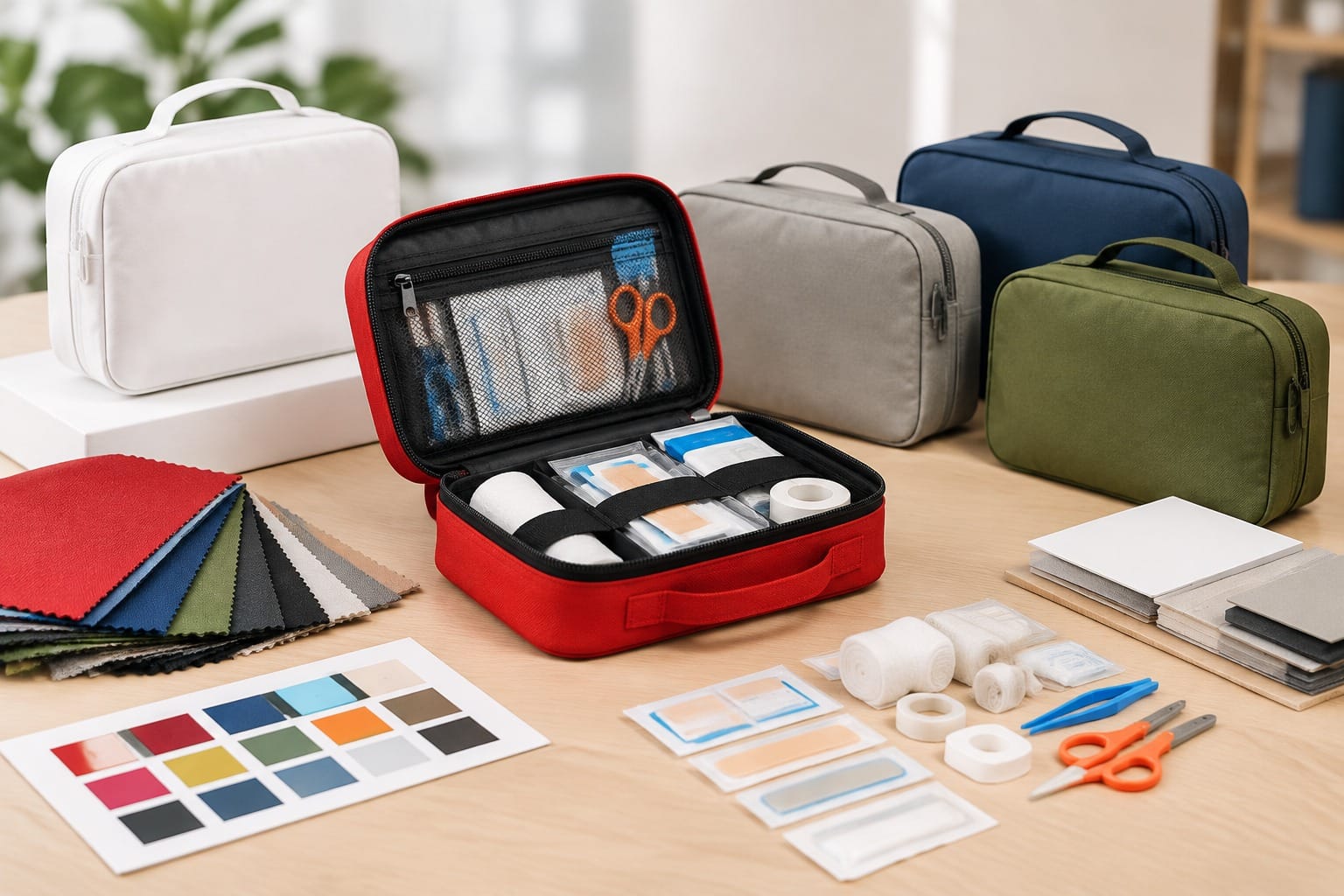
Three decisions come before a pattern is cut, and each one changes the others.
The first is the carrying format. A waist pouch, a hand-carry bag, a backpack and a fold-out all impose a different maximum panel size, and panel size decides how much reinforcement each seam needs.
The second is the load. A bag holding dressings and tape behaves nothing like a bag holding a rigid suction unit. Weight in kilos and the shape of the heaviest item determine whether the base needs a second layer.
The third is the environment. A bag wiped with disinfectant several times a day needs a coating and a seam finish that a bag living in a vehicle boot does not.
Write those three down and the fabric conversation gets short. Leave them implicit and the factory selects for the middle of the market, which is not the same thing as selecting for your programme.
Fabric: the denier decision that sets everything else
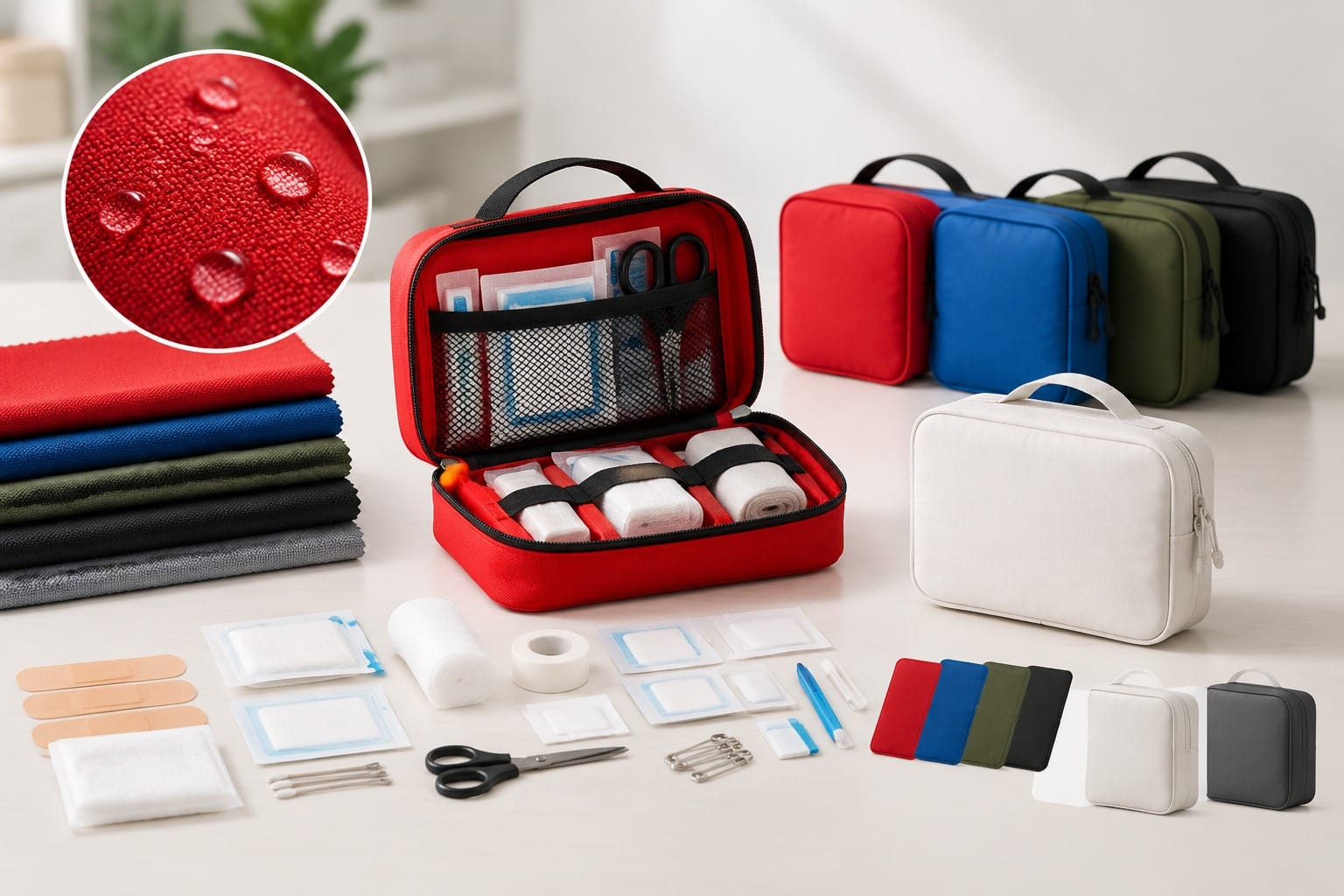
Denier measures the linear mass density of yarn, in grams per 9,000 metres. A higher number means a heavier yarn per unit length, not automatically a stronger bag, because weave and coating matter as much as the yarn does. Published material charts from bag factories list polyester Oxford from 210D to 1000D, nylon Oxford from 210D to 1680D, canvas by weight from 12 oz to 20 oz, and neoprene by thickness from 3 mm to 7 mm.
| Fabric | Common published specs | Typical published price band | Usually chosen for |
|---|---|---|---|
| Polyester Oxford | 210D / 420D / 600D / 840D / 1000D | about US$2–4 per yard | The default for general medical bags and first aid kits |
| Nylon Oxford | 210D / 420D / 840D / 1680D | about US$3–5 per yard | Abrasion resistance and a softer hand where the bag is carried often |
| Canvas | 12 oz / 14 oz / 16 oz / 20 oz | about US$3.50–6 per yard | Structured cases with a traditional look |
| Neoprene | 3 mm / 4 mm / 5 mm / 6 mm / 7 mm | about US$6–10 per yard | Padding around instruments and insulated compartments |
600D polyester is the most often quoted default in the listings we reviewed, and one supplier’s own material guide places medical bags in the 420D to 840D nylon Oxford band. Denier above 1000D usually signals a responder or trauma pack rather than a general kit bag. A custom first aid bag manufacturer quoting outside these bands without explanation deserves a follow-up question.
Two costs sit outside the fabric price. Coating raises cost per yard and changes how the bag behaves when wiped. Lining adds a second material, and choosing between PEVA and TPU moves both the usable temperature range and the resistance to repeated disinfection.
Neither line is visible in a photograph, which is why they get left out of the specification and then discovered at the sample stage.
Colour: how a custom first aid bag manufacturer holds a shade
Colour is where a specification and a production run separate most often. The cause is rarely a mistake in the artwork. It is usually one of three things.
A Pantone reference without a substrate. The same Pantone number printed on 600D polyester with a PU coating and on uncoated nylon will not match. Coating changes surface sheen, and sheen changes perceived saturation. State the substrate alongside the reference or the reference means little.
A tolerance that was never written down. Print and dye both drift between runs. What you need is not an exact match but an agreed range, expressed as a numeric tolerance on a colour measurement, plus a rule for what happens when a run lands at the edge of it.
A light source that was never agreed. A shade approved under office lighting can look different under daylight or under the lamps in a warehouse aisle. Agree the viewing condition at approval time.
One factory’s published inspection list names colour fastness to artificial light, tested to the ISO 105-B02 method, at grade 4 or above. Read that as one factory’s stated house standard rather than an industry floor, and ask every custom first aid bag manufacturer you shortlist to name their own figure in writing.
Dye-lot control is the practical safeguard. Ask whether the whole order will come from a single production run, and if it will not, ask how the split is managed. Two runs of the same colour can be visibly different side by side, and a distributor shipping to several customers will find out.
Hardware: zips, webbing and handles
Hardware is the least expensive place to save money and the fastest place to lose a customer. Three components carry most of the risk. They are also the three a custom first aid bag manufacturer is most likely to swap without saying so.
Zips. A two-way zip gives access from either end, which matters on a bag opened under pressure. Slider quality decides the feel, and coil versus moulded teeth decides how the zip behaves when the bag is overfilled. One factory’s published inspection routine describes 5,000 open-and-close cycles as its durability check. Ask what cycle count applies to your bag rather than assuming that figure travels.
Load-bearing seams and webbing. Bar-tack stitching, binding tape and reinforced base panels are the three reinforcements worth specifying. One published routine describes a minimum 200 N pull force on load-bearing seams and a load test at 150 percent of intended weight held for 24 hours. Those are useful numbers to request, because they turn a vague promise about strength into a test you can ask for evidence of.
Handles and attachment points. A grab handle on a responder bag is a load path, not a decoration. Where the bag needs to mount on a vest, a wall bracket or a vehicle panel, the attachment system has to be chosen before the pattern is cut, not added afterwards.
Rip-away panels, MOLLE-compatible webbing, buckle and hook-and-loop closures and reflective trim all sit in this layer. Each adds cost, and each one is easy to promise and hard to verify from a sample photo.
Where custom first aid bag manufacturing goes wrong
- Specifying colour by name instead of by reference plus substrate. “Red bag” covers a wide range, and the range includes several shades you would reject. A custom first aid bag manufacturer who accepts a colour name without asking for the substrate has not read the specification closely.
- Treating MOQ as a factory trait. MOQ attaches to a specific fabric, colour and print method. Listings we reviewed cluster around 500 pcs, with bands at 300, 500, 1,000 and 2,000 per style depending on the build.
- Reading one lead time. Sample stages are commonly quoted at 6–10 days, with some factories offering a 3-day expedite on simple builds. Bulk production is more often quoted at 27–45 days. Ask for the production figure in working days, in writing, as a single number.
- Leaving packing out of the quote. A carton of 50 × 45 × 50 cm holding 15 units gives you a volume to check against the stated gross weight. Container fill is decided by carton geometry, and a bag that ships flat but packs badly costs more than the unit price suggests. Delivery terms belong in the same line, and the international commercial terms published by the International Chamber of Commerce decide where risk and cost transfer.
- Assuming print method is interchangeable. Silk screen, heat transfer, embroidery and woven labels carry different setup costs and different minimums. Published quotes we reviewed put screen printing at roughly US$2–5 per item with an opening fee near US$20, while heat transfer was quoted with a plate cost of about US$100 per plate. Setup economics, not unit price, decide which method survives at low volume.
- Skipping third-party textile testing where the destination market expects it. Independent textile testing schemes such as the OEKO-TEX standards exist precisely so that a claim about a fabric can be checked by someone other than the seller. Whether your buyer needs that evidence is a destination-market question.
The documentation duties that follow a finished bag are a separate matter from the fabric. Where a kit contains a regulated medical device, obligations attach to whoever places it on the market, and the EU framework for medical devices is one example of how far those duties reach. Confirm the position for your own destination rather than relying on a supplier’s summary of it.
FAQ
What denier should a first aid bag be?
Most general medical bags sit between 420D and 840D, and 600D polyester is the most commonly quoted default. Move above 1000D when the bag is carried into rough environments or holds heavy rigid contents. Move lower only when the bag is light, unlikely to be dragged, and cost is the deciding constraint. Denier is one input among several, so ask any custom first aid bag manufacturer for the weave and coating as well.
How do I control colour across repeat orders?
Specify a Pantone reference together with the substrate, agree a numeric colour tolerance, and name the viewing condition for approval. Then ask how the order will be split across production runs. If it must be split, agree in advance that the second run will be matched against a retained reference sample rather than against the previous run, which keeps drift from compounding order after order.
How long does sampling take for a custom bag?
Published sample stages cluster around 6 to 10 days for a new pattern, with some factories offering a 3-day expedite on simple builds and others quoting a 7-day prototype from a sketch. Bulk production is more often quoted between 27 and 45 days. The number that matters is the one written against your specification revision, not a range printed on a website.
What hardware should be specified in writing?
Ask any custom first aid bag manufacturer to name the zip type, the slider, the seam reinforcement, the attachment system and the load tests you want evidence for. A workable short list is a two-way zip, bar-tack stitching at load points, a reinforced base panel, and a documented seam strength figure. Adding cycle counts and load percentages turns each item into something a factory can be measured against.
Should I buy a stock bag or a custom one?
Buy stock when the format already fits the contents and the only variable is the printed logo, because setup costs stay low and lead times are short. Go custom when the contents list or the mounting method drives the pattern. Custom only pays back when the volume supports the tooling, so count print setup fees and minimums as part of the volume calculation rather than as an afterthought.
Closing
Fabric, colour and hardware are the three lines that decide whether a bag is a container or a piece of equipment. They are also the three lines most often left to the factory, which is where specification drift begins.
Write them down, attach a revision number, and quote every candidate against that document. A custom first aid bag manufacturer who answers line by line is telling you how the production run will go. The pricing conversation then has something to be about. Our own guide to OEM private label first aid kit projects covers how a brand project runs from first sample to bulk order, and the custom medical bag specification sheet shows how to put the lines above into a document a factory can quote against.
Buyers comparing factories should read the OEM first aid kit supplier comparison method alongside the logo branding methods guide, since print method is usually where setup cost first appears. Anyone still settling the container should start from the empty first aid kit bags and boxes sourcing guide, and the emergency medical bags range shows the formats we produce.
Our own MOQ starts at 1,000 pcs, with sample-based validation before production and a feasibility review wherever a specification line is not yet fixed. Where a material or a component has not been confirmed for a given build, we say so and route the question back to you rather than filling the gap with an assumption.