
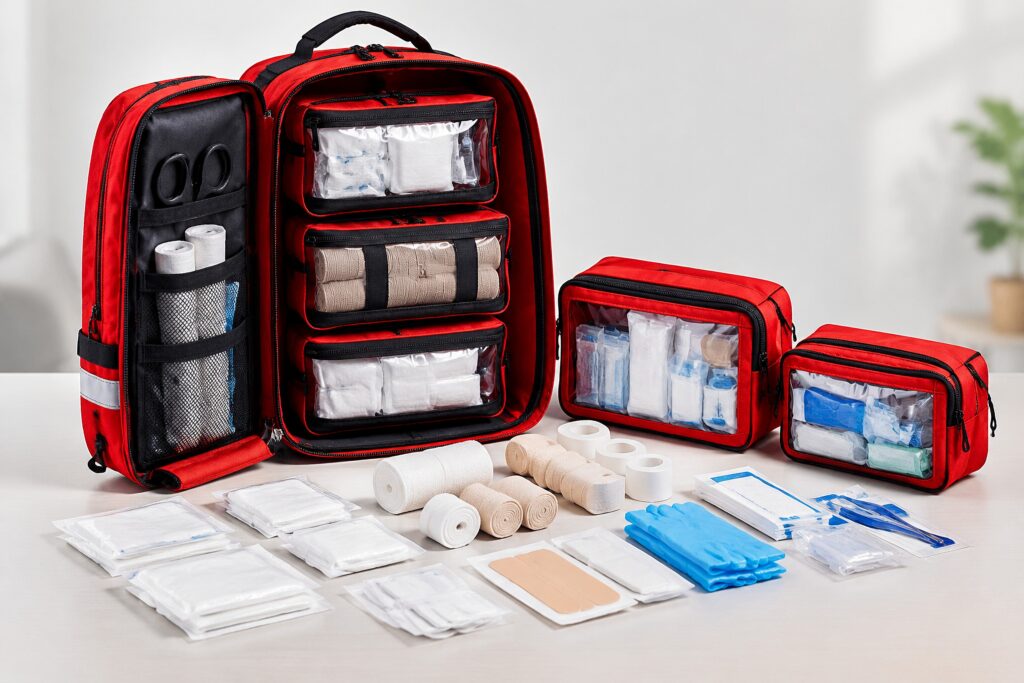
A kitchen manager opens the first supplier quote and finds three different cabinets, four contents lists and no statement of what the site actually has to hold. That gap is normal. Restaurant first aid kit requirements are not published as a single list anywhere, and the documents that come closest are written for general industry rather than for a line cook working beside a fryer.
The specification has to be assembled. It comes from one federal duty, one model food code, one consensus standard, and two injury streams that every commercial kitchen produces.
This article sets out that assembly in the order a buyer can act on it: what the rules require, what a kitchen adds, which container survives, how deep the burn coverage has to go, and what belongs in the RFQ.
Where restaurant first aid kit requirements actually come from
The binding text in the United States is short. 29 CFR 1910.151(b) requires that first aid supplies be readily available, and that a person trained to render first aid be present where no infirmary, clinic or hospital is in near proximity to the workplace.
That is the whole supply obligation. No item list. No kit count. No distance figure.
Appendix A to the same section is labelled non-mandatory. It names ANSI/ISEA Z308.1 as an example of minimum contents for a generic kit, calls those contents adequate for small worksites, then hands the judgement back to the employer: larger operations, or several operations at one address, decide whether more kits, more equipment types or larger quantities are needed.
Where employees may be exposed to blood while giving first aid, 29 CFR 1910.1030(d)(3) adds personal protective equipment to the list. Gloves stop being an accessory at that point.
The FDA Food Code takes a different route. It is a model code that state and local jurisdictions adopt in whole, in part, or with amendments, and it does not set a kit contents list. What it does regulate is employee health and wound coverage, because an uncovered lesion on a food handler is a contamination route. That is why the bandage question sits inside the kit discussion at all.
Two commercial consequences follow. First, the written specification is the buyer’s document, not the supplier’s. Second, a supplier can build to a published baseline and supply documentation by SKU, but confirming that a specification satisfies a particular market stays with the buyer and its advisers.
The two injury streams that shape restaurant first aid kit requirements
A commercial kitchen concentrates harm in a way an office does not. Two streams dominate, and each pushes restaurant first aid kit requirements away from an office fill in a different direction.
Thermal injury. Fryer oil, range surfaces, oven racks, steam wands and hot water at the dish station. Exposure is continuous rather than occasional, and the surface area involved is often larger than a fingertip. Burn gel sachets sized for incidental contact run out fast in a kitchen that fries.
Lacerations. Knives, slicers, mandolins, can edges and broken glass. These are volume events rather than severity events, and they carry a constraint no other sector has: a dressing that leaves the wound and lands in food is invisible if it matches the food.
A third exposure sits under a separate paragraph of the same standard. Where the eyes or body may be exposed to injurious corrosive materials, 1910.151(c) requires suitable facilities for quick drenching or flushing within the work area. Oven cleaners, degreasers and dish chemistry bring a restaurant inside that paragraph, and a squeeze bottle in the cabinet does not satisfy it.
| Exposure | Office-grade fill | Kitchen-grade specification |
|---|---|---|
| Thermal | A few burn gel sachets | Burn dressings and gel in quantity, staged near the line |
| Laceration | Flesh-tone adhesive bandages | Detectable bandages in every size the crew uses, plus finger cots |
| Blood contact | Minimal gloves | Exam gloves above minimum, CPR barrier present |
| Corrosive chemistry | None | Plumbed eyewash or drench facility in the work area |
| Storage environment | Climate-controlled cupboard | Heat, grease and steam, so a sealed mounted cabinet |
Read the table as a starting position, not a finished specification. Restaurant first aid kit requirements are settled by the hazards a particular site runs, and a pastry kitchen and a high-volume fry line do not land on the same answer.
Choosing a container that survives a kitchen shift
Format decides whether the contents are still usable in three months. A soft bag left on a shelf beside the pass absorbs grease, takes splash from the dish sprayer, and ends up under a stack of takeaway lids during service.
Four properties matter more than capacity.
- The cabinet mounts at a named, fixed location the crew can point to without looking.
- It sits clear of the cook line, so heat and splash do not reach it, but close enough to reach during service.
- It seals, because adhesive backing and gel sachets age faster in humid kitchen air than in an office cupboard.
- It is sized to the crew on the busiest shift, not the roster average.
Wall-mounted emergency boxes cover the first three properties by construction. Where a site has both a front-of-house counter and a back-of-house line, the usual arrangement is one mounted cabinet per area rather than one large kit carried between them.
The format decision itself has a separate write-up comparing wall-mounted boxes against portable kit bags, including the cases where a portable bag is the better answer.
Matching kit class to a kitchen rather than to headcount
ANSI/ISEA Z308.1 sets two content levels, Class A and Class B, with minimum quantities per item. Class A is the smaller fill. Class B is the larger one, and busy kitchens with a real burn load sit closer to it.
Two practical checks sit on top of the class choice.
Confirm the edition on the label. Kits labelled to the 2015 revision and kits labelled to the 2021 revision are sold side by side, and the contents differ. A quote that says only “ANSI Z308.1” without a year is not a specification.
Decide the burn tier deliberately. The burn allowance inside a generic fill is sized for incidental contact. A kitchen that runs a fryer all evening needs burn dressing surface area and gel volume set by the site, not inherited from a catalogue default. Standard kit configurations show what fixed fills look like, and they are a starting reference rather than a substitute for the site assessment.
On bandages, the food-safety convention is worth stating plainly. No federal rule in the United States names a bandage colour. Blue metal-detectable dressings are a food-industry practice: visible against most food, and findable by in-line metal detection if one is lost. Many buyers hold detectable bandages to be the only bandages allowed in a production kitchen, and keep flesh-tone stock front of house.
Eyewash where corrosive chemistry is used
Dish machines, oven cleaners and heavy degreasers put a restaurant inside the drenching paragraph. The requirement is a facility in the work area, and the accepted performance reference for plumbed units is the ANSI/ISEA Z358.1 emergency eyewash standard.
Two procurement errors repeat here.
The first is substituting a personal rinse bottle for a facility. A bottle is only supplementary and does not deliver fifteen minutes of flushing. This is the part of restaurant first aid kit requirements most often met on paper and missed on the floor.
The second is placing the station where nobody can reach it during an incident. A unit behind a locked chemical store satisfies no one. Eye wash and rinse supplies covers the consumable side; the placement and plumbing decision sits with the site.
Writing restaurant first aid kit requirements into an RFQ
Once the site has decided the hazards, the format and the class, the RFQ becomes mechanical. Six items carry most of the restaurant first aid kit requirements into the quote, and each one closes a question a supplier would otherwise answer by assumption.
- State the injury profile. Fryers, slicers, dish chemistry, or all three. Suppliers price burn coverage differently from laceration coverage.
- Name the class and the edition. Class A or Class B, and ANSI/ISEA Z308.1 with a year.
- Specify the container. Mounted cabinet dimensions, mounting method, and whether a sealed gasket is required.
- Name the bandage type. Detectable, metal-detectable, or standard, and in which sizes.
- Ask what documentation ships with each SKU. Item-level lists, material statements and any test reports the supplier actually holds. Do not accept a general claim covering a whole catalogue.
- Set the restock rhythm. Kit contents expire, and a kitchen that restocks annually will run empty in month seven.
The workplace first aid kit configuration checklist covers the generic workplace version of this sequence, and construction site first aid kit provisioning works the same logic for a site with different hazards. Both are useful cross-reads because the method transfers even when the contents do not.
For buyers assembling a first order across several sites, the broader B2B guide to emergency first aid kits and bags sets out how kit, bag and box formats are specified together.
FAQ
Are restaurants required to have a first aid kit?
In the United States, the requirement comes from the general industry standard rather than from a food-specific rule. 29 CFR 1910.151(b) requires adequate first aid supplies to be readily available and a trained person present where medical care is not in near proximity. No text lists the contents. Many state and local health codes add their own provisions on top, which is why the destination market and jurisdiction have to be confirmed locally before a specification is locked.
What should a restaurant first aid kit contain?
Start from an ANSI/ISEA Z308.1 fill at the class that matches the site, then adjust for kitchen hazards. That means burn dressings and gel in a quantity suited to fryer and range exposure, detectable adhesive bandages in the sizes the crew uses, finger cots, exam gloves and a CPR barrier. Add scissors, tweezers, gauze and tape for laceration volume. Where corrosive cleaning chemistry runs, eyewash belongs in the work area as a facility, not as a bottle inside the kit.
Do restaurant first aid kits need blue bandages?
No federal rule in the United States requires a bandage colour. Blue metal-detectable dressings are a food-industry convention adopted because they stand out against most food and can be found by in-line metal detection if one is lost. Many operators require them in production areas for that reason, and keep flesh-tone stock only in front-of-house kits. It is a control decision, and a sound one, rather than a compliance citation.
Where should a restaurant first aid kit be stored?
Somewhere fixed, known and reachable during service, and away from heat, grease and splash. A cabinet mounted clear of the cook line but within a short walk of it covers both halves of that. Storage also has a food-safety dimension: the Food Code’s employee health provisions turn on wounds being covered, so the supplies that cover a wound have to be available before the next order goes out, not after a trip to the office.
How many first aid kits does a restaurant need?
There is no published ratio, and headcount is a poor proxy. Count work areas instead. A separate front-of-house counter, a production line, a dish and chemical area and a delivery entrance may each need their own point of access, especially when they are not visible from one another. Where shifts run late, provision has to hold at 2am as well, which usually means a second stocked location rather than a larger single kit.
从规格到报价
A kitchen specification is finished when the buyer can hand a supplier a hazard profile, a class, a container and a bandage type, and get back a quote that can be compared line by line. Everything before that is site assessment. The emergency kit RFQ checklist turns that handover into a document a purchasing team can issue without rewriting it.
Hotels that run a kitchen under the same roof should run the two specifications together, and the zone logic is set out in hotel first aid kit planning.
The supply side of that problem is worth reading next: how burn dressings and eye wash are specified as components is set out in burn care and eye wash component sourcing.