
Most exporters begin a restricted items first aid kit export from the wrong end. They inventory the components, decide which ones look hazardous, and then try to build a declaration out of the answers. The regulations start somewhere else. A first aid kit is itself a named entry in the dangerous goods lists, and that entry is what a carrier reads first.
A second distinction decides more shipments than the first. Transport classification is class-based and broadly harmonised between air, sea and inland regimes. Market restriction is per-country and per-item, and it does not follow the classes at all. An article can be correctly classified, correctly packed and correctly declared, and still be refused at destination. A restricted items first aid kit export therefore needs two separate answers, not one.
A first aid kit is a declared article, not a box of parts
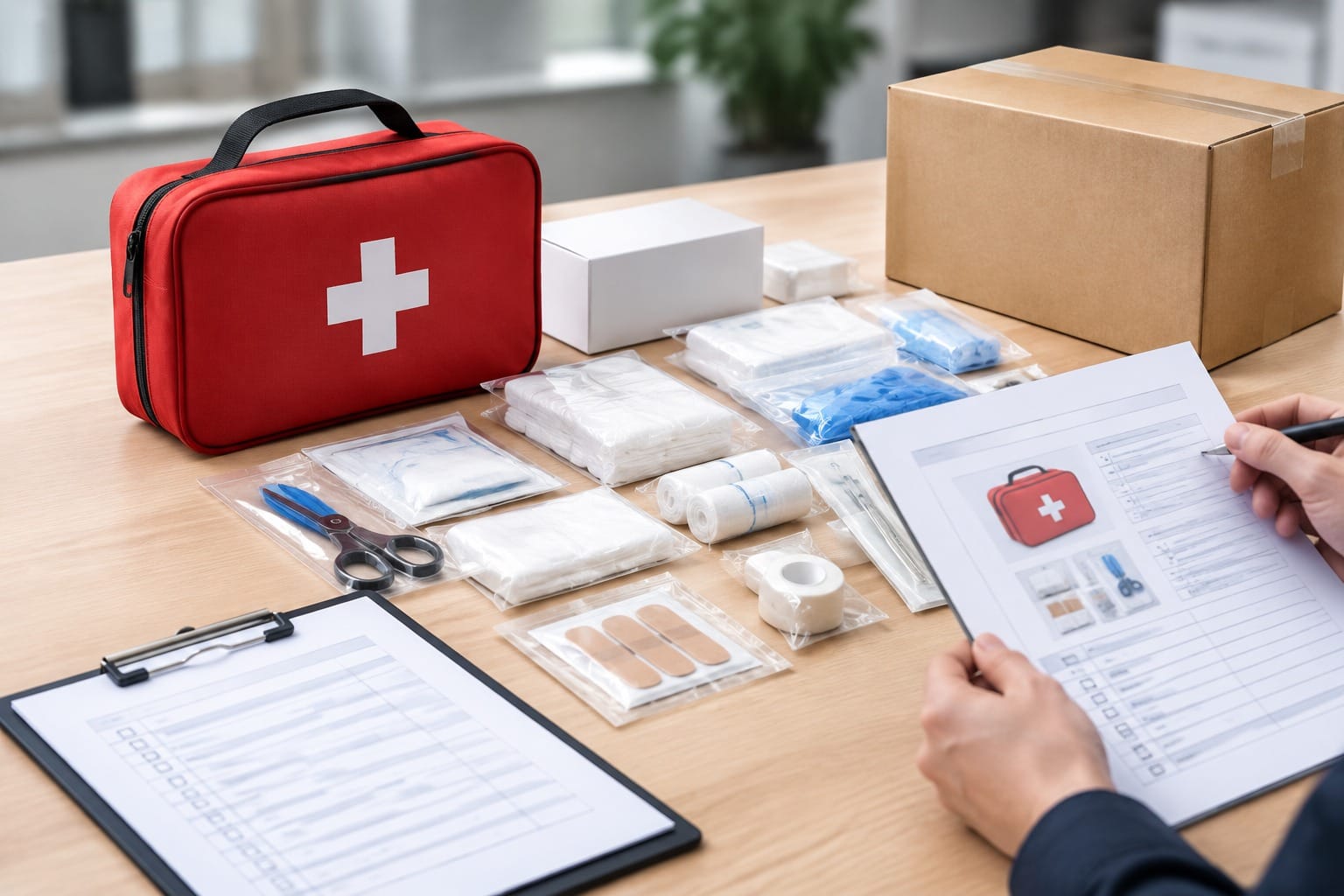
A kit can travel as a single line on a declaration because a dedicated entry exists for it: UN 3316, whose proper shipping name is CHEMICAL KIT or FIRST AID KIT. It sits in Class 9, miscellaneous dangerous substances and articles, under classification code M11, and no packing group is assigned to it. The entry allows a kit holding several small regulated components to be handled as one article rather than as a list of separate declarations.
| Regime | Instrument | Entry as published | Quantity ceiling |
|---|---|---|---|
| Air | IATA Dangerous Goods Regulations | UN 3316, Class 9, packing instruction 960 | 10 kg net per package, permitted on passenger and cargo aircraft |
| Air, excepted quantity | IATA DGR, packing instruction Y960 | UN 3316 as an excepted quantity | 1 kg per package |
| Road and rail | ADR and RID | UN 3316, packing instruction P901, special provisions 251, 340 and 671 | Carriage in bulk and in tanks is not permitted |
| United States | 49 CFR 172.101 Hazardous Materials Table | UN 3316, label 9, emergency response guide 171 | Governed by the packing group and quantity columns of the entry |
Three details in that table change how an order is packed. The air ceiling of 10 kg net is stated per package and not per shipment, so a large order can be split across several boxes and still sit under one declaration. Bulk and tank carriage is expressly refused for this entry, which means the kit entry never becomes a loose-fill option. And the mixed loading rule attached to the entry prohibits loading it with Class 1 explosives other than division 1.4S, or with the self-reactive and organic peroxide entries named in the same provision, which matters whenever a container is consolidated. The IATA dangerous goods regulations are the reference for the air row, and the entry appears in the United States hazardous materials table under the same number.
Which components pull a kit into a class
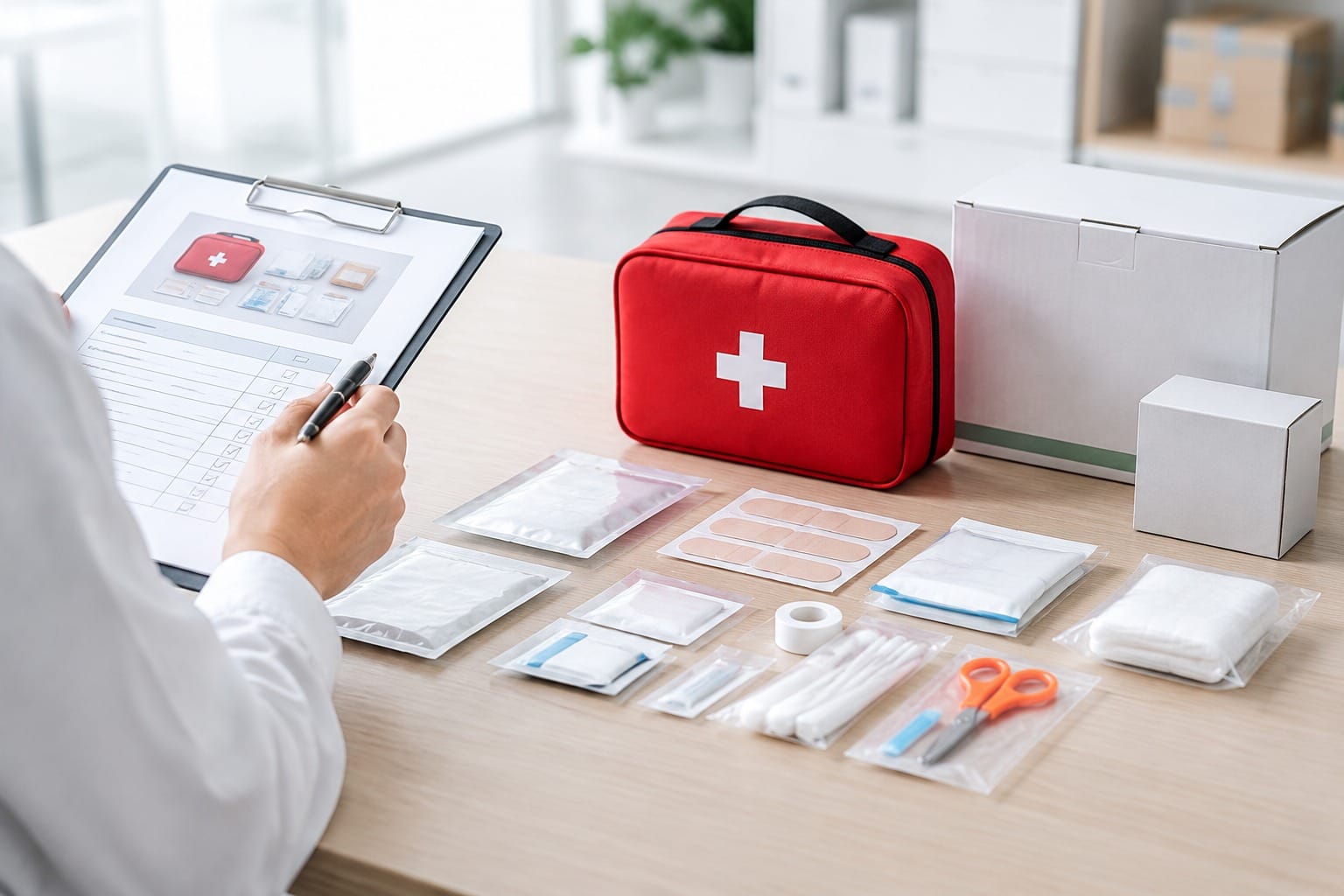
A restricted items first aid kit export is decided by the component list rather than by the kit label. The kit entry does not make the components disappear. It changes what has to be declared, not what has to be contained. Each component still belongs to its own class, and the component list is what tells you whether the kit entry applies at all.
| Component | Class | Entry as published | What triggers it |
|---|---|---|---|
| Alcohol-based disinfectant, free liquid | 3, flammable liquids | — | Alcohol content above the published threshold |
| Alcohol wipes and pads | 4.1, flammable solids | UN 3175 | Alcohol carried in a solid substrate rather than free |
| Aerosol sprays, including burn care and disinfectant sprays | 2, gases | UN 1950 | A pressurised container |
| Lithium cells offered on their own | 9, miscellaneous | UN 3480 | Cells shipped outside equipment |
| Lithium cells packed with or contained in equipment | 9, miscellaneous | UN 3481 | Cells inside or alongside a device |
| Oxygen cylinders | 2, gases | — | Contents held under pressure |
| Mercury thermometers | 8, corrosives | — | Mercury inside a manufactured article |
| Fire extinguishers | 2, gases | — | Stored pressure |
| Used dressings, used sharps and clinical waste | 6.2, infectious substances | — | Contamination, not the article itself |
Two rows in that table are the ones buyers miss. Wipes are the first. An alcohol wipe reads as a solid article and is classified as one, under UN 3175 in Class 4.1, which is a different class from the liquid it contains. The second is used material. A dressing or a syringe is unregulated when new and becomes a Class 6.2 infectious substance once it has been used, which is why clinical waste is refused outright by most postal operators for international destinations. A published dangerous goods list from a logistics operator shows the same split, classifying a complete first aid kit under Class 9 while listing used surgical needles under Class 6.
A third category deserves a check rather than an assumption. Instant cold packs and similar chemically activated devices appear in medical supply lists as potential oxidisers or organic peroxides, and the only dependable way to settle the question is to read the classification in the safety data sheet rather than infer it from the product name. The dangerous goods list published by a global logistics operator is a useful cross-check because it names the class against the everyday item name.
How quantity relief changes a restricted items first aid kit export
The most consequential decision in a restricted items first aid kit export is not which class applies. It is how much of each item sits in each inner package. Quantity provisions remove documentation, not hazard.
| Tier | How it is reached | What it removes | What it never removes |
|---|---|---|---|
| Excepted quantity | Packing instruction Y960, at or below 1 kg per package for UN 3316 | Hazard labels and the full shipper’s declaration, leaving minimal marking | Correct classification, packaging integrity and training |
| Limited quantity | Special provision 251 in the ADR and RID entries | The full declaration regime, in favour of a reduced marking set | The classification and the packaging specification |
| Small-package relief for wipes | Published trade practice at or below 1 kg per inner package and 30 kg per carton | The packaging certificate requirement for that configuration | The dangerous goods classification itself |
| Aerosol concession | Valve cap fitted, at or below 500 ml per item, no more than two aerosols per package | Standard freight handling, in favour of a consumer commodity label | Correct labelling and the staffed-counter acceptance step |
Read the last column before the third. Every relief tier is a reduction in paperwork attached to a condition about packaging. Step outside the condition and the tier no longer applies, which restores the full set. This is also why a specification change late in an order is a compliance event rather than a cosmetic one.
The four documents that carry the declaration
The paperwork is mostly a consequence of the classification rather than a separate task. Four documents do the work.
- The safety data sheet, read at Section 14. The UN number and the proper shipping name sit in that section. Where the section is silent, the item is usually not classified, but silence on a sheet supplied by a third party is not evidence of anything. Ask the party that formulates the item.
- The shipper’s declaration for dangerous goods. The standard form records the UN number, the proper shipping name, the class, the packing group where one exists, the quantity, the package type and the packing instruction, and closes with a signed statement of compliance. It is prepared in triplicate and retained for a period typically between three and six months depending on jurisdiction.
- The air waybill statement and the notification to the captain. The waybill must state that dangerous goods travel under an attached shipper’s declaration, and the operator raises the notification to the captain from the declared load.
- UN specification packaging and the marks that accompany it. Outer packaging carries a UN specification marking encoding the package type, the performance level and the test data. Lithium cells add the lithium battery mark and handling label, and aerosols add the consumer commodity label.
Responsibility for the declaration in a restricted items first aid kit export sits with the shipper, not the forwarder. A forwarder accepts, checks and carries a shipment; it does not certify a classification it did not make. Published penalty ranges reflect that allocation. Aviation compliance guidance cites figures in the region of US$50,000 per violation under FAA and EASA enforcement, while other published guides cite ceilings up to US$500,000 with criminal exposure for wilful violations. The figures differ by authority, so confirm the exposure that governs your route instead of relying on a single published maximum.
One training requirement is easy to overlook. Shipper-side dangerous goods training is time-limited, with recurrent training published on a 24-month cycle. A declaration signed by a colleague whose qualification has lapsed is a declaration signed outside the regime.
Where the declaration duty stops
Classification and market restriction are separate questions, and the second one is not answered by the first.
Transport classification is harmonised to a useful degree. The ICAO technical instructions and the IATA regulations govern air carriage, the IMDG Code published by the International Maritime Organization governs sea carriage, and the ADR, RID and ADN instruments govern inland carriage in the markets that adopt them. A UN number means the same thing across all of them, which is what makes a kit entry portable between modes. That portability is the part of a restricted items first aid kit export the regimes agree on.
Market restriction is not harmonised at all. The same article can be permitted domestically and refused internationally, and the line is often drawn by transport mode rather than by hazard. Published postal restrictions from a national operator show the pattern plainly: personal care and medicinal aerosols accepted for domestic mail but refused for international destinations, alcoholic liquids between 24 and 70 per cent by volume accepted domestically and refused internationally, and lithium cells offered on their own refused in both directions. None of those outcomes is a classification question. They are destination and route decisions taken above the classes.
Nothing in the declaration covers that second layer, which is why a restricted items first aid kit export cannot be closed out by a declaration alone. Import licensing, labelling language, registration duties and item-level prohibitions sit with the importer, and they are worth settling before an order is confirmed rather than after it has been produced.
The failures that repeat
Five patterns account for most refused shipments in a restricted items first aid kit export, and none of them is exotic.
- Concluding an item is not hazardous because it looks harmless. The classification lives in the safety data sheet, and an assumption that a wipe or a cold pack is unregulated is the most common origin of an undeclared shipment.
- Declaring the components and forgetting the kit, or the reverse. The kit entry and the component entries answer different questions, and a carrier can ask to see both.
- Reading a forwarder’s acceptance as a compliance decision. Acceptance is a judgement about a route. It does not transfer the declaration duty.
- Reusing last year’s declaration against a changed component list. A single substitution can move a class, an entry or a quantity ceiling.
- Assuming the container consolidates cleanly. The mixed loading prohibition attached to the UN 3316 entry is a loading instruction, not a paperwork item.
What to settle before the first shipment
Six items close the loop on a restricted items first aid kit export, and the order in which they are settled matters less than settling all of them before production.
- Build the component list item by item, with the quantity held in each inner package, before requesting a quotation.
- Collect the safety data sheet for every item containing alcohol, a pressurised container, a cell, a gas cylinder, mercury or a chemical activator, and read Section 14.
- Decide the package configuration so that the relief tier you intend to rely on is genuinely reached.
- Name the route, because the mode decides which instrument applies and which operator variations sit on top of it.
- Ask the importer to confirm the destination market’s own restrictions separately from the transport classification.
- Check the training currency of whoever will sign.
UneedAid supplies the component list by SKU and the item-level documents a declaration is built from, and where a specification line or a classification question is not yet settled we say so and route the question back to you rather than filling the gap with an assumption. Confirm the position for your own destination market rather than relying on any supplier’s summary of it. Our guide to compliance documents for first aid products sets out which paper belongs to which class of evidence, the responsibility matrix for first aid import requirements shows where the importer’s duties begin, and the shipping methods guide for first aid supplies covers how mode selection interacts with carrier acceptance.
FAQ
Is a first aid kit itself a dangerous good?
A kit containing regulated components is declared under a dedicated entry, UN 3316, in Class 9. A kit containing nothing classified is not. The outcome turns on the component list and on the quantity held in each inner package, not on the kit being a medical product. Read the safety data sheet for every component before deciding which way it falls.
What is UN 3316 used for?
UN 3316 is the entry whose proper shipping name is chemical kit or first aid kit. It lets a kit holding several small regulated components travel as a single declared article, with its own packing instruction and quantity ceiling. For air carriage the packing instruction is 960 and the ceiling is 10 kilograms net per package, on both passenger and cargo aircraft.
Do alcohol wipes count as dangerous goods for export?
Wipes carrying alcohol are classified as a flammable solid under UN 3175 in Class 4.1, which is a different class from the free liquid they contain. Published trade practice applies small-package relief where the inner package stays at or below 1 kilogram and the carton at or below 30 kilograms. Confirm the classification on the sheet for the specific wipe being shipped.
Who signs the shipper’s declaration?
The shipper signs it, not the forwarder. A forwarder accepts, checks and carries the shipment, but the declaration is the shipper’s own statement that the goods are correctly classified, packed, marked and described. Because it is a legal declaration, the person who signs it should also hold current dangerous goods training for the role.
What changes if the kit contains an AED or a powered device?
A device with a lithium cell brings Class 9 into the kit on its own terms. Cells offered outside equipment sit under a different entry from cells packed with or contained in equipment, and the outcome differs again by aircraft type and by operator. Handle the cell as a separate classification question and settle it before the kit configuration is frozen.
Closing
The kit is the unit of declaration and the component list is the unit of classification. Keeping those two apart is what makes the paperwork tractable, because it turns a forty-item inventory into one entry plus a short list of exceptions.
Then comes the second question, which has nothing to do with classes. Whether the destination will admit the shipment is answered by that market and not by the declaration, and the answer should arrive before the order is produced. Write the component list, collect the sheets, name the route, and confirm the destination position in writing. The declaration is the last step, and it is the easy one.
Two more references are worth pairing with this one. The guide to verifying a supplier’s certification claims covers how to check a document rather than accept it, and the labelling and language requirements guide covers the paperwork that belongs to the destination rather than to the carrier. Buyers assembling a supplier shortlist will also find the supplier compliance checklist useful, because it asks for the same item-level sheets this article builds a declaration from.
Our own MOQ starts at 1,000 pcs, with sample-based validation before production and a feasibility review wherever a specification line is not yet fixed.
Transport restrictions and tariff classification are separate questions, and a kit can raise both at once. The HS code basics for first aid products cover the customs side of that pair.