
A custom medical bag specifications sheet is not a product description. It is a controlled document that tells a factory what to build and tells you what to inspect when the fifth shipment lands. Buyers who skip it tend to receive a bag that matches the photograph and misses the brief. The fabric arrives at the wrong weight. A divider pattern has shifted 15mm. The logo sat perfectly on the sample and drifted on the reorder.
This guide sets out the seven fields that belong in custom medical bag specifications, the two fields buyers omit and then argue about, and the sequence that turns one approved sample into a repeatable order.
What a custom medical bag specifications sheet has to pin down
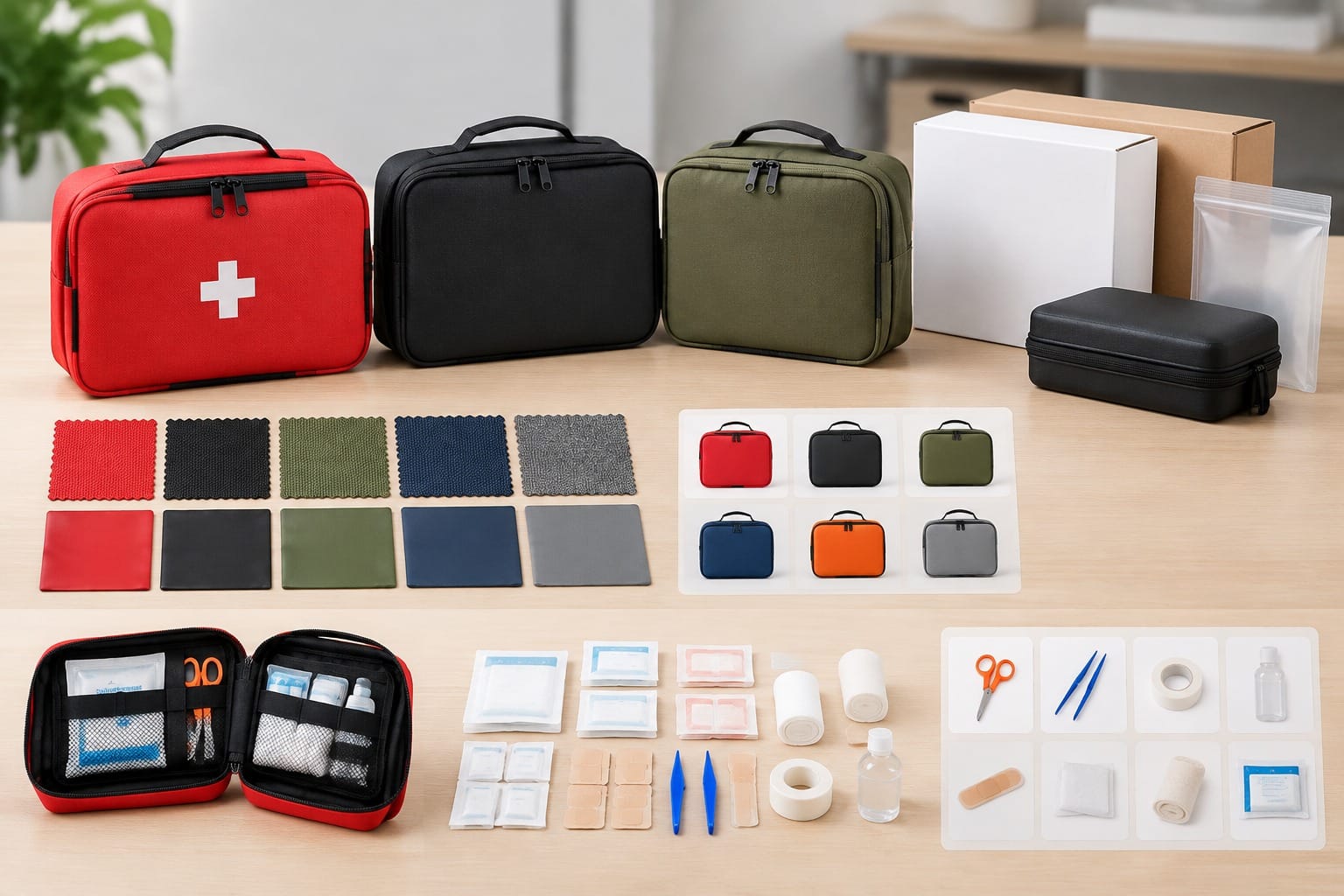
| Field | Why it belongs in the sheet | What goes wrong without it |
|---|---|---|
| Construction | Format, outer dimensions and a tolerance band | Sample fits, bulk does not |
| Materials | Fabric, coating, weight, lining and trim | Substituted material on the repeat run |
| Compartment map | Zones derived from the item list and access order | Contents shift, first-response items buried |
| Attachment system | Belt loop, strap geometry or MOLLE webbing | Bag cannot be mounted the way the buyer assumes |
| Label fields | ID window size and barcode area | Labels do not fit or scan |
| Packaging | Unit pack, carton quantity, carton marking | Mixed cartons, unusable shelf stock |
| Revision control | Version number, date, approver | No way to prove which version was built |
The table is deliberately dull. Dull is what makes it reusable. A specification sheet is read by people who were not in the original conversation, often eighteen months later, and it either answers their questions or it does not.
A second habit matters as much as the fields. Each field should carry one value and one unit, not a range of options. “Nylon or polyester” is not a specification. It is an invitation for someone else to decide.
Three of those lines, fabric and denier, colour control and hardware, carry most of the risk, and this manufacturing guide for custom first aid bags shows what to write against each.
Why the compartment map comes before the materials list
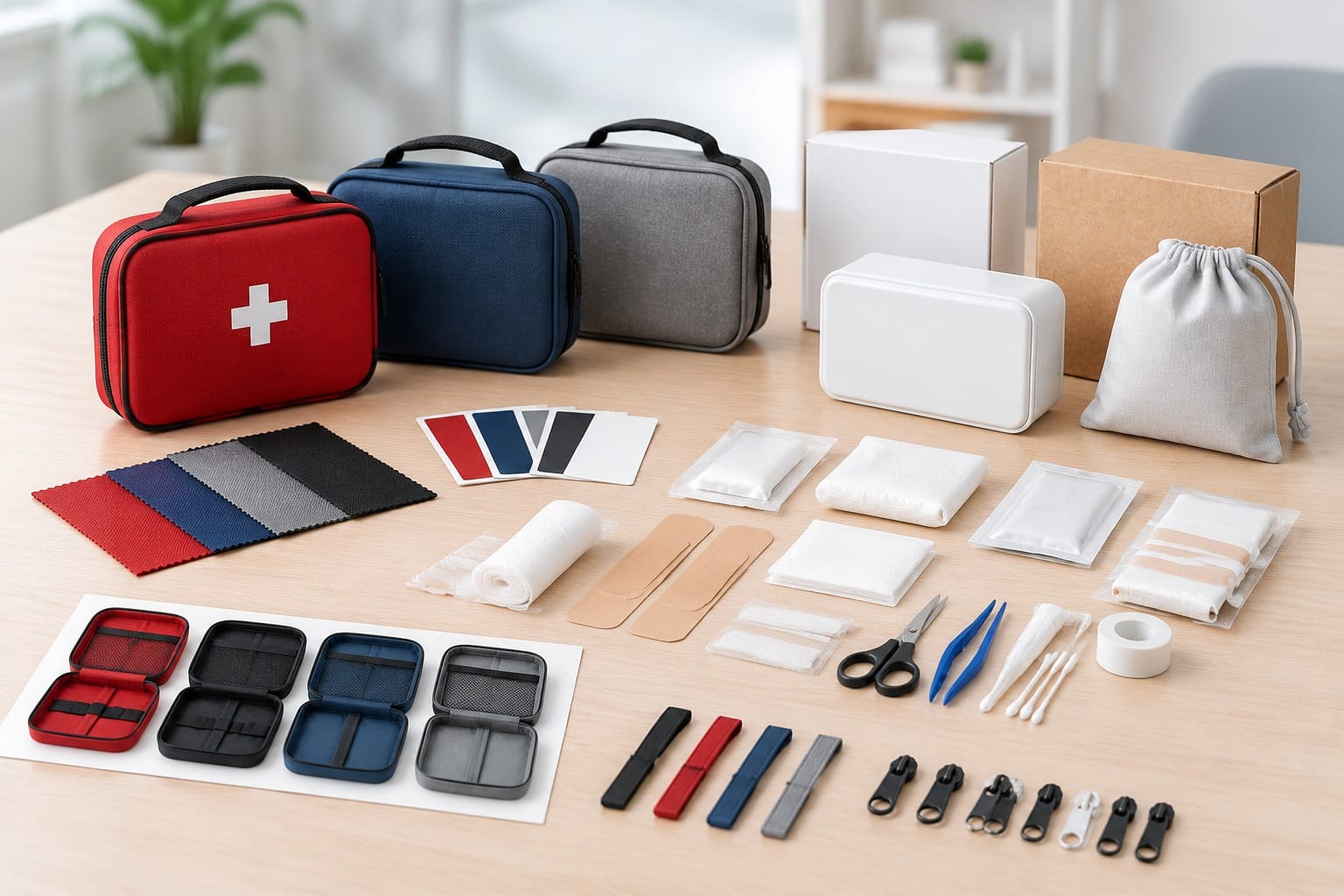
Most custom medical bag specifications start with fabric. Start with the item list instead, and work backwards.
The logic is simple. The bag exists to hold a known list of items in a known access order. Design the zones from that list, then choose the material that survives the layout and the cleaning routine. Suppliers who design from the item list backwards describe the same approach as kit mapping, and it shortens prototyping because the layout is settled before the fabric is argued about.
Put the map in the sheet as zones with an access priority attached. Rapid-access front, main compartment, identity area, and any insulated pocket. Then state what belongs in each zone and how many units of it. This is the part of the sheet that prevents the most common complaint after delivery. A bag can meet every dimensional requirement and still be unusable if the tourniquet sits behind the saline.
Attachment belongs on the same page. If a buyer expects the bag to hang from a rack or clip to a vest, the loop geometry and webbing pattern have to be written down. MOLLE webbing, for example, is a mounting standard rather than a decorative row of stitching, and its spacing is what determines whether a pouch attaches at all.
The two fields buyers omit: tolerance bands and revision references
These are the two omissions that cause most repeat-order disputes. Both are cheap to add.
Tolerance bands. Buyers write dimensions as single numbers, as if a sewn bag could be built to the millimetre. It cannot. Fabric stretches, cutting tables drift, and seams consume material differently across batches. Tolerances exist because they are based on machine and tooling capability. The published guidance on healthcare product specifications groups dimensions and tolerances as one combined requirement, precisely because tolerances determine what tooling a factory needs. Write the band into the custom medical bag specifications sheet, and decide it while the sample is on the table rather than after three containers have shipped.
Revision references. A sheet without a version number cannot be audited. The convention in regulated manufacturing is a released specification: the buyer has signed off on one version and production is cleared against it. Any later edit starts a new revision with a new date. This is the mechanism that makes reorders comparable. Without it, a factory can change the lining weight in month nine and still be building to “the spec”.
How custom medical bag specifications drive repeat-order continuity
Component continuity is a sourcing problem before it is a manufacturing problem. Two buyers can order the same bag and receive two different products, because each order was quoted against a different verbal brief.
A custom medical bag specifications sheet fixes this by making change visible. Any alteration to a material, a divider count or a logo placement becomes a numbered revision, and the buyer can decide whether to accept it. Suppliers usually reinforce this with pre-production checkpoints: material confirmation, in-process checks at load seams and layout assembly, and a final inspection against the same document.
Documents do the same work on the commercial side. A common expectation in export manufacturing is a pre-production document set that pairs the specification sheet with a design proof, a material confirmation, an approved sample record and stated inspection criteria. The phrase some suppliers use is blunt: no document, no production. For a buyer, the value is that the sheet becomes the reference during an inspection, so an argument about quality turns into a comparison against agreed text.
Our own production starts at 1,000 pieces per configuration, and documentation is issued by SKU. That combination pushes in one direction. Every configuration in a programme carries its own specification sheet and its own minimum, so a programme split across three bag sizes carries three sheets and three minimums. Writing the sheets properly is what stops those three versions from blending into one another.
The input package to assemble before you write the sheet
The sheet is an output. Assembling the inputs first is what keeps it to one or two revisions instead of six.
- Use case and environment. Clinical, emergency response, home care or field use. Indoor or outdoor decides coating and closure far more than aesthetics do.
- Item list with quantities and access priority. What must be reachable with one hand, and what can sit behind it.
- Layout preference. Modular dividers, fixed dividers or elastic loops. Each locks a different part of the manufacturing process.
- Cleaning routine. Which agents will be used on the shell and the lining, because material selection has to match them.
- Labelling and traceability needs. Identity windows, barcode labels, reflective marks, writable surfaces.
- Branding method. Screen print, heat transfer, woven label or patch. Each has its own artwork requirement and its own cost driver.
- Target quantity, SKU count and destination market. Compliance planning and material sourcing both depend on this.
Search data captured by our own reporting shows buyers querying for a supplier selection guide rather than a product listing. That is a useful signal. The people arriving at this stage of a sourcing project want a framework to compare suppliers with, and the input package above is the first artefact that framework produces.
FAQ about custom medical bag specifications
Which fields are mandatory on a first draft?
Start with construction, materials, compartment map and revision control. Those four cover the failures that cannot be corrected downstream. Attachment, labelling and packaging can be marked as open items and closed before sampling, as long as the sheet says they are open. What matters is that every field is either specified or explicitly deferred. A blank field is read as “supplier’s choice”.
How detailed should the tolerance band be?
Detailed enough to reject a bad batch, loose enough that a normal production run passes. Start with the critical dimensions only: overall length, width, depth, and the internal pocket widths that hold fixed-size items. Ask the factory what its normal process capability is, then set the band around that. A band tighter than the machine capability turns into either a rejected good shipment or an unenforceable clause.
Can I use a supplier’s own template?
You can, and it saves time, but read it as a quotation document rather than a specification. Supplier templates are built to capture what the factory needs to price the job. They rarely prompt for tolerance bands or revision history, and those are exactly the fields that protect the buyer on the second and third order. Crossing two suppliers’ templates usually produces better custom medical bag specifications than accepting either one as written.
What happens if I change the sheet after sampling?
The sample is then invalidated for that change, so the change has to be re-validated. Practically that means a new revision number, a dated entry describing the change, and a decision on whether a revised sample is required or whether a written confirmation is enough. Load-bearing changes such as material, compartment count or attachment geometry normally need a physical sample. Cosmetic changes such as carton marking often do not.
Should the sheet cover the contents or only the bag?
Cover the bag, and cover the interface to the contents. The bag specification should state what has to fit where, but the component specification for each consumable belongs in its own document tied to the same SKU. Keeping them separate lets you change a bandage supplier without re-issuing the bag sheet. Keeping them cross-referenced stops the bag from being built for a content list that has already moved.
A sheet that survives its own revisions
Read custom medical bag specifications as an operating document rather than a marketing description, and the whole project gets easier to control. Seven fields, one value each, a compartment map drawn from the item list, a tolerance band agreed while the sample is present, and a revision number on every copy.
Buyers building that structure for the first time usually start from the guide to OEM and private-label first aid kits, then narrow the housing format against the emergency medical bag directory or the hand-carry emergency bags range. Two companion pieces cover the details that sit on either side of the sheet: logo and branding methods for bags and cases for the marking fields, and sample validation for OEM bulk orders for the approval gate that follows.