
The first aid box vs bag question is usually framed as a preference. It is a specification decision. A wall-mounted box does one job: it makes supplies findable at a fixed point, so nobody has to remember where they are. A portable bag does a different job: it moves supplies to where the incident happened. Sites with people who stay put need the first format. Sites with people who move need the second. Most buyer programmes end up specifying both, and the sourcing work sits in getting each format right rather than picking between them.
This guide sets out what actually differs between the two formats, the four questions that decide which one a site needs, and what to write into an order when you are buying either format for import.
First aid box vs bag: what actually differs
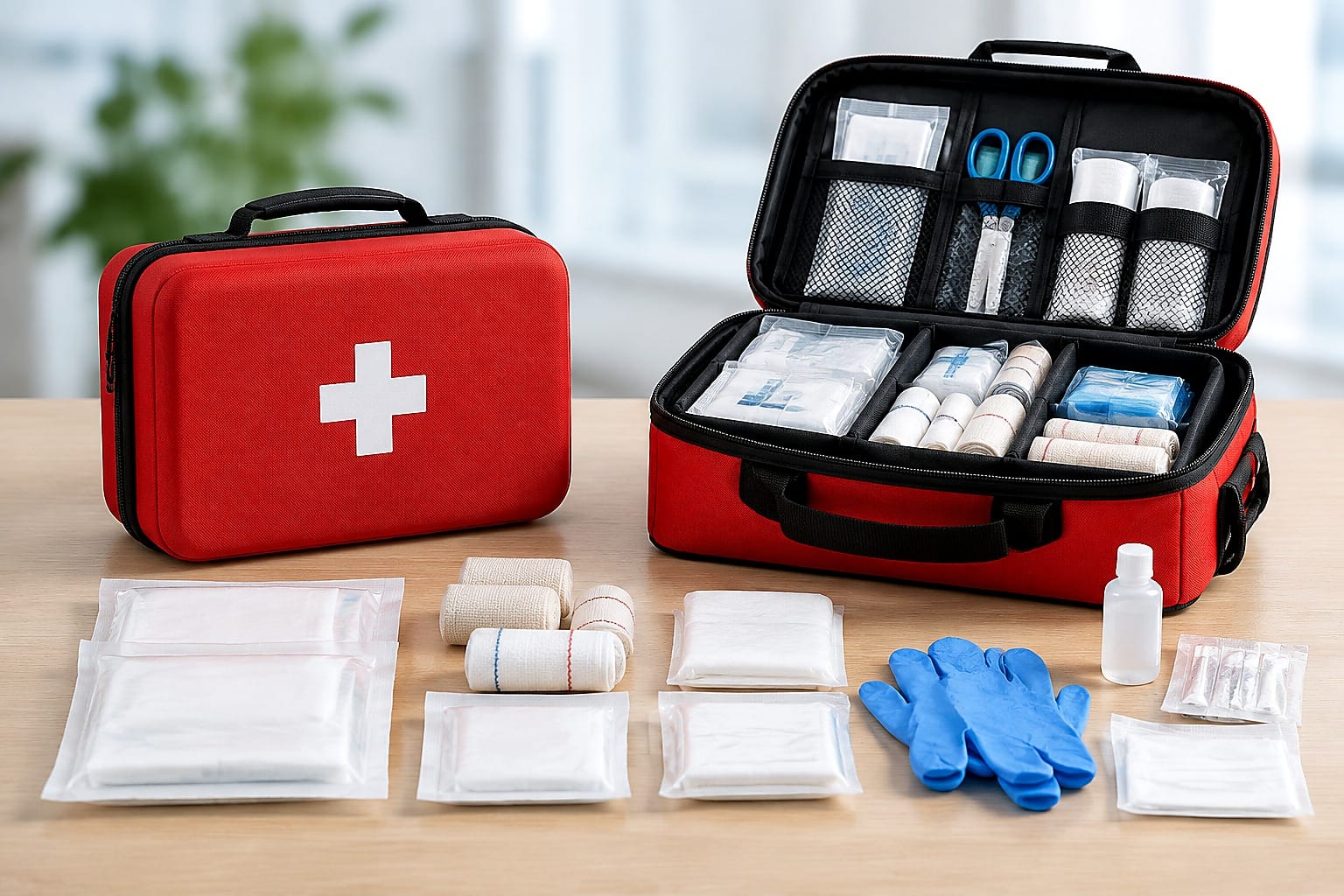
Three dimensions separate the formats, and only one of them is about the container itself.
| Dimension | Wall-mounted box | Portable bag |
|---|---|---|
| Where it lives | A fixed access point, usually marked and signed | With a person, a team or a vehicle |
| How it is restocked | Shelf by shelf, shortfalls visible without emptying it | Checked as a whole, often only after it is used |
| Content protection | A rigid body, closed against dust and knocks | Set by fabric, coating and the closure system |
| Inspection effort | Read at a glance during a walk-through | Requires opening, unloading and repacking |
| Typical fit | Offices, kitchens, warehouses, reception areas | Field crews, vehicles, events, multi-floor sites |
The restocking row is the one buyers underweight. A box that sits in the same place is inspected on a route, so the person checking it sees the same shelf arrangement every time. A bag that travels gets checked when someone thinks to check it, which is usually after an incident rather than before one.
The four questions that decide the format
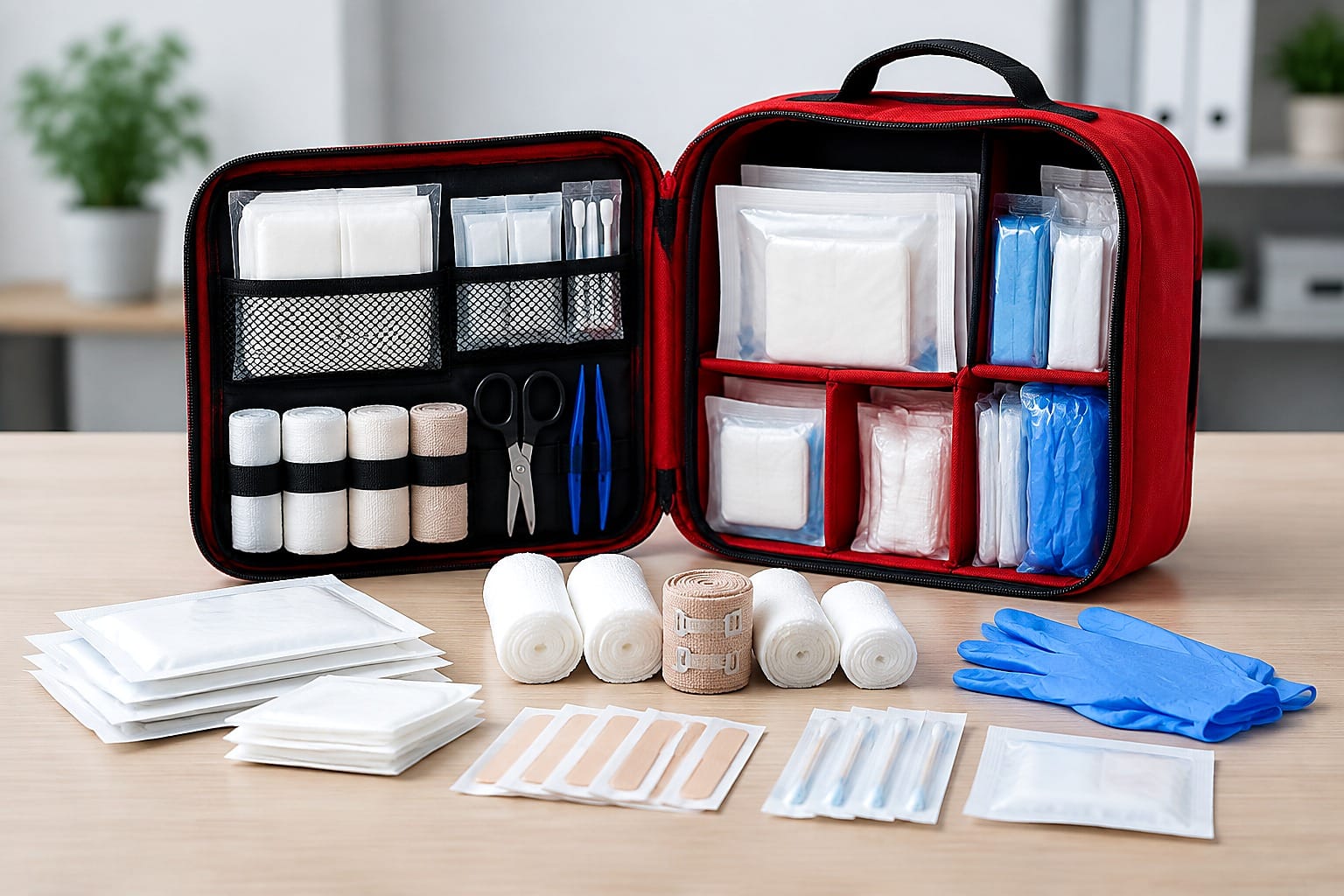
Run these before choosing a container. They are cheap to answer and they settle most of the first aid box vs bag argument.
- Can every user reach one fixed point in the time you accept? If the answer is no for part of the site, that part needs a movable format.
- Does the responder travel, or does the site hold still? A first aider covering four floors carries supplies. A receptionist does not.
- Who checks it, and against what schedule? A named person with a route will maintain a box. An unnamed person will maintain neither format.
- What is the ambient condition? Dust, moisture, heat and vibration change the container requirement long before they change the contents.
For mixed sites, the useful pattern is one fixed station per zone plus personal or per-vehicle bags for staff who leave the zone. Splitting it that way keeps the fixed station simple and puts the portable units where the movement actually happens.
Why the mounting point changes how a kit gets restocked
Mounting a container is a maintenance decision dressed up as a hardware decision. A fixed unit on a wall becomes a station with a route attached. Anything that has to be carried becomes an item with an owner attached.
In the United Kingdom, the duty to provide first aid equipment and facilities sits with the employer, and the practical checkpoints for a workplace provision sit in the HSE leaflet on first aid at work, which covers what first-aid regulations require, what a first-aid box or kit contains, and a checklist for setting out provision. That framing is useful for buyers because it makes the container part of a system rather than a purchase on its own.
Contents also move with the setting. A vehicle kit and a workplace kit hold different things because the situations differ, as the Red Cross anatomy of a first aid kit sets out. When you specify a first aid box vs bag, you are choosing a container for a contents list you have already decided, not the other way round.
Contents protection: where a rigid box wins and where a bag wins
The first aid box vs bag comparison reaches the container specification at this point. A rigid box holds its shape. That matters for molded trays and for anything that has to stay flat, and it makes a shelf layout repeatable. A bag holds its contents against the body, which matters when the kit has to be carried some distance, and it packs down when it is not in use.
Some destination markets’ standards separate the container and the contents into two independent axes rather than one product definition. Summaries of the ANSI/ISEA framework published in the United States describe a content class and a container type, where the type covers portability, mounting and environmental resistance. Those published summaries paraphrase the standard differently, and the standard itself is the authority, so check the ANSI/ISEA Z308.1 listing for the current wording. For sourcing purposes the useful part is the concept: decide the fill and the container separately, then check both against the destination market rather than assuming one implies the other.
Protection is also where specification shortcuts appear. A coated fabric and an uncoated one can look identical in a photograph. Ask for the coating and the fabric weight in writing, and confirm the closure system, because the closure is what keeps dust and moisture out of a bag that lives in a vehicle.
Specifying a first aid box vs bag order for import
Buyers who import the two formats are usually buying the container, the contents, or both. Each choice changes what has to be documented.
- Empty or stocked. Empty bags and boxes ship as containers and are ordered against a housing specification. Stocked kits add a bill of materials, which means every component needs its own revision reference.
- Mounting hardware. A box that is described as wall-mountable needs the bracket, the fixing pattern and the wall type stated. A bracket that arrives without a fixing pattern is a site problem, not a factory problem.
- Label and marking fields. The window or panel that carries the identity of the kit has to accommodate the longest field the destination market needs.
- Refill architecture. Whether components are unit-packaged or loose decides how a station is restocked, and unit packaging is what keeps a part-used kit usable.
Quantity planning works the same way in both formats. Our own production starts at 1,000 pieces per configuration, so a buyer who splits a programme across a box and two bag sizes carries the minimum three times. That arithmetic is covered in the workplace kit configuration checklist.
It is worth noting that search demand around this category positions the container as a product in its own right. Queries such as empty first aid box wholesale and aid box appear in the search data our own reporting captures, which suggests buyers shop for the housing separately from the fill. A supplier that can quote the housing on its own is easier to work with than one that will only quote a complete kit.
What buyers get wrong when they compare on price
Comparing a wall-mounted box and a portable bag on unit price produces a decision that holds for about a month. The costs that decide the outcome sit elsewhere.
- Restocking labour. A station that can be topped up shelf by shelf takes minutes. A bag that has to be emptied takes considerably longer, and that cost repeats at every refill.
- Write-off from exposure. Supplies stored where moisture and heat reach them expire and degrade faster, and the loss shows up months after the purchase.
- Duplicate buying. Sites that cannot reach a fixed point buy a second station, which is a larger cost than the original choice.
- Refill minimums. A housing order and a component order rarely share a minimum. Programme the two together or expect two order cycles.
- Replacement of the housing. A bag that is carried wears at the handle and the zip first. Budget for the housing as a consumable in high-movement roles.
A first aid box vs bag comparison is far more useful when it runs across a refill cycle than across a single purchase.
FAQ about first aid box vs bag selection
Which format suits a multi-floor office?
Usually both, split by zone. Put one fixed station per floor in a marked location, and add a portable bag for the first aider who moves between floors. A single central station fails on the floors that are furthest from it, and a single bag fails as soon as it is being carried somewhere else when it is needed. Splitting the two roles keeps each format doing the job it is good at.
Does a portable bag need to be water-resistant?
It depends on where it travels. A bag that moves between indoor locations needs a cleanable shell far more than a waterproof one. A bag that lives in a vehicle or goes outdoors needs a coated fabric and a closure that keeps dust out, because moisture and grit are what degrade sealed stock. State the intended environment in the order and let the specification follow.
Can I buy the housing empty and fill it locally?
Yes, and many importers do. Buying the empty bag or box and filling it in-market shortens the documentation chain, because only the housing crosses the border as a container. It also moves the fill decision to the buyer, which is useful when the contents have to match a local requirement you already know. The trade-off is that you then own the component specification.
How many units should a first order cover?
Size it against sites you can actually reach, not against a forecast. One station per zone plus one portable unit per responding role is a defensible opening programme, and it is easier to repeat than a speculative bulk order. Our own production starts at 1,000 pieces per configuration, so aim the first order at the configurations you have already validated rather than spreading it thin.
Does the container choice affect how the kit is inspected?
It changes the inspection method, not the requirement. A fixed station is checked on a route, where a missing item is visible from the front of the shelf. A portable unit has to be opened, and that means the check depends on somebody remembering to do it. Whichever format you choose, name the person responsible and set the interval in writing, because an inspection that depends on goodwill does not survive a busy month.
A format decision that survives a programme rollout
Read the first aid box vs bag choice as two specifications rather than one comparison, and the rollout gets easier. The fixed station carries the visible, high-use consumable lines. The portable unit carries the response kit that has to travel. Both are ordered against a written housing specification, both have a named owner, and both are restocked on a schedule rather than after an incident.
Buyers building that structure across several sites usually start from the B2B guide to emergency first aid kits and bags, then work the format list down to the bag shapes that match each site. Where the answering unit has to leave the building entirely, the trade-offs between the outdoor first aid kit bag formats are the next decision, and the mounting question mostly resolves itself.
Whichever format you pick, the purchasing step is the same: an emergency first aid kit RFQ that fixes the contents table and the MOQ tier keeps two format quotes on the same basis.
Format is only the first of the lines that has to be fixed. Where the container is bought empty, the specification sheet for empty first aid kit bags and boxes sets out the remaining five fields, from fabric and closure through to carton and delivery term.