
Payment terms decide who funds the production run. On an international first aid supply order, four structures cover almost every deal: full payment in advance, a deposit with the balance against shipping documents, a documentary letter of credit, or open account credit. Which one applies moves with order value, lead time and how much of the supplier you can verify.
This guide sets out how first aid supplier payment terms are structured on real export orders, what each structure costs the buyer, and how to write the terms into an RFQ so the quotes you receive can actually be compared.
Why first aid supplier payment terms differ from other categories

A first aid kit is an assembly, not a single unit. Contents come from several production lines: hemostasis items, dressings, antiseptic supplies, bandages, gloves, and the bag or box that holds them. A custom project adds tooling for the housing, printed labels, and an instruction leaflet that has to survive review in the destination market.
That structure shapes payment. Money does not move against one finished good. It moves against stages: artwork approval, component consolidation, assembly, inspection, and release to freight. Suppliers who assemble kits from bought-in components carry a working-capital exposure that a single-line manufacturer does not.
There is also a documentation layer. Buyers commonly need file sets matched to each SKU before release, and responsibility for confirming destination-market requirements sits with the buyer rather than the supplier. A payment schedule is the lever that keeps both sides aligned on which documents must exist before the final balance is released.
The four structures buyers choose between
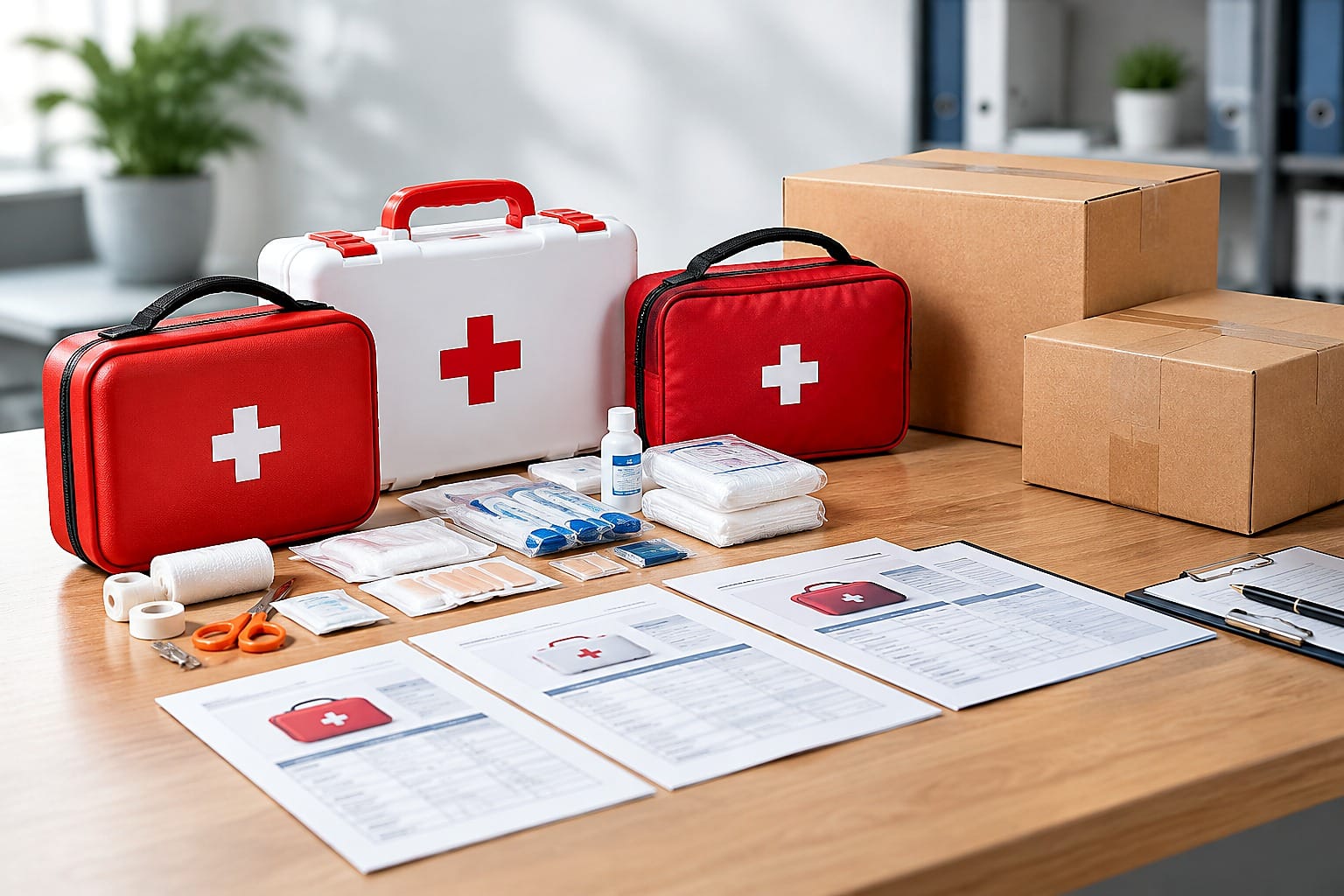
Most export orders settle into one of four patterns. They differ less in price than in who carries the risk of a run going wrong, which is why first aid supplier payment terms are more usefully read as a risk allocation than as a price concession.
| Structure | Typical trigger | Who carries the risk | What to confirm in writing |
|---|---|---|---|
| Full payment in advance | Low order value, new relationship, or a custom run with no resale value if cancelled | Buyer carries all of it | Written cancellation and delay remedies |
| Deposit plus balance against documents | Standard for first bulk orders | Shared; the balance is protected until documents exist | Which documents count as documents |
| Documentary letter of credit | High value, or where the buyer’s bank is the funding source | Bank interposes; both sides accept conditions | Exact document set and discrepancy rules |
| Open account credit | Established repeat orders with a payment history | Supplier carries the risk | Credit limit, credit period, and review date |
The deposit plus balance structure is the default for a first bulk order of kits. The deposit funds component purchasing, and the balance releases when shipping documents are presented. The weak point is the definition of documents. If the RFQ does not name them, a supplier can present an invoice and a bill of lading and consider the condition met.
For the letter of credit, the governing rules are published by the ICC as UCP 600, which sets out how banks examine documents and how discrepancies are handled. Read the document list as a checklist, because that list is what a bank will apply. For pricing tiers that sit above the payment structure, the way quote tiers are built for first aid supplies is a separate negotiation and should not be bundled into the payment discussion.
How Incoterms change what the payment terms have to cover
Payment milestones and delivery milestones have to line up. First aid supplier payment terms that ignore the Incoterm tend to break at the exact point where the buyer believed protection started. The ICC’s Incoterms rules define where the seller’s obligation ends, and that boundary decides which documents a buyer can hold back payment against.
Three practical consequences follow:
- Under FOB or FCA, the buyer controls the main carriage. The supplier’s proof of shipment is a bill of lading or an air waybill in the buyer’s name. A balance against documents works cleanly here.
- Under CIF or CIP, the seller arranges carriage and insurance. Confirm which insurance cover applies and that the certificate is transferable to you, because you cannot claim on a policy you are not party to.
- Under DAP or DDP, the supplier carries the goods to the destination. The final payment milestone should sit after arrival and after any import formalities you are contractually bearing, not at the port of loading.
A payment schedule that releases the balance on shipment while the contract is DDP leaves the buyer with nothing to hold. Match the milestone to the term in the RFQ, and the same term appears in the proforma invoice.
Matching first aid supplier payment terms to the order stage
Payment terms should move as the relationship matures. Applying the same schedule to a sample, a first bulk run and the fourth repeat order wastes either money or leverage.
- Sample stage. Sample cost is small relative to tooling. Pay in full and keep it separate from the production contract, so a sample dispute never blocks a bulk order.
- First bulk order. A deposit with balance against documents is normal. Confirm whether tooling or plate charges sit inside the deposit or are billed separately.
- Repeat orders. Once delivery and quality are demonstrated, negotiate a credit period. Structure the request around your own sell-through cycle rather than asking for a blanket extension.
- Configuration changes. A content revision, a new artwork file, or a component substitution raises the supplier’s risk again. Expect terms to tighten for that run, and price it in advance.
This is where MOQ interacts with payment. Our own production starts at 1,000 pieces per configuration, and terms are set against that quantity. If a buyer splits a launch across three configurations to test the market, each line carries the minimum, and total working capital rises sharply. Buyers who plan a launch this way usually get more value from planning quantity tiers around the MOQ than from pushing on price.
What to put in the RFQ about payment
Put the payment question in the RFQ rather than negotiating it after the quote. Terms requested late are priced late.
Ask for all of the following, and require a single answer format so quotes can be compared:
- The percentage split, and the trigger for each instalment
- The named document set for any balance against documents
- Whether the price is exclusive or inclusive of the currency conversion cost
- The Incoterm proposed, quoted alongside the payment schedule
- The validity period of the quotation and the currency
- Any tooling, plate, or artwork charge, listed separately
- Late-delivery and quality remedies tied to the instalments
- The credit terms available on a repeat order, stated now rather than later
For buyers mapping this onto their own funding, the US Commercial Service overview of payment methods sets out the same menu from the importer’s side. It is useful for briefing an internal finance team that has not handled an import before. Where a destination market imposes its own registration or labeling conditions, those belong in the file set that gates the balance, not in a separate email thread. The division of those obligations between buyer and supplier is set out in the import requirements responsibility matrix.
Red flags in a proposed payment schedule
A schedule that looks generous can be a signal rather than a concession. The same suspicion applies to first aid supplier payment terms offered with no documentation gate attached.
- A deposit far below the component cost. If the deposit does not cover the purchased-in contents, the supplier is funding your run from another buyer’s money. That is a delivery risk, not a discount.
- A balance due before inspection. Once the money has left, a pre-shipment inspection finding has no leverage behind it.
- Vague document wording. Balance against shipping documents, without a named list, means the supplier chooses the list.
- No credit conversation on a repeat order. A supplier that will not discuss terms after three clean deliveries is telling you something about their own cash position.
- A separate payment route. Any instruction to pay a different entity than the contracting party on the proforma invoice should stop the order until the relationship between the two entities is explained in writing.
A schedule that keeps documentation moving
The payment schedule is also a document schedule. Tie the final instalment to the file set you need: batch records, test reports by model, and the declaration that names your SKU. Buyers who place the documentation gate before the balance report fewer release disputes than buyers who chase files after delivery.
When we structure a first bulk order, the feasibility review happens before production and the sample is validated before the run starts. Those two gates are commercial, not technical, and they exist because a run that begins on an unapproved sample is expensive for both sides. Payment terms make the gates enforceable, and that is the practical test of any set of first aid supplier payment terms.
FAQ about first aid supplier payment terms
What is the most common payment structure for a first bulk order?
A deposit with the balance against shipping documents. The split varies, but the balance is normally released when a named document set is presented. Insist on that list being written into the proforma invoice, because an unnamed document set gives the supplier discretion over when the condition is met and leaves the buyer with no lever.
How do I get open account credit from a first aid supplier?
Usually by demonstrating a payment and delivery history first. Ask for the credit terms at the RFQ stage so you know what becomes available later, then negotiate a period after two or three clean cycles. Approach it as a shared risk decision: the supplier is funding your inventory, so a limit, a period and a review date should be agreed together.
Should I ask for a letter of credit on a small order?
Usually not. Banks charge issuance, amendment and discrepancy fees, and those costs are material against a small order value. A documentary letter of credit makes sense when the order value is high enough that the fees are a small percentage, or when your own bank is the funding source and requires the instrument.
How does the Incoterm affect when I should pay the balance?
The Incoterm sets where the supplier’s obligation ends, so it sets the last point at which you still hold leverage. Under FOB or FCA, a balance against a bill of lading works well. Under DAP or DDP, the milestone should sit after arrival, because the supplier still carries the goods until then and a payment on shipment removes your protection early.
Payment structure is one agreement and the delivery term is another, and this guide to choosing Incoterms for first aid supply orders explains where the two meet.
What documents should trigger the final payment?
Name them individually: invoice, packing list, bill of lading or air waybill, certificate of origin where applicable, and the product documentation your market requires by SKU. Add batch records and test reports if your internal quality process needs them before release. If a document cannot be produced, the buyer should know that before the balance is scheduled.
Can payment terms be renegotiated on a repeat order?
Yes, and they normally are. A supplier that has been paid in full on three consecutive runs has a track record to price from, so the case for a credit period is commercial rather than relational. Put the request in writing with the volume you expect over the next twelve months, then ask for a limit rather than an open-ended extension.
Putting the terms in place
Read first aid supplier payment terms as a procurement instrument, not an administrative detail. The schedule decides who funds the components, who holds leverage at each gate, and whether your documentation arrives before or after the money. Get the structure into the RFQ, tie it to a named Incoterm and a named document set, and set a review date on the credit side. Buyers running a multi-line sourcing programme tend to fold this into a standard B2B first aid procurement process rather than negotiating each order from scratch.
Payment terms release the goods, and the shipping mode decides when they arrive, so planning the shipping method alongside payment keeps both clocks moving together.
Payment mechanics in public contracts follow their own path, and the bidder’s overview of public sector first aid products tenders covers how they interact with the award method and with call-offs under a framework agreement.