
A first aid products tender is usually lost before anyone opens the price envelope. The notice looks like a shopping list. It is actually a two-stage filter, and price only matters in the second stage. Suppliers who bid on the list instead of the filter spend weeks assembling a response that is rejected on a document they never read.
Two questions decide most outcomes. Is this tender open to a supplier like us at all? And which lot are we actually competing in? Both are answerable from the published notice. Neither is answered by the product list at the end of it.
Public procurement is only partly open to international bidding. The rules that open it are specific, and they are narrower than most suppliers assume.
The WTO Agreement on Government Procurement is a plurilateral agreement, which means not all WTO members are parties to it. As published by the WTO, it has 22 parties comprising 49 WTO members. The agreement requires open, fair and transparent conditions of competition, and its parties have opened procurement worth more than US$ 1.7 trillion annually to international competition.
The critical limit sits in the coverage schedules. Only procurement carried out by covered entities, for listed goods, above specified threshold values, is covered. A notice can be published, be genuine, and still be closed to a supplier outside the relevant coverage. That is why the first question in a first aid products tender is about eligibility, not about capability.
The second structural point follows from the first. Government procurement sits outside the WTO’s multilateral trade agreements, so the GPA is a treaty in its own right, administered by a Committee on Government Procurement and enforced through domestic review and dispute settlement. A supplier’s practical remedy therefore lives in the buyer’s national review process, not in an international one.

Most notices are divided into lots. A lot is a separately evaluated package, often with its own value, its own award criteria and its own winner. Two lots in the same notice can be different businesses.
This matters directly in our category, because pre-packed kits and empty bags are not the same product to a procurement team. A first aid products tender for stocked kits asks about contents, expiry management and configuration control. A tender for empty bags and cases asks about fabric, colour, hardware and print. Our own catalogue holds them as separate lines for the same reason, and a bidder should never assume one lot’s terms carry into the other.
The classification codes tell you more than the lot titles do. In the European Union, the Common Procurement Vocabulary establishes a single classification system for public procurement. Its use has been mandatory in the EU since 1 February 2006. The main vocabulary is a tree of codes of up to nine digits: two digits for the division, three for the group, four for the class, five for the category, with the final digits adding precision inside the category and a ninth digit verifying the previous ones. A supplementary vocabulary adds qualitative detail.
Read the codes before you read the specification. A code near the division level describes a broad family. A code five digits deep describes a narrow one. The same notice can carry both, which means the buyer has not finished deciding what they want.
Publication is decentralised, and this is an operational problem rather than a legal one. Miss the portal, miss the tender.
In the United Kingdom, the Find a Tender service is an e-notification service used to post and view public sector procurement notices. It is free to use and replaced the role of Tenders Electronic Daily for UK procurements. It does not replace everything: it works alongside Contracts Finder, MOD Defence Contracts Online, Public Contracts Scotland, Sell2Wales and eTendersNI, and EU opportunities are still accessed through OJEU and TED.
For a supplier, that means maintaining registrations in several places, each with its own alert settings and its own document formats. Two practical habits reduce the load. Register once per portal and set alerts on the classification codes rather than on keywords, because codes are stable and keyword alerts are not. Then keep the master document file in one folder, dated, so that a notice requiring a current copy can be answered the same day it appears.
Eligibility is evidenced on paper. A first aid products tender usually fails a bid on a missing or expired document rather than on a weak price, and the requested documents are broadly similar across markets even when the names differ.
| Document | What it evidences | Typical failure point |
|---|---|---|
| Business licence and registration | Legal capacity to contract in the buyer’s market | Scope of business does not name the product family |
| Product registration or licence by class | Market authorisation for the devices being supplied | Class of the actual SKU is higher than the class held |
| Quality management certification | A maintained system, where the notice names a standard | Certificate expires before the contract end date |
| Credit-record clearance | No exclusion on integrity or tax grounds | Search result not submitted as a dated printout |
| Similar-project track record | Delivered comparable supply before | Contract references do not show quantity or destination |
| Product documentation by SKU | Configuration, materials and handling data for each item | One document for a family instead of per SKU |
| Certificate of origin | Origin of goods for import clearance | Issued after the deadline instead of before |
| Physical sample | The actual item, not a photograph | Sample arrives after the submission window closes |
We supply documentation per SKU, and our position on destination-market requirements is deliberate: compliance for the importing market stays with the buyer, who can confirm what their own authorities require. A first aid products tender is the moment that division of labour becomes visible, because the notice will ask for a specific document, in a specific form, by a specific date. Suppliers who cannot produce it are excluded regardless of price.
Two award methods dominate, and they lead to opposite bidding strategies.
| Award method | How the winner is chosen | What it rewards | Where it hurts |
|---|---|---|---|
| Lowest compliant bid | The lowest-priced bid that passes the gate | Cost discipline and a clean file | Suppliers who quote before reading the gate |
| Weighted scoring | Price combined with quality, service and lead time | Verified capability and delivery record | Suppliers with no evidence for the non-price criteria |
| Framework call-off | A place on the framework first, then competition per call-off | Registration and readiness | Suppliers who expect a volume from the framework itself |
The first two rows are frequently confused. Under lowest compliant bid, compliance is a gate and price is the ranking, so a supplier with a strong technical file and a high price loses. Under weighted scoring, price is only one column, so a supplier with a good price and no evidence behind the other columns also loses. The notice states which applies. Read it before deciding how much effort to invest.
A framework agreement establishes terms and pricing for a period, and buyers call off against it as needs arise. This is where suppliers most often misread the opportunity.
A framework is not an order. It is admission to a shorter list. Being accepted means the work of bidding has been done once instead of many times, but it does not commit the buyer to any volume. Reading a framework award as a booking leads to capacity being reserved against demand that has not arrived.
For a supplier with a low entry quantity, that distinction is workable. Our own production minimum starts at 1,000 pieces, which is a normal call-off scale rather than a factory-run scale. The real constraint in a framework is not the minimum quantity. It is whether the supplier can hold a specification stable across several call-offs over four years without the component list drifting. A catalogue of 216 routes, 190 of them product pages and 26 of them category hubs, is not a marketing asset in this context. It is a documentation schedule that has to stay consistent for the life of the agreement.
Work through this before committing time to a first aid products tender:
If two or more items are unobtainable before the deadline, the honest answer is no-bid. That is a decision, not a failure, and it protects both the bid team and the buyer’s evaluation timeline.
Not necessarily. Publication and eligibility are separate. Coverage under the WTO Agreement on Government Procurement depends on three things at once: whether the buying entity is covered, whether the goods are listed in the relevant schedule, and whether the contract value exceeds the specified threshold. A notice can be authentic and complete while remaining outside the coverage that would open it to a supplier from another market. The notice itself usually states the eligibility conditions, and suppliers should read those conditions as the first screening test rather than assuming that a public advertisement means open access.
Read the lot descriptions and the classification codes together, not the lot titles alone. Lot titles are written for the buyer’s internal structure and often use wording that does not match the trade’s vocabulary. The classification code is more reliable because it is drawn from a standardised tree, and its depth tells you how narrowly the buyer has defined the purchase. Where a notice mixes a broad division-level code with a narrower category-level code, the buyer has not finished specifying, and that is worth a clarification question before the enquiry deadline rather than after submission.
Assume that every document must exist in dated, current form before the submission window closes, because most notices read the submission date as the test rather than the award date. In practice that means a business licence covering the relevant product family, product documentation supplied per SKU rather than per family, evidence of a maintained quality system where a standard is named, a credit-record search result submitted as a printed or dated record, and contract references that show quantity and destination. Certificates that expire before the contract end date are a common reason for rejection.
A framework sets the terms under which future purchases may be made, so the buyer keeps the right to decide whether and when to buy. The buyer’s obligation is procedural, not commercial: they must run the call-off correctly, but they are not obliged to place a minimum quantity. That is why framework notices commonly state that there is no commitment of business. For a supplier, the value of a framework is the reduced bidding overhead across many call-offs, and capacity should be planned against expected call-off patterns rather than against the framework’s headline value.
Often yes, but the two should be prepared as separate bids with separate documentation, because they are normally separate lots with separate award criteria and separate winners. Stocked kits are evaluated on contents, configuration control and expiry management. Empty bags and cases are evaluated on material, construction, hardware and print. Our own catalogue holds them as distinct product lines for the same reason. If the notice allows bids on multiple lots, prepare each on its own terms, and do not carry a specification or a price structure across from one to the other.
Public sector work rewards preparation more than persuasion. If you are assembling the document set for the first time, the compliance checklist we use for supplier RFQs is a workable starting point, and the sourcing guide for empty first aid kit bags and boxes covers the lot where bag and case specifications do most of the work. For the procurement mechanics that sit behind a notice, see our B2B first aid procurement guide. Suppliers preparing a response can review standard kit configurations and the wider product catalogue to check which family each lot maps to.
A reseller keeps three first aid suppliers on file. Two quotes land within 4% of each other, both kits look complete in photographs, and the decision comes down to who answered email faster. Six months later one of them has changed its gauze source without saying so. A first aid supplier scorecard exists to move that decision out of the inbox and onto a page you can reread.
It does not rank suppliers by reputation. It scores them against categories a distributor can attach evidence to, weights those categories before scoring starts, and leaves a category blank when no evidence exists yet. Blank is a legitimate result. Most scorecards never allow it, and that omission is why so many of them produce confident numbers that mean nothing.

Three properties make first aid harder to score than a commodity.
The unit of purchase is a configuration, not a product. A 25-person workplace kit is a contents list plus a bag or box. Two suppliers can both satisfy that name while shipping different counts of the same component. Score “product quality” as a single number and you bury the only thing a reseller needs to compare.
The evidence sits in two supply chains. Consumables inside the kit and the bag or box around it are often made by different factories, on different lead times, against different minimums. One averaged quality score hides a difference that will surface at reorder.
The buyer usually cannot inspect before the first order. Samples travel; production lines do not. So the sheet has to separate evidence that exists at bid stage from evidence that only exists after two production runs.
Ignore those three properties and the sheet becomes a popularity ranking. Buyers searching for selection frameworks are asking something narrower than “who is good”. In our own search data, the phrases that actually appear are things like “empty first aid bag supplier selection guide” and “empty first aid bag odm manufacturer” — both describe a decision process rather than a product.

| Category | Weight | What earns a high score | Evidence you attach |
|---|---|---|---|
| Specification closure | 25% | Contents list, bag or box dimensions and material stated as fixed, with a revision number | Signed specification sheet with revision date |
| Component continuity | 20% | Named components stay named across reorders; substitutions are proposed in writing | Two consecutive packing lists for the same SKU |
| Delivery terms precision | 20% | Quoted delivery term, port, packing dimensions and lead time in working days | Quote with the term written out rather than implied |
| Documentation handover | 20% | Destination-market documents identified by type, with the buyer’s confirmation step stated | Document list by SKU, naming the register that confirms it |
| Commercial fit | 15% | MOQ, sample path and tier logic matched to your first order size rather than an ideal one | Written MOQ and a sample plan |
Weights are a starting position, not a universal truth. A reseller opening a new channel should raise component continuity, because an inconsistent reorder costs more than a slightly worse unit price. A reseller running a tender against a fixed configuration can lower it.
Score each category from 1 to 5, or record it as unverified. Multiply, sum, then read the total only next to the unverified count. A total of 3.8 built on four blank categories is not a score. It is a statement about your access to information. That distinction is the discipline a first aid supplier scorecard has to hold to.
Pre-order evidence is the scarce resource, so the sheet should name what is obtainable. Five artifacts can be requested before any deposit:
Anything outside that list is either post-order or third-party evidence. Record it as unverified until you hold it. Inside that list, a first aid supplier scorecard can be completed before money moves. Generic procurement templates that weight quality at 30% assume a defect rate you can look up. A buyer sourcing first aid supplies from an unfamiliar factory has no such number, and inventing one turns a guess into a figure.
Two anchors are worth keeping in view. Workplace first aid requirements are set per jurisdiction rather than globally, so “meets the standard” is not scoreable until you name the market — the Health and Safety Executive states the position for the United Kingdom, and other markets legislate differently. Where a kit contains a regulated medical device, documentation duties also attach to the importer; the European Commission’s medical device pages describe that split, which is why documentation is scored on what is issued rather than on what is claimed.
Two suppliers, one tender, identical contents list.
| Category | Supplier A | Supplier B |
|---|---|---|
| Specification closure (25%) | 4 — revised sheet supplied | 3 — catalogue description only |
| Component continuity (20%) | 2 — gauze source unnamed | 4 — two prior packing lists supplied |
| Delivery terms precision (20%) | 4 — term and port named | 4 — term and port named |
| Documentation handover (20%) | 3 — list by SKU, register unnamed | 2 — documents described as available |
| Commercial fit (15%) | 5 — MOQ 1,000 pcs, sample path defined | 3 — MOQ stated as negotiable |
| Unverified categories | 0 | 0 |
| Weighted total | 3.45 | 3.30 |
In conversation the two look equal. The sheet separates them on the categories a reseller pays for later. Supplier A wins on specification closure and commercial fit. Supplier B wins on continuity, which matters more at the second order than the first.
Run the same arithmetic with an unverified count above zero and the total becomes provisional. Show it that way. A provisional total reviewed in 90 days is worth more than a finished total that was never evidence-based. Any first aid supplier scorecard that hides the provisional part is doing its reader a disservice.
Used badly, a first aid supplier scorecard produces the answer the person filling it wanted.
It is a weighted sheet that rates candidate suppliers against the same categories on the same scale, so the comparison can be repeated and the reasoning stays visible to whoever reads it next. It differs from a general procurement scorecard in what it weights: configuration closure and component continuity carry more weight than defect history, because a reseller usually cannot observe defect history before placing a first order.
Two or three. A single supplier gives you a baseline for the next review but no comparison, and beyond three the pre-order evidence work grows faster than the decision quality improves. Score the whole shortlist in one session, before any negotiation starts, so a late concession cannot quietly move the weights in someone’s favour.
Put price inside commercial fit instead. A unit price without a delivery term, packing dimensions and an MOQ tier is not comparable with anything, and a separate price category rewards whichever quote states the fewest terms. At 15% of the total, a supplier can still win commercial fit comfortably without winning on headline price alone.
Record it as unverified, keep the total provisional, and set a review date. Do not convert it into a zero or a mid-range score. A blank records what you have not obtained yet; a fabricated value records nothing at all, and it will be the number you quote back in the meeting where the decision is actually made.
Score at selection, then again after the second production run, because continuity and documentation behaviour only become visible once there is a history to compare. Quarterly review suits suppliers carrying steady volume. Annual review is reasonable for low-volume suppliers. Repetition is what turns the sheet into a trend, and the trend is what predicts the substitution a single quote cannot show.
Yes. The same categories apply. The practical difference is that configuration detail often sits with the factory rather than on a website, so each request has to name the artifact you want: a contents list with counts, packing dimensions, the material of the bag or box. Suppliers who keep those records are easier to score, and that ease is a useful signal about process rather than about product.
A first aid supplier scorecard used once is a comparison. Used twice, it becomes a measurement.
The reorder cycle is where the continuity category earns its weight. When a repeat order arrives, the contents list should match the one you scored, component by component. Where a substitution is proposed, it should reach you in writing before production rather than in the packing list afterwards. Buyers who plan for component continuity across repeat first aid kit orders are scoring exactly that behaviour.
For channel decisions the sheet pairs with the framework in our guide to building a first aid distribution strategy. The strategy defines which channel you are supplying; the scorecard defines whether a given supplier can support it. Where a reseller is still testing demand, the metrics in the first aid distributor channel scorecard show what to watch after launch.
If the shortlist is still open, the method in how to compare OEM first aid kit suppliers applies the same evidence rules, and the compliance checklist for a first aid supplier RFQ covers the document side in more depth. Buyers who want the quote structure itself can start from the first aid supplies RFQ template.
Our own MOQ starts at 1,000 pcs, with sample-based validation before production and a feasibility review wherever the configuration is not yet fixed. In our catalogue data the category hubs, not the individual product pages, carry most of the search impressions, so a supplier’s hub pages are usually the faster read when you are comparing capabilities.
The same six-field discipline applies one layer down, when the item being quoted is an empty format rather than an equipped kit: the B2B sourcing guide for empty first aid kit bags and boxes applies the evidence rules to the container itself.
A scorecard works well for private channel partners, and a public sector first aid products tender applies comparable weighting under a stricter document gate, with the award method stated in the notice itself.
Two shipments of the same first aid kit can carry matching part numbers and still arrive different. The gauze pad measures 7.5cm on one run and 10cm on the next. The pouch tape shifts from white to cream. Nobody announced anything, because nobody inside the factory classed it as a change worth announcing.
Component continuity is the discipline that closes that gap. It bites hardest on first aid kit repeat orders, where the buyer is not reviewing a new design. The buyer is confirming that an already-approved configuration has been produced again, unchanged, against the same reference.
This guide covers the component baseline, the two routes a change takes into first aid kit repeat orders, and a notice format that makes the change visible before production rather than after inspection.

A sample is a controlled object. Someone signed for it, it sat on a desk, and it was measured. The first bulk run is built from a drawing and a work order instead, and those two documents are rarely identical.
Three mechanisms produce most of the drift.
None of that is bad faith. All of it is invisible unless a document forces it into view. A buyer who waits for a complaint to reveal a change is working from evidence that arrives a container late.

A baseline is the version of the product the buyer has accepted, and it is the one document that makes first aid kit repeat orders comparable. It has to name the items that can actually move, at a level of detail that lets a factory recognise a difference.
| Baseline item | What it should name | Failure when left open |
|---|---|---|
| Product identity | SKU, revision number and dated approved sample | Factory builds to “the usual kit” |
| Components | Item, size, material grade, individual pack format | A 7.5cm pad becomes a 10cm pad |
| Sub-suppliers | Named component makers where continuity carries risk | Silent switch to an untested maker |
| Expiry logic | Shelf-life rule and minimum remaining life on delivery | Stock arrives with months already gone |
| Packaging | Unit pack, carton configuration, label artwork version | Mixed cartons and unscannable labels |
| Production site | Named assembly location when location carries risk | Order moves to a second line unannounced |
| Acceptance | Inspection method and pass criteria | Dispute with no agreed yardstick |
“Our usual quality” is not a baseline. It gives a factory nothing to compare against, so nothing escalates.
Substitution is the change most likely to pass unnoticed, because the finished kit still looks correct. The bag is right, the count is right, the label is right. Only the component inside has moved.
It is the failure mode that most first aid kit repeat orders carry into their second year. This matters more in first aid kits than in most assembled goods, for one reason: the contents carry shelf life. A kit programme is also a consumable programme. Changing a wipe supplier changes the expiry profile of every unit built after that date, and a distributor holding six months of stock ends up with a mixed-age shelf.
Regulated manufacturing handles this as a control rather than a courtesy. In medical device quality systems, a change to a specification, method, process or procedure must be verified or validated before implementation, and the change must be documented. The requirement sits in 21 CFR 820.70(b). That rule does not automatically govern every first aid kit sold commercially, and it is not a claim about any particular product. It is the clearest published statement of why change notification exists: a change is cheaper to review before production than after an inspection finds the goods no longer match.
A practical buyer stance is a written rule that no material, component, process, artwork or packaging substitution is used without a recorded review. Sourcing guidance aimed at brand owners describes the same minimum stack — a versioned product definition, a change-control rule, applicable evidence, and a named person who releases the order. The requirements brand buyers should set for China sourcing sets that out in detail.
When a change is unavoidable, the transition takes one of two shapes. Picking the wrong shape creates the dead stock and the mixed cartons.
| Transition | How it works | Use it when | Main risk |
|---|---|---|---|
| Cut-off | Old component stops immediately; the new one starts from a stated date or order number | The old component fails a requirement, or a marking must change for compliance | Unused old stock is written off |
| Run-out | Old component is consumed to a calculated depletion point, then the new one takes over | The change is cosmetic or cost-driven and both versions pass the same checks | Two versions circulate at once |
The depletion point is arithmetic, not judgement. You need three numbers: quantity on hand, quantity already in transit, and build rate per week. Without those, a run-out plan is a guess with a date attached.
If a distributor or a public buyer will hold both versions at the same time, the run-out has to carry a visible version marker. Otherwise the change is invisible at the shelf, which is the exact outcome the notice was meant to prevent.
Advance notice only works when the notice is specific enough to act on. A one-line message reading “minor update, no impact” is a disclosure, not a control.
A usable notice carries six fields. A structured change notification template built for Chinese suppliers covers these same six, and the ordering matters because each one removes a way for the change to stay vague.
Then state the response window. A notice that arrives with the goods is a disclosure. A notice that arrives with ten working days of review time is a control. The distinction costs nothing to define in a purchase-order appendix.
Two habits make the rule stick on first aid kit repeat orders. Keep one living specification file per SKU, because a programme split across three bag sizes carries three baselines. And re-confirm the prior approval at each reorder, since a change made on your side — a new artwork file, a revised carton mark — invalidates the reference the factory is still building against.
That structure is also what makes documentation usable in practice. In our own production we start at 1,000 pieces per configuration, and documents are issued by SKU. A catalogue at our scale covers 216 product routes, split across 190 individual product pages and 26 category hubs. Any one of those routes can carry its own component list, so continuity is not a single promise. It is a record per SKU, and the buyer confirms the destination-market requirements that apply to it.
Ask for the production record rather than a statement. The record should quote the baseline revision number and identify the component lots used on the run. Compare that against your own copy of the approved sample record and the dated drawing. If the reply is an assurance instead of a document, you have no evidence in either direction. On first aid kit repeat orders, that gap is the only thing the review is meant to close.
A change request starts with the buyer: you ask for a different carton mark, a new quantity or another artwork file. A change notice starts with the supplier, who proposes or must disclose an alteration to material, component, process, packaging, label or production site. Both need a written record, and both reopen the question of whether the earlier approval still applies. Keeping them in separate registers stops a supplier-originated change from being filed as though you asked for it.
Enough notice that the substitution is reviewed before it enters production, which in practice means before the component is purchased for your order. The useful benchmark is not a fixed number of days but a sequence: notice, buyer review, and a release decision, all completed before the first affected batch starts. Where a sample is needed for the review, add the sampling turnaround to the window. A supplier that cannot name its own response time has no process to audit.
No. Replacing a labelling hand tool or updating a contact name inside a factory document has no product impact, and routing it through a review queue only teaches people to ignore the queue. Require notice for changes that touch the agreed baseline or its traceability: materials, components, sub-suppliers, tooling, test methods, packaging, artwork, production site, and anything affecting price, minimum quantity or lead time. Define that list once, and the rule stays usable.
It changes the shape of the notice, not the need for one. A run-out still moves the product, just gradually, and gradual changes are the ones that surface as unexplained quality complaints later. The notice still has to identify the affected SKUs, the depletion point and the first batch to carry the new component, and it still needs the buyer’s release decision. Notification and transition planning are separate controls that happen to share the same email.
Read component continuity as a documentation problem rather than a relationship problem, and first aid kit repeat orders become far easier to hold steady. One baseline per SKU. One rule that no substitution is used without a recorded review. One notice format with six fields and a stated response window. One decision, cut-off or run-out, made with three numbers in front of you rather than on instinct.
Buyers building this into a channel programme usually start from the framework for first aid distribution strategy, then attach the metrics that show whether continuity is actually holding through the channel scorecard for distributors. Two companion pieces cover the commercial decisions that sit on either side: quantity tiers and MOQ planning for how the first order is sized, and the wholesale assortment guide for how the range is shaped once reorders are routine. For the housing side of the same problem, the hand-carry emergency bags range shows the formats a component list has to fit into.
Continuity is easier to hold a supplier to when it carries a weight in writing rather than sitting in a conversation. That is how it appears in this first aid supplier scorecard for distributors and resellers, where it is one of five scored categories.
Where a kit is sold under a fixed retail description the substitution problem is sharper still, as the guide to home first aid kit contents for retail and distribution explains.
A first aid channel can look healthy on revenue while it is quietly stalling. Shipments to a distributor are not the same as sales through the distributor. Sell-in, sell-through and sell-out are three separate numbers, and only the third one reflects real demand. Five first aid distributor metrics catch the gap early: sell-through rate, secondary sales growth, expiry exposure, SKU continuity and perfect order rate.
This guide sets out how each of those first aid distributor metrics is calculated, what it catches on a first aid line specifically, and how to lay them out on a one-page scorecard a distributor can maintain without a data team.

A general distribution scorecard assumes a product that sits on a shelf until it sells. First aid supply breaks that assumption in three places.
The category holds two product types at once. A first aid line carries consumables such as sterile dressings, bandages, antiseptic supplies and gloves. It also carries assemblies: a bag or box plus a contents list. Consumables are dated and used up. Assemblies are bought once and refilled. They move at different speeds and should be measured separately.
Consumable demand repeats on a use-and-expiry cycle. A workplace kit that gets opened for a minor injury usually triggers a refill order. That refill follows incident rates, inspection schedules and expiration dates rather than season.
Institutional demand follows statutory provision. In the United Kingdom, an employer works out what to provide from an assessment of their own workplace rather than from a fixed list, as set out in the HSE guidance on assessing first aid needs. Contents also move with the setting, because a vehicle kit and a workplace kit answer different situations, as the Red Cross breakdown of first aid kit contents shows.
The practical consequence is uncomfortable. Revenue and units can both rise while the channel is deteriorating. A distributor loading up on kits that do not move reports a good quarter and a bad year.

| Metric | How it is calculated | What it catches |
|---|---|---|
| Sell-through rate | Units sold on to end users ÷ units supplied, same period. | Stock accumulating in the channel. |
| Secondary sales growth | (Current period sell-out − prior period sell-out) ÷ prior period sell-out. | Whether demand is expanding or just ordering. |
| Expiry exposure | Units written off at expiry ÷ units received. | Dated stock that cannot be recovered. |
| SKU continuity | Reorders filled with unapproved component changes ÷ total reorders. | Whether a listed line can be repeated. |
| Perfect order rate | Orders on time, in full, damage-free and correctly documented ÷ orders delivered. | Service failures that damage your own resale. |
Each one answers a different question, and none of them is revenue.
Sell-through compares what left your warehouse with what a reseller actually moved. A rate below the level you planned means the channel is holding stock you already paid for. Track it per line rather than per order, because a strong top line can hide two dead lines.
Secondary sales growth measures sell-out movement between two periods. It is the honest number in the set. A distributor can grow orders for three quarters by building stock, and secondary growth will show flat demand from the first month. When secondary growth and order growth diverge, the divergence is the finding.
Only dated categories need this metric, and first aid is one of them. Expiry exposure is the share of what you received that you had to write off because it passed its date before it sold. It is the cost of buying in bulk without matching the buy to the sell-through cycle.
A first aid kit is an assembly, so a repeat order depends on the same components being available again. SKU continuity counts how often a reorder arrives with an unapproved substitution: a different dressing size, a different glove material, a different bag fitting. Each substitution forces you to re-list the item or re-label the shelf.
Perfect order rate combines four failure modes into one number: late, short, damaged, or missing paperwork. Dated goods make the documentation arm of this metric heavier than in most categories. Buyers in many markets need labelling that names the product and its date, and the requirements are set by the destination regulator rather than by the supplier, as the FDA labelling requirements for medical devices illustrate for the United States.
Most channel reporting stops at sell-in, because sell-in is the number the supplier already knows. It is also the number that flatters everyone.
Sell-through is harder to get, and there is no way around asking for it. Ask a supplier for the sell-through rate they see on comparable accounts in your market, over the same period. A supplier that cannot answer has not looked. One that answers with a range and a period is giving you something you can plan against.
Two habits make first aid distributor metrics usable:
For buyers testing a new market before committing to a full launch, the same discipline applies at a smaller scale, as covered in how distributors test first aid product demand.
Inventory turnover is a standard metric, and on its own it is misleading for first aid. A slow-moving line of assemblies is a working-capital problem. A slow-moving line of sterile consumables is a write-off, because the date keeps running whether the product sells or not.
Set the first aid distributor metrics up before the first bulk order:
This is where the quantity decision and the channel metric meet. Our own production starts at 1,000 pieces per configuration, so a distributor splitting a range across several configurations carries the minimum on each line and multiplies the exposure. The arithmetic of that choice is set out in the guide to building a wholesale first aid product assortment.
A monthly scorecard is a common default. On first aid channels it is often the wrong interval, because the first aid distributor metrics that matter respond to different clocks.
| Channel | Driver | Cadence that fits |
|---|---|---|
| Workplace supply | Assessment and inspection cycles at each site. | Quarterly review, with a monthly order pulse. |
| Safety distributors | Reorder points on consumable lines. | Monthly scorecard, weekly exceptions. |
| Public sector and tenders | Contract award and delivery windows. | Per-contract review, not calendar review. |
| Outdoor and vehicle retail | Seasonal buying ahead of the season. | Pre-season and post-season, plus expiry check mid-season. |
The rule behind the table is simple. Put the review where the decision happens. A tender-funded channel reviewed monthly produces reports nobody can act on, because the buying decision is only open during the award window.
Five first aid distributor metrics fit on one page if each gets a target, a period and an owner. Four sections is enough.
| Section | Fields | Question it answers |
|---|---|---|
| Commercial | Units supplied, units sold, secondary sales growth. | Is the channel growing or only filling? |
| Channel execution | Sell-through rate, line-level spread, coverage. | Which lines move and which sit? |
| Risk | Expiry exposure, SKU continuity, documentation exceptions. | What will cost us later? |
| Service | Perfect order rate, lead time variance. | Can we promise a delivery date and hold it? |
Reviewing the same page every period matters more than the choice of metrics. A scorecard that changes shape between reviews cannot show a trend, and trend is the only thing that separates a slow month from a failing channel.
One further check belongs on the page even though it is not a metric. Search demand around this category arrives with supplier-selection phrasing rather than catalogue phrasing. Queries such as empty first aid bag supplier selection guide and empty first aid bag customization options account for a meaningful share of the impressions our own reporting captures on the empty-bag line. A channel that answers those questions on its own site converts the demand instead of passing it upstream.
Start with sell-through rate and expiry exposure. Sell-through tells you whether stock is moving at all, and expiry exposure tells you what the delay is costing on dated lines. Add secondary sales growth once you have two comparable periods. The remaining two metrics, SKU continuity and perfect order rate, are worth adding when you place repeat orders often enough for a substitution or a short shipment to matter.
Turnover measures how quickly stock leaves your own warehouse, whatever the reason. Sell-through measures how much of what you received has actually been sold to end users. A line can show healthy turnover because you shipped it to a sub-distributor, while sell-through stays flat because that sub-distributor has not sold it on. Tracking both keeps the second layer visible.
Because a large part of the category carries a date and cannot be sold after it. Slow movement on a durable good costs working capital, which you recover when the stock eventually sells. Slow movement on sterile consumables costs the stock itself. The longer the gap between the date on the pack and the observed sell-through, the more of the opening order you should plan for as at risk.
Match the review to the buying decision, not to the calendar. A workplace supply channel is driven by site assessments and inspection cycles, so a quarterly review with a monthly order pulse fits it. A safety distributor reordering consumables monthly needs a monthly scorecard. A tender-funded channel only has a decision to review during the award window, so per-contract review is more useful than a fixed monthly meeting.
Only partly, and it is worth being precise about which part. A supplier can share shipment history, lead-time variance and the substitution record on past reorders, because those sit on their side of the transaction. Sell-out at the final point of sale sits on your side, so you have to collect it. A supplier can still help by giving you a comparable-market benchmark and a fixed period to measure against.
Take the scorecard to the next supplier review instead of the price list. The five first aid distributor metrics above give you five specific questions: sell-through rate, secondary sales growth, expiry exposure, SKU continuity and perfect order rate. The answers decide whether the next order grows or pauses. Buyers building the wider channel plan around this normally start from the B2B first aid distribution strategy framework, then use the scorecard to hold the plan to a number.
The scorecard tells you whether a channel is worth keeping. Before you extend it, the same discipline applies to whoever is supplying it: scoring the first aid supplier on the five categories that carry evidence stops a good channel from resting on a weak supplier.
A distributor can fill a catalogue with dozens of first aid SKUs and still miss the products that buyers reorder. The problem is usually mix design, not the size of the catalogue. A workable wholesale first aid products assortment connects one buyer segment to a clear use case, a manageable price ladder, a replenishment item and the documents required for that destination market.
Start with a narrow assortment map. Select a core kit or bag for the channel, add consumables that create repeat orders, then add a small number of optional formats. Keep the product revision, packaging assumptions and destination market visible in the RFQ. This approach gives sales teams a coherent offer and gives procurement teams comparable information when they request samples or quotations.

An assortment has four jobs. It must be easy for a buyer to understand, feasible for a supplier to quote, suitable for the channel and economical to replenish. A large list without these links creates internal work while leaving the buyer to design the offer themselves.
Use the following test for each proposed SKU:
The World Health Organization describes first aid as immediate assistance provided for illness or injury until professional help is available. That broad purpose does not define a commercial SKU. A distributor still needs to specify contents, quantities, format, labeling and intended market. Use the WHO first aid overview for general context, then validate every product claim and destination requirement with the responsible importer.

Build the assortment by function rather than by supplier catalogue order. The table below gives a starting architecture for wholesale first aid products. Actual contents and feasibility must be confirmed by SKU.
| Product family | Role in the assortment | Typical buyer question | Replenishment pattern |
|---|---|---|---|
| Equipped first aid kits | Ready-to-stock solution for a defined use case | What is included and for how many users? | Periodic replacement, contract or project order |
| Empty bags and boxes | Lets a distributor add local contents or private-label packs | Can our own BOM and artwork fit the container? | Container reorder plus local component fill |
| Bandages, gauze and dressings | High-frequency consumables that support repeat sales | What sizes, pack counts and sterile status are available? | Regular replenishment by pack or case |
| Gloves and CPR barriers | Adds workplace and responder coverage | Which sizes, materials and packaging are offered? | Replenishment tied to training or workplace use |
| Burn, eye-wash and irrigation items | Use-case extension for industrial or outdoor channels | What documents and shelf-life data accompany the item? | Seasonal, project or scheduled replacement |
| Emergency response tools | Raises order value for specialist channels | Is the tool compatible with the bag and training plan? | Lower frequency, often project-led |
The equipped and customizable first aid kit category can anchor a standard configuration. Use the first aid supplies and consumables category for repeat items, and add an emergency medical bag format when the channel needs portable response equipment. These category pages are starting points for an RFQ, not a statement that every configuration is suitable for every country.
There is no useful universal SKU count. The right launch size depends on sales coverage, warehouse capacity, buying cycles and documentation workload. A practical first range is a small set that can be explained in one meeting and compared in one quotation sheet.
Separate the range into three layers:
| Layer | Purpose | Selection rule |
|---|---|---|
| Core | The item a sales team leads with | One clear use case, stable specification and defined target buyer |
| Options | Choice without catalogue sprawl | Change one major variable, such as format, pack count or contents |
| Replenishment | Creates a repeat-order path | Components with predictable usage and pack-level pricing |
For example, a workplace reseller might lead with one equipped kit, offer a compact and larger version, and add bandages, gauze and gloves as replenishment lines. A vehicle-safety distributor may need a durable bag and a smaller refill pack instead. The channel determines the sequence.
Avoid launching several versions that differ only in color or minor trim. Those variations consume stock and artwork effort while providing little evidence about buyer demand. Add a new variant after a named account requests it or after a test shows a clear use-case gap.
Buyers compare delivered economics, not only unit price. A wholesale first aid products range should show a simple ladder that distinguishes opening quantity, standard order and higher-volume planning. Keep the delivery basis, packaging and one-time charges the same when comparing tiers.
| Tier | Commercial purpose | Information to show |
|---|---|---|
| Sample or evaluation | Confirms specification and workmanship | Sample cost, preparation time, revision code |
| Trial quantity | Tests a channel with controlled exposure | Quantity, packing, delivery basis and review date |
| Standard wholesale | Supports routine distributor replenishment | Unit price, carton details, lead-time assumption |
| Volume project | Covers tenders or seasonal allocations | MOQ driver, capacity check and document plan |
Pack sizes should follow the buyer’s operating unit. A reseller may need inner packs for shelf handling, while an institutional buyer may purchase case quantities. Ask for the intended sales unit, monthly or seasonal volume and target resale band before finalizing the quote. The first aid distribution strategy framework explains how channel economics affect the offer; apply that framework to each SKU rather than averaging unlike products.
Do not use a low headline price to hide freight, artwork, testing or small-lot charges. List those items separately. A transparent quotation helps the distributor decide whether to hold stock, use a drop-ship model or consolidate a purchase across accounts.
Documentation is part of the product offer. For each SKU, keep a controlled file with the product identifier, revision date, component list, material description, packaging, label language, shelf-life information where applicable and available test or conformity documents. State which documents are supplied by the factory and which must be obtained or confirmed by the importer.
Destination rules vary by product type and market. The European Commission medical devices overview and the U.S. FDA medical device guidance hub show why a distributor should not assume that one document set fits every destination. The buyer remains responsible for confirming classification, labeling, registration and import obligations before placing a production order.
Keep the assortment file synchronized with the sample and quotation. If a component, pack count or label changes, issue a new revision. This prevents a buyer from approving one version while procurement prices another.
Run the initial range as a controlled channel test. Choose one buyer segment and one priority market. Present the same product brief, sample images and price basis to each account, then record comparable events. This wholesale first aid products test should use one revision code across the account set.
Track at least:
The distributor demand-testing method gives a structured way to classify these signals. A page visit or general enquiry indicates attention. A sample request or specification review shows stronger intent. A trial purchase and repeat request provide evidence that the mix works for that account, subject to margin and compliance review.
Set the decision rule before outreach. For example, keep a core SKU when several qualified accounts request the same revision and at least one account progresses to a trial order. Revise or remove a SKU when objections repeat and no account accepts the specification after the agreed test period. Record the reason so the next RFQ does not restart the same discussion.
Once the mix is coherent, convert it into an RFQ pack. Include a numbered SKU list, approved or requested BOM, pack and carton assumptions, artwork status, target quantities by tier, destination, delivery basis and required documents. Ask the supplier to identify the MOQ driver for every customized line and to separate fixed charges from unit pricing.
Review component continuity before committing to a range. If one bag, insert or consumable is shared across several SKUs, a change to that component can affect every listing. Agree how revisions will be communicated and how repeat orders will reference the approved sample.
Finally, assign ownership. Sales owns account feedback, procurement owns quote comparison, quality or compliance staff own document review, and the importer confirms destination-market obligations. Clear ownership keeps the assortment useful after the first order.
A wholesale first aid products assortment is a planned set of kits, bags, consumables and related tools offered to business buyers through a defined channel. It is organized around buyer use cases and operating units rather than an unfiltered catalogue. A sound assortment identifies the role of each SKU, its target account, pack size, price tier, documentation status and replenishment path. The assortment may include a standard kit, optional formats and refill items, but each variation should have a commercial reason. Product specifications and destination-market requirements still need confirmation by SKU. The term describes a sourcing and merchandising structure; it does not imply that every item has the same regulatory classification or can be sold in every market.
Start with whichever format matches the channel’s buying event, then connect the other format as an extension. A workplace reseller may lead with an equipped kit because the buyer wants a ready configuration, while a pharmacy wholesaler may lead with bandages, gauze or gloves that move as repeat items. Kits can establish the use case and order value. Consumables can create a replenishment path. Test the connection with account feedback instead of assuming that a kit buyer will purchase every refill. Keep the BOM, pack count and label version controlled so the quotation and any sample refer to the same specification.
Give every proposed SKU a defined role and a review date. If two items serve the same buyer, use case and price band, combine them unless a documented account requirement supports both. Limit early changes to one major variable, such as contents, pack count or container format. Track inventory exposure, sample effort, artwork revisions and quote frequency alongside sales interest. A SKU that receives views but no specification questions may be a messaging issue, while a SKU that repeatedly receives the same objection may need revision or removal. Review the range after a set pilot period and keep the decision record with the assortment file.
Request the product specification, component or BOM list, packaging and label details, available test or conformity documents, shelf-life information where applicable, carton data and the supplier’s revision code. Ask which documents are standard and which require a project request. Then map those documents to the destination market and product classification. The importer or distributor must confirm local obligations, including labeling, registration and language requirements. A document list is not a regulatory conclusion. It is a control sheet that shows what has been received, what is still under review and who owns the next check before production.
Refresh it when evidence changes, not on a calendar alone. Review reorder data, lost-quote reasons, sample feedback, document changes, supplier continuity and channel strategy at a defined interval. Seasonal channels may need a review before their buying window; institutional channels may require a review after a tender cycle. Keep the core specification stable when it is working, and introduce variants through a separate revision and test. Remove or hold items when the required documents cannot be confirmed, the MOQ no longer fits the channel or repeated buyer feedback shows a mismatch. Record the decision and effective date so sales and procurement use the same range.
Building a wholesale first aid products assortment is a channel exercise before it is a catalogue exercise. Choose a clear buyer, define the use case, connect a core item to replenishment, show transparent tiers and keep documentation tied to each revision. That structure gives a distributor a practical base for sampling, RFQs and repeat orders.
Range decisions only hold up if the lines in the range keep moving, which is why first aid distributor metrics such as sell-through rate and expiry exposure belong in the same review as the assortment plan.
Assortment planning assumes that a reordered line stays the same line, which is why a written component baseline and change notice belong next to the range plan rather than in a quality folder.
A distributor can place a large first aid order, build stock, and still learn that the channel wanted a different pack size, label language, or price point. First aid product demand testing reduces that exposure by testing a small, defined offer before committing to a full production run. The test should measure real buyer actions: qualified replies, sample requests, quote conversions, sell-through, and repeat interest. Likes and unqualified enquiries are useful signals, but they do not prove purchasing demand.
The practical sequence is simple: choose one channel and use case, freeze a test specification, show a sample or controlled listing, collect comparable feedback, and set a decision rule before scaling. A supplier can discuss sample and bulk options from the starting quantity that product feasibility allows. The distributor remains responsible for confirming destination-market requirements and the commercial case.

Demand is not one question. A distributor needs evidence across four points in the buying path. In a first aid product demand testing plan, each point should have a recorded event:
Write each point as a measurable event. For example, “ten procurement contacts open the brochure” is an attention measure. “Three qualified distributors request a sample with a destination market and target quantity” is a stronger commercial event. “Two repeat orders within the agreed review period” is evidence of continuity, not merely initial curiosity.
Avoid treating a market-size estimate as proof for a specific SKU. The U.S. Census Bureau’s guidance on wholesale trade describes business activity categories, but it does not tell a distributor which first aid configuration will move in a particular region. Use macro data to frame a hypothesis, then test the actual offer with identifiable buyers.

Start with one product family and one buying situation. A workplace replenishment kit, an outdoor retail bundle, and an emergency-response bag may share components but require different messages, packaging, and sales routes. Combining them in one pilot makes the result hard to interpret.
Use this selection table before requesting samples:
| Decision field | Narrow test choice | Why it matters |
|---|---|---|
| Buyer type | Regional distributor, safety reseller, pharmacy wholesaler, institutional procurement partner | Different buyers use different approval and stocking rules |
| Use case | Workplace, outdoor, vehicle, school, industrial response | Defines the relevant contents and format |
| Product format | Equipped kit, empty bag or box, consumables, emergency tool | Changes price, documentation, and replenishment pattern |
| Market | One destination country or language group | Keeps labels, standards, and freight assumptions controlled |
| Price basis | Target resale band and quoted delivery basis | Prevents a low unit price from hiding other costs |
| Test quantity | Sample, micro-pilot, or limited first order | Limits exposure while creating a real buyer event |
The first aid distribution strategy framework provides the wider channel context. For the pilot itself, keep the variable count small. If the bag, BOM, color, logo, carton, and language all change at once, a positive or negative result cannot be traced to one decision.
Build a one-page test brief. It should be specific enough for a buyer to evaluate and simple enough for a sales team to repeat.
Include:
The equipped and customizable first aid kit category can be used as a starting point for kit configurations. An emergency medical bag category may fit a different channel test. These pages are reference points, not a promise that every listed format is ready for a specific destination. Confirm current specifications and feasibility in the RFQ.
Rank signals by the buyer’s commitment and the cost of collecting them. A simple scorecard keeps the pilot from being judged by the loudest comment.
| Signal | Example evidence | Interpretation |
|---|---|---|
| Low commitment | Page visit, catalogue download, general reply | Message or category interest; useful for reach only |
| Medium commitment | Named company, target market, target quantity, request for price | Qualified commercial conversation |
| High commitment | Sample request, specification review, RFQ with delivery window | Product and sourcing fit are being evaluated |
| Very high commitment | Trial PO, deposit discussion, approved sample, reorder request | Evidence for a scale decision, subject to terms and compliance |
Use a consistent lead form. Ask for company type, countries served, current category, expected monthly or seasonal volume, desired pack format, target resale band, and required documents. Without those fields, two enquiries may look equal even though one is a consumer query and the other is a distributor with an active tender. This is the data layer of first aid product demand testing.
Digital research can help set the test hypothesis. Google Trends shows relative search interest over time, while Google Ads Keyword Planner is designed for keyword planning. Neither tool proves an order. Compare their patterns with direct buyer conversations, sample requests, and quote activity for the exact product configuration.
Define the rule before outreach. Otherwise, a distributor may keep extending a weak test because the initial idea feels familiar. A first aid product demand testing rule should state the evidence needed to move from interest to an RFQ.
One example is a 30-day review with three gates:
Add a stop condition. Stop or revise the offer when buyers repeatedly reject the same specification for a stated reason, when the requested quantity is below feasible production assumptions, or when destination-market documentation cannot be confirmed. A failed pilot is useful if the reason is recorded and the next test changes one variable.
Version control matters even for a small pilot. Use one reference file for the product brief, sample photos, BOM, label artwork, and quotation assumptions. Mark every revision with a date or code. Send the same version to each account in the test group.
Track the following in a simple sheet:
Do not change the product halfway through the pilot without creating a new test cell. If the label language changes for one market, separate that result. If one buyer sees a lower quantity tier or a different delivery basis, flag it. Comparable inputs make the conclusion from first aid product demand testing more credible.
A positive signal starts procurement work; it does not finish it. Convert the pilot evidence into an RFQ package with the approved sample, BOM, artwork, packing plan, quantity allocation, and requested delivery basis. Ask the supplier to identify the MOQ driver for each version and to separate fixed charges from unit pricing.
Review destination-market responsibilities before production. The buyer or importer should confirm whether the product, components, labels, claims, and documents meet local requirements. Keep a written record of who supplies each document and when it will be reviewed.
Then decide whether to:
The scale decision should reference evidence from the pilot and the exact revision that generated it. That link protects the distributor from scaling a version buyers never actually evaluated.
There is no universal account count. A focused test with a small list of qualified distributors can produce more useful evidence than a large list of unfiltered contacts. Set the number based on channel size, expected response rate, sales capacity, and the cost of preparing samples. Define what counts as a qualified response before outreach, such as a named company, destination market, current category, and target quantity. If the first round produces only general interest, expand or refine the list rather than claiming demand. Record non-responses and objections as well as positive replies. The purpose is to compare evidence across a defined buyer group, then decide whether the next test should change the channel, product, or offer.
A sample request is a strong intent signal, but it is not the same as sell-through or a repeat order. The buyer may be checking quality, documentation, or internal approval. Ask what decision follows sample approval and when that decision will be made. Link the sample to a product revision, quotation basis, and estimated quantity. After delivery, record whether the buyer approved the specification, requested changes, issued an RFQ, or stopped. A sample can validate product fit while the commercial test still needs a trial PO or a reorder signal. Handle each stage separately so the pilot does not overstate what the evidence shows.
Test the product configuration first when the contents, format, or label are still uncertain. A low price for the wrong configuration creates misleading interest. Once the specification is stable, compare a small number of price or quantity tiers on the same delivery basis. If the channel has a clear target resale band, include that band in the brief and ask buyers to explain where the offer falls short. Change one major variable at a time. Otherwise, a response cannot show whether buyers reacted to price, contents, packaging, documentation, or timing. Keep the test cell and revision code in the lead sheet.
Use a defined review window that matches the buying cycle. A fast reseller channel may respond within days, while institutional procurement can require several weeks for specification and document review. Set an end date and an interim checkpoint. The checkpoint is for correcting obvious data gaps, not for moving the goalposts. If buyers need additional documents, record that requirement and extend only with a stated reason. At the end of the window, classify each account as no fit, information needed, sample, RFQ, trial order, or repeat potential. The classification creates a clean next action instead of an open-ended follow-up list.
It is possible, but it increases variables. Language, labeling, importer details, freight scope, documentation, and channel practice may differ by destination. If several countries are included, keep the product revision common and separate the market-specific fields in the test sheet. Do not combine their conversion rates into one conclusion when the offer or regulatory work differs. A staged approach is usually easier to interpret: test one priority market, document the reasons for success or failure, then reuse the approved base specification where product feasibility and local requirements allow. Confirm each destination’s responsibilities before any production commitment.
First aid product demand testing works when it connects a defined buyer, a controlled specification, and a measurable commitment. Start with one channel, keep the pilot comparable, and scale only when the evidence supports the quantity, economics, and documentation plan. Record the conclusion as part of the first aid product demand testing file so the next RFQ uses the same evidence.
Once a pilot market is running, the numbers that decide whether to scale are the ones on the channel scorecard, and the metrics first aid distributors should track show how sell-through and secondary sales growth separate real demand from a stocking effect.
A distributor can win a first aid tender and still lose money if the assortment is too broad, the replenishment cycle is unclear, or every reseller receives a different quote. A workable first aid distribution strategy starts with the channel’s job: who creates demand, who holds stock, who owns the customer relationship, and which records must travel with each SKU.
For most international B2B programs, the practical sequence is to segment channels, select a small launch assortment, define partner rules, run a measured pilot, and then expand only when sell-through and replenishment data support it. This framework is for importers, distributors, resellers, safety suppliers, and institutional procurement teams. It is a commercial planning guide, not medical or legal advice.

The word “distribution” can mean four different activities: importing goods, stocking them in a regional warehouse, selling through a reseller, or supplying an institutional contract. Those activities should not share one vague price list. Each has a different cash cycle, service burden, and evidence requirement.
Write the channel brief before requesting supplier pricing. Record:
McKinsey’s 2024 B2B Pulse research describes buyers using an average of ten interaction channels during a purchasing journey. That finding matters for first aid because a distributor may acquire a lead through a marketplace, validate a specification by email, approve a sample on a video call, and reorder through an EDI or spreadsheet workflow. A channel plan that names only “online” or “offline” will miss the handoffs where pricing and product data become inconsistent. See the McKinsey B2B Pulse research for the multi-channel finding and its commercial context.
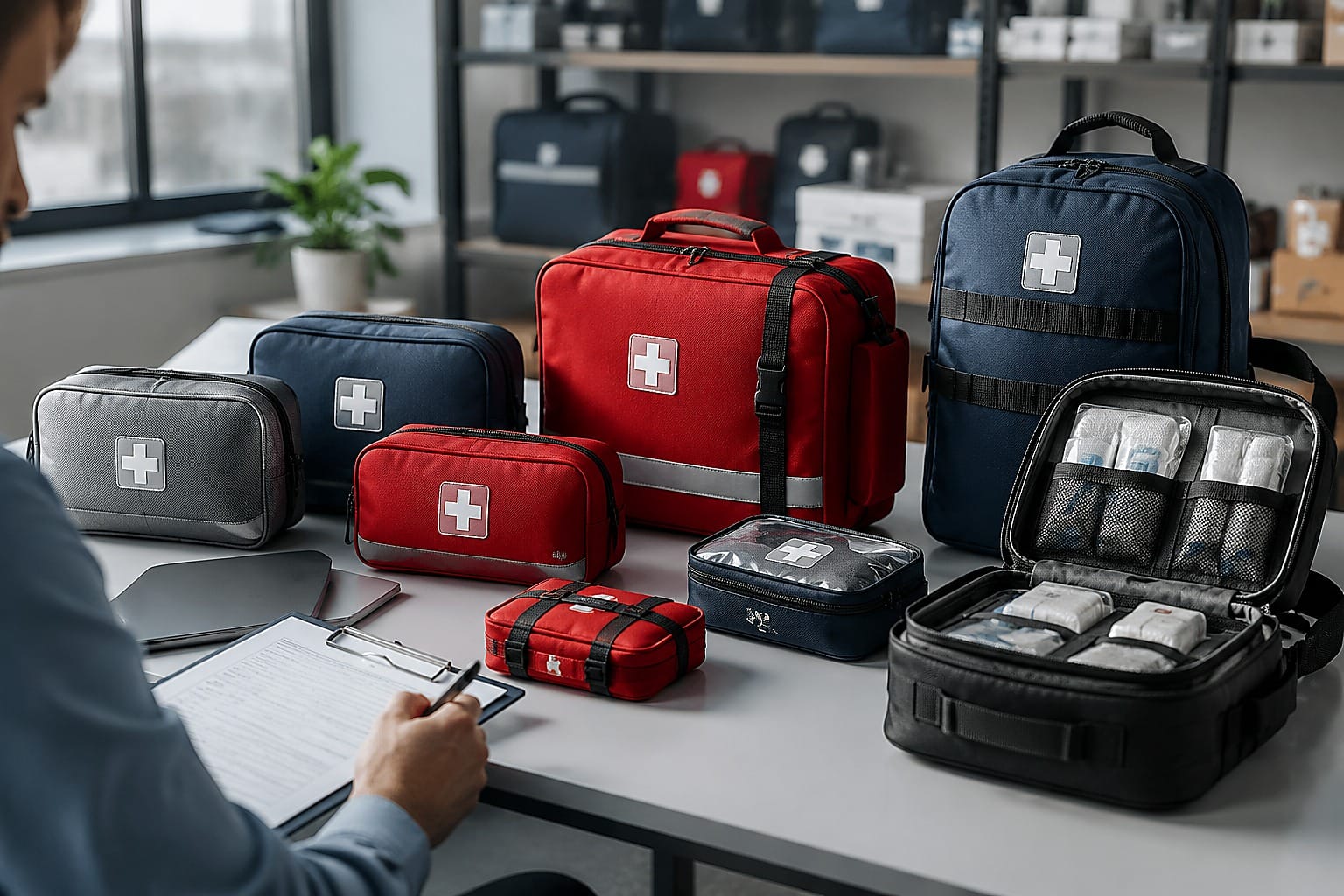
Choose a channel by the work it performs, not by its audience size. A first aid distribution strategy should assign a job to each route before a partner is recruited. First aid products are often replenishment items, but a distributor may still need to educate the buyer, bundle components, manage expiry rotation, or support a destination-market review.
| Channel | Where it fits | What the partner must do | Main control point |
|---|---|---|---|
| Regional importer-distributor | Multi-country or multi-city coverage with local stock | Import, warehouse, local sales, customer service, and replenishment | Territory, forecast ownership, and document scope |
| Industrial safety reseller | Workplace, construction, manufacturing, and EHS accounts | Convert hazard or site requirements into a practical assortment | Use-case fit, refill cadence, and label route |
| Medical or emergency equipment reseller | Higher-specification kits, bags, and response tools | Explain configuration, accessory compatibility, and service needs | SKU identity, sample approval, and technical evidence |
| B2B e-commerce seller | Search-led demand and small account orders | Maintain accurate listings, stock status, pack units, and delivery promises | Content revision, inventory feed, and returns |
| Institutional or public tender | Contracted volume with defined specifications | Meet bid documents, delivery milestones, and reporting rules | Tender compliance, lot traceability, and change control |
The same kit can appear in more than one route, but it should not have five uncoordinated specifications. Use a master SKU record and let each channel add its own pack, label, or service layer. A B2B first aid procurement guide can help teams turn that master record into a comparable RFQ.
Start with a narrow assortment that can be explained, stocked, and replenished. A distributor that lists every possible dressing, bag, box, and kit before measuring demand creates dead stock and weak product pages. The first release should have a clear reason for each SKU.
Use a three-layer assortment:
For each SKU, document the following before the first shipment:
| Record | Why it matters to the channel |
|---|---|
| Buyer and supplier SKU | Prevents a reseller listing from drifting to a visually similar item |
| Unit and inner-pack quantity | Sets the order unit, margin calculation, and carton plan |
| Dimensions and packed weight | Supports freight quotes, storage planning, and marketplace content |
| Lot, expiry, or shelf-life field where applicable | Enables rotation rules and customer communication |
| Label and language revision | Keeps the sales listing aligned with the shipped unit |
| Document reference and scope | Shows which file belongs to which SKU, site, or model |
| Substitution rule | Stops a stock change from becoming an unapproved channel promise |
The counterintuitive point is that a larger catalog can reduce channel reach. Resellers often delay onboarding when every item requires a separate document review, photo set, carton calculation, and reorder rule. A smaller launch range with complete data can reach more accounts than a large range with unresolved fields.
For category discovery, the UneedAid product category hub can help buyers group supplies, emergency bags, boxes, tools, and customizable kits before the assortment is frozen. The hub is a planning reference; the distributor still needs a line-level specification and destination review.
Channel conflict usually begins with an undefined rule rather than a bad intention. A distributor may quote a reseller below the importer’s direct-account price, or two partners may believe they own the same customer. Put the operating rules in writing before samples or market launch.
Define at least these eight controls:
Do not promise exclusivity only because a partner asks for it. Tie any protection to measurable actions such as approved listings, trained sales staff, quarterly forecast updates, or a minimum number of active accounts. A channel rule should describe the evidence that keeps the rule active.
A pilot should answer a commercial question, not create a smaller version of a full launch. In a first aid distribution strategy, select one channel, one geography, and a defined assortment. Then set a review date before the first order ships.
A practical pilot design is:
Track sell-through rather than shipment volume alone. Useful measures include active accounts, quote-to-order conversion, units sold per active account, days of stock on hand, reorder interval, gross margin after freight, document-related delays, and return or complaint reason. A shipment to a distributor is not demand validation if the stock remains in the warehouse.
The mechanism is simple: a controlled pilot separates product-market signal from channel loading. This is the measurement core of a first aid distribution strategy. If three partners all ask for the same missing pack unit or label language, the issue is probably an information or configuration gap. If partners view a product but do not request a quote, the problem may be positioning, price architecture, or channel fit. Those are different decisions and should not be mixed.
Replenishment needs a visible trigger. A useful starting point is:
Reorder point = average demand during supplier lead time + agreed safety stock
The formula is only as good as its inputs. Separate confirmed sales from forecasts, and record whether the lead time includes artwork, sample approval, production, inspection, export packing, and transit. For dated or regulated items, add the buyer’s remaining-shelf-life requirement to the decision.
Set a review rhythm by channel:
Do not use one safety-stock percentage for every item. A fast-moving glove pack, a custom-color bag, and a slow-moving emergency box have different demand variance, MOQ, and replenishment constraints. The distributor should model each SKU family and show the assumptions to the supplier.
Product data is part of channel infrastructure. GS1 describes the GTIN as an identifier for trade items in the supply chain. A distributor can use a stable identifier to connect the supplier record, warehouse unit, carton, reseller listing, and reorder file. That does not replace destination-market review, but it reduces the chance that two systems refer to different items by the same short name. See the GS1 GTIN reference for the identifier’s supply-chain role.
Build one controlled data pack per SKU:
For workplace-oriented channels, context still controls the assortment. In the United States, OSHA 29 CFR 1910.151 requires adequate first-aid supplies to be readily available when the standard’s conditions apply, while its non-mandatory Appendix A points to workplace hazards and professional consultation. That is a U.S. workplace reference, not a universal kit list. A distributor should ask the buyer to confirm the applicable destination and use-case requirements.
The supplier quote and the channel margin can look healthy until freight scope is compared. State the shipment rule and named place in every quote. ICC’s official Incoterms rules overview explains how the rules allocate tasks, costs, and risk between seller and buyer. The rule does not replace the sales contract, product specification, payment terms, insurance decision, or import review.
Model at least three scenarios when launching a channel:
| Scenario | Buyer should show |
|---|---|
| Small trial shipment | Express or air cost, handling, brokerage, and the price basis for low volume |
| Consolidated replenishment | Carton count, dimensions, gross weight, freight mode, and expected handoff |
| Planned container or pallet order | Forecast, loading assumptions, inspection timing, destination charges, and stock exposure |
Keep freight, duties, taxes, local delivery, inspection, storage, and payment charges as separate lines. A distributor can then decide whether to change the order unit, consolidate SKUs, or adjust the channel price without hiding a cost inside the product figure.
Before expanding beyond a pilot, confirm that the team can answer these questions in one shared file:
The strongest first aid distribution strategy is usually the one that makes fewer assumptions. It gives each channel a clear role, keeps the launch range manageable, and turns partner feedback into a documented product or process decision.
The answer depends on destination coverage, account density, service capacity, and who can hold compliant stock. Direct sales can preserve customer visibility but require local lead handling, quotation work, and post-sale support. A distributor can provide warehousing, local language coverage, and established accounts, but the supplier must set data, price, and account-ownership rules. Many programs use a mixed route: direct management for strategic accounts and distributors for regional coverage. Decide by channel role and measurable service requirements, not by a blanket preference for one route.
There is no universal number. A controlled starting point is 3–5 SKUs with a shared buyer problem, complete product data, and a realistic replenishment path. Add depth only after the team records sell-through, quote feedback, stock age, margin after freight, and repeat inquiries. A larger range is justified when the channel can maintain the additional listings, documents, pack units, and inventory controls. If each added SKU creates a new packaging or evidence workflow, include that workload in the launch decision.
Write territory, named-account, quote validity, price-level, and opportunity-registration rules before partners begin selling. Define what evidence activates or renews protection, such as a forecast, approved listing, or documented account activity. Keep one master specification and revision history so partners do not sell different versions under the same name. When an exception is necessary, record the customer, quantity, period, and approving person. A written exception is easier to review than an informal promise made in a sales conversation.
Provide a stable SKU and revision, product description, dimensions, unit and carton packing, current photos, label and language files, barcode or buyer-code information where applicable, document register, shelf-life or storage fields where applicable, and approved substitution rules. The reseller also needs clear commercial fields: MOQ, order unit, quote validity, lead-time basis, shipment term, and who pays which charges. Product data should match the physical sample and the shipped revision. A catalog image alone is not enough for a listing, tender, or reorder record.
No. A forecast is a planning signal unless the parties expressly make it binding. Record the period, SKU, quantity, confidence level, and review date. Ask the distributor to separate expected demand, approved purchase orders, and stock already on hand. The supplier can use the forecast to plan materials or capacity, but custom packaging, special colors, or dated components may require a separate commitment. Keeping the categories distinct protects both sides from treating a planning estimate as a fixed shipment obligation.
Review active accounts, quote-to-order conversion, units sold per account, reorder interval, stock age, gross margin after freight, document questions, sample issues, returns, and lost-order reasons. Then classify each SKU as expand, revise, hold, or remove. Also review the partner’s data maintenance and response time. If demand is weak because listings lacked pack units or the quote excluded freight, fix the process before rejecting the product. If the product repeatedly misses the channel’s use case or margin requirement after a controlled test, keep the result as a documented decision.
For the wider commercial workflow, connect this channel plan with the B2B first aid procurement guide, the first aid supplies sourcing guide, and the emergency first aid kits and bags guide. Those articles cover RFQ normalization, product-family sourcing, and use-case configuration that support a channel launch.
A channel framework sets where a range is sold, and the component continuity rules that keep repeat orders identical set whether the second shipment still matches the first.
Which supplier sits behind that framework is a separate comparison, and it is easier to hold to a standard when the criteria are written down in advance. That is what a weighted first aid supplier scorecard for distributors and resellers is for.