
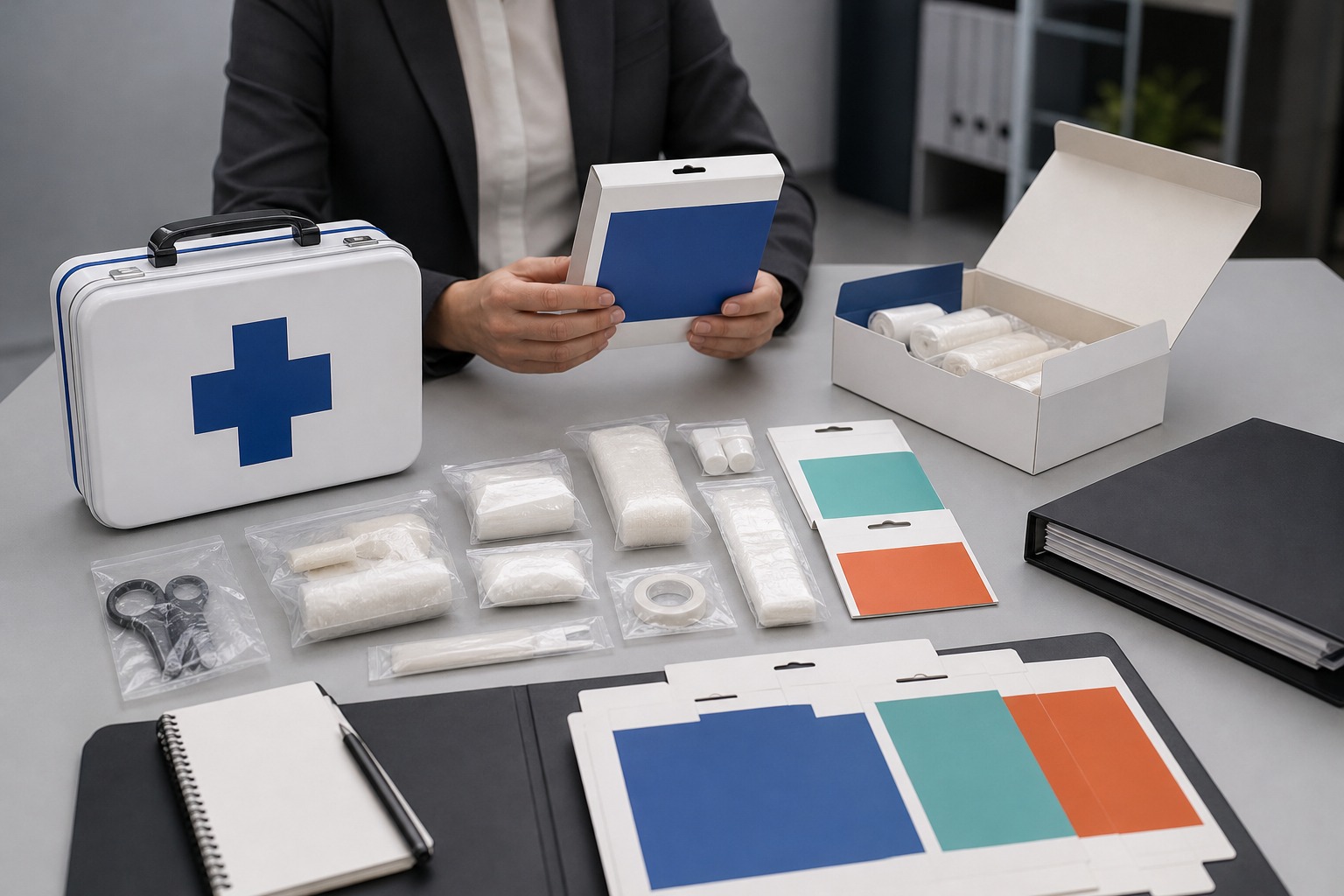
A pallet of 500 first aid kits lands in Hamburg. The kits are fine. The cartons, the inner trays and the shrink wrap are now the importer’s problem, because under German packaging law the party that first places packaged goods on the German market commercially carries the take-back obligation for that packaging, and an importer bearing legal responsibility at the border is that party.
Recycling the cartons at the end of the chain does not discharge the obligation. Registration on a national register, a paid system participation contract, and recurring volume reports come first.
This guide sets out what packaging EPR registration importers actually have to do, why the EU regulation did not replace national registers, and which documents a supplier can hand over and which ones only the importer can complete.
What Packaging EPR Registration Importers Actually Register For

Three obligations are routinely bundled under one label, and packaging EPR registration importers who unbundle them early spend less on corrections. The three are separate.
- Registration on a national producer register. This creates a registration number, which marketplaces, authorities and customs-adjacent checks increasingly ask for.
- System participation. A paid contract with a compliance scheme that funds collection and recycling of the declared volume.
- Volume reporting. Forecast volumes before the period, actual volumes after it, filed with the scheme and usually mirrored to the register.
A company can complete the first and fail the other two, and most packaging EPR registration importers who self-report as compliant have done exactly that. In Germany that is the single most common failure: a LUCID registration number exists, but no system participation contract sits behind it, and no volume has ever been reported. The number looks like compliance and is not.
For packaging EPR registration importers the practical consequence is that “we are registered” is not an answer to a buyer’s due diligence question. The answerable version is a registration number plus a scheme contract plus a filing history.
The EU Layer: One Regulation, Twenty-Seven National Registers
The Packaging and Packaging Waste Regulation, Regulation (EU) 2025/40, has been in force since 11 February 2025 and applies from 12 August 2026. It replaced the 1994 Packaging and Packaging Waste Directive, which was generally repealed on the same August date, and as a regulation it applies directly rather than waiting for national transposition.
That does not produce a single EU register. Registration and extended producer responsibility remain organised nationally, and the obligations attach where packaging is first made available on a member state’s territory. A first aid kit shipped from China to a Dutch distributor and then sold into Germany can create obligations in both countries, in different registers, with different evidence requirements.
Two timing details matter for planning.
Labelling is later than registration. Harmonised packaging labelling sits further out than the general application date, so a compliant registration does not arrive with a compliant label. Decoupling the two workstreams prevents a supplier from promising artwork changes that the regulation does not yet require.
One obligation is in flux. In December 2025 the Commission proposed, as part of its environmental simplification package, to suspend the requirement for producers to appoint an authorised representative when they sell packaged products directly to consumers in member states other than their own. The Commission describes that proposal as still under examination by the European Parliament and the Council. A proposal under examination is not law. Building a compliance plan on a suspended obligation that has not yet been suspended is a predictable way to be wrong twice.
Germany as the Worked Example: LUCID, System Participation, Reporting
Germany is worth studying closely because its register is public and its rules are explicit, and because a large share of European first aid distribution passes through it.
The German packaging register states the trigger plainly: every company that distributes packaged goods commercially on the German market, or imports packaged goods into Germany, must register in the LUCID Packaging Register, regardless of where in the world that company is based. There is no minimum quantity in the framing.
Who counts as the producer is the part importers misread. The register’s own guidance defines the producer as the party that first fills packaging with goods and places it on the German market commercially. It then names the cases that catch traders:
- Importers, where they bear legal responsibility for the goods at the moment those goods cross the border.
- Retailers selling own brands, where a third party filled the packaging on the retailer’s behalf and the packaging carries only the retailer’s name or brand.
- Mail order and online retailers, where they fill shipment packaging with goods for the first time.
The second bullet is the one that decides a surprising number of cases in this trade. A distributor that asks a supplier to print its logo on the bag and ship under the distributor’s brand can be the producer for packaging purposes even though it never touches the product.
There is also a hard procedural limit. The register states that the producer must apply to register personally, that the required information and declarations may not be provided by third parties, and that granting power of attorney for this purpose is prohibited under section 35(1) VerpackG. An authorised representative can be appointed by a foreign producer without a German branch for the other duties, but not for the registration itself.
That single rule reshapes how a sourcing conversation should run. A supplier cannot register on a buyer’s behalf, and a consultant cannot lawfully complete the declarations in the producer’s name. What a supplier can do is provide the packaging data the buyer needs to register and to declare volumes.
Who Registers When Goods Cross a Border
The same shipment can generate different answers depending on three variables: who holds legal responsibility at the border, whose brand is on the packaging, and who is the first to place the goods on the market commercially.
| Scenario | Likely producer | What usually has to happen |
|---|---|---|
| Supplier ships under its own brand to a German distributor, DAP | Supplier, if it remains responsible at the border | Supplier registers and participates; distributor verifies the registration number |
| Supplier ships unbranded kits; distributor’s brand printed on the bag | Distributor, where the packaging carries only its brand | Distributor registers; supplier supplies packaging weight data |
| Distributor buys in bulk and repacks into its own shipment cartons | Distributor, as the party filling shipment packaging | Distributor registers and declares shipment packaging volume |
| Marketplace seller ships from outside the EU directly to consumers | Seller, as mail order business | Seller registers; marketplace may require the number before listing |
| Supplier ships to a Dutch importer who resells into Germany | Dutch importer for NL; the party first placing on the German market for DE | Two registers, two filings, potentially two schemes |
None of these rows is decided by the Incoterm alone, but the Incoterm is the evidence most often used to establish who was responsible when. That is why the Incoterm selection and the packaging question should be settled in the same conversation rather than months apart.
The Three Documents Buyers Ask Suppliers For
A supplier cannot register for the buyer. It can shorten the buyer’s path to registration by supplying three things, and buyers who ask for them early avoid a stalled first shipment.
A packaging weight and material breakdown per SKU. Registration is not an abstract declaration. System participation is priced on declared volume by material, so the importer needs grams of paper, plastic and other fractions per unit, and per carton. This is the document most often missing, and it is the one a factory can produce fastest from a bill of materials, which makes it the first request any packaging EPR registration importers should send.
A packaging structure sheet that separates the three layers. Retail packaging, grouped packaging and shipment packaging are categorised differently and carry different obligations. A supplier that reports a single “packaging weight” number forces the importer to guess the split, and guesses become amended filings.
A change notification. If the bag weight, carton specification or artwork changes, the declared volume changes. A supplier that files packaging changes as internal detail will silently invalidate the buyer’s declaration. The change path here is the same one used for order amendments, and packaging should be an explicit line in it.
What a supplier cannot supply is the registration number itself, because registration is personal to the producer. Any supplier offering to “handle EPR registration” for a buyer’s own brand is either registering itself as the producer, which shifts the obligation rather than removing it, or describing something it cannot lawfully do.
For carton and pallet decisions that drive the declared tonnage, the configuration choices are set out in export carton and pallet configuration. Reducing packaging weight is a legitimate way to reduce the fee, provided the reduction does not breach the transit protection the shipment needs.
Where Importers Get Caught
Four failure modes account for most of the problems packaging EPR registration importers run into, and all four are visible before the first filing.
The registration exists, the participation does not. A LUCID number is issued on registration. It says nothing about whether a system participation contract exists. Buyers who accept the number as proof of compliance inherit the gap.
The volume declared is a guess. Declared tonnage that does not match the bill of materials survives until an audit or a scheme reconciliation. At that point the importer pays the difference plus the cost of reconstructing records.
The brand question was never asked. A distributor that moves from reselling a supplier’s brand to selling under its own name changes its legal position without changing its purchase order. Nothing in the transaction marks the change. This is the scenario where a thirty second question at quoting stage prevents a year of filings in the wrong name.
The record chain breaks at the trader. Importers need a documented trail from purchase order to declared volume. Import record keeping covers the wider file. The packaging exhibits belong inside it, not in a separate folder that nobody reconciles.
FAQ
Does an importer have to register in every EU country where it sells?
Registration attaches where packaging is first made available on a member state’s territory, and each member state maintains its own register. Selling into five countries can therefore mean five registrations, five scheme relationships and five filing calendars. Sellers offering goods to consumers in the EU through an online platform or fulfilment provider are expected to supply their registration number and a self-certification for the member state where the consumer is located. The practical planning rule is to map the fulfilment path first, because the country of the buyer and the country of first placement are not always the same.
Can our Chinese supplier register in LUCID on our behalf?
No. The German register states that the producer must apply personally, that the required information and declarations may not be provided by third parties, and that granting power of attorney for that purpose is prohibited under section 35(1) VerpackG. This is why packaging EPR registration importers cannot outsource the act of registering, even when they outsource everything around it. What a supplier can do is supply packaging weights, material splits and change notifications so the registration and the volume report are accurate on the first filing.
Is EPR the same thing as a packaging tax?
No. EPR is an obligation to fund collection and recycling of the packaging you place on the market, discharged through a compliance scheme and reported by volume. A tax is levied by a state. The two can coexist, and some countries operate fees that look tax-like in collection, but the obligation to register and report is separate from any fiscal charge. Buyers who conflate them tend to budget for a rate and forget the register, which is the part with the deadline.
We only sell to business customers, not consumers. Does EPR still apply?
Business-to-business distribution does not remove the obligation. The German register frames the trigger around placing packaged goods on the market commercially, and its own guidance covers both private consumers and the commercial sector. A kit sold to a hospital trust or a distributor is still packaged goods placed on the market. What changes with the channel is the category of packaging and the volume, not whether the obligation exists.
What happens if the packaging weight changes after we register?
The registration identity persists but the declared volume does not. A heavier bag, an added insert or a different carton specification changes what should be reported to the scheme and to the register. Log packaging changes as reportable events rather than engineering details, and put a named owner on the notification. Suppliers that issue a packaging change note as part of the amendment process remove most of this risk before it reaches the importer’s filing calendar.
Does the new EU regulation mean national registers disappear?
No. Regulation (EU) 2025/40 harmonises requirements and applies directly, and it has applied generally since 12 August 2026, replacing the 1994 directive. Registration and extended producer responsibility are still delivered through national structures, and producers still register where they make packaging available. The regulation raises the floor and standardises the requirements. It does not collapse twenty-seven registers into one, and any plan that assumes a single EU filing will fail the first time a member state asks for its own number.
What to Fix Before the Next Shipment
Start with the register, not the artwork. Confirm which entity is the producer for the destination country, using the brand question and the responsibility-at-border question, and write the answer into the order file. Then collect packaging weights per SKU with the three layers separated, because that single document drives registration accuracy, scheme cost and the volume report. Then confirm a scheme contract exists behind the registration number, not merely a number. Then set a reporting owner and a change-notification rule.
Importers who do this once have a repeatable file. Importers who skip it discover the gap at the worst moment, usually when a marketplace asks for a number or a scheme reconciles a year of declarations against purchase records. The wider destination-market compliance picture sits in regulatory burden by destination market, and the packaging exhibits belong in the same file as the safety data sheets that buyers already request.