
The waist bag vs backpack first aid question usually arrives as a preference. It is a hand-budget question. A responder who has to hold a dressing pad in place cannot open a buckle at the same time, and a responder who walks 200 metres to reach the casualty cannot carry a cabinet.
Three formats cover most programmes, and they are not alternatives to each other so much as three tiers of one system. A waist bag serves the person who stays within arm’s reach of the incident. A backpack serves the person who has to travel and carry for others. A wall cabinet stays where the stock is counted, and it refills both.
This article sets out what each tier does, how to run the volume arithmetic before comparing quotations, what the format choice does to your SKU count, and which fields an RFQ has to fix so that three quotes arrive on the same basis.
What the waist bag vs backpack first aid decision actually turns on
Most waist bag vs backpack first aid comparisons start with the container. Three variables actually separate the formats, and none of them is the container.
Hand budget. Waist and belt formats keep both hands free and put the kit under the responder’s own hand. A backpack frees the shoulders for carrying but forces the wearer to swing it off, or ask someone to open it, before the first item comes out. For an incident where one hand is already occupied with pressure on a wound, that difference decides the format.
Load. A belt system carries a personal load well and a team load badly. Once the pack-out grows past the point where it sits against the small of the back without swinging, the belt becomes a handling problem rather than an access advantage. Backpacks move weight to the shoulders and hips, which is why they hold the larger configurations.
Distance. A fixed cabinet assumes the casualty comes to the kit, or that somebody fetches it. Both are acceptable in a building with a marked station on each floor. Neither works on a site where the incident happens away from the building, which is why mobile formats exist at all.
The HSE leaflet on first aid at work frames provision as an assessment of the organisation’s own hazards, workforce and working arrangements, with a checklist rather than a fixed list of contents. That framing matters here: the format follows the assessment, and the assessment is about people and movement, not about which bag looks more professional in a catalogue.
A useful discipline is to fix the contents first and the container second. Buyers who choose a bag and then try to fit a contents list into it usually end up with a second order, because the pack-out that matters is the one that has to come out of the bag under pressure.
What each format does that the others cannot

| Dimension | Waist bag | Backpack | Wall cabinet |
|---|---|---|---|
| Who carries it | One responder, worn | One responder, carried for a group | Nobody; it stays mounted |
| Hand budget at the incident | Both hands free | Hands free while walking, occupied while opening | Both hands free once the item is taken out |
| Practical load | Personal pack-out only | Team or extended pack-out | Bulk stock, shelf by shelf |
| Access route | Direct, from the worn position | Stop, open, search | Walk to the station |
| Refill path | Repacked by the wearer | Repacked by the team leader | Checked on a route |
| Main failure mode | Overloaded until it swings | Packed until the first item is buried | Mounted where nobody walks past |
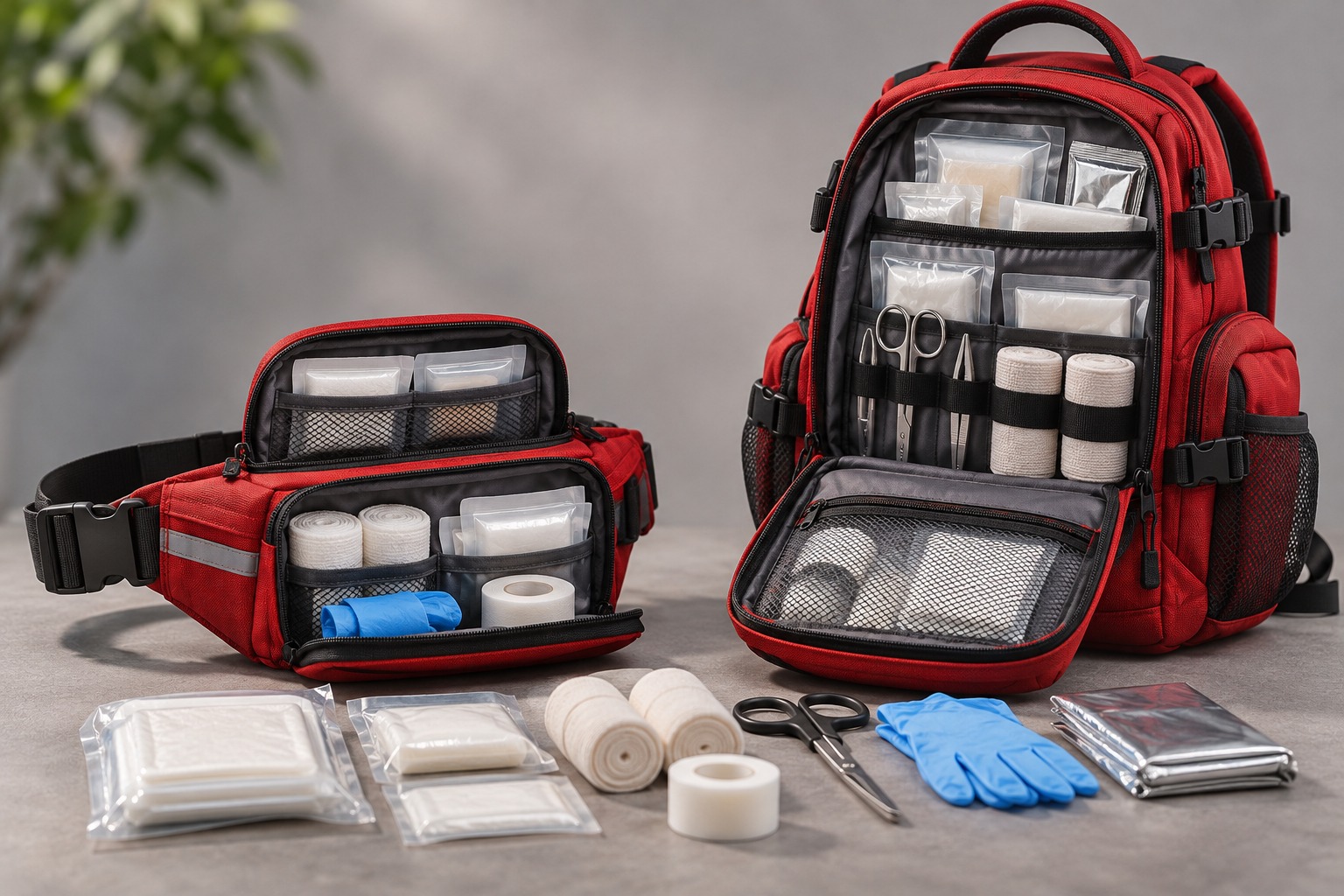
The waist format earns its place when the wearer is the first person at the incident and needs one specific item fast: a pressure dressing, a pair of gloves, a burn gel sachet. It loses that advantage the moment the pack-out grows to include tools, spare garments or several refill groups.
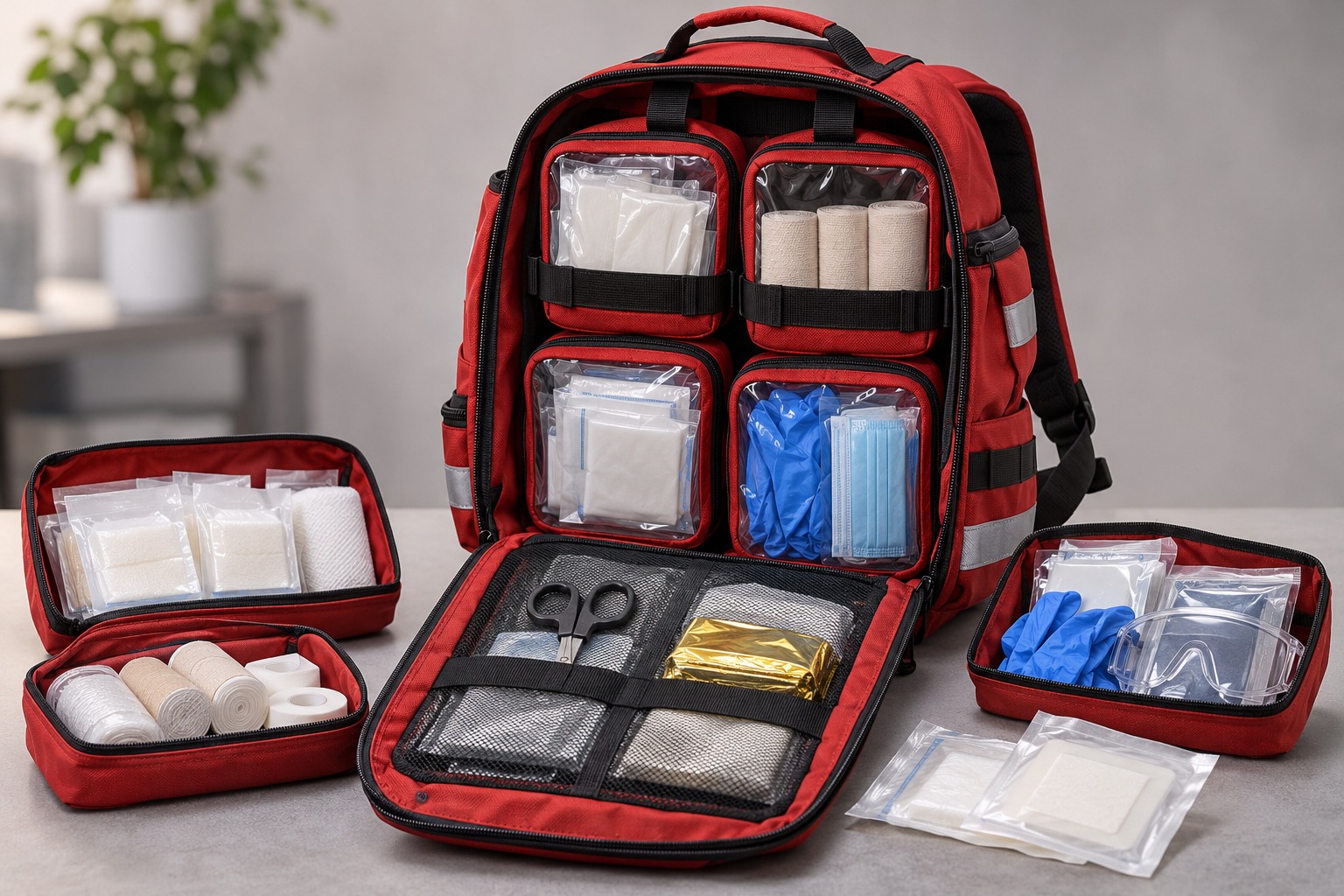
The backpack earns its place when the kit has to serve more than the wearer. It also demands a layout rule, because a large bag with one compartment turns a 20-second retrieval into a two-minute search. Modules and labelled zones are not cosmetic in this format. They are the difference between a team kit and a bag of supplies.
The cabinet earns its place by being findable and countable. Its weakness is placement: a cabinet in a room nobody enters is a storage unit, not a station. Mounting it is a maintenance decision as much as a hardware one, since a fixed unit acquires an inspection route and a named owner, while a carried unit acquires neither by default.
The two-portable-versus-fixed comparison is worked through in more detail in first aid box vs bag provisioning, and the outdoor variants of the same trade-off sit in outdoor first aid kit bag formats.
Run the volume arithmetic before you compare formats
Most format arguments in a waist bag vs backpack first aid review die once somebody converts litres into centimetres. A bag described as 9 litres has a cavity of roughly 9,000 cm³, but the usable fraction is smaller: seams, zip intrusion, a rigid base and a lid panel all take space, and an over-filled bag loses the one-handed access that justified the format.
The arithmetic that matters is the pack-out, not the bag. Take the contents list, estimate each item as a box, and add the total.
| Pack-out item | Approximate volume |
|---|---|
| 5 × gauze pad packs at 10 × 10 cm | 500 cm³ |
| 2 × conforming bandage rolls, 7.5 cm × 4 m | 640 cm³ |
| 1 × triangular bandage, folded | 250 cm³ |
| 1 × trauma dressing at 12 × 8 × 4 cm | 384 cm³ |
| 2 × pairs of gloves in a pouch | 300 cm³ |
| 1 × tape roll, 2.5 cm × 10 m | 220 cm³ |
| 10 × antiseptic wipes | 50 cm³ |
| 1 × scissors and 1 × tweezers | 250 cm³ |
| Total, before void space | ≈ 2,600 cm³ (2.6 L) |
Add 30 to 40 percent for air, packaging and the space a hand needs to enter, and a personal pack-out lands near 3.5 litres. That fits a 6 to 9 litre waist bag with room to spare, which is the practical finding: volume is rarely the binding constraint at the personal tier. Retrieval design is.
Scale the same list to a team of six to eight responders and the consumable lines multiply four to six times. The total moves to roughly 12 to 20 litres before void space, which is why team kits land in 25 to 31 litre packs. A waist bag cannot absorb that, and a backpack sized at 15 litres will be packed to the zip on day one.
The number to write into the specification is the internal dimension, not the claimed capacity. Ask for the main compartment in centimetres, then test the actual pack-out inside a sample. The arithmetic above tells you which format is even possible; the sample tells you whether the layout works.
A three-part access test for any sample
A waist bag vs backpack first aid review ends with a sample in your hands. Run these three tests before approving a bulk order, and record the result for each configuration.
- One-handed open, with a glove on. Put a glove on the dominant hand, hold a dressing pad in the other, and open the compartment that contains the pressure dressing. If the closure needs two hands, the format fails at the moment it is needed.
- Retrieval without unloading. Ask for the second-most-used item without removing anything else from the bag. If the answer requires emptying a compartment, the pack-out is wrong, not the bag.
- Re-close and carry. Close the kit, walk 50 metres with it, and open it again. Belt formats that swing, or backpacks whose straps migrate, will show up here rather than in a photograph.
Record the outcome as pass or fail per configuration. A sample that passes two of three tests is a sample with a layout problem, and layout problems are cheaper to fix before the carton is printed than after.
What format choice does to SKU count and MOQ
The waist bag vs backpack first aid choice is also a configuration decision. Every format you add is a separate configuration, and configurations carry their own minimum. Our own production starts at 1,000 pieces per configuration, so the arithmetic is blunt: three formats in two colourways is six configurations, and a programme that wants all six is committing to six times the minimum quantity.
There are two ways to keep that under control.
- Share the component list across formats. If the waist bag and the backpack carry the same 22-line pack-out, the component order is one order, and only the housing changes. This keeps the fill pricing stable and makes the refill line common to both.
- Differentiate the housing, not the contents. Colour, logo and label panel are the cheap variables. A different contents list per format is the expensive one, because it multiplies the bill of materials and the documentation set.
Documents follow the SKU, not the order. Where the destination market regulates the product as a medical device, the classification and the file sit with the party placing it on the market, and the EU framework for that is Regulation (EU) 2017/745. Buyers should confirm what their own market requires before the pack-out is frozen; a supplier can provide the file set per SKU, and the buyer confirms the destination requirement. Our sample validation runs before bulk production for exactly this reason: the pack-out, the label and the housing are signed off together, not separately.
Making the wall cabinet the supply point for the two mobile formats
In a waist bag vs backpack first aid programme, the fixed unit is usually bought separately. In a mixed programme it is cheaper to run it as the warehouse for the mobile kits.
Three design decisions make that work. First, the cabinet carries the same component lines as the mobile pack-outs, so a refill can be drawn from one stock rather than two. Second, the mobile kits are packed in refill groups rather than loose items, which lets a team leader restock from the cabinet shelf without opening every pouch. Third, the label panel on the cabinet records the pack-out revision, so a station check confirms that the mobile kits match the current version.
That last point is where mixed programmes fail quietly. A cabinet is restocked against a list, the mobile kits are restocked against memory, and the two drift apart within two refill cycles. Writing the revision code into both the station label and the kit label costs almost nothing and makes the drift visible.
The refill quantities and the intervals behind them are set out in first aid kit refill cycle planning. The zone count that decides how many fixed units a building needs sits in the workplace kit configuration checklist.
What to fix in the RFQ so three quotes compare
A format comparison is only as good as the specification behind it. These fields decide whether quotes are comparable.
| Field | Why it has to be fixed |
|---|---|
| Internal dimensions of the main compartment | Claimed litres hide layout and void space |
| Closure system and opening geometry | Decides one-handed access |
| Belt specification, if applicable | Width, adjustment range, buckle type, concealment |
| Attachment pattern, if applicable | MOLLE or belt loop, and the stitch pattern |
| Label panel size | Must fit the longest field the market requires |
| Carton cube and pack quantity | Changes freight cost per unit more than the bag does |
| Empty or stocked | Two different bills of material and two documentation paths |
| Pack-out revision code | Makes a later refill quote traceable to the approved sample |
The full RFQ structure, including the contents table and the MOQ tier, is set out in the emergency first aid kit RFQ checklist. Buyers comparing portable formats side by side can start from the emergency medical bags range, and the fixed units sit in the wall-mounted emergency boxes range.
FAQ
Is a waist bag enough for a workplace first aider?
The waist bag vs backpack first aid answer depends on the walk. A waist bag covers a responder who stays within a short distance of the incident and carries only a personal pack-out, which is enough for a floor warden or an event marshal. It stops working when the responder has to cover a large site, carry supplies for several people, or hold tools. In those cases the belt format becomes a supplement to a backpack rather than a substitute for it.
How much volume does a two-person kit actually need?
A two-person personal pack-out of dressings, bandages, gloves, wipes and a small tool set usually totals 3 to 4 litres once void space is added. That fits a 6 to 9 litre waist bag or a small hand-carry case. The constraint is not the volume but the retrieval order: the bleeding-control items have to be reachable without unloading the rest.
Can the same bag serve a distributor and an institutional buyer?
Sometimes, with different pack-outs and different labels. The housing can stay the same while the contents list, the label language and the revision code change per channel. That keeps the component order common and limits the configuration count. What does not work is one bag sold to both channels with one pack-out, because the institutional buyer usually needs a larger consumable quantity and a station-compatible refill group.
Does a wall cabinet replace portable kits?
No. A cabinet holds stock at a fixed point and makes it countable; it does not travel to the incident. Sites with people who move need at least one portable format alongside the fixed station, and most mixed programmes end up with a cabinet per zone plus a personal or team kit for each responding role. The cabinet’s job in that structure is to keep the mobile kits complete.
What should a sample review record?
Record four things per configuration: the internal dimensions as measured, the packed weight, the result of the one-handed access test, and the pack-out revision it was built against. Photographs help, but the measurements are what a later refill order is priced against. A sample approved without those four records tends to be re-approved, at cost, when the second order arrives.
How many formats should a first order cover?
Cover the formats you have validated, not the full range. A defensible opening programme is one fixed station per zone, one personal format per responding role, and one team format per site that has people working away from the building. Each configuration carries its own minimum, so spreading a first order across six configurations usually buys less depth than covering three well.
Three formats, one decision rule: put the kit where the hands are. The waist bag serves the hand that is already at the wound, the backpack serves the responder who has to arrive, and the cabinet serves the stock that keeps both complete. Get that assignment right and the container specification becomes a detail, not an argument.
For buyers moving from format selection into the order itself, the emergency first aid kit RFQ checklist fixes the contents table and the quantity tier, and the empty bag and box sourcing guide covers the housing-only route when the fill is bought in-market.