
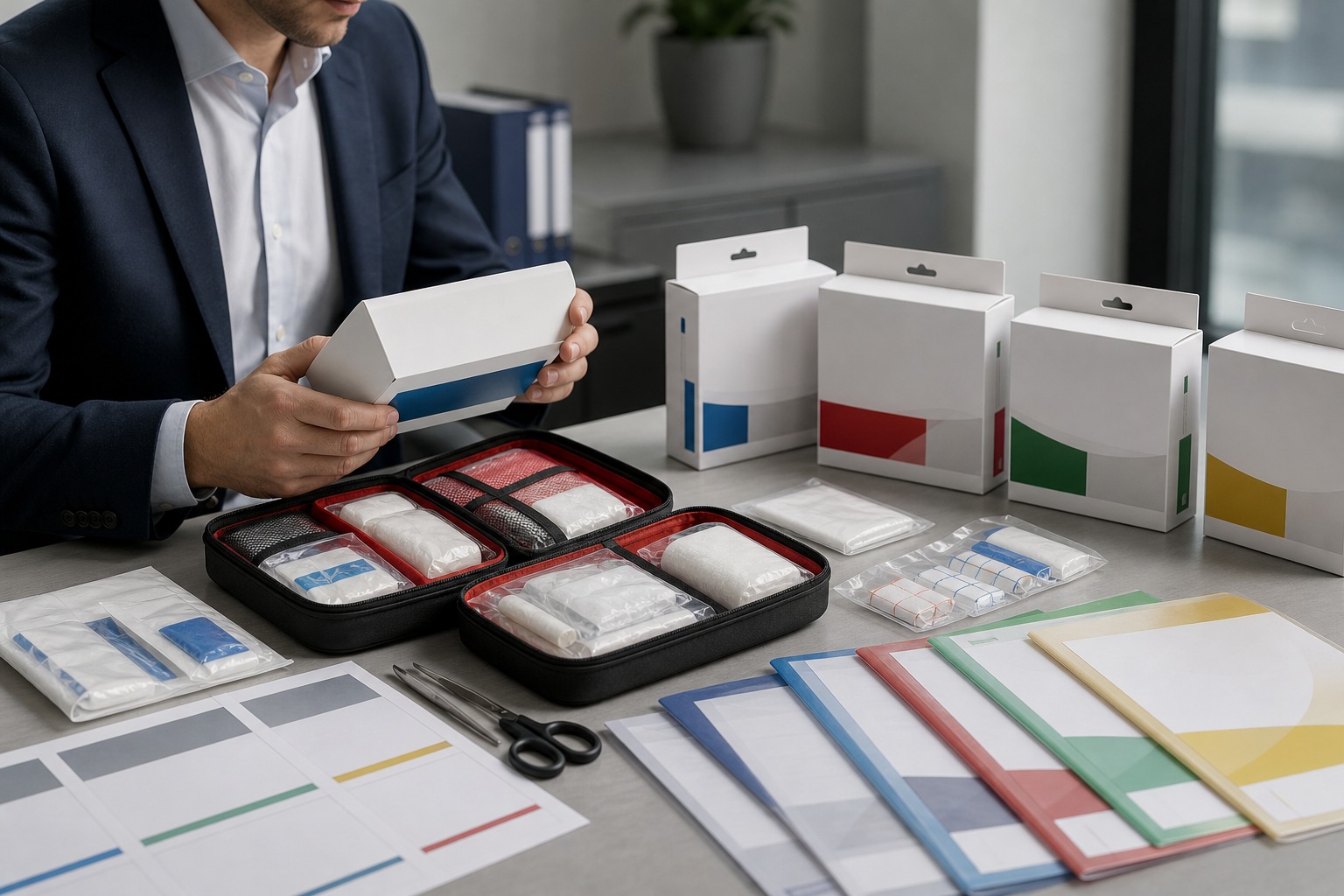
A distributor running four spot orders a year for the same twelve kit SKUs rebuilds the same document pack four times. The same distributor under a framework agreement often assumes the pack was built once and never touched again. Neither assumption survives a customs broker’s first query, and the cost sits in the gap between them.
Framework agreement documentation medical buyers inherit is not a single file. It splits into two layers: terms fixed once for the life of the agreement, and shipment records that repeat at every call-off. Spot orders collapse both layers into one transaction, which is why they feel lighter on paper and heavier in total.
This comparison sets out which records belong to each layer, where the repetition actually lands, and which clauses decide how much documentation work returns in year two.
What a framework agreement commits, and what it leaves open
A framework agreement is usually a priced standing offer, not a purchase. The buyer commits to terms, and the supplier commits to hold price and specification for a period. Actual purchases happen through call-offs issued against those terms. In documentation terms, the framework agreement documentation medical buyers rely on is a terms layer, not a shipment record.
Public sector frameworks state this plainly. The NHS Supply Chain framework agreement appoints a supplier as a potential supplier and confirms that there is no obligation for the authority to purchase any goods during the term. The same agreement requires the supplier to pass on quality, performance and safety-related notices promptly, and within one business day where patient safety may be affected (NHS Supply Chain framework agreement).
That structure has a documentation consequence. The agreement binds commercial terms, delivery obligations and change rules. It does not bind a shipment, because no shipment exists until a call-off is issued. Each call-off therefore needs its own commercial record set, even though the specification behind it never moves.
What framework agreement documentation medical buyers collect at each call-off

The per-shipment layer looks close to a spot order’s paperwork. Commercial invoice, packing list, transport document, and an origin certificate where a preference is claimed. What changes is that each record must point back to the agreement.
A broker reading an invoice with no agreement reference sees an ordinary sale. A broker reading an invoice that cites the framework number and the call-off number can reconcile it to the approved specification in one step. That single field prevents most repeat questions, and it costs nothing to add at the drafting stage.
| Record | Fixed by the agreement | Repeats per call-off |
|---|---|---|
| Contents table per SKU | Yes, with version and date | Referenced only |
| Label and artwork proof | Yes, approved proof on file | Referenced only |
| Packaging and carton specification | Yes | Referenced, with lot data added |
| Commercial invoice | No | Yes, cites agreement and call-off |
| Packing list | No | Yes, per carton and per lot |
| Transport document | No | Yes, per shipment |
| Certificate of origin | No | Yes, where a preference is claimed |
| Batch and expiry records | No | Yes, per lot |
The right-hand column is where framework agreement documentation medical supply teams underestimate volume. Eight records repeat, and four of them carry lot-level data that cannot be produced in advance. A monthly call-off pattern multiplies that column by twelve.
One practical consequence: the invoice is a compliance document, not an accounting artefact. Where the destination market regulates first aid kits as medical devices, the importer’s own route is set by the market authority. In the European Union that route runs through Regulation (EU) 2017/745, which places technical documentation and declaration obligations on the party placing the device on the market (Regulation (EU) 2017/745). In the United States, establishments that manufacture or process devices for commercial distribution must register and list them (FDA device registration and listing). Neither obligation transfers to the supplier because a framework exists.
The document set that is fixed once per agreement
The fixed layer is where a framework earns its keep. Framework agreement documentation medical supply work concentrates here, because every record in this layer is signed once and referenced many times.
- Contents table per SKU. Every line item, quantity and unit, with a version number and a date. This is the record that makes price comparable, and the one most often left in prose.
- Approved artwork and label proof. Signed and dated by both sides, held as a sealed reference. Colour references belong here, not in email threads.
- Packaging and carton specification. Carton dimensions, pallet configuration, marking format and language set.
- Quality agreement. Inspection points, acceptance criteria, and who signs what before release.
- Change-notification clause. The notice window, the re-approval route, and which party carries the cost of re-documenting.
- Delivery term. The Incoterms rule and its version, named explicitly, because the delivery term decides which transport records the buyer must hold (ICC Incoterms rules).
Six documents, fixed once. If any of them is vague, the ambiguity reappears at every call-off, and it reappears as a delay rather than a dispute.
Where the burden shifts: call-off frequency, lot size and shelf life
Two buyers can run identical annual volumes with very different documentation loads. For framework agreement documentation medical programmes, the split matters more than the annual total. The variable is how the volume is split.
Twelve monthly call-offs produce twelve invoices, twelve packing lists, twelve transport documents and twelve lot record sets. Three quarterly call-offs of the same total quantity produce a quarter of that. Nothing about the product changed. The document count changed by a factor of four.
Shelf life adds a second constraint. Public tenders for medical supplies routinely set a minimum remaining shelf life at delivery, and 80 per cent or 24 months is a common floor. A floor on remaining shelf life limits how far ahead a call-off can be produced, which in turn limits how much a buyer can consolidate shipments into fewer, larger lots.
That is the trade-off in one line: consolidation cuts document count, shelf-life floors cap consolidation.
Change control: the clause that decides your documentation cost
Component substitution is the most expensive event in a framework. A dressing swapped for an equivalent, a bag fabric changed, a print method moved from one process to another. Each of those resets a record in the fixed layer, and the reset propagates into every later call-off. Framework agreement documentation medical files feel this most sharply, because a substitution invalidates a reference both sides already signed.
A workable clause covers four things:
- Notice window. Thirty days is a common expectation for a component change, longer where artwork is involved.
- Re-approval trigger. Which changes require a new signed proof, and which only require a note on file.
- Responsibility for re-documentation. Who produces the revised contents table, and who pays for the new artwork proof.
- Version discipline. Superseded documents are retired, not deleted, because a shipment already in transit references the old version.
Without the fourth item, a buyer ends up holding two versions of the same contents table and no way to show which one a given lot was built to. Import record keeping rules in most markets expect a traceable chain, and a documents folder with two live versions breaks it (first aid import record keeping).
Choosing between them
Neither order type is better in general. The choice follows from how predictable the demand is and how tightly the destination market regulates the product.
- Choose spot orders when volumes are irregular, the SKU mix changes each cycle, or the buyer is still validating a market. Each order carries its own pack, and there is no fixed layer to maintain.
- Choose a framework when the SKU list is stable for twelve months or more and the buyer can forecast within a reasonable band. The fixed layer pays for itself once two or more call-offs use it.
- Consider a hybrid where a core SKU list sits under a framework and seasonal or promotional items run as spot orders. This is common for buyers running several brands at once, and it keeps the fixed layer small.
The specification work behind either choice is the same. A contents table that prices line by line, and a delivery term that is named rather than implied, decide more of the outcome than the contract format does. Any framework agreement documentation medical buyers sign should name both, with a version and a date. Kits assembled to a defined contents reference behave more predictably at the border than kits built to a description, which is why the standard kit configurations hub is a useful starting point when the buyer has not fixed contents yet.
For buyers building a first framework from scratch, the RFQ stage is where the document split should be written down. The supplier compliance RFQ checklist covers the questions that force a supplier to state which records it produces and which it expects the buyer to hold. The wider document set that sits around either order type is mapped in the first aid compliance documents guide.
FAQ
Does a framework agreement reduce documentation work?
A framework agreement documentation medical programme reduces the fixed layer and leaves the recurring layer intact. The contents table, artwork proof, packaging specification and quality agreement are signed once instead of once per order. Invoices, packing lists, transport documents and lot records still repeat at every call-off. A buyer moving from four spot orders a year to four call-offs saves the fixed-layer work, not the shipment work, and should budget the difference accordingly.
Which documents must reference the call-off number?
The commercial invoice is the anchor, and the packing list should carry the same reference. Where a certificate of origin is issued for a specific shipment, it should point to the same call-off. The transport document usually carries the invoice reference instead, which is enough to link the chain. A broker who can follow agreement, call-off, invoice and lot in one pass has no reason to hold the shipment for clarification.
Can one technical file cover several SKUs in a kit range?
It can cover a family, and it usually should, but only where the devices share the same design and manufacturing logic. Adding a different dressing format or a different container material changes the technical content and weakens a family claim. The practical test is whether an assessor could review one document and understand every variant. If not, the file needs splitting, and the framework’s contents table should show which file applies to which SKU.
What happens to documentation if a component is substituted mid-term?
The fixed layer resets for the affected SKU, and every later call-off refers to the new version. Shipments already in transit keep the version they were built to, so both versions must stay retrievable. That is why the change clause needs a retirement rule rather than a delete rule, and why a substitution late in an agreement term often costs more in documentation than the component change itself.
Is a framework agreement a purchase commitment?
Usually not. Most frameworks are standing offers that give the buyer the right, not the obligation, to purchase. Suppliers price against an expected volume and carry the risk that the buyer orders less. Buyers should read the volume language before treating a framework as secured supply, and should confirm whether a minimum quantity, a minimum spend or a forecast commitment appears anywhere in the terms.
Do delivery terms change from one call-off to the next?
They can, and that is where confusion starts. Unless the agreement fixes the rule and its version, a call-off may be priced on one basis while the transport documents are arranged on another. Fixing the delivery term in the framework, then allowing a named exception only in writing, keeps the transport record set consistent across call-offs.