
A buyer approves a neat sample, places a bulk order, and later finds that component labels, pouch sizes, or carton marks no longer match the signed files. OEM private label first aid kits avoid this failure when the sample is treated as a controlled production reference, not a sales display.
The practical process is to define the market and use case, freeze a bill of materials, approve actual artwork and a loaded sample, and write the inspection and change rules before bulk assembly. This guide gives distributors, importers, resellers, and institutional sourcing teams a sample-to-bulk framework. It does not prescribe a universal kit content list or replace destination-market review.
What should buyers define before asking for an OEM quotation?
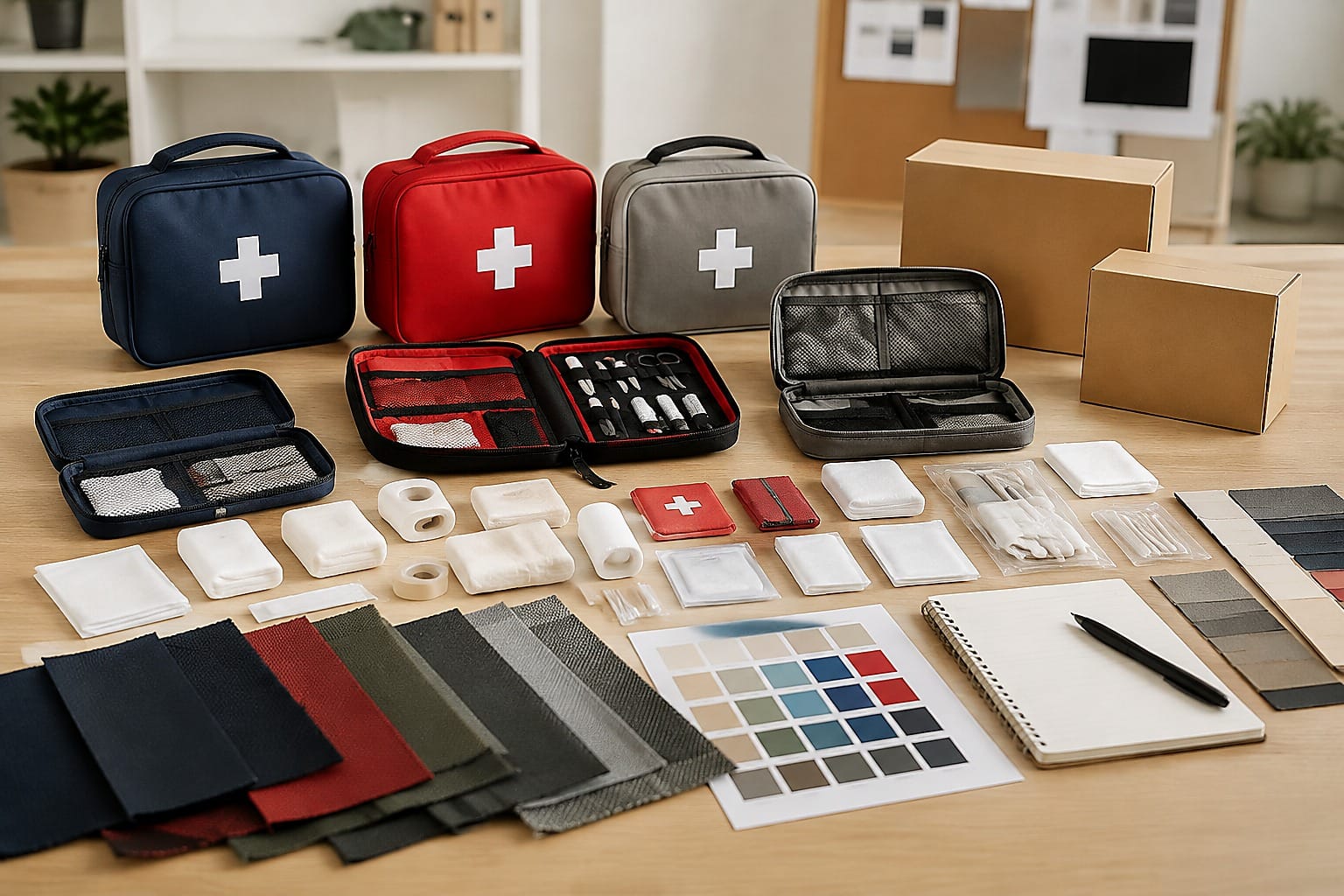
An OEM request needs more than a logo file and a target piece count. The supplier must know what is being customized, which decisions remain open, and which market receives the finished configuration. Otherwise, two quotations can appear comparable while using different bags, contents, label routes, and packing assumptions.
Start with eight project inputs:
- Identify the buyer, sales channel, intended use case, and destination market.
- State whether the project begins from an existing kit, a buyer BOM, or a new configuration.
- Give the target order quantity and forecast tiers without presenting a forecast as a firm order.
- Select the bag, case, box, or pouch format and approximate loaded capacity.
- Define the logo, color, label, insert, barcode, and master-carton scope.
- List the documents that must be reviewed for each relevant SKU.
- Specify sample checks, approval authority, and required revision records.
- Request commercial terms, packing data, and lead-time factors as separate fields.
This brief lets a supplier separate stock elements from custom work. A stock red bag with one printed logo is a different project from a custom-color backpack with new pockets, buyer-defined contents, multilingual labels, and retail packaging.
Buyers can use UneedAid’s OEM and ODM project overview to frame the first feasibility discussion. The final quotation still needs to identify the exact configuration, documents, customization limits, and buyer approvals.
Which customization layer should be approved first?
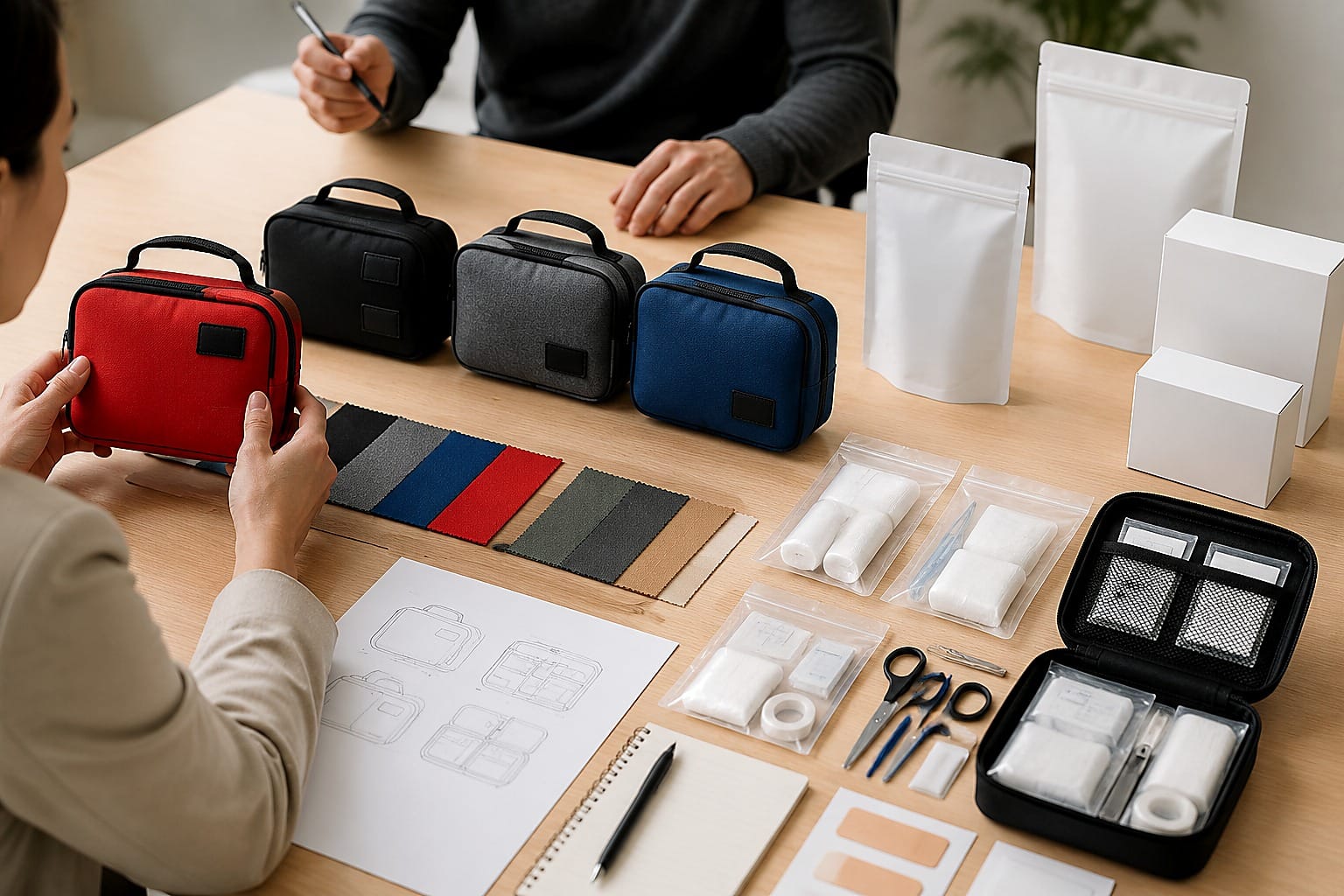
Customization has several layers. Approving them in the wrong order creates rework. A printed insert cannot be finalized if the BOM is still changing. A bag compartment map cannot be approved until the approximate component volume is known.
| Customization layer | Decision to freeze | Common dependency | Approval evidence |
|---|---|---|---|
| Kit concept | Use case, channel, destination, target quantity | Buyer program and market route | Written project brief |
| Contents | SKU, description, size, quantity, pack unit, substitution status | Availability and document review | BOM revision |
| Container | Format, material description, dimensions, color, internal layout | Loaded component volume | Loaded sample and specification |
| Branding | Logo method, print area, color reference, artwork position | Container material and print process | Artwork proof and physical sample |
| Unit packaging | Label, insert, barcode, language, seal, retail box | Final contents and market requirements | Approved artwork revision |
| Export packing | Unit count, carton size, carton mark, pallet request | Final packed unit dimensions | Packing specification |
The kit concept and provisional BOM should come first. The supplier can then assess whether an existing container fits or whether the bag or box needs structural changes. Branding and retail packaging follow after the configuration is stable enough to support accurate dimensions and label text.
For early format selection, compare standard kit configurations as baselines. A baseline shortens discussion, but it should not be presented as automatically suitable for every workplace, tender, channel, or jurisdiction.
How should the bill of materials control the project?
The BOM is the central record for OEM private label first aid kits. Photos, piece counts, and product names are supporting material. They do not replace line-by-line specifications.
Each BOM line should contain a stable line number, buyer code or supplier SKU, product description, size, material or format where relevant, quantity per kit, pack unit, label route, lot or expiry field where applicable, document status, and substitution rule. If the item uses buyer artwork, add the artwork revision.
Use explicit status values such as approved, alternative proposed, document pending, sample pending, or unavailable. A blank cell is ambiguous. It may mean stock is unconfirmed, a document was not requested, or the supplier has not reviewed the line.
The BOM should also state how changes are handled:
- No substitution without written buyer review.
- The proposal identifies the old SKU and proposed SKU.
- The supplier explains specification, label, document, price, and packing effects.
- The buyer states whether a new physical sample is required.
- The approved change receives a new BOM revision.
This process matters because a visually similar component can have a different size, pack unit, label owner, shelf-life presentation, or supporting file. It may also change how the loaded kit closes or how many kits fit in a master carton.
What is the difference between a concept sample and a production reference sample?
A concept sample answers, “Is this direction workable?” A production reference sample answers, “Is this the configuration we authorize for bulk assembly?” Mixing those purposes is a frequent source of disagreement.
| Sample stage | Main purpose | What may remain provisional | What the buyer records |
|---|---|---|---|
| Material or print swatch | Compare color, fabric, coating, or logo result | Container structure and contents | Swatch code, color reference, print method |
| Empty-container sample | Check shape, construction, pockets, closures, and carrying method | Final BOM and printed component labels | Model, dimensions, materials, construction comments |
| Concept loaded sample | Test capacity, layout, access, and overall presentation | Some components, artwork, and packing | Provisional BOM and exception list |
| Pre-production reference | Authorize the proposed bulk configuration | Only documented exceptions | Frozen BOM, artwork, packing, photos, sample ID |
The pre-production reference should be loaded and labeled as proposed for the order. If a component cannot be represented, the exception must be written. The buyer should not assume that a stock substitute in the sample will automatically be replaced in production.
Record the sample ID, date, BOM revision, bag or box specification, artwork revisions, packing revision, photographs, exceptions, and approver. Keep one agreed reference with the supplier and one with the buyer where the project and shipping arrangement permit.
How should buyers inspect an OEM first aid kit sample?
Inspect the sample against documents first, then test it as a packed unit. An attractive presentation can hide count errors, unreadable labels, strained closures, and compartments that cannot be refilled efficiently.
Use this sequence for OEM private label first aid kits:
- Photograph the sealed unit, all sides, every compartment, each label type, and the carton mark.
- Count every BOM line and record missing, extra, or substituted items.
- Check item descriptions, sizes, pack units, and dated fields against the BOM.
- Compare every logo, label, insert, barcode, and carton mark with the approved artwork.
- Open and close zippers, latches, buckles, hook-and-loop panels, and seals while fully loaded.
- Carry, mount, stack, or display the unit as intended by the project.
- Repack the contents using the proposed layout and confirm that key labels remain visible.
- Measure the packed unit and compare the master-carton proposal with the physical sample.
For bag-led projects, the emergency medical bag directory helps buyers compare waist, hand-carry, backpack, and fold-out formats before requesting a loaded sample. A directory image does not establish fabric, reinforcement, loaded comfort, or component fit. Those points require the quoted specification and sample.
Which artwork and labeling files need version control?
Private-label projects often contain more artwork files than expected. The bag logo may be only one file among component labels, an instruction insert, barcode label, unit box, polybag mark, inspection label, master-carton mark, and pallet label.
Create an artwork register with these fields:
| Field | Purpose |
|---|---|
| Artwork ID and revision | Prevent an email attachment from becoming the unnamed final file |
| Application | Bag, component, insert, unit box, carton, or pallet |
| Language | Identify the approved language version |
| Dimensions and position | Define print area and placement |
| Color reference | Give the production team a stated reference |
| Print method | Connect the artwork to the actual substrate and process |
| Approval date and approver | Establish release authority |
| Superseded file | Make obsolete artwork traceable |
Digital proofs can verify text, dimensions, and placement. They cannot fully represent ink behavior, fabric texture, curved surfaces, adhesive performance, or color under different lighting. Where those factors matter, approve a physical application sample.
The buyer should also confirm which economic operator appears on labels and which claims are allowed in the destination market. Logo ownership does not answer those questions. They depend on the product, market route, contractual roles, and applicable rules.
What compliance responsibility changes under private label?
Private label does not turn a collection of supplier files into automatic evidence for the finished kit. The regulatory role may depend on the component, claims, labeling, destination, and whether the buyer places the product on the market under its own name.
In the United States, the FDA’s device registration and listing guidance identifies activities such as manufacturing, relabeling, repackaging, and specification development when explaining who may need to register and list. Buyers should assess their actual activity and product classification rather than infer responsibility from the word “OEM.”
For the European Union, Articles 13 and 14 of Regulation (EU) 2017/745 set obligations for importers and distributors. Other obligations may apply to manufacturers, authorized representatives, or a party that makes changes described in the regulation. The buyer should map the actual supply chain and obtain qualified advice when the role is unclear.
Use a responsibility table during sourcing:
| Topic | Supplier evidence | Buyer or importer confirmation |
|---|---|---|
| Product identity | Quoted SKU, specification, label sample | Correct classification and intended market route |
| Document scope | Named model, site, report, certificate, or declaration where applicable | Scope, validity, issuer, and relevance to the ordered SKU |
| Label content | Artwork template and available product information | Required operator details, language, symbols, claims, and local rules |
| Kit configuration | BOM and component files | Whether the assembled assortment creates added requirements |
| Change control | Supplier notification process | Who reviews a changed component or label before release |
This guide cannot determine the legal role for a specific order. That conclusion needs the actual product set, claims, parties, and destination.
How do MOQ and lead-time factors differ across a custom kit?
One quoted MOQ can hide several separate constraints. The bag, printed label, insert, custom box, and individual components may each have a different production or purchasing batch. The workable project quantity is shaped by the most restrictive approved element and by how surplus materials will be handled.
Ask the supplier to separate these drivers:
- Existing bag or box stock versus a custom color or structure.
- Stock component packaging versus buyer-branded packaging.
- Printed label, insert, retail box, and carton-mark quantities.
- Component production batches and shelf-life requirements.
- Assembly capacity, inspection time, and export packing.
- Artwork approval, sample preparation, and buyer response time.
- Transport method and handoff point.
Do not convert these factors into a fixed delivery promise before the configuration is frozen. A wording change on an insert can delay print release. A component substitution can reopen document and sample review. A custom fabric color may follow a different schedule from a stock bag.
For OEM private label first aid kits, request a milestone schedule tied to approvals: brief confirmed, BOM confirmed, artwork released, pre-production sample approved, materials available, assembly started, inspection completed, and shipment released. Dates should be updated when an approval or specification changes.
What should the bulk production and inspection plan contain?
The approved sample is a reference, but the purchase order also needs measurable acceptance criteria. For OEM private label first aid kits, state which files control production and what evidence must be available before shipment.
A practical production release pack contains:
- Purchase order and commercial terms.
- Frozen BOM revision and approved substitution rules.
- Container specification and approved reference sample ID.
- Artwork register with released files.
- Unit and master-carton packing specification.
- Inspection checklist, sampling approach, and acceptance criteria.
- Required batch, lot, expiry, and traceability records where applicable.
- Change-notification contacts and release authority.
For attribute inspection, buyers may refer to ISO 2859-1, which covers sampling procedures indexed by acceptance quality limit for lot-by-lot inspection. The buyer must choose an appropriate plan and acceptance criteria for the product and risk. Citing the standard without defining defects and inspection levels does not create an inspection plan.
Defect definitions should be specific. “Artwork issue” is broad. Separate wrong language, missing text, wrong revision, unreadable print, incorrect position, color outside the agreed reference, and damaged label. Do the same for BOM counts, container construction, closures, contamination, packing, and carton marks.
How should repeat orders be kept consistent?
The first approved order creates the baseline for later OEM private label first aid kits. Repeat orders should reference that baseline and list every requested change. Reusing only the old product name or a photograph leaves too much room for interpretation.
Before each reorder, ask for a continuity review:
| Review point | Reorder question |
|---|---|
| BOM | Are all SKUs, sizes, quantities, and pack units unchanged? |
| Dated items | Does the proposed remaining shelf-life meet the purchase requirement? |
| Container | Are fabric, color, dimensions, pockets, closures, and reinforcement unchanged? |
| Artwork | Is the same revision still approved, and have addresses or barcodes changed? |
| Documents | Are requested files still current and applicable to the proposed SKU? |
| Packing | Are unit count, carton dimensions, gross weight, and marks unchanged? |
| Inspection | Are the same defect definitions and sampling rules being used? |
The supplier should disclose a proposed change before assembly, not at final inspection. The buyer can then decide whether documentary review, a component sample, an artwork proof, or a new loaded sample is required.
Component continuity does not mean every raw material or upstream source will remain available indefinitely. It means the project has a method for identifying, reviewing, approving, and recording changes before they enter the order.
What belongs in an RFQ for OEM private label first aid kits?
A structured RFQ makes supplier responses comparable and exposes unresolved assumptions. Ask each supplier to respond in the same table rather than returning only a total price and a catalog image.
| RFQ section | Buyer provides | Supplier confirms |
|---|---|---|
| Project | Channel, use case, destination, target quantity | Feasibility and base configuration |
| BOM | Line-by-line list and substitution rule | Confirmed SKU, exception, alternative, document status |
| Container | Format, dimensions, material, color, layout | Model, customization scope, sample route |
| Branding | Logo, language, barcode, label and packaging needs | Print method, template, setup, MOQ driver |
| Evidence | Required files by product or component | Available file, scope, gap, and timing |
| Samples | Required stages and approval checklist | Cost, preparation factors, courier arrangement |
| Inspection | Defect definitions and sampling request | Proposed checks and records |
| Commercial | Quantity tiers, Incoterm request, packing limits | Price tiers, payment, lead-time factors, carton data |
| Continuity | Forecast horizon and change rules | Notification method and repeat-order process |
Ask suppliers to price standard and custom elements separately. This shows whether the main MOQ or cost driver is the container, a printed component package, the retail box, or assembly. It also gives the buyer alternatives if the first configuration exceeds the launch quantity.
FAQ
How long does an OEM first aid kit project take?
There is no reliable universal lead time. The schedule depends on whether the project uses an existing container and stock packaging or requires new construction, custom colors, printed component packs, inserts, retail boxes, and market-specific review. Buyer response time also matters. A project can pause while the BOM, artwork, documents, or sample exceptions await approval. Ask for a milestone schedule instead of one unsupported date. The schedule should show brief confirmation, BOM review, artwork release, sample preparation, sample approval, material availability, assembly, inspection, and shipment handoff. When a specification changes, request an updated schedule and identify which completed approvals must be reopened.
What should be frozen before bulk production starts?
Freeze the purchase order, BOM revision, container specification, reference sample ID, artwork register, unit packing, master-carton packing, substitution rules, inspection criteria, and required pre-shipment records. The word “approved” should point to a named file or sample, not an email thread with several attachments. Any unresolved exception belongs in a written release list with an owner and due date. If the supplier cannot reproduce one item shown in the sample, decide whether to approve an alternative and whether a new sample is needed. Bulk assembly should begin only after the parties understand which records are final and who has authority to release a change.
Can one sample represent every unit in a bulk order?
No. A sample establishes the agreed configuration and gives the parties a physical comparison point. It does not show the condition of every production unit. The bulk order still needs process checks and a defined inspection plan. Buyers should state the defect categories, inspection stage, sampling method, acceptance criteria, and records they expect. High-impact issues may require different controls from cosmetic issues. The inspection should compare units with the frozen BOM, artwork, container specification, and packing rules. Receiving inspection may also be appropriate because transport can affect cartons and packed units after the supplier’s final check.
Who is responsible for private-label compliance?
Responsibility cannot be assigned from the term “private label” alone. It depends on the product, claims, labeling, destination, and the activities of each party. A supplier can provide specifications and applicable files, but the buyer or importer should verify its own market role and obligations. In some jurisdictions, relabeling, repackaging, importing, distributing, or placing a device on the market under another name can affect responsibilities. Map the manufacturer, brand owner, importer, distributor, and any authorized representative for the actual order. Review label ownership, registration, language, traceability, and document scope with the relevant authority or qualified advisor before market release.
How can a buyer reduce MOQ without weakening control?
Reduce the number of custom layers, not the quality records. A buyer can evaluate an existing bag color, stock container structure, standard component packaging, a common insert size, or a simpler logo application. The supplier should explain which change reduces a real production or print batch. Keep the BOM, artwork revision, sample checks, inspection criteria, and change process even for a smaller trial. Removing those controls makes the order harder to reproduce. It may also hide whether the lower quantity uses a different component, label, or packing route. Ask for two or three clearly defined configurations and compare their MOQ drivers, rather than requesting an undefined lower minimum.
What records should buyers keep after shipment?
Keep the final purchase order, BOM, specifications, artwork files, approvals, reference-sample record, supplier documents, inspection report, packing list, lot or batch records received, shipment documents, and approved change history. Store them by project and order number. A repeat order should begin from this file set, followed by a written continuity review. If a market question or customer complaint arises, the records help identify which configuration, labels, components, and lots were supplied. Retention periods depend on the product, market, contract, and buyer procedures, so the project team should define them rather than applying one generic period to every order.
The sample-to-bulk path for OEM private label first aid kits is a chain of controlled decisions: brief, BOM, container, artwork, evidence, sample, release pack, inspection, and change control. Keep every decision tied to a revision. That gives the buyer and supplier a shared production reference without turning assumptions into specifications.