
A distributor can receive a first aid supplies quote that looks complete, then discover during sample review that expiry labels, sterile-barrier wording, refill quantities or carton marks are missing. A practical first aid supplies sourcing guide should help B2B buyers compare product formats, documentation, packaging, MOQ, repeat-order continuity and RFQ details before they approve samples or place bulk orders.
For UneedAid buyers, this hub is a procurement checklist. It is not medical guidance, and it does not replace destination-market review. Instead, use this first aid supplies sourcing guide to organize supplier questions for dressings, gauze, eyewash, barriers, hot and cold therapy, kit refills and private-label first aid supply programs.
First aid supplies sourcing guide: what should B2B buyers check first?
Start with the buying context, not the product photo. First aid supplies are often quoted as simple consumables, but the actual order may support a workplace kit program, reseller catalog, institutional tender, outdoor kit, vehicle kit, tactical-style assortment or OEM/ODM refill project. Each route changes the checks that matter.
For a first screen, separate the project into six fields:
- Use case: workplace refill, distributor shelf item, kit assembly, institutional program or private-label bundle.
- Product format: sterile dressing, non-woven swab, roll gauze, compressed gauze, eyewash fluid, eye covering, gloves, barrier, cold pack or refill set.
- Pack unit: each piece, pouch, bottle, inner box, refill bag, kit module, carton or master case.
- Shelf-life plan: expiry date, lot number, storage condition and replacement cycle.
- Label route: neutral stock label, importer label, multilingual label, private label or tender-specific artwork.
- Documentation pack: specification sheet, label draft, carton mark, available test files and market-specific review notes.
In practice, this structure keeps the RFQ practical. A supplier can quote the same item in bulk inner packs, retail blister cards, kit refill pouches or private-label cartons. Therefore, the buyer needs to know which route is being quoted before comparing unit cost.
OSHA’s interpretation of 29 CFR 1910.151(b) says adequate first aid supplies should be readily available, and it notes that ANSI/ISEA Z308.1-2021 is often used as guidance rather than an OSHA-adopted mandatory standard for general workplaces. That distinction matters for B2B sourcing: a buyer may ask for ANSI/ISEA Z308.1-2021 alignment, but the importer or end customer still confirms how the kit contents, workplace placement and labels fit the destination market.
Product format map for a first aid supplies sourcing guide
A hub-level first aid supplies order usually mixes several product families. First, the buyer should map them before requesting samples, because each family has a different evidence burden.
| Product family | Typical B2B buying question | Evidence to request |
|---|---|---|
| Sterile dressings and pads | Is the size, absorbency, sterile-barrier pack and expiry format clear? | SKU spec sheet, pouch artwork, lot and expiry layout, carton mark |
| Gauze rolls and compressed gauze | Is the weave, fold, compression, packaging and reorder unit consistent? | Material description, dimensions, sample photos, pack unit and carton loading |
| Eyewash bottles and rinse supplies | Is fluid type, volume, shelf life and replacement cycle visible? | Bottle label, fluid documentation, lot record format, carton configuration |
| Gloves and CPR barriers | Is material type, size range, barrier format and unit packaging defined? | Material declaration, size chart, inner box layout, label draft |
| Hot and cold therapy | Is activation method, storage condition and carton packing suitable for the route? | Instruction draft, unit weight, leak-control notes, carton test notes if available |
| Kit refill modules | Does the refill list match the buyer’s installed kit program? | Refill checklist, substitution rule, dated item list, reorder SKU map |
For assortment planning, buyers can use UneedAid’s first aid product categories as the broad entry point, then narrow the review through wound care consumables or eye wash and rinse supplies.
Also, the map keeps product claims in check. A sterile pad, an absorbent dressing and a hemostatic gauze are not interchangeable just because all three sit under wound-care supplies. The supplier should describe what the SKU is, how it is packed and what evidence is available. As a result, the buyer can avoid catalog wording that expands the product role beyond the supplier’s verified specification.
How should buyers compare dressings and wound-care consumables?
Dressings and pads create hidden variation in B2B orders. Two samples can share the same nominal size but differ in pouch size, folded dimension, absorbent layer, backing material, edge seal, individual pack strength and carton count. Those details affect private-label layout, refill lists and repeat-order consistency.
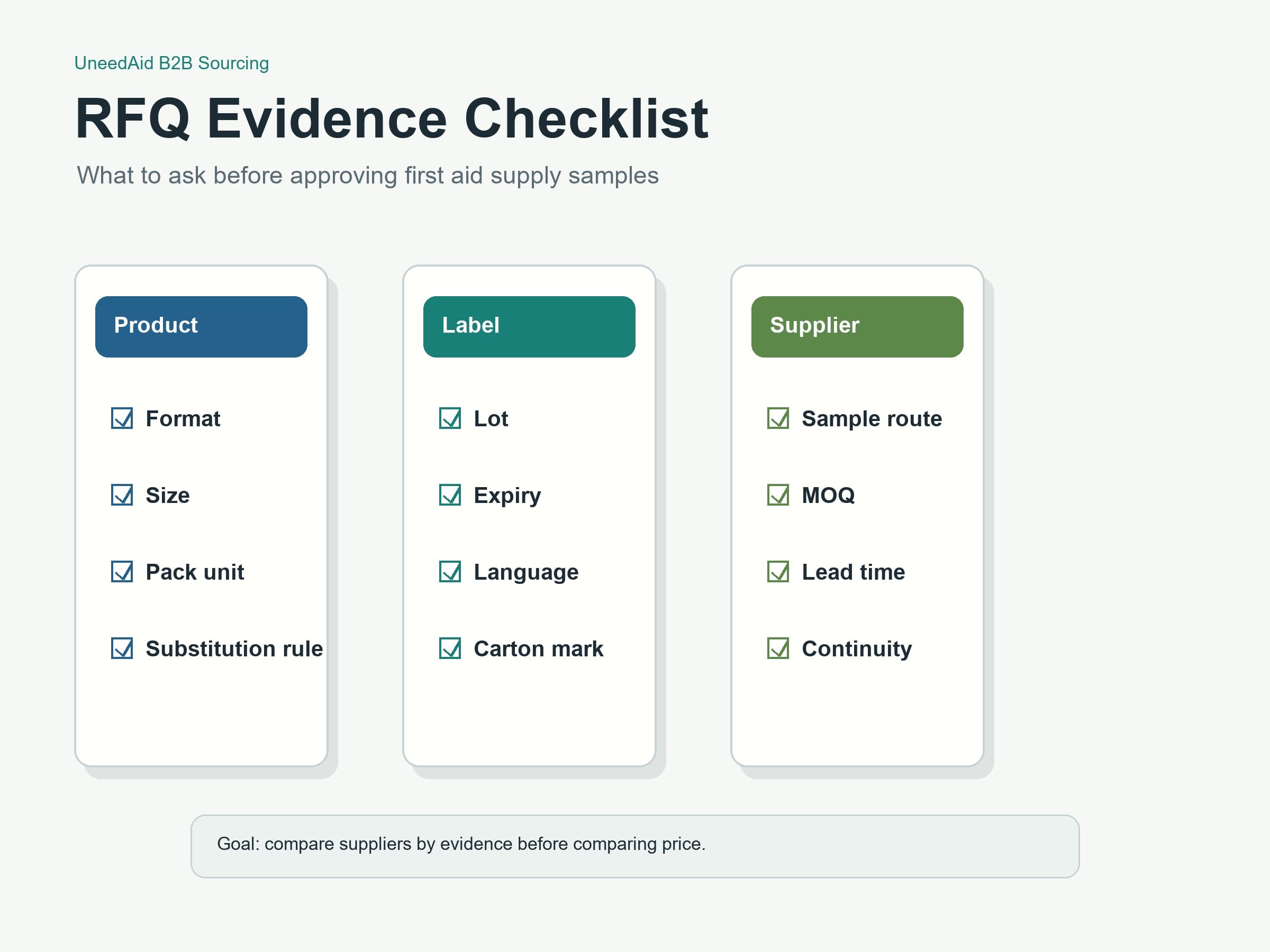
For dressings, request the following before approving a sample:
- Open size and folded size.
- Material description for the contact layer, absorbent layer and backing, where applicable.
- Sterile or non-sterile status as written on the supplier’s label.
- Individual pouch artwork with lot and expiry placement.
- Inner box quantity and master carton quantity.
- Sample photos from the current production route, not only catalog renders.
- Substitution rule if the exact material, pouch or pack count changes.
FDA labeling guidance is useful as a reference point for documentation discipline. The FDA notes that labels should remain legible through customary distribution, storage and use, and that control numbers or expiration dates, when used, should be checked as part of label control. For B2B buyers, the sourcing takeaway is simple: do not approve artwork only because it looks neat. Instead, check whether lot, expiry, storage wording and product identity remain readable after private-label changes.
The related Israeli emergency bandage sourcing framework goes deeper into pressure bandage format, component continuity and private-label sampling. This hub uses the same logic for general dressings: define the component, verify the pack and document what can be repeated.
How should buyers compare gauze formats without mixing different products?
Gauze is easy to over-simplify. A buyer may ask for gauze pads, rolls, compressed gauze and hemostatic gauze in one RFQ, but those products serve different catalog roles and need different comparison fields.
Use this split:
| Gauze format | What changes in sourcing | What to confirm before bulk order |
|---|---|---|
| Sterile gauze pad | Size, ply, pouch, sterile-barrier pack, expiry field | Size tolerance, pouch artwork, lot and expiry, carton count |
| Gauze roll | Width, length, stretch, edge finish, pack type | Roll dimension, compression level, inner pack, carton loading |
| Compressed gauze | Fold pattern, compression density, vacuum pack or pouch | Packed size, open length, shelf-life label, reorder unit |
| Hemostatic gauze | Active material route, regulatory status, destination review | Technical file availability, label wording, sample approval process |
The civilian hemostatic gauze sourcing guide explains how buyers can compare kaolin, chitosan-style and plain compressed formats from a procurement perspective. For this hub, the key point is not to benchmark all gauze by price per piece. Price per usable roll, price per packed module, expiry risk and documentation burden may tell a different story.
Buyers should also ask how gauze will be used in refill packs. For example, a distributor may need pads in retail-ready boxes, while a kit assembler may need bulk pouches organized by module. A private-label buyer may need a gauze roll with neutral product text and a custom carton. Those are different SKUs for operations, even when the base product is similar.
How should eyewash and eye-care supplies fit into a first aid supplies program?
Eyewash products often sit between workplace safety, first aid refill and emergency supply categories. The buyer should define whether the RFQ covers small eyewash bottles, sterile saline bottles, rinse solution, portable station refill packs, eye pads, eye shields or complete station programs.
For bottles and refill fluids, confirm:
- Bottle volume and closure type.
- Fluid description and shelf life.
- Lot and expiry position on bottle and carton.
- Inner pack and master carton quantity.
- Language and warning fields needed for the destination market.
- Whether the order is for stock label, importer label or private label.
The eyewash station solution sourcing guide covers fluid type, shelf life and refill economics in more detail. For a broader hub order, eyewash should be tied to replacement planning. If the buyer sells eyewash bottles as kit refills, carton count and expiry rotation may matter more than bottle appearance. However, if the buyer supports workplace eyewash stations, refill interval, inspection label and matching station compatibility become part of the same RFQ.
Future cluster work should reserve clear internal-link space for three topics: portable emergency eyewash stations, eye pads and shields, and ocular dressing modules. Later, those pages should connect back to this hub when they are drafted or updated, because eye-care products need a different checklist from general wound-care consumables.
First aid supplies sourcing guide documentation before sample approval
Documentation does not have to be complex, but it must be tied to the actual SKU. In other words, a buyer cannot rely on a generic product image when the order depends on expiry dates, sterile-barrier wording, importer labels or destination-market files.
Ask for a document pack in this order:
| Document | Why it matters | When to request it |
|---|---|---|
| SKU specification sheet | Confirms size, material, pack unit and intended label route | Before sample dispatch |
| Label artwork or pouch artwork | Shows product identity, lot, expiry and language fields | Before sample approval |
| Carton mark draft | Confirms product name, quantity, gross weight and handling fields | Before bulk order |
| Available test or conformity files | Shows what evidence exists for the SKU or component | Before customer submission |
| Shelf-life or stability statement where applicable | Links expiry dating to storage condition and product route | Before final artwork |
| Sterile-barrier packaging reference where applicable | Confirms what part of the item is sterile and how it is packed | Before private-label approval |
The FDA’s medical-device labeling guidance says labels and user instructions should stay legible during customary distribution, storage and use. In addition, FDA material on recognized consensus standards lists ISO 11607-1 for packaging of terminally sterilized medical devices, which is relevant as a reference point when buyers discuss sterile-barrier packaging. These references do not mean a supplier can promise market clearance for every order. They simply show why document wording, packaging integrity and label control should be checked before the buyer commits to volume.
Therefore, keep one rule in the RFQ: evidence should match the item being quoted. A file for one gauze size should not be treated as evidence for a different format, a different pouch or a private-label version unless the supplier explains the relationship clearly.
Supplier evidence: sample validation, MOQ and repeat-order continuity
A first aid supplies supplier should be evaluated on repeatability, not only on a single sample. At first, the first shipment may pass visual review. However, a distributor’s real problem often appears on the second or third reorder when packaging, pouch material, carton count or refill mix changes without notice.
For sample validation, build a comparison sheet with these fields:
- SKU code and buyer code.
- Product family and exact format.
- Sample date and sample batch notes.
- Agreed material, size, pack unit and artwork version.
- Label fields approved by the buyer.
- Carton quantity, carton size and gross weight.
- MOQ by product, label, carton and refill module.
- Substitution rule and approval trigger.
MOQ deserves special attention. A supplier may support low MOQ on standard items but require higher MOQ for private-label pouch printing, custom carton marks or refill-module assembly. Ask the supplier to separate MOQ by operation:
| Operation | Possible MOQ driver | Buyer question |
|---|---|---|
| Stock consumable supply | Existing stock or standard production batch | Can the same SKU code be repeated? |
| Private-label pouch | Printed film or label run | What is the minimum artwork batch? |
| Custom refill module | Assembly labor and component allocation | Can modules be reordered without changing contents? |
| Carton mark customization | Carton printing or label application | Is custom carton marking separate from product MOQ? |
| Mixed-category shipment | Consolidation and export packing | Can wound care, eyewash and barriers ship together? |
For private-label and assortment work, UneedAid’s OEM/ODM project route is the natural path for sample review, artwork discussion and component continuity. Buyers with a ready project brief can submit product format, target quantity and document needs through the B2B portal. Meanwhile, buyers who are still building an assortment can use the catalog center to review category coverage before sending a full RFQ.
Kit refill checks for distributors and institutional buyers
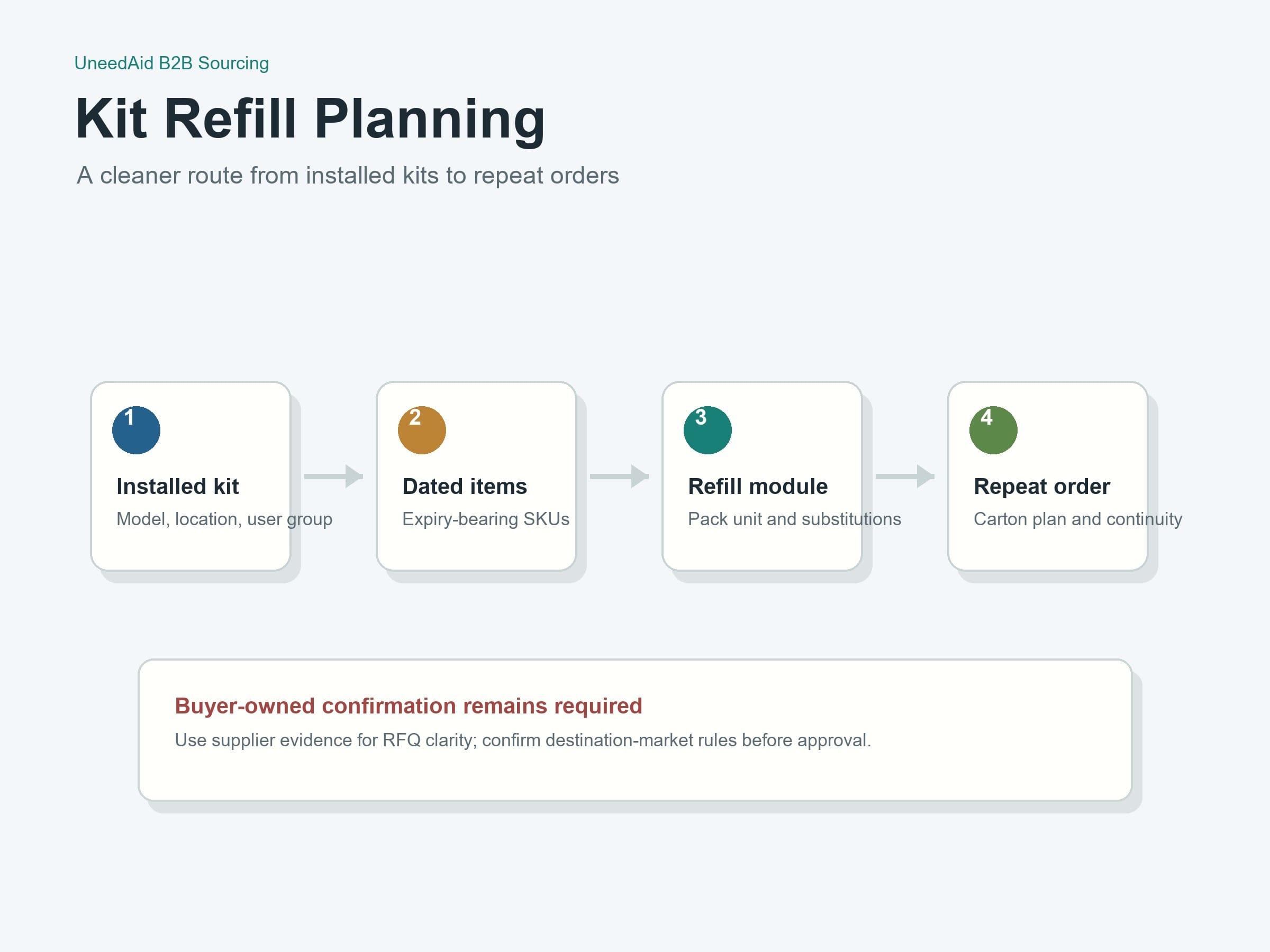
Refill sourcing is different from buying loose supplies. A refill order must match an installed kit population, a distributor catalog or a customer replacement schedule. If the refill list changes casually, the buyer may create downstream confusion for branches, resellers or tender customers.
Use a refill matrix:
| Refill field | What to record | Why it matters |
|---|---|---|
| Original kit model | Buyer kit code, box type or bag type | Keeps refill set tied to the correct installed kit |
| Item list | Product name, size, quantity and pack unit | Reduces missing-item disputes |
| Dated items | Eyewash, sterile pads, gloves or other expiry-bearing items | Supports replacement planning |
| Substitution rule | Allowed equivalent, approval step and label change | Protects repeat-order consistency |
| Module format | Loose pack, refill pouch, inner box or compartment set | Affects assembly and receiving checks |
| Outer packing | Carton quantity, carton mark and pallet plan | Affects landed cost and warehouse receiving |
For workplace-oriented buyers, the OSHA SHMS manual gives a practical example of periodic kit inspection and replacement of expired items in its internal program guidance. A B2B supplier should not present that as a universal rule for every destination. Still, it supports a useful procurement habit: refill SKUs should make inspection and replenishment easier.
Distributors should also define whether they want refill packs by kit size or by supply family. A “25-person refill pack” is simple for catalog buyers but may vary by market. By contrast, a wound-care refill pack, eyewash refill pack or glove-and-barrier refill pack can be easier to adapt across product lines. The choice affects SKU count, inventory and future content planning.
RFQ checklist in a first aid supplies sourcing guide
Before sending an RFQ, gather the minimum information that lets a supplier quote correctly. This first aid supplies sourcing guide uses the following fields as the minimum practical set:
- Buyer type: distributor, importer, institutional buyer, kit assembler or private-label owner.
- Target market and label language.
- Product list with format, size, quantity and pack unit.
- Dated-item requirements, including lot and expiry layout.
- Sterile or non-sterile status as required by the buyer’s product route.
- Private-label needs for pouch, bottle, inner box, instruction sheet or carton.
- MOQ target and first-order quantity by SKU.
- Sample requirement and approval criteria.
- Documentation needed before sample approval.
- Shipment route, carton constraints and consolidation request.
Then turn those fields into a short RFQ table:
| RFQ line | Example buyer input | Supplier response needed |
|---|---|---|
| Product family | Sterile gauze pads, eyewash bottles, CPR barriers | Available SKU list and sample route |
| Quantity | 5,000 pieces per SKU or 1,000 refill modules | MOQ, lead time and carton plan |
| Packaging | Neutral pouch plus importer carton mark | Artwork feasibility and extra MOQ |
| Documentation | Spec sheet, label draft, carton mark, shelf-life notes | Files available before sample approval |
| Repeat order | Same components for 12-month refill program | Continuity plan and substitution rule |
This checklist is intentionally plain. It gives procurement teams a way to compare suppliers without turning the article into a medical or regulatory instruction. Ultimately, the buyer still owns destination-market confirmation, but the supplier should be able to provide clean product information, samples, packaging details and available evidence.
FAQ
What is included in a first aid supplies sourcing guide for B2B buyers?
A first aid supplies sourcing guide should cover product format, pack unit, shelf-life fields, labeling, documentation, MOQ, sample review and repeat-order continuity. For first aid supplies, the guide should also separate dressings, gauze, eyewash, gloves, barriers and refill modules because each family has a different sourcing risk. The goal is not to decide the final market requirement for the buyer. Instead, the goal is to make RFQs comparable and to catch missing evidence before sample approval.
Are ANSI/ISEA Z308.1 first aid kit contents mandatory for every workplace buyer?
Not always. OSHA has referred to ANSI Z308.1 as a useful source of guidance for workplace first aid kits. However, OSHA’s interpretation also notes that ANSI Z308.1 was not adopted by OSHA as a mandatory standard for general workplace first aid kits. B2B buyers should use the current ANSI/ISEA listing as a reference point, then confirm the required kit contents, quantities, placement and label wording with the destination market or end customer.
What documents should a distributor request for sterile dressings or gauze?
Ask for a SKU specification sheet, pouch artwork, lot and expiry format, carton mark, available test or conformity files, and any sterile-barrier packaging references that apply to the quoted item. The document pack should match the exact SKU, size, pouch and label route. If a private-label version changes artwork, language, material or packaging, then the buyer should request updated files before bulk approval.
How should buyers compare eyewash bottles and rinse supplies?
Compare bottle volume, closure, fluid description, shelf life, lot and expiry location, carton count, label language and replacement cycle. If the eyewash item is part of a kit refill program, expiry rotation and refill quantity may matter more than bottle appearance. However, if it supports a station program, buyers should also confirm station compatibility, inspection labels and matching refill order quantities.
What should a first aid kit refill checklist include?
A refill checklist should tie every replacement item back to the original kit model or buyer code. It should list product name, size, quantity, pack unit, expiry-bearing items, allowed substitutions, module format and carton plan. As a result, distributors can avoid vague refill orders such as “same as last time,” which can hide changes in gauze size, dressing pack, eyewash bottle volume or label fields.
Can first aid supplies be private-labeled for B2B orders?
Yes, where product feasibility allows and the buyer approves samples and artwork before bulk production. Private-label work should protect required product identity, lot, expiry, storage and instruction fields. In practice, a logo or brand color should not crowd out information needed for receiving, replenishment or destination-market review. MOQ may differ for stock items, printed pouches, carton marks and assembled refill modules, so those lines should be quoted separately.
This first aid supplies sourcing guide is most useful when buyers compare evidence before price. Define the product family, pack unit, shelf-life fields, label route, document pack, MOQ and repeat-order rule. Then send the RFQ. That order gives distributors and procurement teams a cleaner basis for sample approval, private-label planning and future refill work.