
A distributor adding hemostatic gauze to a civilian first aid line runs into a fork almost immediately: kaolin, chitosan, or plain compressed gauze with no active agent. The three look similar in a product photo and sit in the same kit slot, but they carry different unit costs, different shelf-life logic, and different documentation burdens at the border. For a buyer sourcing for civilian and distribution channels rather than military contracts, picking the wrong one shows up as either a margin problem or a compliance problem on the reorder.
This guide works through the sourcing decision from a B2B angle: what each gauze type is, how the cost and MOQ math differs, what documentation to request per SKU, and where the importer’s responsibility starts. It assumes the buyer is comparing several Asia-based manufacturers, which is the dominant supply cluster for civilian-grade hemostatic gauze, and wants an evaluation framework rather than a single quote.
What “hemostatic gauze” actually means for a civilian buyer

Hemostatic gauze is a wound dressing designed to speed up clotting at the point of bleeding. The gauze substrate is usually a rayon or rayon-polyester blend, and what makes it “hemostatic” is either a mineral or polymer agent bonded to the fibers, or in some products, the compression and absorbency of the gauze itself with no active agent at all.
The word “civilian” in the search term matters more than most suppliers acknowledge. Military and tactical procurement usually specifies a named CoTCCC-referenced product and a documentation trail to match. Civilian and distribution buyers are sourcing for workplace kits, vehicle kits, outdoor and EDC channels, and general retail, where the priorities are consistent quality, honest labeling, a defensible shelf life, and a landed cost that leaves channel margin. That shifts the sourcing question from “which branded product” to “which agent type, from which supplier, with what documentation.”
Two facts drive the rest of the decision:
- The agent type sets the cost floor and the shelf-life ceiling. Kaolin and chitosan behave differently in storage and in the wound, and they price differently at volume.
- It is a sterile single-use device. Sterility validation, lot-level expiration dating, and packaging integrity are functional requirements, and they are where thin suppliers cut corners.
Kaolin vs chitosan vs plain compressed: how each one works
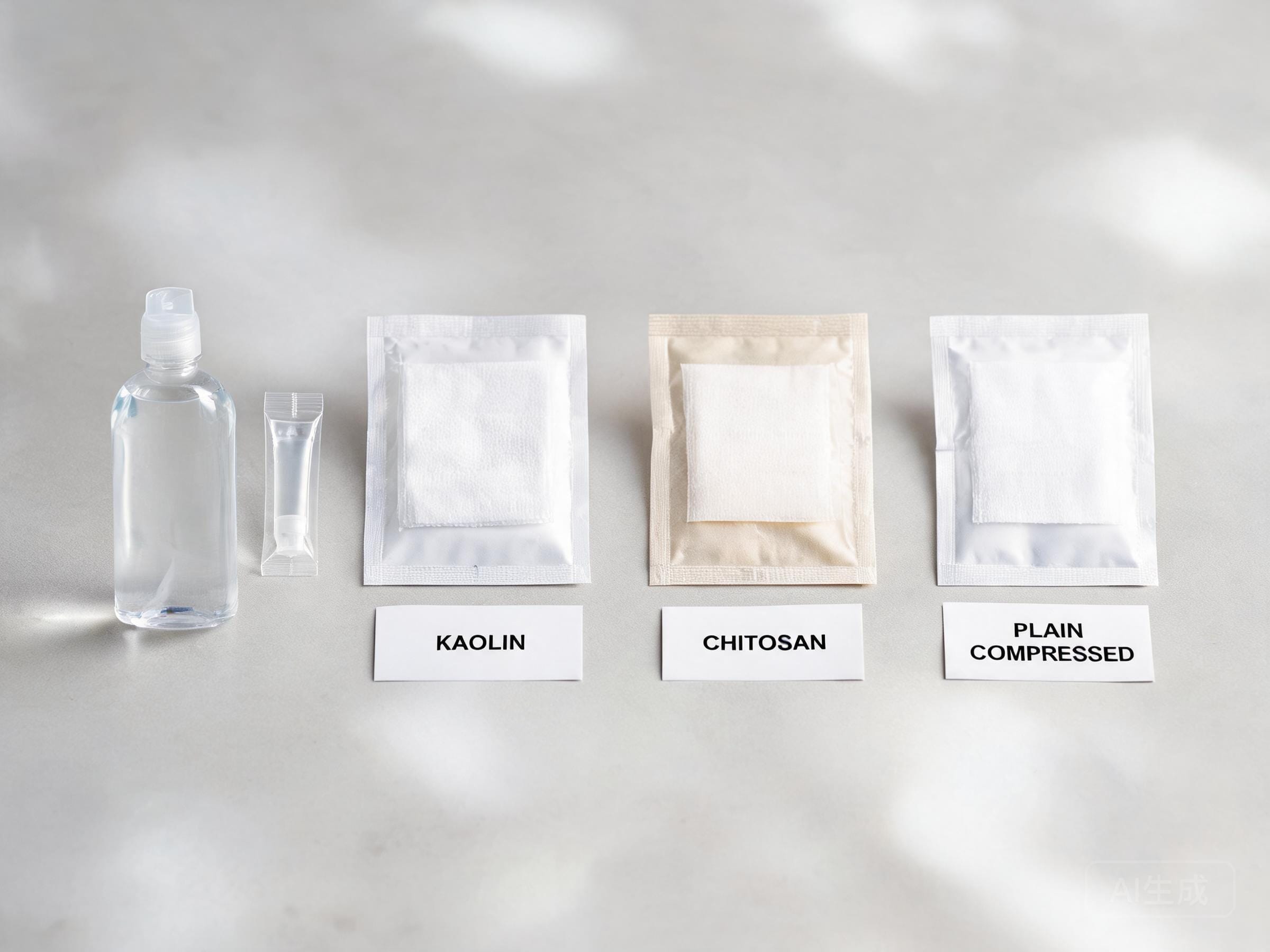
The three categories are not interchangeable, and the mechanism explains why the cost and handling differ.
Kaolin-based gauze. Kaolin is an inert aluminosilicate mineral. It works by activating Factor XII in the clotting cascade, which accelerates the body’s own clot formation at the contact surface. Because kaolin is inert and does not react with blood chemistry to swell, it is stable across a wide temperature range and typically carries a long shelf life. It is the mineral agent most civilian buyers recognize because the most widely known branded product in this class uses it.
Chitosan-based gauze. Chitosan is a polymer derived from crustacean shells (chitin). It works differently from kaolin: it is mucoadhesive and positively charged, so it binds to red blood cells and forms a seal largely independent of the body’s clotting cascade. That mechanism matters for one practical reason a buyer should understand — chitosan can work even where a patient’s own clotting is impaired. The trade-off is that chitosan products can be more sensitive to humidity in storage and often carry a shorter validated shelf life than kaolin.
Plain compressed gauze (no active agent). This is high-absorbency rolled or Z-folded gauze with no hemostatic agent. It relies on packing and direct pressure. It is the lowest-cost option, has the simplest regulatory profile in many markets, and is often the honest answer for a general first aid line where the channel does not require an active hemostatic claim. Selling plain compressed gauze as “hemostatic” is the single most common mislabel in this category, and it is a compliance exposure the importer inherits.
| Type | Mechanism | Shelf-life tendency | Relative unit cost | Typical civilian channel fit |
|---|---|---|---|---|
| Kaolin | Activates Factor XII, speeds native clotting | Longer, temperature-stable | Mid | Workplace trauma, vehicle, outdoor/EDC, tactical-civilian kits |
| Chitosan | Binds red cells, seals independent of clotting cascade | Shorter, humidity-sensitive | Mid-to-high | Outdoor, marine, kits where storage is controlled |
| Plain compressed | Absorbency plus direct pressure | Longest, simplest | Lowest | General first aid, budget kits, markets that do not need an active claim |
A buyer serving mixed channels often stocks kaolin as the default hemostatic line and plain compressed as the budget consumable, and keeps chitosan as a specialty add. The kaolin hemostatic gauze category is a useful reference point for how the mineral-agent format is packaged for bulk, and the broader hemostasis and bandaging range shows how it sits next to trauma bandages and dressings that share the same dating and documentation logic.
What to request from a supplier before the bulk order
The gap between a supplier’s website claim and what they can document per SKU is the biggest source of post-shipment problems in this category. A practical evaluation framework has five checkpoints.
1. Agent identity and loading, in writing. Confirm which agent the gauze uses and, for kaolin or chitosan, that the agent is actually bonded to the substrate rather than dusted on. Ask for the agent type on the spec sheet, not just “hemostatic” as a marketing word. A supplier that cannot name the agent is selling either plain compressed gauze or an unverified formulation.
2. Sterility and shelf-life validation. Every lot should ship with a sterilization certificate (EO gas is common for this category), a lot number, a manufacturing date, and a printed expiration date. The critical check: shelf life is bounded by the sterile-barrier film and the agent stability, whichever is shorter. A 5-year claim on a chitosan product deserves the validation report before you believe it.
3. Quality system registration. ISO 13485 (medical device quality management) is the reference point most North American and European buyers cite. A supplier holding ISO 13485 sits in a different risk category from one holding only ISO 9001. ISO 9001 is not disqualifying, but it signals that medical-device-specific controls are outside the certified scope. Ask for the certificate number and verify it.
4. MOQ and reorder cadence. The headline MOQ on a website is rarely the flexible first-order MOQ a buyer can negotiate. Ask, in writing, for the lowest MOQ per SKU on a first order and the reorder MOQ for a repeat. The gap between the two tells you how the supplier scales and whether a refill program is realistic.
5. Packaging and labeling control. For a private-label program, the supplier holds the print files for the buyer’s brand and keeps them continuous across reorders. Component continuity — same substrate, same agent loading, same lot-coding format — is what makes a repeat line work. A supplier that changes the substrate or agent loading silently between orders breaks the buyer’s channel and the buyer’s shelf-life assumptions at the same time.
Cost and MOQ: where the money actually goes
Pricing on hemostatic gauze is spec-sensitive and order-size-sensitive. A few structural points a buyer should hold going into an RFQ:
- The agent is a real cost line, not a rounding error. Chitosan raw material and the bonding process usually cost more than kaolin loading, which is why chitosan products tend to price higher at the same size. Plain compressed gauze skips the agent cost entirely, which is most of the price gap between it and an active hemostatic product.
- Sterilization and validated packaging drive unit cost more than the gauze. The rayon substrate is inexpensive. EO sterilization and the validated sterile-barrier pouch are where the unit cost concentrates. A quote that undercuts the category on price is usually cutting one of those two, and both are the parts you cannot see in a sample photo.
- Per-unit price compresses with case quantity. A 1,000-unit first order and a 10,000-unit reorder are two different cost tiers. Confirm both before RFQ, because the reorder economics usually matter more than the first-order headline.
- Private-label adds print-file setup and branded packaging. A first private-label run typically carries a one-time plate or setup fee plus a per-unit uplift for branded pouches, which amortizes on reorder. Changing the pouch print is straightforward; changing the substrate, the agent, or the sterile-barrier film is a validation conversation, not a print change. Where product feasibility allows, OEM and ODM options can be discussed according to order type and volume through the OEM and private-label workflow.
A low-risk sequencing for a buyer scoping a new hemostatic line: start with the stock kaolin format at a low first-order MOQ, validate it through a sample cycle, confirm the documentation clears the destination market, then move into custom packaging or a second agent type on reorder.
Destination-market compliance: where the importer’s job starts
Hemostatic gauze is regulated as a medical device in most markets, and the classification is often higher than plain first aid gauze because of the hemostatic function claim. The supplier provides the documentation they hold; the importer confirms whether it is sufficient for the destination.
- United States. The FDA regulates hemostatic dressings as medical devices, and the class depends on the product code and intended use. The importer is responsible for establishment registration, device listing, and 510(k) assessment where applicable. A supplier can supply documentation; the filing is the importer’s.
- European Union. The MDR (Medical Device Regulation 2017/745) governs. The product needs an MDR-compliant technical file, CE marking under an MDR pathway, and an EU Responsible Person if the manufacturer is not EU-based. A supplier’s older MDD certificate does not automatically transfer under MDR — confirm what the certificate covers.
- United Kingdom. The GB market requires UKCA marking, separate from EU CE. The importer confirms which mark the destination requires.
- Australia, Canada, and other regulated markets. Each runs its own device classification and registration scheme. A supplier can hold ISO 13485 and still have no standing in a given market; that call sits with the importer’s regulatory advisor.
The consistent pattern: the supplier holds ISO 13485, sterilization reports, biocompatibility data on the agent and substrate, and a technical file; the importer or distributor confirms sufficiency for the destination market. A supplier that promises destination-market regulatory endorsement for the buyer’s specific use is overstating. Those are buyer-side filings, not supplier-side endorsements. Note also that hemostatic performance claims are tightly scrutinized in most markets, so a buyer should keep marketing language qualified and let the documentation carry the technical claim.
Common sourcing pitfalls and how buyers catch them
- Plain gauze sold as hemostatic. The most frequent mislabel. Request the agent identity and loading on the spec sheet. When a supplier cannot name and document the agent, the safe assumption is plain compressed gauze regardless of the listing.
- Overstated shelf life. A long expiration quoted on a chitosan product that the sterile-barrier film or agent stability does not support. Ask for the shelf-life validation report, and remember the shelf life is bounded by the weaker component.
- Agent-substrate separation. A cheaper process dusts the agent on rather than bonding it, so it sheds in the pouch. Ask how the agent is fixed to the substrate and, where available, for a shedding or particulate test.
- Silent formulation changes. A reorder arrives with a different substrate blend or a different agent loading. Build a component-change approval clause into the purchase agreement: any change to substrate, agent, or sterile-barrier film requires written notice and buyer approval.
- Lot dating inconsistency. Some lots carry per-unit expiration, others only case-level dating. Confirm per-unit dating before commit, because FIFO rotation in a distribution channel depends on it.
These checks are not unique to hemostatic gauze. They are the same set any sterile first aid consumable line should clear before bulk commitment, and they line up with the framework a buyer would apply to trauma bandages and other dressings in the same kit.
FAQ
What is civilian hemostatic gauze?
Civilian hemostatic gauze is a sterile, single-use wound dressing designed to speed up clotting, sourced for civilian and distribution channels rather than military contracts. It is usually a rayon or rayon-blend gauze carrying an active agent — kaolin or chitosan — or, in the plain compressed version, no agent at all. Civilian sourcing prioritizes consistent quality, honest labeling, a defensible shelf life, and a landed cost that leaves channel margin, which shifts the decision toward agent type and supplier documentation rather than a single branded product.
What is the difference between kaolin and chitosan hemostatic gauze?
Kaolin is an inert mineral that activates Factor XII to speed the body’s own clotting cascade; it is temperature-stable and usually carries a longer shelf life. Chitosan is a polymer from crustacean shells that binds red blood cells and seals largely independent of the clotting cascade, which means it can work where a patient’s own clotting is impaired. Chitosan tends to be more humidity-sensitive in storage and often carries a shorter validated shelf life, and it usually prices higher than kaolin at the same size.
Is plain compressed gauze the same as hemostatic gauze?
No. Plain compressed gauze has no active hemostatic agent; it relies on packing and direct pressure, and it is the lowest-cost option with the simplest regulatory profile in many markets. Selling plain compressed gauze as “hemostatic” is the most common mislabel in the category and a compliance exposure the importer inherits. For a general first aid line that does not require an active hemostatic claim, plain compressed gauze can be the honest and correct choice — as long as it is labeled as what it is.
What MOQ should a buyer expect for a first hemostatic gauze order?
MOQs vary by supplier, agent type, and spec. A practical approach is to ask in writing for the lowest MOQ per SKU on a first order and the reorder MOQ for a repeat. Many Asia-based B2B suppliers will negotiate a first-order MOQ below the headline website figure, with a higher reorder tier once the program is validated. Starting with a stock kaolin format at a low first-order MOQ and moving to custom packaging on reorder keeps first-order risk low.
What documentation should I verify before importing hemostatic gauze?
Request and verify, in writing: the agent identity and loading on the spec sheet, an ISO 13485 certificate (verify the number and scope), the sterilization validation report (commonly EO gas), a shelf-life validation report, per-unit lot dating, and biocompatibility data on the agent and substrate. Then confirm with your own regulatory advisor whether that documentation satisfies the destination market’s device classification. The supplier provides documentation; destination-market registration and listing are the importer’s responsibility.
Does a supplier’s ISO 13485 certificate mean the gauze is approved for my market?
No. ISO 13485 confirms the manufacturer runs a medical-device quality management system, which is a supplier-side quality signal. It is not a market approval. FDA registration and listing in the United States, CE marking under MDR in the EU, and UKCA marking in the UK are importer-side filings specific to the destination. A supplier can hold ISO 13485 and have no standing in a given market. Confirm what the certificate actually covers and what your own jurisdiction requires before you rely on it.
A buyer moving from this framework to a quote typically confirms agent type, sterile-barrier format, MOQ tier, private-label scope, and destination-market documentation, then validates a sample before committing to volume. The same checkpoints apply whether the order is 1,000 units or 50,000 — only the reorder cadence and the per-tier unit cost change. For buyers building a full hemorrhage-control line, hemostatic gauze usually sits alongside a pressure dressing, and the Israeli emergency bandage sourcing framework covers the companion product in the same kit slot.