
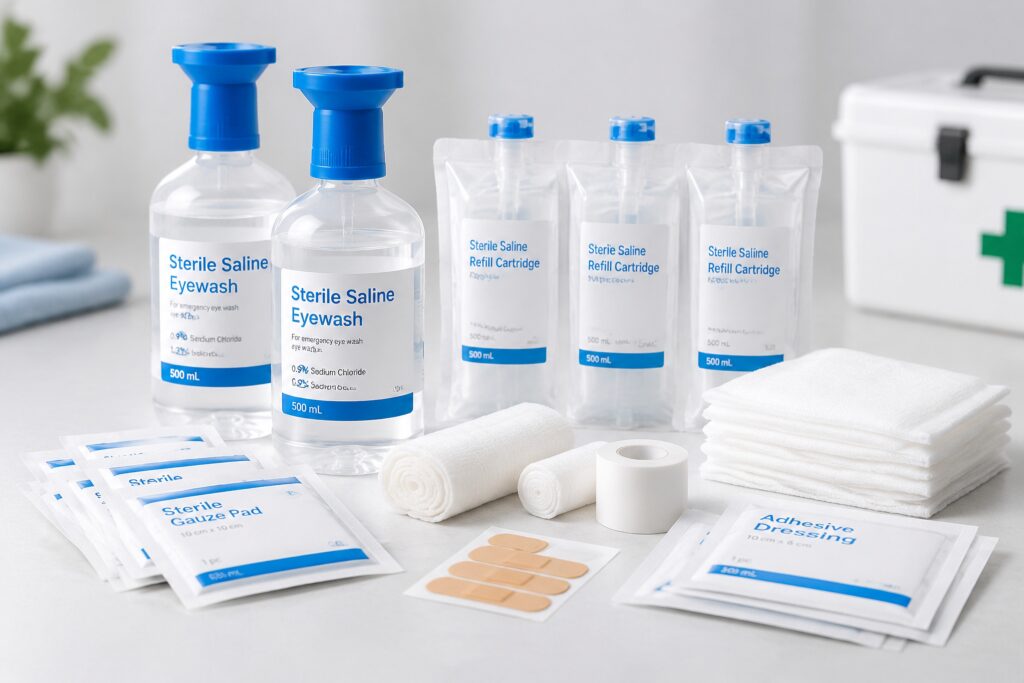
A purchasing manager building a workplace kit rarely orders burn dressings and eyewash from the same shelf. Burn care is a wound-contact purchase. The dressing touches broken skin, so the buyer specifies material, adhesion, sterility and pack format. Eyewash splits again. A bottle inside a kit is a supplemental item. A plumbed or self-contained station is facility equipment with its own performance numbers. Most burn care dressing b2b sourcing problems start when one RFQ line tries to cover both families under a single specification.
This guide sets out what belongs in each RFQ line. It covers the dressing families, the eyewash formats, the standards that actually bind each one, and the place where buyers most often lose money.
Why burn care dressing B2B enquiries split into two specification systems
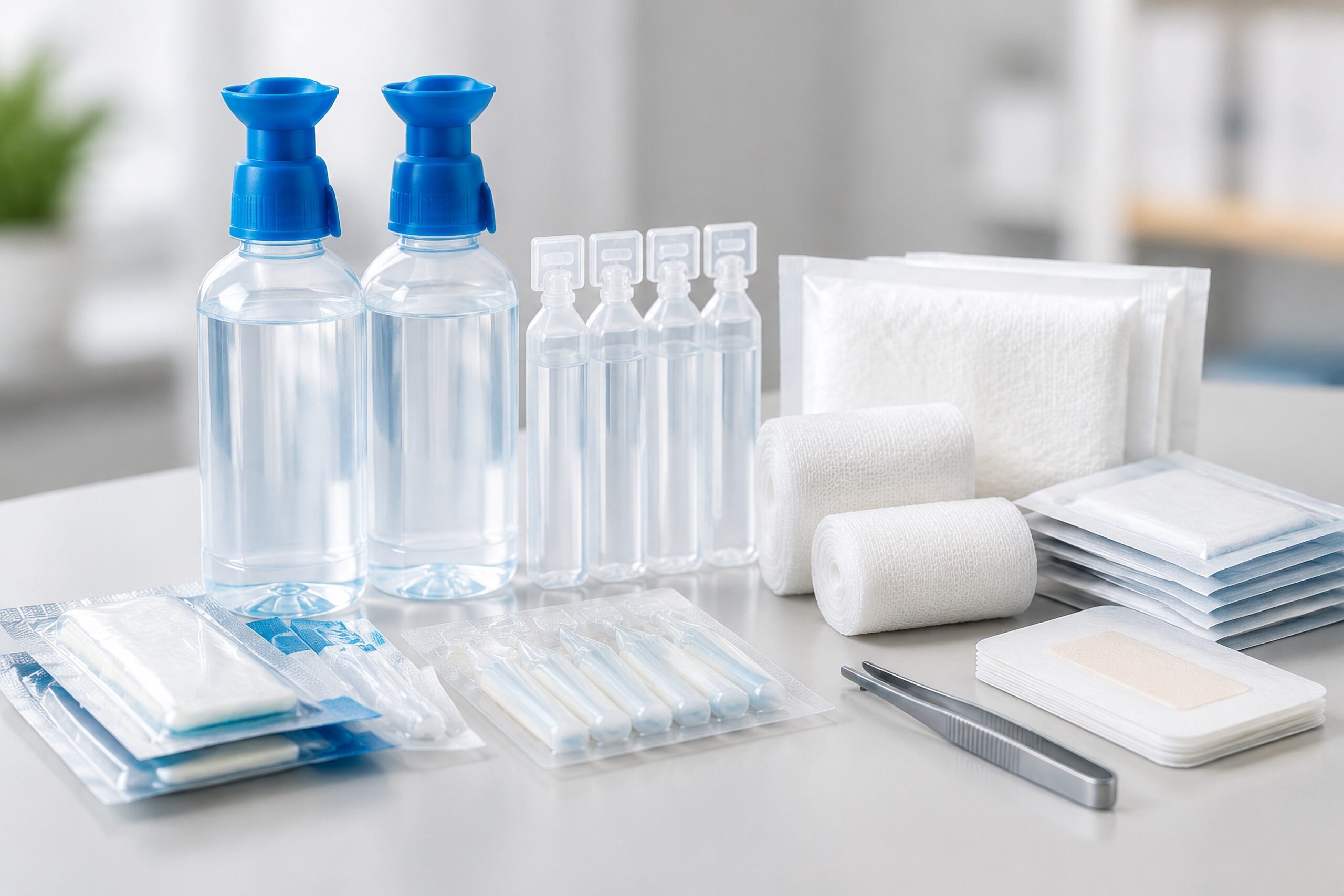
The two families answer to different rulebooks, and the difference is not cosmetic. A dressing is a product. A station is an installation.
On the product side, the buyer is evaluating what the dressing is made of, how it behaves on a wound, how it is packed, and how long it stays usable. Those answers come from the manufacturer’s technical file and from the sample the buyer approves before mass production.
On the installation side, the rules are numeric and they belong to the site, not the shipment. In the United States, the enforceable rule is 29 CFR 1910.151(c). It requires suitable facilities for quick drenching or flushing of the eyes and body, provided within the work area for immediate emergency use. The regulation names no flow rate and no duration. Inspectors fill that gap with ANSI/ISEA Z358.1, which is where the numbers live.
That single sentence explains a common sourcing error. A buyer who orders a wall-mounted unit and asks only for a price has bought hardware without a performance specification. A buyer who orders a case of saline bottles and expects them to satisfy a corrosive-chemical exposure has bought the wrong category of product. Both mistakes are specification mistakes, and both are cheaper to fix at the RFQ stage.
What buyers specify on burn dressings
Burn dressings are not interchangeable. Each family solves a different problem, and a kit that stocks only one family will leave a responder improvising. Settling the family is the first decision a burn care dressing b2b enquiry has to make, and it comes before size or price.
| Dressing family | Behaviour at the wound | What the buyer must state | Common failure |
|---|---|---|---|
| Paraffin gauze | Non-adherent contact layer, low absorbency | Mesh count, impregnation weight, pack size, whether sterile | Ordered as an absorbent pad; exudate passes straight through |
| Amorphous hydrogel | Adds moisture, cools on contact, conforms to irregular areas | Gel volume in grams, applicator type, whether a secondary dressing is included | Supplied without a cover dressing, so the responder has nothing to secure it |
| Foam dressing | Absorbs moderate to heavy exudate, cushions | Thickness, adhesion border or border-free, size grid | Size grid too coarse for the hands and face |
| Silver-containing dressing | Antimicrobial category for colonised wounds | Whether the claim is permitted in the destination market, silver release basis | Buyer assumes the antimicrobial claim travels with the goods across borders |
| Non-adherent film or contact layer | Protects granulating tissue, allows inspection | Perforation pattern, whether it can be cut to shape | Cut edges lift and the dressing migrates |
Three clauses decide whether a dressing line survives the first shipment.
The first is the size grid. A dressing range that steps in 5 cm increments forces the responder to cut, and a cut foam dressing loses its border. Buyers serving occupational sites usually ask for a grid aligned to hand, forearm and torso areas, then check the carton count against the site’s headcount.
The second is sterility and pack format. A sterile dressing in a single peel pack suits a kit. The same dressing in a ten-unit flow pack suits a clinic shelf and is a liability in a kit, because once opened the remaining units are no longer protected. Buyers should state the unit-of-use pack, not the carton, and let the supplier build the carton around it.
The third is the secondary dressing. Hydrogel and contact layers need something over them. If the RFQ does not name that cover dressing, the supplier will quote the primary layer alone and the kit will arrive incomplete.
What buyers specify on eyewash components
In most burn care dressing b2b orders, eyewash is the component specified by habit rather than by function. The format decides which rules apply, so the format choice has to come first.
| Format | Where it fits | Performance basis | Common mistake |
|---|---|---|---|
| Single-use bottle or pod in a kit | Supplemental flushing where no plumbing exists | Manufacturer’s declared volume and shelf life; not a substitute for a station | Treated as compliance for corrosive exposure |
| Portable self-contained unit | Remote sites, vehicles, temporary works | Must still deliver a full fifteen-minute flush per the consensus standard | Tank filled once and never recharged |
| Plumbed wall-mounted station | Fixed workplaces with corrosive chemicals | ANSI/ISEA Z358.1 flow, duration and temperature limits | Installed at the far end of the hall, beyond the ten-second travel limit |
| Eye and face wash combination | Splash risk to the whole face | Higher flow than an eyewash alone | Specified on eyewash flow figures |
The current ANSI/ISEA Z358.1 figures are specific, and a buyer can put them straight into the RFQ. A state safety bulletin summarising the standard puts it plainly: an eyewash must deliver at least 0.4 US gallons per minute, about 1.5 litres per minute, for at least fifteen minutes. An eye and face wash must deliver at least 3.0 gallons per minute, about 11.4 litres per minute. A drench shower must deliver at least 20 gallons per minute, about 75.7 litres per minute. Flushing fluid must be tepid, defined as 16 to 38 degrees Celsius. The unit must sit within ten seconds of travel from the hazard, on the same level, with no obstruction. It must switch on in one second or less and stay on without hands.
The CONN-OSHA summary of Z358.1 is a workable reference to send with an enquiry.
Maintenance obligations follow the same standard. Plumbed units are activated weekly. Every unit, plumbed or self-contained, is fully inspected annually. Buyers who distribute into industrial accounts should expect the end user to ask for that schedule in writing, and a supplier who cannot describe it is a weak partner for that channel.
One point of scope trips up distributors repeatedly. Bottled eyewash and personal wash units are supplemental equipment. They do not replace a station and do not meet the intent of the workplace rule. A four-ounce bottle in a first aid kit satisfies a kit contents list. It does not satisfy an immediate drench requirement. Those are two separate obligations citable on the same inspection.
The twenty-minute cooling rule changes what you stock
Burn first aid guidance is unusually consistent across markets, and it has a direct consequence for kit design. It is also the step that burn care dressing b2b planning skips most often, because cooling does not appear on a packing list.
The NHS instruction is to hold the burn under cool running water for twenty minutes, as soon as possible and within three hours of the injury. It also says not to remove anything stuck to the area, not to apply creams, oils or butter, not to use plasters or sticky dressings, and not to burst blisters. A layer of cling film is laid over the cooled area, not wrapped around it. The full guidance is on the NHS burns and scalds page.
Read that against kit contents and the arithmetic becomes uncomfortable. Twenty minutes at a modest one litre per minute draws twenty litres of water. A 500 ml bottle holds 0.5 litres, which is 2.5 percent of that volume. No kit-sized container can deliver the cooling step. Cooling needs a tap, a shower or a hose.
This changes the job of the burn components in a kit. They are not the cooling device. They are what goes on afterwards: a non-adherent layer that will not stick to the wound, a cover dressing, and enough volume to handle the dressing change. Buyers who write the RFQ around cooling end up over-specifying bottle volume and under-specifying dressing format.
There is a second consequence for training material. If the kit ships with an instruction card, the card has to send the responder to water first and to the dressing second. A card that implies the gel in the kit replaces the twenty-minute flush is worse than no card at all.
Sterility, pack format and shelf life decide the RFQ line
These three clauses are where quotations differ most, and where the lowest quote usually stops looking low. A burn care dressing b2b quotation that leaves any of them open is not comparable to one that closes them.
Sterility has to be stated as a requirement, not assumed. Say whether the dressing is supplied sterile, and say which unit is sterile. A sterile primary dressing inside a non-sterile outer carton is normal. A non-sterile dressing described as sterile on the artwork is a documentation problem the buyer inherits.
Shelf life needs a number and a basis. Ask for the declared shelf life in months and the storage conditions attached to it. Dressings stored in a vehicle or an unheated storeroom can see temperatures well outside a controlled warehouse, and a shelf life validated for controlled storage does not transfer to a dashboard in summer. Buyers running fleet or outdoor accounts should raise this before the order, not after the first recall of expired stock.
Labelling is the third clause. Language, batch number, manufacture and expiry dates, and the presence of a symbol set all belong in the specification. A distributor who resells into two markets often needs two label versions, and that is a plate change, not a sticker.
Documentation belongs here too. The buyer confirms which documents the destination market requires, and the supplier states which documents it can issue per SKU. Our own position is that the buyer owns the destination-market confirmation, and that we supply documentation by SKU against the confirmed requirement. Where a regulatory status is in question, it is confirmed for the specific product, model, market and order, not inferred from a catalogue page. The same discipline applies to safety data sheets, which are separate documents from conformity paperwork and are covered in our guide to safety data sheets for first aid kit components.
How to write the RFQ that covers both families
A burn care dressing b2b enquiry can cover both families, but it needs two specification blocks. Mixing them produces a quote that cannot be compared.
- State the use context first: workplace headcount, hazard class, whether corrosive chemicals are present, and whether the site has plumbing.
- For dressings, list the family, the size grid, the unit-of-use pack, the sterility requirement and the secondary dressing.
- For eyewash, state the format, then the performance basis. If the site has corrosive exposure, quote against the fifteen-minute flush and the ten-second travel limit, not against bottle volume.
- Ask for the shelf life in months, the storage conditions, and the batch and expiry marking method.
- Ask which documents can be issued per SKU, and name the destination market so the answer is specific.
- Ask for the sample that will be approved before production, and name the items in it. A sample that covers the dressing but not the pack format approves half the order.
Buyers who send this as one document get comparable quotes. Buyers who send a list of product names get five quotes that cannot be lined up against each other, and the decision defaults to price.
For the dressing side in more depth, the wound dressing selection guide for B2B buyers walks through material behaviour against exudate level. For the station side, the eyewash flushing solution guide covers solution specification and refill intervals. Both are worth reading before the RFQ goes out, because both change what the RFQ should ask.
Two product areas are worth bookmarking while the specification is being drafted. The eye wash and rinse supplies range covers consumable formats, and the wall-mounted eye wash station page shows the installation format that the travel-distance rule applies to. For the dressing side, the wound care consumables range lists the families described above.
FAQ
Does a first aid kit need burn dressings and eyewash as separate items?
Yes, because they answer different requirements. In burn care dressing b2b terms, a dressing and a bottle of saline sit in separate specification systems. A burn dressing is a wound-contact product specified by material, sterility and pack format. Eyewash in a kit is a supplemental flushing item with a declared volume and shelf life. Neither one substitutes for the other, and neither replaces the twenty-minute water flush for a burn or a fixed station for corrosive exposure.
Is bottled eyewash enough for a workplace with corrosive chemicals?
No. Bottled eyewash and personal wash units are supplemental equipment under the consensus standard, and they do not meet the intent of the workplace drenching requirement. A site with corrosive exposure needs a plumbed or self-contained station that delivers a fifteen-minute flush within ten seconds of travel.
How long must an eyewash station run?
At least fifteen minutes. An eyewash delivers a minimum of 0.4 US gallons per minute, about 1.5 litres per minute. An eye and face wash delivers at least 3.0 gallons per minute, about 11.4 litres per minute. Flushing fluid must stay between 16 and 38 degrees Celsius for the full duration, which is the requirement most often failed in practice.
Can hydrogel replace cooling under running water?
No. The cooling step is twenty minutes of cool running water, started as soon as possible and within three hours of the injury. A hydrogel dressing adds moisture and conforms to the wound afterwards. It is a dressing, not a water supply, and a kit instruction card should never blur that line.
What shelf life should the RFQ ask for?
Ask for the declared shelf life in months plus the storage conditions it was validated against. A dressing validated for controlled warehouse storage does not automatically carry the same life in a vehicle or an unheated store. Buyers with fleet, construction or outdoor accounts should raise the storage profile before the order is placed.
Who confirms the regulatory documents for the destination market?
The buyer. The supplier states which documents it can issue per SKU, and the buyer confirms what the destination market requires for that product, model and order. Treating a catalogue page as proof of status is how documentation gaps reach customs.
Where this leaves the specification
Burn care and eyewash look like neighbours on a kit contents list. They are not. One is a wound-contact product with a material and sterility specification. The other is either a supplemental kit item or a piece of facility equipment with flow, duration and temperature limits attached to the building.
Write them as two blocks in the RFQ, put the numbers in the block where the numbers belong, and the quotes become comparable. Leave them merged, and the lowest quote wins by default. That is the failure mode this guide exists to prevent. For the wider consumable picture, the first aid supplies sourcing guide sets out how the other categories fit around these two.
Burn care and eyewash components share a pouch with gloves in many workplace kits, and the glove and barrier specification sets out the barrier lines.