
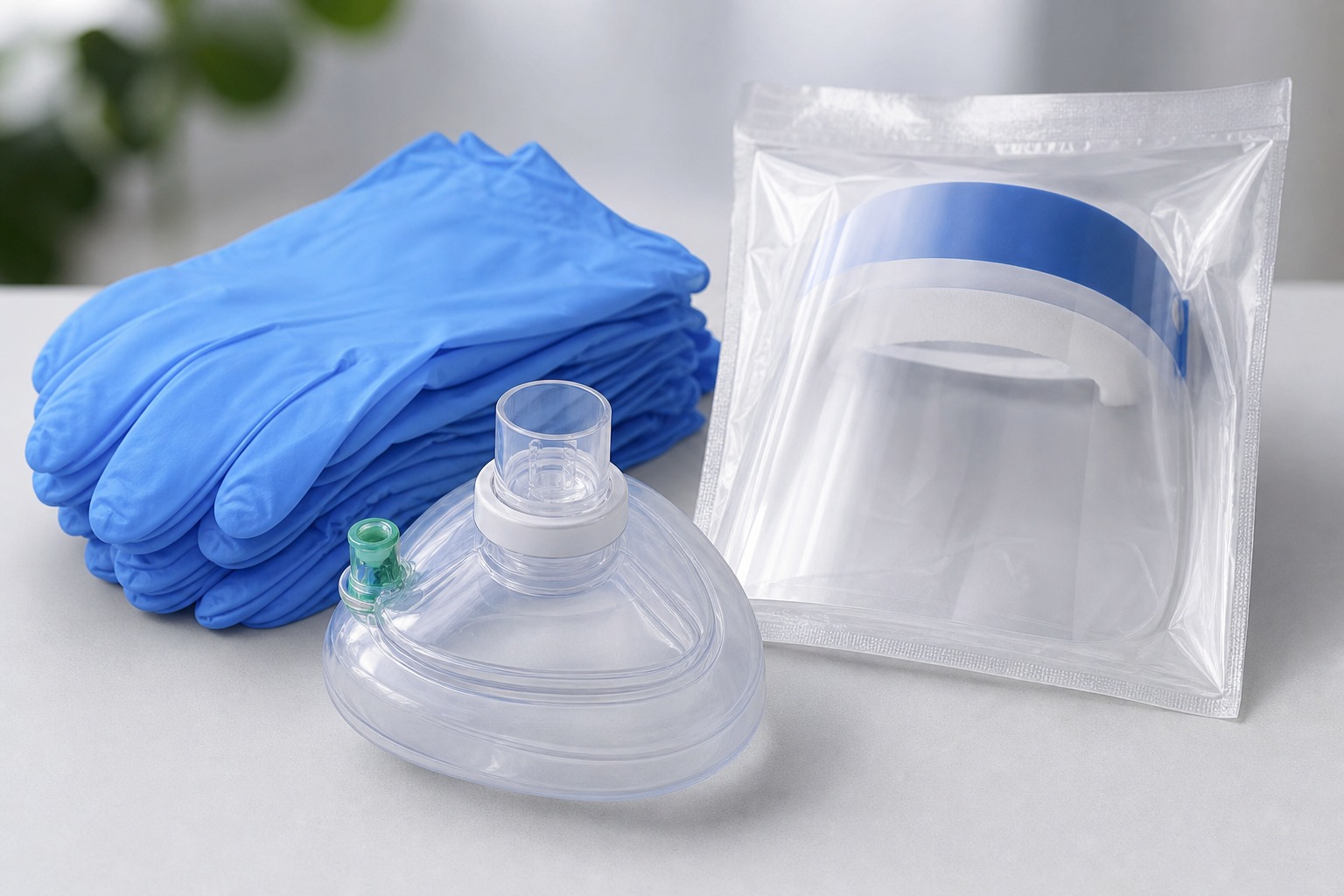
A distributor quotes a fifty-person workplace kit and the buyer asks one question: which gloves are in it. The quote lists a quantity of four pairs. It does not list a material, a pinhole limit or a shelf life. The order sits for two weeks while the buyer requests documents the supplier never held.
Gloves and CPR barriers are the lowest-cost lines in a kit and the only lines that sit between a responder and body fluid. A disposable gloves cpr barrier supplier should answer four questions before a purchase order is raised. What is the glove made of. What pinhole limit applies and at which inspection level. What force at break does the material still hold after aging. Which barrier format sits in the pouch. Everything else on the quote is packaging.
This guide sets out those four answers as a purchase specification. It also explains where the two common standard families diverge, because a certificate that passes one is not automatically valid for the other.
What a Disposable Gloves CPR Barrier Supplier Should Document

A disposable gloves cpr barrier supplier inherits the quantity from the kit standard and the specification from nowhere. Kit standards set quantities, not glove specifications. DIN 13157:2021, the German workplace kit standard, lists four disposable gloves and two face masks to DIN EN 14683 in a kit sized for up to fifty people in administrative settings. The glove line references DIN EN 455, which is a test regime rather than a product grade. Nothing in the kit list tells a buyer which polymer to accept.
That is why the specification has to be written separately. A glove can meet the kit standard on count and still fail at the point of use, because the count says nothing about film integrity.
| Document line | What it should state | Why a buyer needs it |
|---|---|---|
| Polymer and standard | Nitrile to ASTM D6319, latex to ASTM D3578, vinyl to ASTM D5250, or the EN 455 series for EU-bound goods | Determines elasticity, chemical resistance and allergy profile |
| Pinhole performance | EN 455-1 water leak test at AQL 1.5 | The only measurable barrier claim on the certificate |
| Inspection basis | Sampling standard, inspection level and sample size | The same AQL number means different rigour at different sample sizes |
| Physical strength | Force at break or tensile strength, before and after aging | Aging separates a stable compound from a cost-reduced one |
| Barrier format | Face shield, pocket mask or kit, with valve and filter described | Format changes the unit price and the regulatory path |
| Lot traceability | Lot number on the certificate matching the carton | Device-level approval does not cover the goods in the container |
Material Choice: Nitrile, Latex and Vinyl Fail in Different Ways
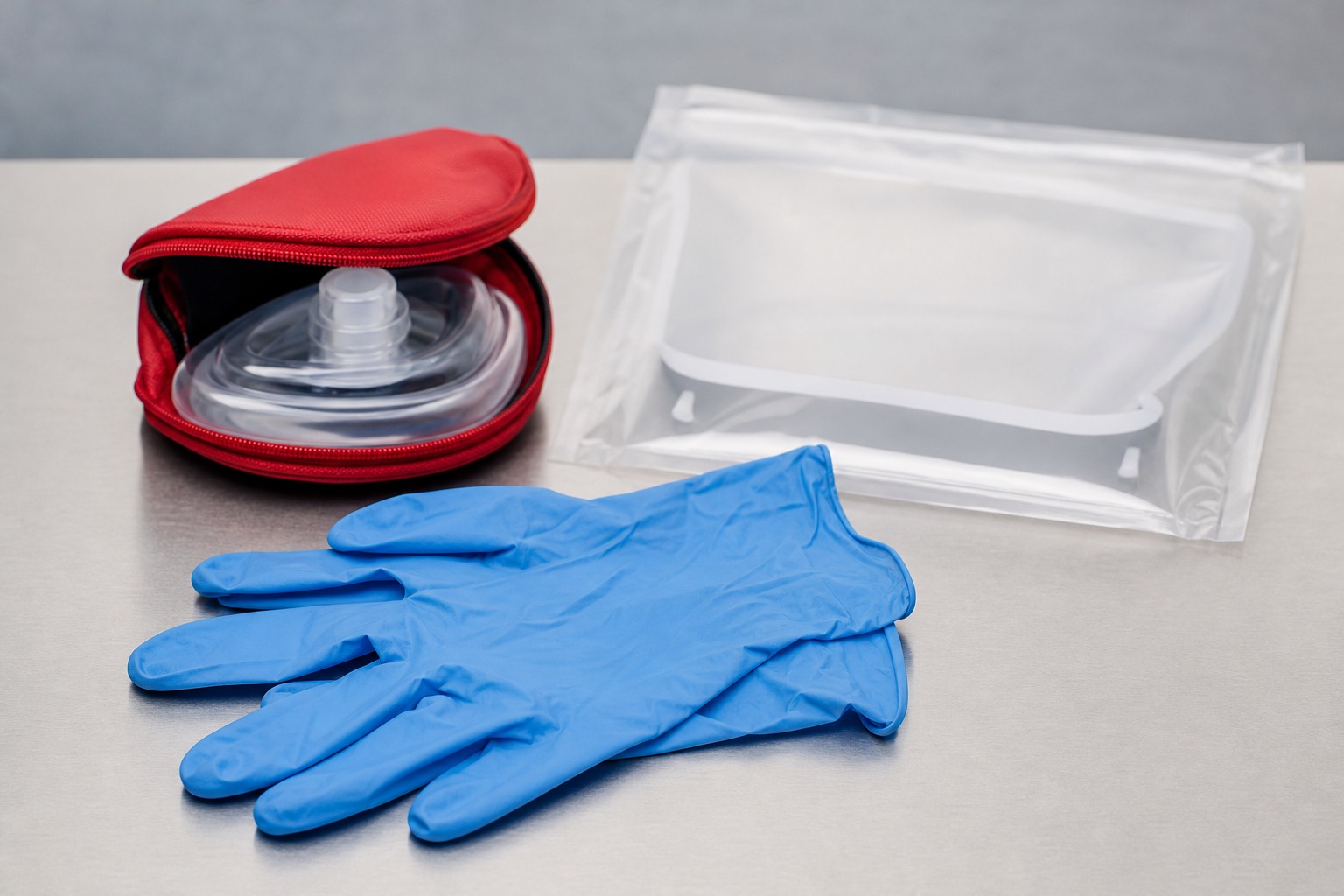
For a disposable gloves cpr barrier supplier, the material choice decides most of the remaining specification. Nitrile is the default for export kits that cross several markets. It contains no natural rubber latex protein and resists a wider set of oils and solvents than vinyl. ASTM D6319 sets its floor at 14 MPa tensile strength before and after aging, with 500 percent elongation before aging. Those are minimums, not targets, and a compound that only just clears them tends to drift below spec near the end of shelf life.
Natural rubber latex remains the most elastic film and the easiest to don. It also carries the protein exposure problem that pushed many institutional buyers toward synthetic options. Vinyl carries the lowest unit cost of the three and the weakest fit and barrier performance, which is why it survives mainly in short-duration, low-risk food handling.
Powder is no longer a neutral choice for US-bound goods. The FDA published a final rule on 19 December 2016 banning powdered patient examination gloves, powdered surgeon gloves and absorbable lubricating powder, effective 18 January 2017. The same rule restates the agency position that finished powder-free gloves should carry no more than 2 mg of residual powder and debris per glove, measured by ASTM D6124. Buyers writing a US specification can take powder-free as a baseline rather than an upgrade.
| Property | Nitrile | Latex | Vinyl |
|---|---|---|---|
| Standard reference | ASTM D6319 | ASTM D3578 | ASTM D5250 |
| Elasticity and fit | Good | Highest | Lowest |
| Chemical resistance | Good against oils and solvents | Moderate | Limited |
| Latex protein exposure | None | Present | None |
| Relative cost | Mid | Mid to high | Low |
| Typical use in a kit | Workplace, industrial, export | Clinical, high-dexterity tasks | Short-duration food handling |
Pinholes, AQL 1.5, and the Inspection Level That Changes the Answer
Every medical glove certificate quotes an AQL, and almost none quotes the number that makes it meaningful. This is the second question a disposable gloves cpr barrier supplier should expect in writing. EN 455-1 uses a water leak test and sets the acceptable quality limit at 1.5. Under ISO 2859-1 sampling, AQL 1.5 at inspection level I draws a much smaller sample than the same AQL at level II. A supplier can therefore claim AQL 1.5 while inspecting too few gloves to detect a bad lot.
Ask for three things together: the AQL, the inspection level, and the sample size actually drawn. A certificate that states only the first is incomplete.
The second trap is comparing values across standards. EN 455-2 expresses strength as force at break in newtons on a strip cut from the glove. ASTM D6319 expresses tensile strength in megapascals on a dumbbell specimen. A 14 MPa result and a 6 N result describe different tests on different specimens, so they cannot be ranked against each other. Read the standard named on the certificate, then read the value.
Shelf life is the third line buyers skip. EN 455-4 requires accelerated aging plus real-time stability data to support the expiry date printed on the box. A five-year claim without an aging protocol behind it is a label, not a finding.
CPR Barrier Format: Valve, Filter and Pack Decide the Line Item
For a disposable gloves cpr barrier supplier shipping into several markets, the barrier line is where classification risk concentrates. A CPR barrier is not one product. A flat face shield is a film with a printed centre. A pocket mask is a moulded dome that holds its shape away from the face. A kit may pair an adult mask with a child mask, or add gloves and a wipe in the same pouch. Each format changes unit cost, packed volume and the amount of training the end user needs.
Valve design is the specification point buyers argue over. A one-way valve is meant to keep exhaled air and fluid on the responder side. A filter layer is meant to do more, and a filter claim needs test data behind it. Where a supplier cannot name the test, the claim should be read as marketing.
Regulatory classification follows the structure, not the price. Under EU MDR 2017/745 a simple non-sterile shield and a valved mask with a filter layer do not necessarily sit in the same class. Sterility adds another variable. Confirm the classification with the technical file for the exact article you are buying, and confirm it per destination market. A supplier who states a class without naming the configuration is guessing.
Two formats cover most workplace demand. The pocket mask with air bag suits single-response kits carried in a vehicle or a wall cabinet. The adult and child mask kit suits sites where the responder cannot choose the casualty size in advance.
Six Lines That Make the Specification Auditable
A specification that cannot be audited at receiving is a wish list. These six lines survive a pre-shipment inspection.
- Polymer and standard reference, including the edition year.
- Size range and measured dimensions, not just the size letters.
- AQL, sampling standard, inspection level and sample size.
- Force at break or tensile strength, before and after aging, with test dates.
- Barrier format, valve type and filter description, with pack count per pouch.
- Lot number, manufacture date and expiry date, tied to the certificate.
Two commercial terms belong under the same heading. UneedAid works from a minimum order quantity of 1,000 pieces, with sample-based validation before bulk production. That sequence matters for gloves more than for most categories, because film thickness and valve fit are the two variables a photograph cannot show. A sample that passes the water leak test tells you more about a factory than a page of specifications.
For the wider consumable range that ships alongside gloves, the first aid supplies sourcing guide sets out how the categories share a container. Dressings and gloves age on different curves, which affects how a mixed order should be sequenced. The wound care dressing selection guide covers the dressing side of the same shipment, and the antiseptic and cleaning supplies guide covers the wipe and sachet lines that usually sit in the same pouch.
FAQ
What AQL should a buyer require for gloves in a first aid kit?
AQL 1.5 under EN 455-1 is the common commercial floor for examination gloves, and it is the figure most tenders quote. The number alone is not enough. Require the inspection level and the sample size as well, because AQL 1.5 at a reduced sample size allows more defective gloves through than the same figure at inspection level II. For container-scale orders, add a third-party pre-shipment inspection so the result does not rest on a factory-issued certificate alone.
Does a CPR face shield need a one-way valve?
A flat shield without a valve still creates a physical barrier, and many workplace kits ship that format because it packs flat and costs little. A one-way valve adds a directed path for exhaled air and reduces the chance of backflow toward the responder. Whether the valve is required depends on the buyer specification and the training level of the end user. Ask the supplier to describe the valve and, where a filter is claimed, to name the test behind the claim.
Are nitrile gloves the right choice where latex allergy is a concern?
Nitrile contains no natural rubber latex protein, so it removes the latex exposure route that affects sensitised users. That does not make every nitrile glove suitable for every task. Accelerator residues from the curing process can still cause skin reactions in some wearers, and EN 455-3 covers the biological evaluation that addresses this. Buyers should ask for the biological evaluation summary rather than treating the word nitrile as a complete answer.
How many disposable gloves should a workplace kit carry?
DIN 13157:2021 specifies four disposable gloves in a kit intended for up to fifty people in administrative settings, twenty in manufacturing, or ten on a construction site. That count assumes single use per incident and no restocking between inspections. Sites with higher incident rates or multiple responders typically raise the count during configuration. The glove line is also the first item to disappear from a kit, so refill planning matters more here than the initial count.
What documents should arrive with a glove shipment?
Any disposable gloves cpr barrier supplier can send a certificate. The useful test is whether the numbers on it survive a receiving check. Four documents cover most import requirements. A certificate of analysis for the lot, showing pinhole results, physical strength before and after aging, and the sample size used. A declaration of the standard the goods were tested to, with the edition year. A shelf life statement supported by aging data. And a packing list that ties lot numbers to cartons, so a receiving check can match goods to paper without opening every box.
Closing
The glove and barrier lines in a kit are small enough to be treated as an afterthought and important enough that a missing document can hold a container at destination. Write the specification as six auditable lines, then buy against it. A disposable gloves cpr barrier supplier who can answer the four opening questions in writing is a different kind of partner from one who answers them verbally. For buyers assembling the rest of the kit around these two items, the A-cluster sourcing framework shows how the lines fit into a single order.
External sources used in this article, each verified reachable on 2026-11-04: the FDA medical device bans page, the FDA Medical Glove Guidance Manual, and the Federal Register final rule on powdered gloves.