
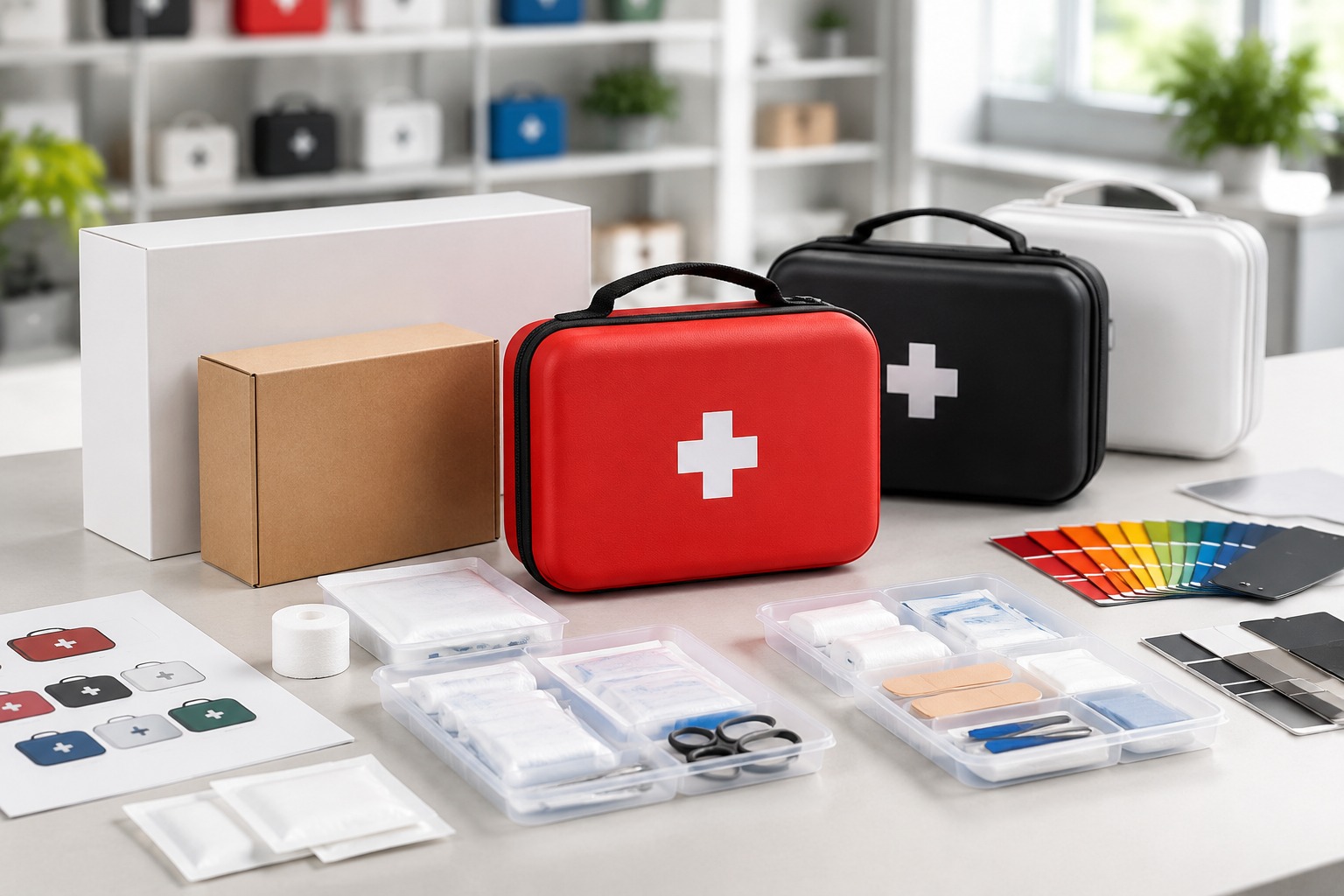
Ask about first aid bag fabric options and one number usually comes back: 600D. That number says less than it looks. Denier measures yarn thickness, in grams per 9,000 metres of yarn. It says nothing about coating weight, seam behaviour, or how the roll survives six months in a humid warehouse. Two rolls can both read 600D and differ by 30 percent or more in measured tear strength.
The decisions that actually change a bag sit one level down. Coating type and coat weight decide water resistance more than denier does. Hydrostatic head figures describe flat laboratory fabric, not the stitched bag in front of you. And a coated shell still leaks along a seam if nobody planned for the needle holes.
This guide works through first aid bag fabric options in that order: construction, coating, lining, seam, then the numbers worth writing into a purchase order.
What first aid bag fabric options decide before a pattern is cut
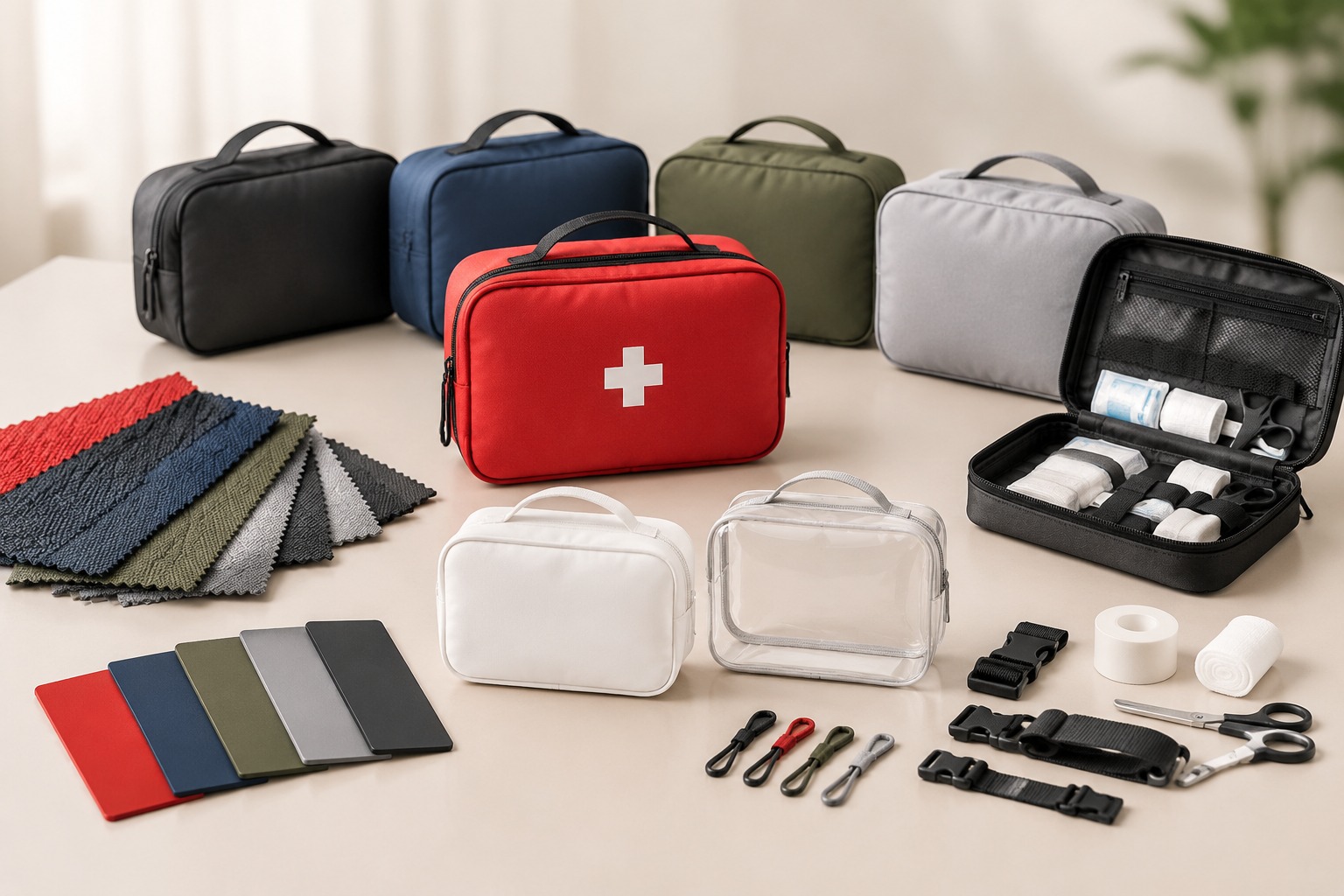
Three answers come before a pattern is cut, and each one narrows the fabric list.
The first is carrying format. A waist pouch, a hand-carry bag and a backpack impose different maximum panel sizes. Panel size decides how much reinforcement each seam needs.
The second is the load. A bag holding dressings and medical tape behaves nothing like a bag holding a rigid suction unit. Weight in kilograms and the shape of the heaviest item decide whether the base needs a second layer.
The third is the cleaning regime. A bag wiped down several times a day asks more of its coating and seam finish than one that lives in a vehicle boot.
Write those three down and the fabric conversation gets short. Leave them implicit and the factory selects for the middle of the market, which is not the same as selecting for your programme.
Denier and construction codes: what the single number leaves out
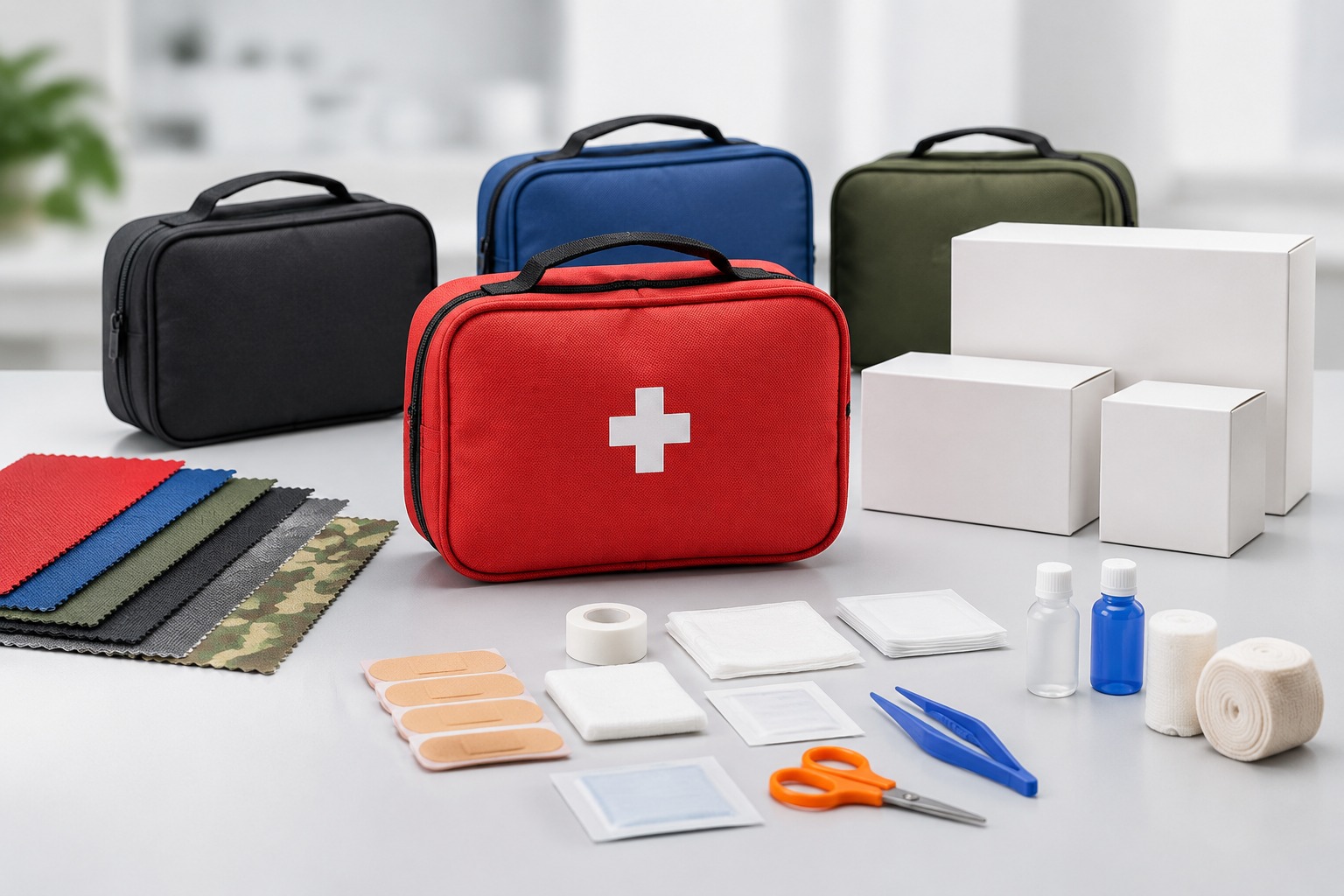
Denier is a linear mass density, not a strength rating. A 600D filament yarn weighs 600 grams per 9,000 metres. That is the whole of what the label promises.
It does not tell you how many filaments sit inside the yarn. A 600D yarn built from 96 filaments and one built from 192 filaments feel different in the hand, and they tear differently at a stitched hole. It also does not tell you whether the yarn is textured or flat, or whether the polymer is standard or high tenacity.
Construction is the first of the first aid bag fabric options to fix, because every later decision sits on it. Codes are written warp first, weft second. So 600D x 300D means a 600D warp with a lighter weft. That build is cheaper and faster to weave. It is also noticeably weaker in the weft direction, which carries much of the load in a bag body panel. A quote that looks unusually cheap for a 600D fabric is often explained here.
Density matters as much as denier. The same yarns woven at 50 ends by 30 picks per inch give a lighter cloth than a 60 by 40 construction, and the gap shows up in tear strength and seam holding.
| Construction | Typical greige weight | Position | Typical end products |
|---|---|---|---|
| 420D x 420D | 150–200 g/m² | Light; resists scuffs, not loads | Daypack bodies, light linings |
| 600D x 600D | 220–290 g/m² | Balanced benchmark | Backpacks, tool bags, kit bags |
| 600D x 300D | 160–220 g/m² | Weaker weft, lighter hand | Promotional bags, pouches, liners |
| 900D x 900D | 300–400 g/m² | High abrasion resistance | Heavy duffels, protective covers |
| 1200D x 1200D | 380–500 g/m² | Highest among common oxfords | Luggage panels, haul bags |
Greige weight is the fabric before coating. Coating adds weight, and the same plain-weave oxford can land anywhere from 280 to 450 g/m² once a PU or PVC layer is applied. Usable width commonly sits around 150 cm. Mill tolerances such as plus or minus 5 percent on weight, or plus or minus 0.05 mm on coated thickness, decide whether your cutting plan still holds on the third order. Ask for them in writing.
Coating chemistry: acrylic, PU, PVC, TPU and film lamination
Ask three mills for 600D with a PU coating and you may receive a 20 g/m² skin on one roll and a 60 g/m² coating on another. Coating type and coat weight decide water resistance, hand feel, cold-weather behaviour and how the roll ages. Denier stays identical in both cases.
| Coating | Typical hydrostatic head | Hand and behaviour | What to watch |
|---|---|---|---|
| PA (acrylic) | 300–800 mm | Soft, thin, quiet | Water repellency rather than water resistance |
| PU | 1,000–5,000 mm | Flexible, good drape | Hydrolysis in hot, humid storage |
| PVC | 1,500–5,000 mm | Stiff, heavy, noisy in cold | Phthalate and REACH restrictions |
| TPU | 5,000–10,000 mm | Flexible, weldable | Higher cost, tighter processing window |
| Film lamination | 10,000 mm and above | Structured, firm | Weight, blocking, delamination along folds |
Uncoated fabric is air permeable and holds almost no hydrostatic head. A light shower beads off until the fibres wet out, and then it does not. For a bag that has to keep contents dry, the first aid bag fabric options worth naming are the coating, the coat weight in grams per square metre, and the test method. The word waterproof on its own is not a specification.
Two coating notes are worth carrying into a brief. PU has a known weakness in prolonged heat and humidity, where hydrolysis degrades the film; anti-hydrolysis grades exist and are the right answer if goods may sit in a hot climate for months. PVC brings lower cost per metre and higher absolute water resistance, but it carries phthalate and REACH questions that a destination market may raise. One mill set out the coating comparison and the storage caveat in a 600D polyester fabric guide that reads 600D as a starting point rather than a finished specification.
Lining and barrier films: PEVA against TPU
The interior film is the layer a wipe actually touches, and it is often left unspecified. A plain polyester lining is fine for general storage. A smooth coated surface is what you want where staff wipe compartments between shifts.
Published supplier figures put PEVA and TPU some distance apart. The same source lists PEVA with a working range of about 0 to 60 °C and TPU at roughly −40 to 80 °C, with TPU tear strength at two to three times the PEVA figure and better resistance to repeated disinfection. Those are one supplier’s published numbers, not an industry floor, and they should be read as a shortlist prompt rather than a pass mark. One medical bag maker sets out the same PEVA and TPU lining comparison alongside its coating claims.
Match the film to the cleaning method, not to a phrase. Wipes based on 70 percent isopropyl alcohol, chlorine bleach, or quaternary ammonium cleaners are the three the industry most often cites, and compatibility is specific to the film and the coat weight under it.
Handle antimicrobial wording with care. A surface that can be wiped should be described as wipeable. Any stronger claim needs test evidence tied to the specific material and the specific project, and that evidence belongs in your file rather than in a supplier summary.
Why a waterproof fabric still leaks at the seam
A coated fabric that passes 3,000 mm of hydrostatic head can still leak through a stitched seam. The needle punches a line of holes straight through the coating. Thread then wicks water along the stitch line.
Buyers who test flat fabric and skip seam sealing usually find this out after the first wet season. For a programme that has to stay dry, plan for taped or welded seams, a finer needle that opens a smaller hole, and a coating flexible enough to close around the stitch rather than crack beside it.
Zips, top openings and binding tapes are the other three leak points, and seam behaviour is the part of first aid bag fabric options that flat-fabric test reports never cover. None of them appear in a fabric test report, so no mill can close that gap for you. Published fabric guidance is explicit that hydrostatic head values assume a continuous coating tested on flat cloth, and that ratings should be matched to the working environment of the finished bag rather than picked from a table. If the design cannot be sealed, label it water-resistant and mean it.
First aid bag fabric options worth writing into a purchase order
A purchase-order line removes arguments that a sample cannot settle. Send this list with any enquiry and most of the ambiguity disappears.
- Yarn: textured or flat, filament count, standard or high tenacity.
- Construction: ends and picks per inch, weave, width, greige weight with tolerance.
- Coating: type, coated side, coat weight in g/m², target hydrostatic head.
- Colour: reference swatch or Pantone value, lab dip approval, tolerance between lots.
- Performance tests, each with a pass or fail value.
- Certificates: scope plus transaction certificates for the actual shipment.
- Commercial terms: MOQ, lead time, roll length, inspection level.
- Storage assumption: if goods may sit for months in a hot climate, say so.
The test set is where the line gets teeth. A workable list for a coated oxford covers grab tensile strength to ASTM D5034 with warp and weft reported separately, tongue tear to ASTM D2261, abrasion by Martindale or Taber, hydrostatic head to AATCC 127 or ISO 811, spray rating to AATCC 22, colourfastness to light and to crocking, dimensional stability, and cold crack or flex resistance at −20 °C for covers and outdoor builds. Grab tensile and tear catch different faults; a fabric can pass one and rip from a stitched hole on the other.
Chemical questions are destination questions. Where a market requires it, the list extends to REACH SVHC, phthalates, azo dyes, formaldehyde, and flame tests under a named standard. The EU REACH regulation overview is a reasonable starting point for the first of those. Independent textile testing schemes such as OEKO-TEX exist so a claim about a fabric can be checked by someone other than the seller. Whether your buyer needs that evidence is for your own market, and we would rather route the question back to you than answer it for you.
Inspection terms matter as much as test values. A four-point roll inspection at AQL 2.5, a stated roll length, and a colour tolerance such as a small numeric value between lots will prevent more disputes than any single laboratory result.
FAQ
How do first aid bag fabric options affect the unit cost of a kit?
Cost moves in steps, not smoothly. The base cloth sets a floor. Coating type and coat weight add to it, and a TPU laminate costs more than a PU coating on the same greige. The lining film adds a second material and a second operation. Seam sealing and binding add labour. None of these lines are visible in a photograph, which is why they get left out of the brief and then discovered at the sample stage rather than at quotation.
Is 600D polyester enough for a first aid bag?
For most general kit bags, a well-built 600D is a sound starting point. It sits in the balanced band of the construction table, between the light 420D builds and the heavier 900D and 1200D fabrics. The first aid bag fabric options that matter more than the number are the weave density, the coating type and the coat weight behind it. A consistent 600D with a proper coating will outlast a loose heavier fabric that is stiff and difficult to sew. Confirm the construction code, not just the denier.
What hydrostatic head should a first aid bag fabric have?
Match the figure to the exposure. A bag that stays indoors or in a vehicle needs far less than one carried in rain or hosed down. Published coating bands run from around 300 mm for acrylic finishes to 5,000 mm and above for TPU laminates, with PU sitting between roughly 1,000 and 5,000 mm. Read any figure as a laboratory value on flat cloth. The seam decides whether the finished bag behaves to that rating.
Which is better for a medical bag, PU or TPU?
They solve different problems. PU is flexible, widely available and cheaper, which makes it the default for general medical bags and kit bags. Its weakness is hydrolysis in prolonged heat and humidity, so anti-hydrolysis grades matter for hot-climate storage. TPU carries a higher water resistance band and is weldable, which is what allows a seamless construction. It costs more and has a tighter processing window. Choose by cleaning regime, storage climate and whether the design needs welded seams.
Do I need seam sealing on a first aid bag?
Only if the bag must keep water out under sustained exposure. A stitched seam punctures the coating, and thread wicks water along the stitch line, so a flat fabric rating does not carry across to the finished product. Sealing options are taped or welded seams, a finer needle, and a coating flexible enough to close around the stitch. If the design cannot be sealed, describe the bag as water-resistant. Water-resistant is a weaker promise than waterproof, and it is the one the product will support.
Closing
First aid bag fabric options come down to four lines: construction, coating, lining and seam. Get those onto paper with a revision number and the sample has something to be judged against. Leave them to the factory and two bags built to the same drawing can differ by a third in weight and by more than that in service life.
Our own guide to custom first aid bag manufacturing covers fabric, colour and hardware side by side, and the custom medical bag specification sheet shows how to put the lines above into a document a factory can quote against. Buyers still settling packaging should read the private label first aid kit packaging options, and the emergency medical bags range shows the formats we build. Our MOQ starts at 1,000 pcs.
Where a material or a component has not been confirmed for a given build, we say so and route the question back to you rather than filling the gap with an assumption.