
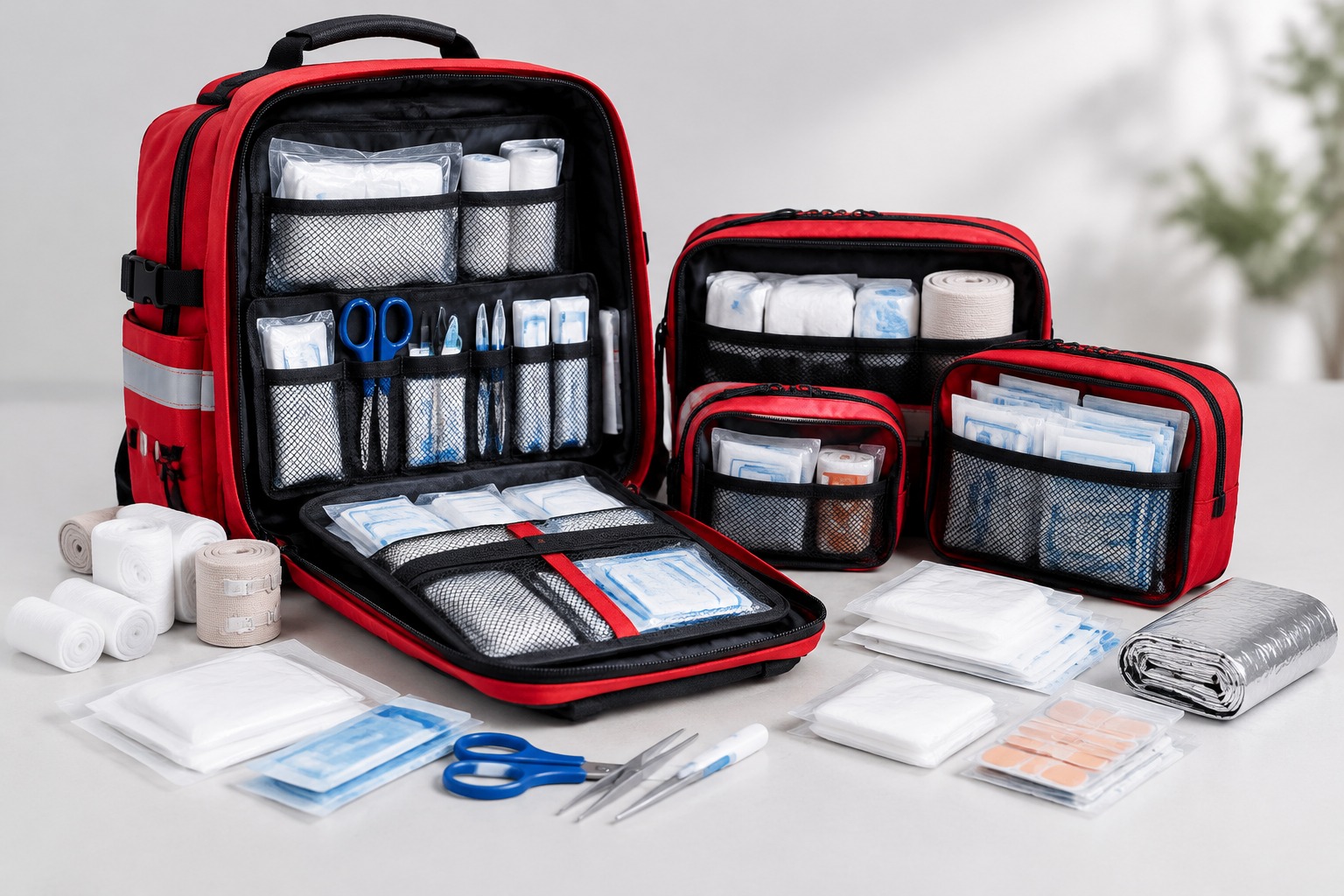
A distribution center fails a first aid audit geographically long before it fails on contents. The picker hurt at racking bay 14 is nowhere near the office kit, and a warehouse first aid station that lives beside the goods-in desk does not exist for that picker.
Coverage comes out of four decisions, and they run in sequence:
- How many stations does the floorplate need, and where does each one sit?
- Which container format holds each station?
- What class of contents goes inside?
- Who keeps each one complete across every shift?
Work in that order and the specification stays short. Start at question three, as most buyers do, and the container set gets rebuilt twice.
What the rules require, and what they leave to you
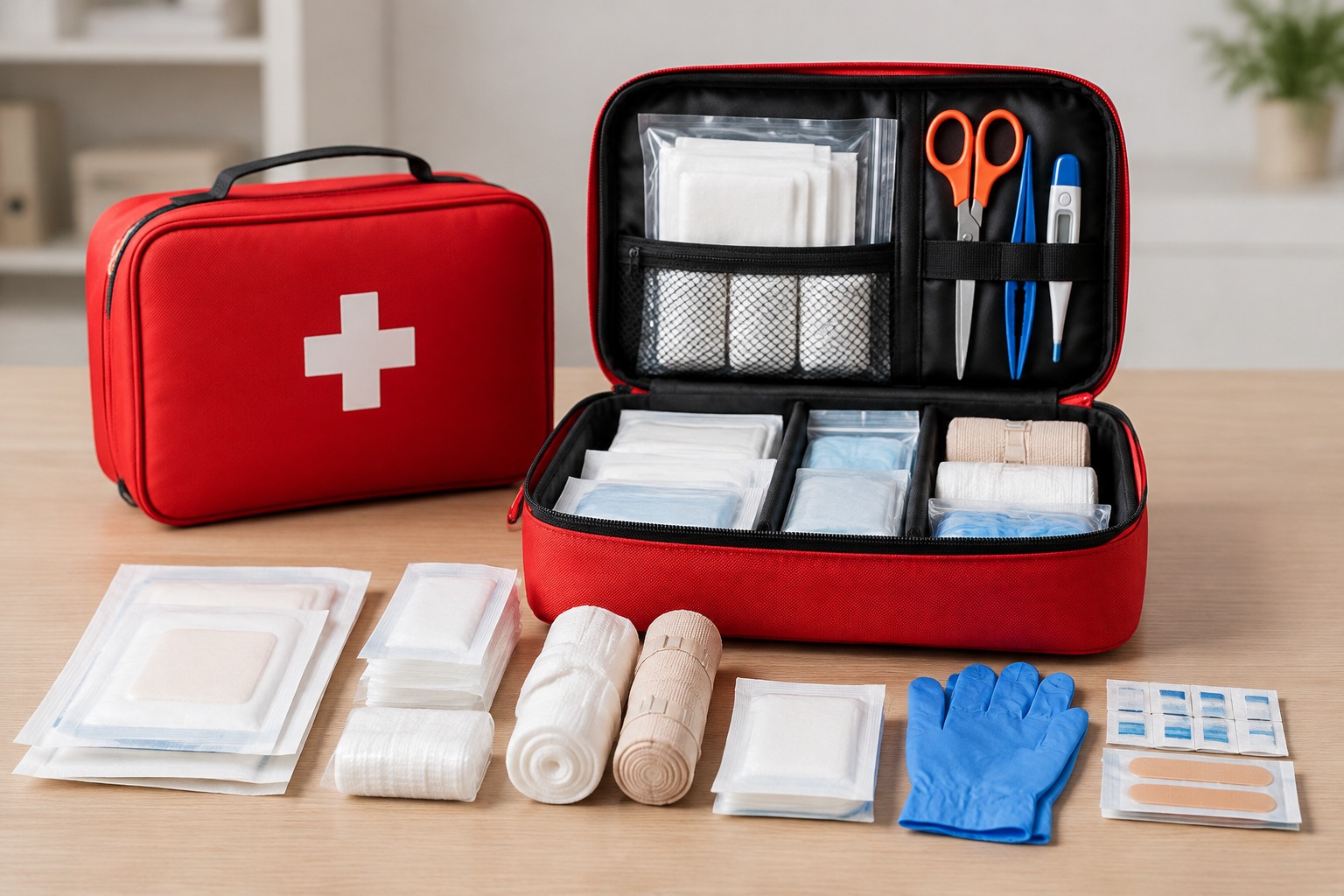
US general industry rules run to three paragraphs. 29 CFR 1910.151 sets the duty: where no infirmary, clinic or hospital sits in near proximity to the workplace, someone must be trained to render first aid, and adequate first aid supplies must be readily available.
That is the entire supply requirement. No item list, no kit count, no distance figure.
Appendix A to the same section is labeled non-mandatory. It points to ANSI Z308.1 as an example of minimum contents for a generic kit, calls those contents adequate for small worksites, then hands the judgement back. Where larger operations, or several operations, run at one location, the employer decides whether more kits, more equipment types or larger quantities are needed.
UK law arrives at the same place by another route. Regulation 3 of the Health and Safety (First-Aid) Regulations 1981 requires equipment and facilities that are adequate and appropriate in the circumstances. HSE’s first aid at work guidance then states that there is no mandatory list of items for a first aid box, and that contents should reflect the outcome of a needs assessment.
Two consequences follow, and both are commercial. How many stations a site needs, and where each warehouse first aid station sits, are decisions the buyer documents. They are not figures a supplier can hand over. A supplier can build to a published baseline, but confirming that a specification satisfies a particular destination market stays with the buyer and its advisers. UneedAid supplies documentation by SKU and coordinates the export file set; it does not rule on another market’s requirement.
Why warehouse first aid station count is a distance problem
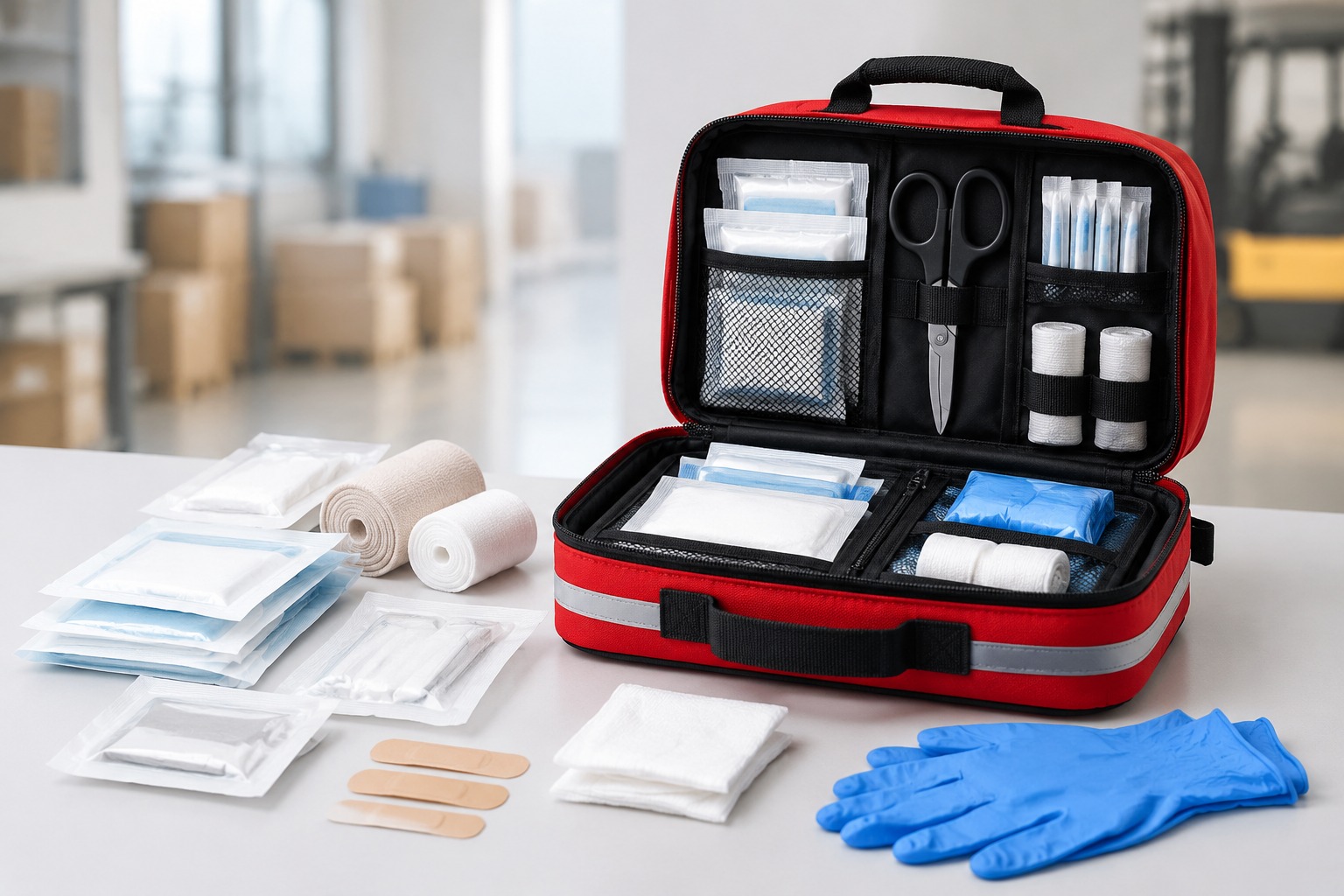
The instinct is to divide headcount by a ratio. Two numbers circulate widely in trade material: one station per 25 workers, or one station per 300 feet of walking distance. Neither appears in 1910.151, in Appendix A, or in ANSI/ISEA Z308.1. They are planning conventions, and the 300-foot figure is the more useful of the two on an industrial floor.
Walking distance is not distributed evenly. A 400,000 square foot building with racking to 30 feet puts more travel between two neighbouring aisles than a small factory puts between its shop floor and its office. HSE frames the same point plainly: where premises are spread out, provision should be considered in each building or on each floor.
Three variables move the station count, and none of them is headcount.
Travel time from the work position. Measure from where the person stands, not from the building entrance. A picker working an aisle selected at 32 feet of racking has a route measured in minutes, not yards.
Work-front spread. Inbound, putaway, picking, packing and dispatch do not share one footprint. A cabinet at the dock serves the dock. It does not serve pickers three aisles deep at 02:00, and it will not be found by a shunter in the yard.
Shift structure. HSE is direct here: where employees work shifts or out of hours, adequate provision has to be in place at all times people are at work. A station count derived from the day-shift roster systematically under-provisions nights.
A placement map that names each zone, names the warehouse first aid station covering it, and records travel time is the document that carries weight in an audit. Deriving the count from a published ratio is not a substitute for it, and it will not survive a question about the far racking.
Choosing the container format for each position
Format follows position. A cabinet bolted at the dock, a case that moves between fixed points, and a pouch that rides in a truck do different jobs, and each warehouse first aid station carries a different depth of contents as a result.
| Position | Typical format | Why it fits there | Refill implication |
|---|---|---|---|
| Dock, charging bay, main aisle | Wall-mounted or case-style supply box, fixed | Stays where the vehicle and pedestrian traffic converges; visible from the aisle | Bulk trays on a monthly calendar |
| Mezzanine, pick-and-pack | Case-style or hand-carry box at a fixed point | Stairs add delay, so the station goes where people already stand | Medium trays, same calendar |
| Yard vehicles, shunters, spotters | Sealed vehicle kit | Leaves the building with the driver and does not return on schedule | Replace on use, no fixed calendar |
| Office, HR suite, contractor room | Small fixed unit | Different hazard profile from the operational floor | Low volume, annual rotation |
Two mismatches drive most of the waste we see in provisioning. The first is a single large cabinet at the office, chosen because the office is where the paperwork lives. Coverage is a function of the furthest work position, not the tidiest room. The second is a portable case used as a fixed station, which walks off with whoever picked it up last.
Fixed positions want wall-mounted units, and open ones: a wall-mounted first aid box in a high-traffic aisle is read at a glance, so a missing item is visible before an incident rather than during one. The related range of wall-mounted emergency boxes covers the fixed points, while case-style and hand-carry supply boxes suit the mezzanine and the yard. The trade-offs between a bolted cabinet and a bag that travels are worked through in a separate comparison of wall-mounted boxes against portable kit bags.
Class A or Class B: sizing contents to the hazard profile
The current revision of ANSI/ISEA Z308.1, the standard referenced from Appendix A, sorts workplace kits into two classes. Class A covers common, low-severity injuries in low-hazard settings. Class B covers workplaces where injuries are more varied and more severe, and it builds on the Class A baseline with additional bleeding-control depth, including a tourniquet, plus larger burn and eye-wash quantities.
Warehouses straddle that line, which is why the class argument recurs every time a distribution center specifies a warehouse first aid station.
| Consideration | Points to Class A | Points to Class B |
|---|---|---|
| Traffic mix | Pedestrian only, low flow | Powered equipment and pedestrians sharing aisles |
| Work at height | None | Racking access, mezzanine edges |
| Manual handling volume | Light, occasional | Continuous, heavy unit loads |
| Injury history | No recurring severe entries | Recurring severe entries in the site log |
| Single-shift headcount | Under 50 | Over 50 |
Read the table as a weight of evidence rather than a single trigger. Any one row pointing to Class B is enough to justify specifying it, and the cost difference between the two classes is small next to the cost of a station that cannot answer the injury actually present on the floor.
Above the class baseline, three additions cover the warehouse profile specifically. Cold packs and elastic wraps for the manual-handling layer. Depth in dressings and bandages for the cut-and-laceration volume that drains a kit fastest. Bleeding-control items staged at the dock, where vehicles, loads and people converge.
Where forklifts and charging bays are present, check the eye and body flushing requirement as well. 1910.151(c) requires suitable facilities for quick drenching or flushing within the work area wherever people may be exposed to injurious corrosive materials, and battery charging areas are a routine example. A bottle at the station supplements that provision; it does not replace it.
None of this constitutes a compliance ruling for a given site. The hazard assessment, the class selection and the adequacy judgement belong to the buyer, and UneedAid supplies to the specification the buyer sets.
Keeping every station complete across shifts
An empty warehouse first aid station is worse than no station at all, because the placement map says it is covered. Contents drift in three predictable ways: consumption that nobody logs, expiry that nobody rotates, and items that migrate to a nearby desk.
Four controls keep the count honest.
- Named ownership per zone. Each station has a person, not a department. Shift leads sign their own zone, so a night-shift gap surfaces on the night shift rather than at the next monthly walk-round.
- One inspection calendar for the whole site. A single date, all stations, one pass. Staggered per-station schedules are how a station gets skipped for a quarter.
- Same-day restock after any use. Treating a used station as a completed event is what turns a two-item gap into a missing trauma dressing six weeks later.
- Dated stock rotation. Move shortest dates forward at the inspection, and retire anything past its date before it is found during an incident.
The procurement side matters here too. Refill trays matched to the class and the format keep counts stable, and repeat orders hold a kit’s component set steady, which is what makes a restock check meaningful across a year. Buyers planning coverage alongside servicing intervals will find the broader sequencing in our B2B guide to emergency first aid kits and bags.
Two adjacent planning problems are worth reading next. Sites that combine a fixed building with a vehicle fleet usually end up planning both in one pass, as set out in vehicle and fleet emergency kit planning. Sites where the workforce is spread across rooms, floors or buildings rather than one floorplate follow the same logic as a workplace first aid kit configuration checklist. Construction sites add a further layer of access constraints, covered in construction site first aid kit provisioning.
FAQ
How many first aid stations does a warehouse need?
There is no published figure. 1910.151 requires supplies to be readily available but sets no ratio, and the common trade conventions of one station per 25 workers or per 300 feet of separation are estimates rather than rules. The workable method is to map the floorplate by zone, measure travel time from the furthest work position in each zone to the nearest station, and add stations until that travel time is short enough for the hazard present. Warehouses running shift patterns need coverage for the night roster as well, so the count is set by the busiest shift rather than the largest one.
Where should stations be placed on a warehouse floor?
Place them where the work is, not where the office is. The load-bearing positions are the dock and the charging bay, each main picking aisle or aisle pair, the mezzanine or pick-and-pack area, and the yard if vehicles operate there. HSE guidance supports the same approach, advising provision in each building or on each floor where premises are spread out. A warehouse first aid station nobody passes during normal work will not be used, however well stocked it is.
Does a warehouse need a Class A or a Class B kit?
It depends on the hazard profile, and distribution centers often justify Class B. Class B builds on the Class A baseline and adds deeper bleeding control, including a tourniquet, plus larger burn and eye-wash quantities. Indicators that point to Class B on a warehouse floor include powered equipment sharing aisles with pedestrians, work at height on racking, heavy manual handling, and any injury log with recurring severe entries. A low-traffic warehouse office can sit on Class A. Buyers should ask the supplier to state in writing which revision and class a kit meets.
Do we need eyewash facilities as well as a first aid station?
Where people may be exposed to injurious corrosive materials, yes. 1910.151(c) requires suitable facilities for quick drenching or flushing of the eyes and body within the work area for immediate emergency use. Battery charging bays, cleaning chemical storage and any area where electrolyte or corrosive products are handled are the usual triggers in a warehouse. A small bottle of eyewash in the station is a supplement to that provision, not a substitute for it.
How often should warehouse first aid stations be checked?
Monthly is the common working cadence, on one calendar date across the whole site, with a same-day restock check after any use. The check itself should confirm three things: that every listed item is present and not expired, that the seal or latch is intact, and that the station is still visible from the working aisle. Station ownership belongs to a named person on each shift rather than to a department, because a shift with no owner is a shift with no coverage.
What goes above the standard kit contents in a distribution center?
Three layers above the class baseline cover most warehouse incidents: cold packs and elastic wraps for manual handling strains, extra depth in dressings and bandages for the cut-and-laceration volume that empties kits fastest, and bleeding-control items staged at the dock where vehicles and loads converge. Some sites add splints where unit loads are heavy and dropped-load foot and hand injuries occur. Each addition should trace back to a hazard identified in the site assessment, not to a generic list, because an item that answers no identified hazard adds cost and inspection time without adding coverage.