
A carton arrives with the brand colour slightly off, the barcode sitting close to a fold, and a safety sentence half covered by a varnish band. Nothing is visibly broken, yet the shipment cannot go to the shelf. Custom first aid packaging printing is where private-label projects quietly lose time, because print is usually quoted as a single line while it actually depends on several separate decisions.
The short answer is to handle print as a controlled document rather than a request. Name the substrate and its finish, the print system, the colour reference, the dieline revision, the finished size and position of every element, the tolerance you will measure, and the sample that defines acceptance. Fix those before artwork release, and quotations from different suppliers start to describe the same thing.
This is the packaging layer of the same project file you use for the bag, case and contents. UneedAid’s OEM private-label first aid kit guide covers how sample, artwork and bulk records connect; this article narrows into the printed packaging itself, the point where a project file becomes a physical surface that custom first aid packaging printing has to reproduce.
How should buyers specify custom first aid packaging printing?
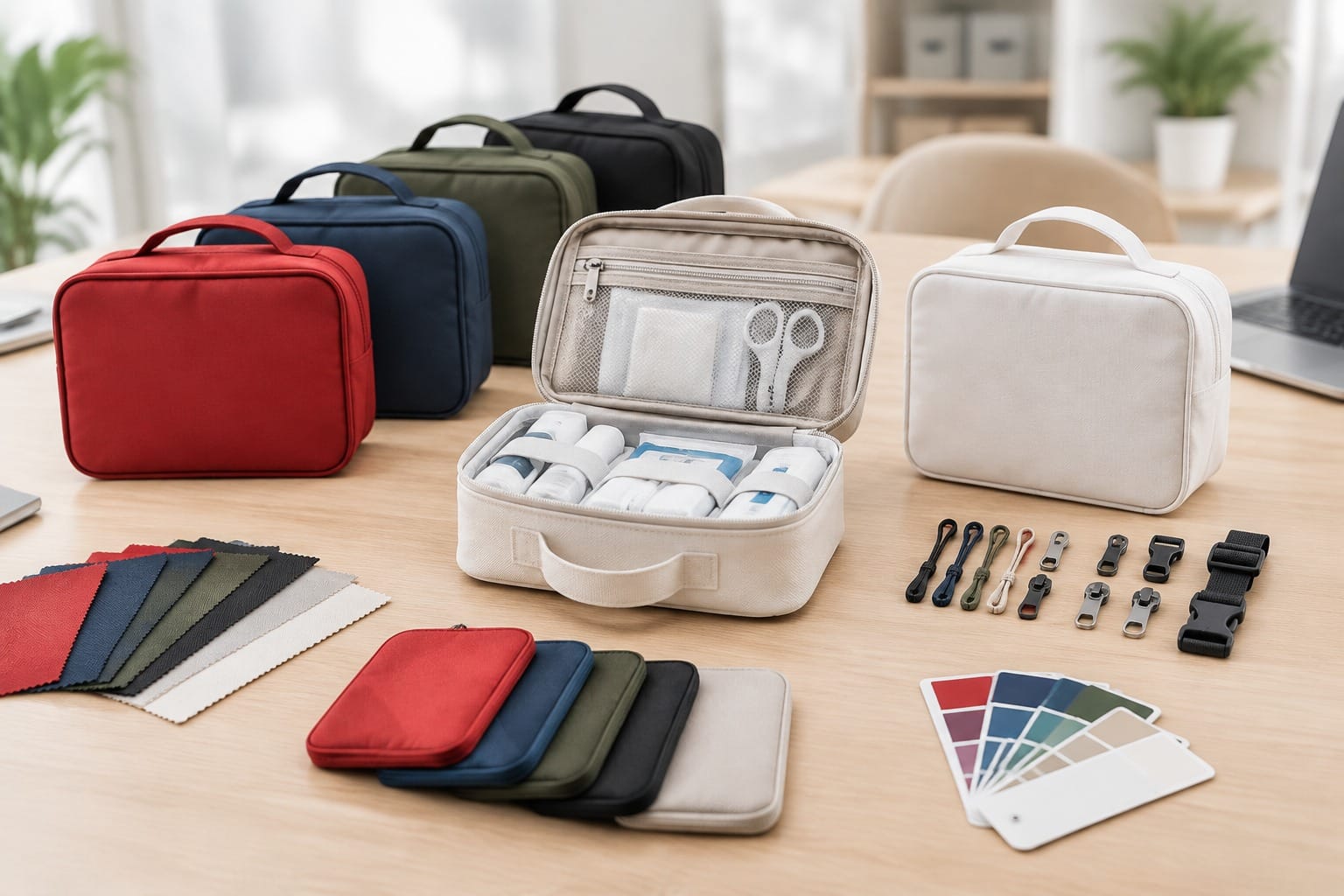
Start from the substrate, not from the artwork. Printing behaviour follows the material and its coating: coated paperboard, uncoated kraft, corrugated board, laminated film pouch, and moulded case surfaces each respond differently to ink, pressure and finishing. A supplier can print the same file on two boards and deliver two different results.
Use a fixed sequence, and keep the sequence in the project file:
- Freeze the packaging format: folding carton, sleeve, card insert, header card, polybag, pouch or master carton.
- Record the substrate grade, thickness or grammage, and the exact surface finish at the print area.
- State the dieline revision that governs the cut and fold layout.
- Describe each printed element separately: brand mark, product name, contents statement, barcode, batch field, market language panel, address block.
- Name the print system and the colour reference, not only the visual colour.
- Define the measured tolerance for position, size and colour, plus who measures it.
- Approve a production sample on the real substrate, then lock the artwork revision that produced it.
Written as a list, the sequence looks obvious. Applied to a real order it is not, because items three and four tend to arrive late. A dieline is often generated by the printer after the buyer has already approved a flat artwork file, and a small shift in the glue flap can move the fold line straight through the brand mark.
The practical fix is to require the dieline before artwork sign-off, not after. When the buyer controls the dieline revision number, a packaging change becomes traceable instead of invisible.
Colour needs the same discipline. The International Color Consortium describes its purpose as promoting open, vendor-neutral, cross-platform colour management systems, and its profile specification was published as the international standard ISO 15076-1. An ICC profile is what lets a file, a proof and a press speak the same language. It does not make two substrates look identical, and it does not remove the need for a physical reference.
Which printing methods fit first aid cartons, sleeves and pouches?
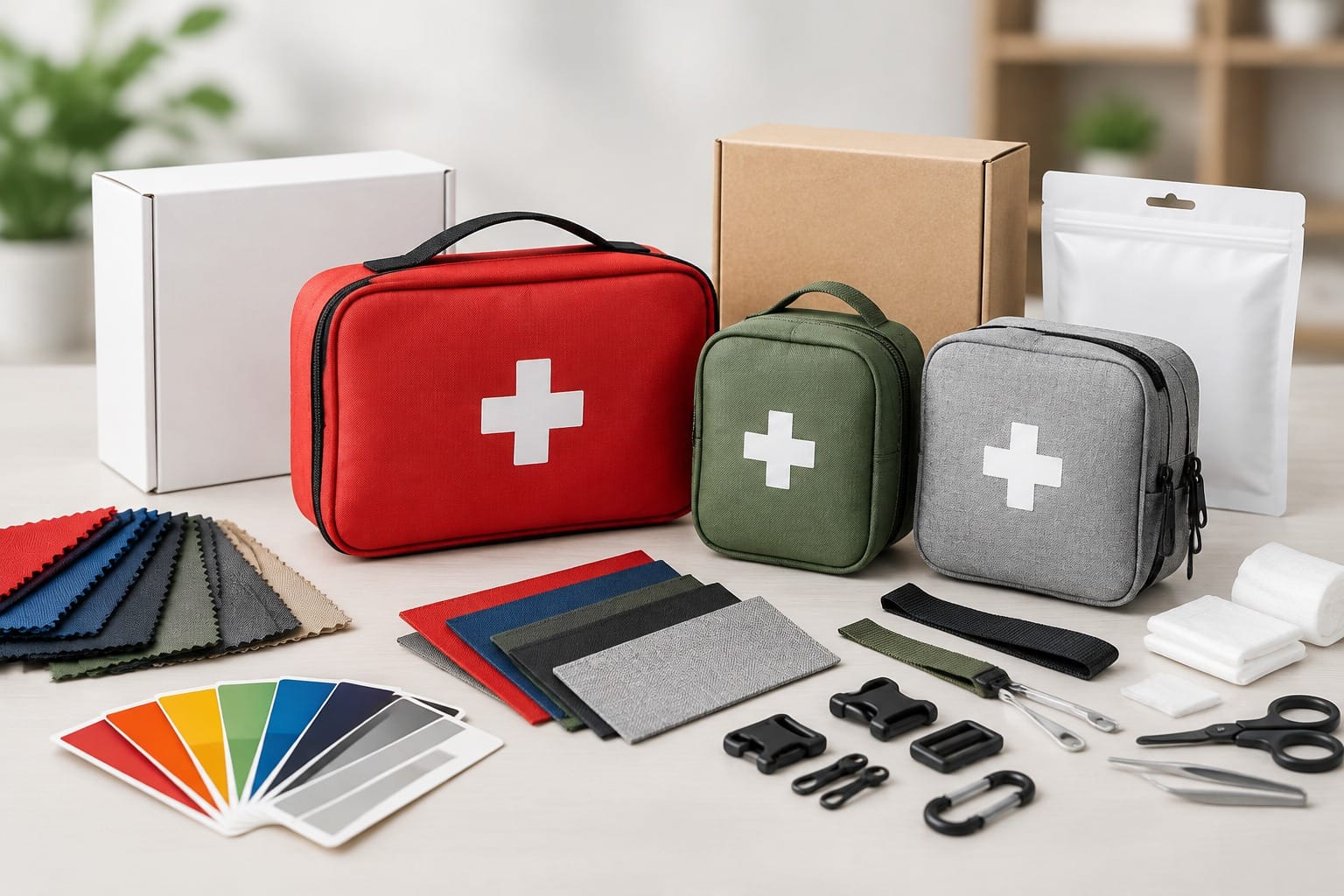
No single method covers every format. The table below is a sourcing comparison for buyer specification, not a production commitment. Feasibility depends on the quoted substrate, the equipment actually used, the artwork, the finishing line and the order quantity.
| Method | Typical fit | What it carries well | What the buyer must verify |
|---|---|---|---|
| Offset litho | Folding cartons, sleeves and inserts in paperboard | Fine text, small regulatory wording, photographic imagery, dense colour | Board grade and coating, plate and make-ready charges, colour bar and density control on the sheet |
| Flexographic | Corrugated shippers, kraft cartons, larger runs | Solid areas, larger marks, functional information across a big panel | Anilox and plate line screen, registration across flutes, ink coverage limits on kraft |
| Digital toner or inkjet | Short runs, labels, late-stage revisions, market variants | Versioning and variable data without a plate charge | Substrate qualification on the actual stock, toner or ink adhesion, colour drift across the run, cost curve against volume |
| Screen print | Pouch film, heavy card, rigid surfaces | Opaque solids, white and metallic effects, thicker ink film | Mesh count, ink system, curing window, opacity over the substrate colour |
| Foil stamping | Premium cartons and rigid case labels | Metallic or high-contrast accent lines and seals | Foil reference, die making, relief depth, coverage limits, adhesion at edges |
| Label on a plain blank | Trial volumes, multi-market shipments, audit trails | Information changes without reprinting the carton | Adhesive and face stock against the substrate, humidity and cold behaviour, whether the blank itself is acceptable to the buyer’s channel |
Two mistakes recur in this table. The first is asking for one price line called “printing”. Carton print, pouch print, label print and master carton print are different supply chains with different setup drivers. Quote them separately so cost movement stays readable, and ask every supplier to describe custom first aid packaging printing in those same four lines.
The second is approving a method from a photograph of a different container. Where the packaging is the visible retail surface, buyers can compare emergency medical bag formats and related packaging options alongside the printed carton, then ask which surfaces are actually printable on the format they intend to order.
Idealliance, now part of PRINTING United Alliance, maintains the G7 family of print production specifications, and G7 Master Facility certification is described as facility-level evidence of predictable, consistent colour delivery across print processes. A buyer can ask whether a nominated printer works to such a specification. The answer frames the conversation around process control on the press rather than one corrected file.
What artwork and dieline files should a print supplier receive?
A print-ready file is a controlled file, not an exported image. Screenshots, resized logos and artwork rebuilt from a supplier template all create version risk. Send an artwork pack with a revision number and a named approver.
The pack should contain:
- An editable vector master, plus a flattened PDF for comparison.
- The dieline as a separate layer or separate file, at the correct revision, with cut, crease and safe-area lines distinguished.
- Bleed, trim and safe margins stated as numbers in millimetres.
- Spot colour references and the intended print system for each one.
- The minimum size at which small text and closed counters remain legible on the chosen substrate.
- Barcode artwork with its quiet zone, plus the barcode standard the buyer requires.
- The market language panel as separate live text where the buyer expects to change wording.
- A superseded-file list, so an old version cannot be pulled by accident.
Pantone describes its systems as tools for selecting, communicating and matching colour. That is a communication benefit, not a visual identity promise. A named spot colour still lands differently on coated board, uncoated kraft and transparent film. Approve a physical reference and an allowed visual range rather than a single code.
Information elements deserve their own control because they change on a different rhythm from the brand mark. A contents statement, importer address, batch field, barcode and user instruction may each be governed by different rules in the destination market. Keeping them as separate elements means a later wording change does not reopen the brand artwork approval.
One naming rule saves a great deal of rework: never let two files share a name. Use product, format, market and revision in the file name itself, and keep the approved sample labelled with the same string. That habit is what keeps custom first aid packaging printing auditable across several market variants.
How does custom first aid packaging printing drive setup cost and MOQ?
Print setup and kit MOQ are different constraints. Our standard kit programmes start at 1,000 pieces, yet a printed carton can carry its own plate, die, foil or make-ready charge that behaves independently of that number.
Ask the supplier to split the quotation into four lines:
| Cost line | What it covers | Why separating it matters |
|---|---|---|
| One-time setup | Plates, dies, screens, foil dies, colour matching, make-ready | Shows what a revision really costs later |
| Unit print | Ink, board or film consumption, press time per thousand | Makes volume tiers comparable |
| Custom component | A printed component with its own minimum, such as a branded insert card | Explains why a small order can breach a packaging minimum even when the kit itself does not |
| Sample and proof | Material, press proof, courier and any colour measurement | Prevents sample cost being hidden in the unit price |
With those four lines separated, buyers can see the real trade: a method with a higher plate charge but better press efficiency may win at volume and lose at trial quantity. A method with no setup charge may be the sensible path for a first market test, provided its appearance and durability match what the buyer promised the channel.
A second lever is artwork simplification. Reducing the number of spot colours, removing very fine reversed lines, or moving a long instruction sentence to an insert card can reduce both setup and rejection risk without changing the brand mark.
Content continuity is the third lever, and it is the one buyers under-specify. Define what counts as a change requiring a new sample: substrate grade, coating, ink system, foil, adhesive, press route, dieline revision, colour reference or print position. Then require written notice before the supplier substitutes any of them. A repeat order that looks identical is not proof the production route stayed identical.
Where a buyer pays for a plate, die or foil tool, the commercial record should state ownership, storage, retention period and what happens when the artwork changes. Setup charges and tool ownership are not the same thing.
What print defects and tolerances belong in the purchase order?
“Inferior print quality” cannot be inspected. Divide the specification into categories a quality inspector can count.
| Defect category | Examples | Controlling record |
|---|---|---|
| Content | Wrong language panel, old artwork revision, missing element, wrong address | Approved artwork ID and revision |
| Colour | Off-target spot colour, weak opacity over the substrate, uneven density across the sheet | Colour reference, density targets and the approved physical sample |
| Position | Element outside the stated tolerance, crossing a crease or glue area, intruding into the barcode quiet zone | Dieline revision and dimensioned placement drawing |
| Registration | Misaligned colour layers, halo around fine text, broken thin reversed lines | Approved production sample and press control strip |
| Surface | Scuffing, set-off, pinholing, foil edge lift, adhesive bleed, uneven varnish band | Method-specific defect standard and finishing reference |
| Structural interaction | Print cracking at a fold, distortion over a glued flap, abrasion where the carton rubs in transit | Dieline, fold test and transit packing requirement |
| Data | Unreadable or out-of-tolerance barcode, missing batch field, wrong variable data | Barcode verification requirement and data file |
Two fields make the table usable. First, the tolerance value and the measuring method, including who performs the check and at which stage. Second, the disposition rule: which defects trigger rejection, which allow rework, and which the buyer may accept as a documented concession. Without a disposition rule, every minor variation becomes a negotiation.
Inspection timing matters as much as inspection criteria. Checks that happen only at final packing cannot catch a plate defect that has already run across the whole order. Ask for a first-off approval on the production press and a documented in-process check, then a final check on packed goods.
Numbering the components in the packaging structure also helps. When the carton, insert card, label, pouch and master carton each carry an identifier, a defect report points to one item rather than to the shipment. The private label first aid kit packaging options overview shows how those layers stack up in a typical configuration.
Where do printed claims cross a compliance boundary?
Printing turns a specification into a permanent statement on the product. That is why the printed panel is the riskiest part of the artwork pack, and why it should be reviewed against the buyer’s destination-market requirements rather than against the supplier’s template.
Three practical rules apply.
First, handle regulatory marks as buyer-supplied content. If a mark, code or statement is required in the destination market, the buyer should supply it with the authority for its use, and should record in writing who confirmed that it is appropriate for that market. UneedAid supplies documentation by SKU and coordinates the export file set, while the buyer remains responsible for confirming destination-market compliance.
Second, do not let a supplier template introduce a claim nobody approved. Templates often carry generic wording about the product category. Any sentence that describes a product property, performance or status should be traceable to an approved source document, or removed.
Third, keep brand artwork and compliance content in separate approval routes. A brand mark can be signed off by a marketing owner. A content statement, language panel or regulatory field usually needs the buyer’s regulatory or quality owner. Mixing them into one file means a marketing change can quietly alter a controlled statement.
The emblem question belongs here too. The International Committee of the Red Cross explains that the red cross, red crescent and red crystal are protected emblems under international and national law. A cross-shaped medical graphic is therefore not automatically available as a commercial brand element, and the symbol, its form and its authorised use should be confirmed before artwork is released for printing.
FAQ
What is the difference between a dieline and print-ready artwork?
A dieline defines the physical structure: where the carton is cut, creased and glued, and therefore where the printable panels sit. Print-ready artwork defines what appears inside those panels. They must share a revision number and a coordinate system, or a fold can move through a printed element. Suppliers should confirm the dieline before artwork sign-off, not after, because a structural change made later invalidates placement approvals, tolerances and the approved sample.
Can a supplier print to a Pantone reference exactly?
A named colour reference is a communication tool. Substrate colour, coating absorbency, ink film thickness, press conditions, finishing and lighting all shift the result. Most projects work better with a measured target plus an allowed visual range, agreed on a physical reference. Two boards printed from the same ink can still differ enough to be visible side by side, so a single code should not be treated as the complete acceptance rule for printed packaging.
How many colours should first aid packaging use?
There is no universal number. Each additional spot colour normally adds a plate, a make-ready step and a registration risk, while process printing handles photographic content differently. The decision should follow the artwork rather than a target count: reduce colours when the design tolerates it, and keep a spot colour when brand recognition depends on it. Ask the printer which elements drive cost at the buyer’s order quantity, and check how the choice behaves across the whole printed range. Colour count is one of the few variables in custom first aid packaging printing that a buyer can change late without rebuilding the structure.
Should a small first order use printed cartons or labels?
It depends on the channel and the promise made to it. Digital print and pressure-sensitive labels avoid plate and die charges, which suits trials and market variants, but the result may not match a large-run carton in surface feel and finish. Buyers can also start with a plain blank and a controlled label, then move to printed cartons once volume and design are stable. Ask for both routes quoted on the same format so the comparison is genuine.
What should a buyer do when a reorder looks different from the approved sample?
Raise it as a change-control event rather than a quality complaint. Compare substrate grade, coating, ink system, colour reference, finishing, print position and dieline revision against the approved record, and ask the supplier to confirm in writing which inputs changed. If a controlled input changed, the sample should be re-approved before further production. Retaining the approved sample and its file record is what makes this comparison possible at all.
Controlled custom first aid packaging printing turns a packaging order from a description into a measurable record: substrate, dieline revision, colour reference, tolerance, sample identity and disposition rules. Buyers who lock those fields before artwork release spend less time arguing about a shipment and more time opening the next market. The next layer, brand marks on the bag or case itself, is covered in the custom first aid kit logo methods framework, so both surfaces stay under one revision history.