
A reseller keeps three first aid suppliers on file. Two quotes land within 4% of each other, both kits look complete in photographs, and the decision comes down to who answered email faster. Six months later one of them has changed its gauze source without saying so. A first aid supplier scorecard exists to move that decision out of the inbox and onto a page you can reread.
It does not rank suppliers by reputation. It scores them against categories a distributor can attach evidence to, weights those categories before scoring starts, and leaves a category blank when no evidence exists yet. Blank is a legitimate result. Most scorecards never allow it, and that omission is why so many of them produce confident numbers that mean nothing.
What a first aid supplier scorecard has to measure
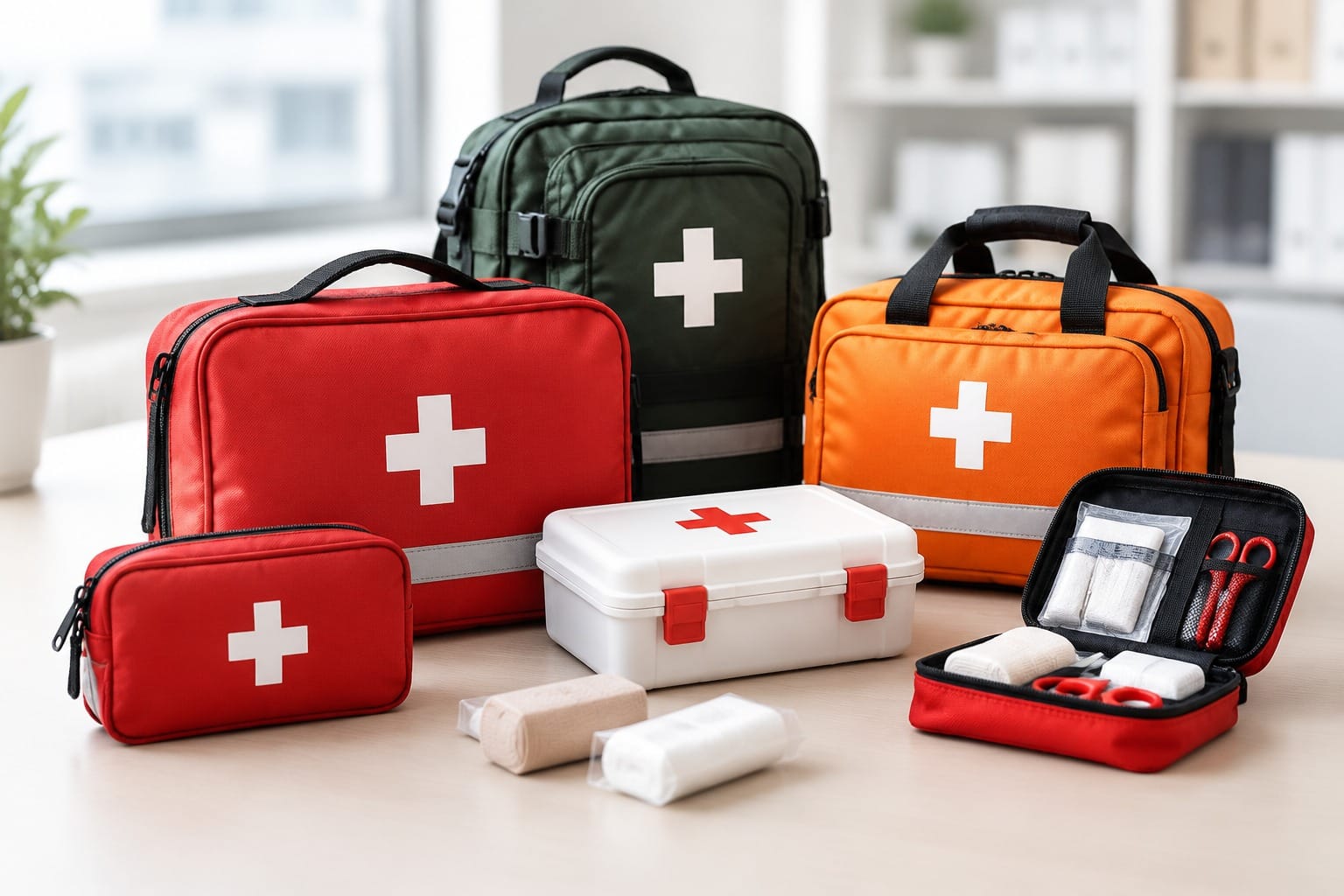
Three properties make first aid harder to score than a commodity.
The unit of purchase is a configuration, not a product. A 25-person workplace kit is a contents list plus a bag or box. Two suppliers can both satisfy that name while shipping different counts of the same component. Score “product quality” as a single number and you bury the only thing a reseller needs to compare.
The evidence sits in two supply chains. Consumables inside the kit and the bag or box around it are often made by different factories, on different lead times, against different minimums. One averaged quality score hides a difference that will surface at reorder.
The buyer usually cannot inspect before the first order. Samples travel; production lines do not. So the sheet has to separate evidence that exists at bid stage from evidence that only exists after two production runs.
Ignore those three properties and the sheet becomes a popularity ranking. Buyers searching for selection frameworks are asking something narrower than “who is good”. In our own search data, the phrases that actually appear are things like “empty first aid bag supplier selection guide” and “empty first aid bag odm manufacturer” — both describe a decision process rather than a product.
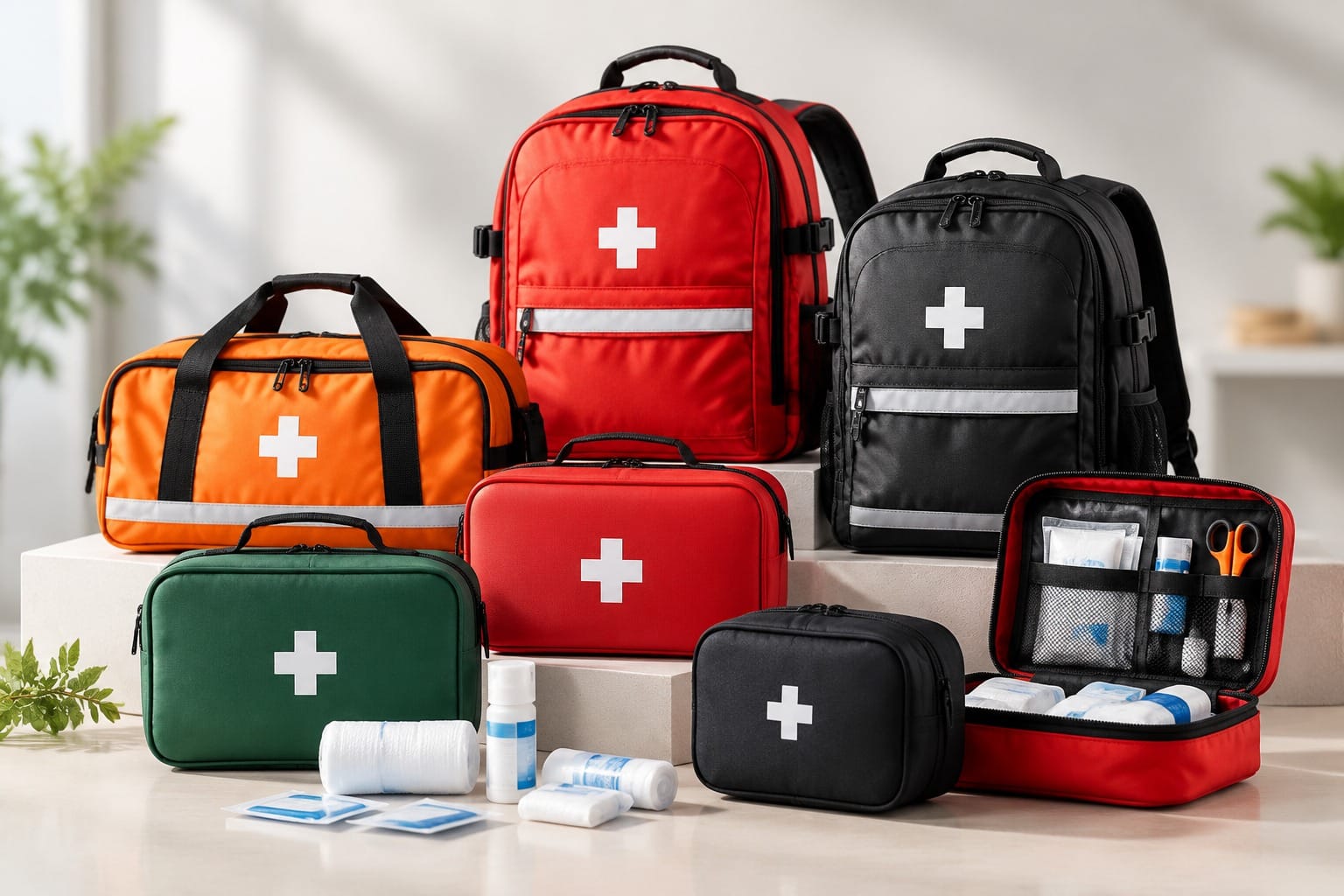
The five categories and the weight each one earns
| Category | Weight | What earns a high score | Evidence you attach |
|---|---|---|---|
| Specification closure | 25% | Contents list, bag or box dimensions and material stated as fixed, with a revision number | Signed specification sheet with revision date |
| Component continuity | 20% | Named components stay named across reorders; substitutions are proposed in writing | Two consecutive packing lists for the same SKU |
| Delivery terms precision | 20% | Quoted delivery term, port, packing dimensions and lead time in working days | Quote with the term written out rather than implied |
| Documentation handover | 20% | Destination-market documents identified by type, with the buyer’s confirmation step stated | Document list by SKU, naming the register that confirms it |
| Commercial fit | 15% | MOQ, sample path and tier logic matched to your first order size rather than an ideal one | Written MOQ and a sample plan |
Weights are a starting position, not a universal truth. A reseller opening a new channel should raise component continuity, because an inconsistent reorder costs more than a slightly worse unit price. A reseller running a tender against a fixed configuration can lower it.
Score each category from 1 to 5, or record it as unverified. Multiply, sum, then read the total only next to the unverified count. A total of 3.8 built on four blank categories is not a score. It is a statement about your access to information. That distinction is the discipline a first aid supplier scorecard has to hold to.
Which scores you can fill before the first order
Pre-order evidence is the scarce resource, so the sheet should name what is obtainable. Five artifacts can be requested before any deposit:
- Contents list with counts for the exact configuration rather than a range.
- Bag or box specification: material, dimensions, closure type, handle or mounting method.
- A quote with the delivery term written out. The international commercial terms published by the International Chamber of Commerce define where risk transfers. An implied term is not a term.
- A document list by SKU, naming which items the supplier issues and which the buyer must obtain.
- A sample plan: what will be sent, and what that sample is meant to prove.
Anything outside that list is either post-order or third-party evidence. Record it as unverified until you hold it. Inside that list, a first aid supplier scorecard can be completed before money moves. Generic procurement templates that weight quality at 30% assume a defect rate you can look up. A buyer sourcing first aid supplies from an unfamiliar factory has no such number, and inventing one turns a guess into a figure.
Two anchors are worth keeping in view. Workplace first aid requirements are set per jurisdiction rather than globally, so “meets the standard” is not scoreable until you name the market — the Health and Safety Executive states the position for the United Kingdom, and other markets legislate differently. Where a kit contains a regulated medical device, documentation duties also attach to the importer; the European Commission’s medical device pages describe that split, which is why documentation is scored on what is issued rather than on what is claimed.
Worked comparison: two resellers, same scorecard
Two suppliers, one tender, identical contents list.
| Category | Supplier A | Supplier B |
|---|---|---|
| Specification closure (25%) | 4 — revised sheet supplied | 3 — catalogue description only |
| Component continuity (20%) | 2 — gauze source unnamed | 4 — two prior packing lists supplied |
| Delivery terms precision (20%) | 4 — term and port named | 4 — term and port named |
| Documentation handover (20%) | 3 — list by SKU, register unnamed | 2 — documents described as available |
| Commercial fit (15%) | 5 — MOQ 1,000 pcs, sample path defined | 3 — MOQ stated as negotiable |
| Unverified categories | 0 | 0 |
| Weighted total | 3.45 | 3.30 |
In conversation the two look equal. The sheet separates them on the categories a reseller pays for later. Supplier A wins on specification closure and commercial fit. Supplier B wins on continuity, which matters more at the second order than the first.
Run the same arithmetic with an unverified count above zero and the total becomes provisional. Show it that way. A provisional total reviewed in 90 days is worth more than a finished total that was never evidence-based. Any first aid supplier scorecard that hides the provisional part is doing its reader a disservice.
Where a first aid supplier scorecard stops working
Used badly, a first aid supplier scorecard produces the answer the person filling it wanted.
- Comparing unlike configurations. Score two quotes against the same contents list. If the lists differ, you are measuring a supplier against a specification nobody wrote.
- Scoring a supplier you have already decided to keep. The sheet is for selection and review. Using it afterwards to justify a choice produces the numbers you were hoping for.
- Averaging across unequal evidence. One verified category and four blanks should not resolve to a usable figure.
- Reading a high total as proof. It records what was documented on a date. It does not predict the next delivery.
- Scoring documents that belong to the buyer. Some paperwork sits with the importer or the destination market. Deducting points from a supplier for it measures your own gap.
FAQ
What is a first aid supplier scorecard?
It is a weighted sheet that rates candidate suppliers against the same categories on the same scale, so the comparison can be repeated and the reasoning stays visible to whoever reads it next. It differs from a general procurement scorecard in what it weights: configuration closure and component continuity carry more weight than defect history, because a reseller usually cannot observe defect history before placing a first order.
How many suppliers should I score at once?
Two or three. A single supplier gives you a baseline for the next review but no comparison, and beyond three the pre-order evidence work grows faster than the decision quality improves. Score the whole shortlist in one session, before any negotiation starts, so a late concession cannot quietly move the weights in someone’s favour.
Should price be its own category?
Put price inside commercial fit instead. A unit price without a delivery term, packing dimensions and an MOQ tier is not comparable with anything, and a separate price category rewards whichever quote states the fewest terms. At 15% of the total, a supplier can still win commercial fit comfortably without winning on headline price alone.
What should I do with an unverified category?
Record it as unverified, keep the total provisional, and set a review date. Do not convert it into a zero or a mid-range score. A blank records what you have not obtained yet; a fabricated value records nothing at all, and it will be the number you quote back in the meeting where the decision is actually made.
How often should the scorecard be repeated?
Score at selection, then again after the second production run, because continuity and documentation behaviour only become visible once there is a history to compare. Quarterly review suits suppliers carrying steady volume. Annual review is reasonable for low-volume suppliers. Repetition is what turns the sheet into a trend, and the trend is what predicts the substitution a single quote cannot show.
Can I use it for a supplier I source in China?
Yes. The same categories apply. The practical difference is that configuration detail often sits with the factory rather than on a website, so each request has to name the artifact you want: a contents list with counts, packing dimensions, the material of the bag or box. Suppliers who keep those records are easier to score, and that ease is a useful signal about process rather than about product.
Putting the scorecard into your reorder cycle
A first aid supplier scorecard used once is a comparison. Used twice, it becomes a measurement.
The reorder cycle is where the continuity category earns its weight. When a repeat order arrives, the contents list should match the one you scored, component by component. Where a substitution is proposed, it should reach you in writing before production rather than in the packing list afterwards. Buyers who plan for component continuity across repeat first aid kit orders are scoring exactly that behaviour.
For channel decisions the sheet pairs with the framework in our guide to building a first aid distribution strategy. The strategy defines which channel you are supplying; the scorecard defines whether a given supplier can support it. Where a reseller is still testing demand, the metrics in the first aid distributor channel scorecard show what to watch after launch.
If the shortlist is still open, the method in how to compare OEM first aid kit suppliers applies the same evidence rules, and the compliance checklist for a first aid supplier RFQ covers the document side in more depth. Buyers who want the quote structure itself can start from the first aid supplies RFQ template.
Our own MOQ starts at 1,000 pcs, with sample-based validation before production and a feasibility review wherever the configuration is not yet fixed. In our catalogue data the category hubs, not the individual product pages, carry most of the search impressions, so a supplier’s hub pages are usually the faster read when you are comparing capabilities.
The same six-field discipline applies one layer down, when the item being quoted is an empty format rather than an equipped kit: the B2B sourcing guide for empty first aid kit bags and boxes applies the evidence rules to the container itself.
A scorecard works well for private channel partners, and a public sector first aid products tender applies comparable weighting under a stricter document gate, with the award method stated in the notice itself.