
A sample tactical bag can look organized on a meeting table and still fail the buyer’s real use case once it is fully loaded. Pockets may become inaccessible, zipper paths may bind, attachment webbing may not fit the intended pouches, and the quoted fabric name may say little about the finished construction.
Useful tactical medical bag specifications define measurable fields: intended load, usable dimensions, fabric and coating, seam and reinforcement details, closure components, compartment layout, carrying system, attachment geometry, marking, packing, and sample tests. The buyer should approve the written specification and a loaded reference sample together. The word “tactical” describes a market or use-case style; it does not by itself prove strength, weather resistance, or suitability for a specific program.
This sourcing framework is written for distributors, institutional buyers, brand projects, and procurement teams. It supports RFQ comparison and sample control. The buyer remains responsible for confirming the required contents, intended-use claims, and destination-market obligations.
What tactical medical bag specifications belong in an RFQ?
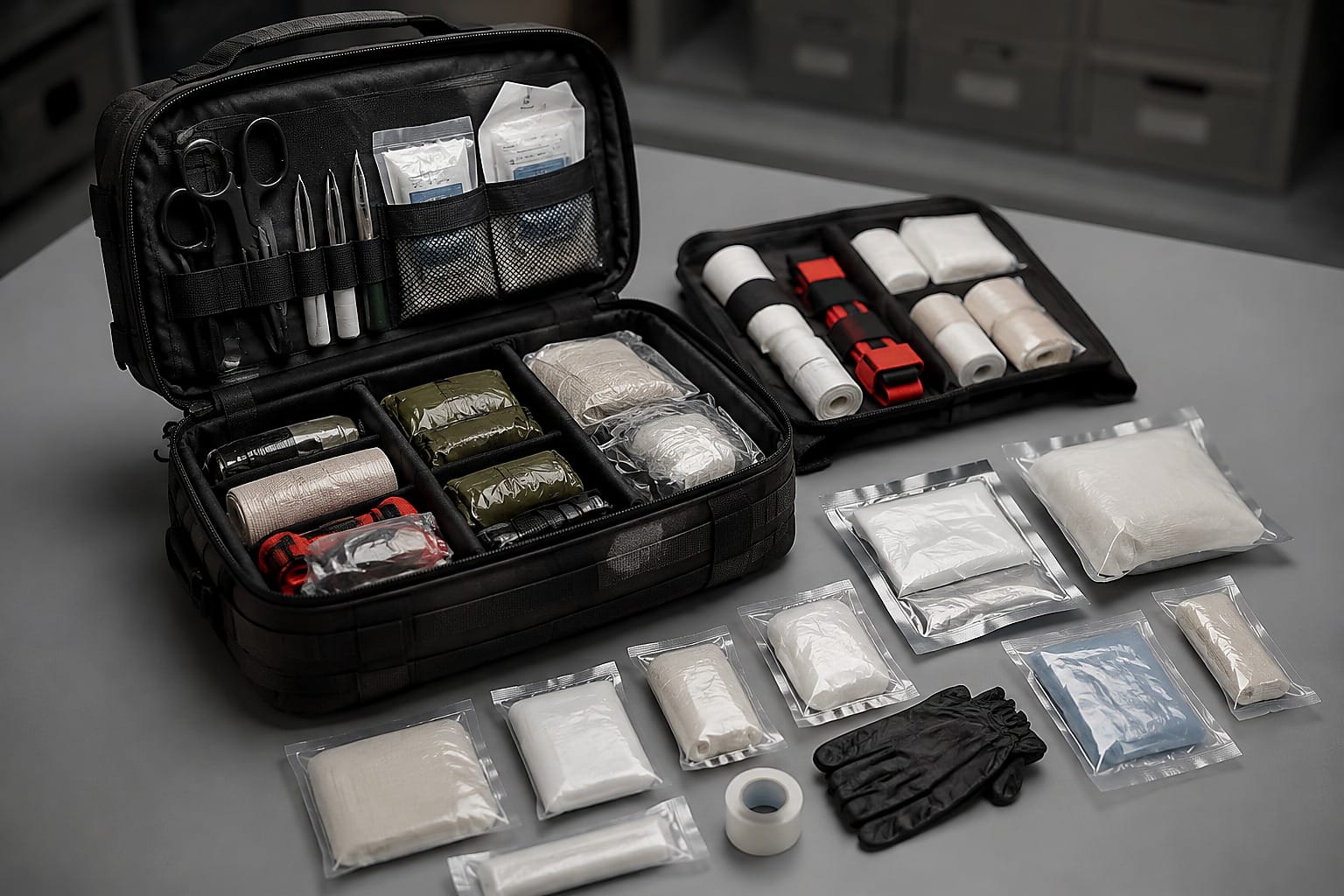
Begin with the operating brief, not a bag photograph. A supplier cannot quote the same construction for a compact belt pouch, a vehicle bag, and a loaded responder backpack without making assumptions. State who carries the bag, where it is stored, how it opens, which modules must be reached first, and what load the sample will hold.
An RFQ should cover ten groups of information:
- Bag format and intended carrying or mounting method.
- External, internal, and loaded dimensions with an agreed measurement method.
- Target component list, module map, and loaded weight.
- Outer fabric, lining, coating, foam, stiffener, and reinforcement details.
- Zippers, sliders, pulls, buckles, hook-and-loop panels, and other closures.
- Pocket, loop, divider, pouch, and identification layout.
- Handle, shoulder strap, backpack strap, waist belt, and anchor construction.
- External attachment webbing or panel geometry, if required.
- Color reference, logo method, labels, barcodes, and carton marks.
- Sample tests, inspection points, acceptable tolerances, and change control.
Use the broader emergency kit and bag sourcing framework to define the use case and bill of materials before freezing these bag fields. For a US workplace project, OSHA 29 CFR 1910.151 provides one example of why supplies and access must reflect the operating context. It does not prescribe one tactical bag design or a universal component list.
How should dimensions, capacity, and loaded weight be stated?
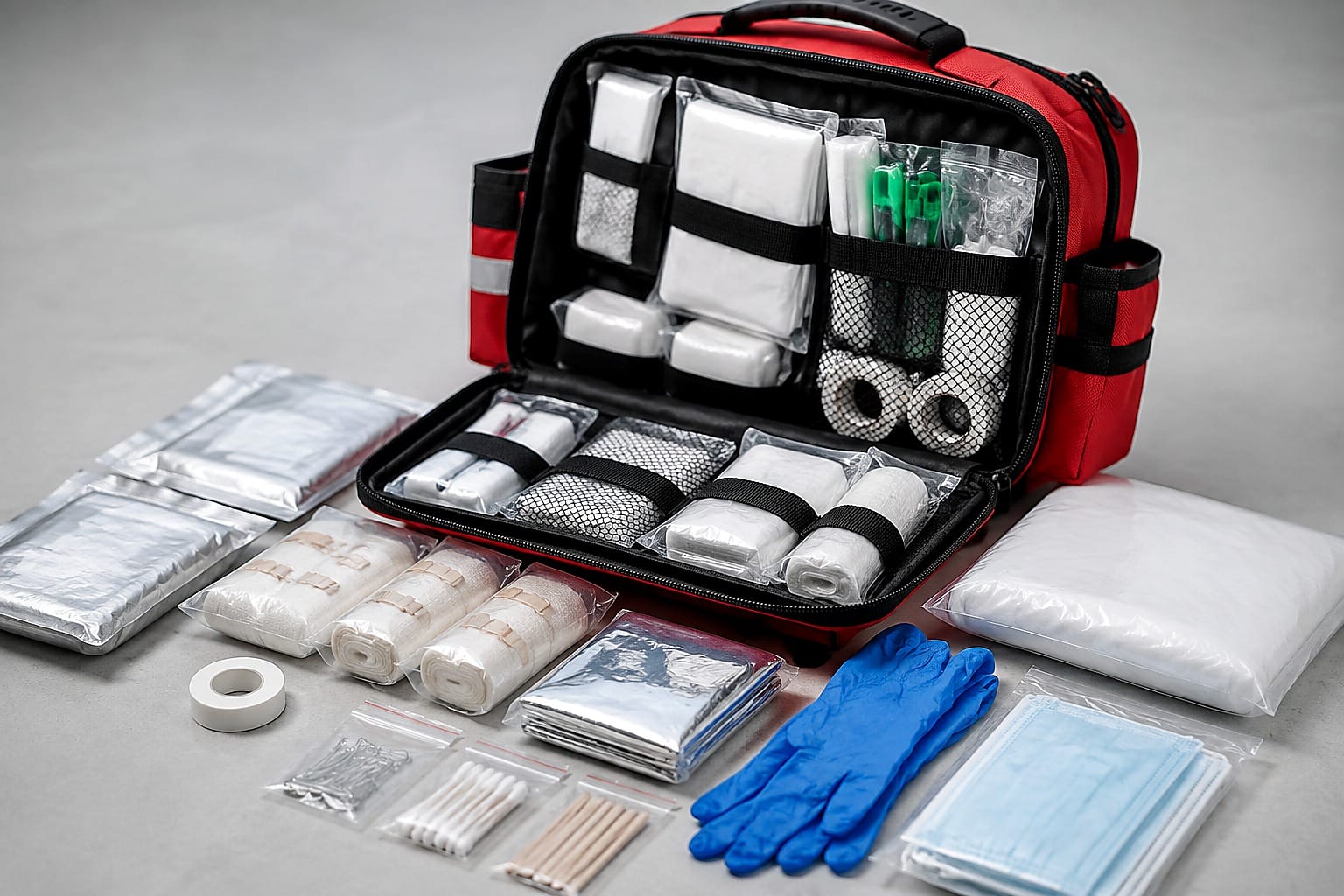
“30-liter medical backpack” is not a complete purchasing specification. Capacity figures can be calculated or measured in different ways, and rounded marketing values do not show whether the buyer’s actual modules fit. Record the method used for length, width, depth, and capacity, then verify the proposed component list inside the sample.
The most useful dimensional record includes:
| Field | What the buyer should state | What to verify on the sample |
|---|---|---|
| External dimensions | Measurement points and tolerance | Bag closed, empty and fully loaded |
| Usable internal dimensions | Clear space after lining, foam, dividers, and seams | Largest module fits without forcing the closure |
| Main opening | Opening width and zipper path | Priority modules can be removed in the planned order |
| Pocket dimensions | Finished usable pocket size | Labels remain visible and contents are retained |
| Empty weight | Bag and included removable parts | Same configuration as the quotation |
| Loaded weight | Approved BOM plus bag | Carry system remains adjustable and stable |
| Packed shipping size | Folded or shape-held unit | Master-carton quantity matches the freight quote |
Do not use one pass/fail load number without defining the load distribution and duration. Ten kilograms spread across a padded main compartment creates different stress from the same weight suspended from one handle. If a buyer requires a handle-hold test, shoulder-strap test, or repeated lift cycle, the RFQ should name the load, duration, cycle count, fixture, conditioning, and acceptance criteria.
Good tactical medical bag specifications also identify the largest rigid item, the thickest module, and any item that must remain upright. Those constraints often determine pocket depth and opening geometry more reliably than nominal liters.
Which fabric and construction fields should buyers control?
Fabric denier alone does not define bag performance. It describes yarn linear density, while the finished bag also depends on fiber type, weave, coating or laminate, backing, panel structure, seam design, thread, binding, and reinforcement. Two materials sold under a similar short description may behave differently after cutting and sewing.
Ask the supplier to return an offered-material table rather than accepting “600D waterproof fabric” as a complete answer:
| Specification field | Example of a controlled response | Why it matters |
|---|---|---|
| Fiber and construction | Supplier-declared fiber and weave | Separates the base textile from a marketing label |
| Mass or weight | Test value and unit | Helps compare actual offered materials |
| Coating or backing | Type, location, and offered finish | Affects feel, structure, and moisture behavior |
| Color | Swatch, reference code, and approval light | Reduces shade disputes across production lots |
| Breaking strength | Direction, method, and result | Makes a strength claim comparable |
| Abrasion method | Method, endpoint, and result | Avoids unsupported “heavy duty” wording |
| Seam construction | Stitch type, seam allowance, thread, and reinforcement | Links panel material to finished assembly quality |
ASTM D5034 describes a grab test for breaking strength and elongation of textile fabrics. A buyer may reference that type of method when relevant, but a test method alone is not an acceptance limit. The RFQ still needs the required result, specimen direction, conditioning, laboratory route, and whether the report covers the actual offered material.
For coated or backed materials, request the supplier’s declared water-resistance method and value if water exposure matters. “Water-resistant” and “waterproof” should not be inferred from coating appearance. Seams, zipper paths, needle holes, and openings can change the finished bag’s behavior. Any performance claim should be tied to a named method and the tested construction.
How should zippers, seams, handles, and anchors be specified?
Closures and load anchors deserve separate line items. A strong fabric panel does not compensate for an undersized slider, a short reinforcement patch, or a strap anchor sewn only through the lining. The loaded sample should expose the complete load path from handle or strap to the structural panels.
Record zipper chain size or supplier series, element type, tape material, slider count, opening direction, pull design, end stops, and any covering flap. Then define the test or inspection relevant to the project. ASTM D2061 covers strength tests for zippers, including components and complete assemblies. Buyers should select the applicable property and acceptance value instead of requesting a vague “zipper test.”
Use the same discipline for other hardware:
- Buckles: material, size, adjustment direction, mating-part identification, and loaded function.
- Hook-and-loop: width, location, orientation, edge stitching, and cycle requirement where applicable.
- Handles: finished width, padding, anchor area, reinforcement stack, and load test.
- Shoulder or backpack straps: adjustment range, foam, edge finish, hardware, and anchor route.
- Compression straps: position, buckle direction, loose-end control, and interference with openings.
In a sample review, inspect the inside of anchor points where accessible. Reinforcement should be described in the construction sheet, not hidden behind a broad claim. Photos of the approved reinforcement stack can be stored with the sample record for later receiving inspection.
What compartment and access details make a loaded sample usable?
The internal layout should follow an access sequence. Separate priority modules, reserve components, documents, and hard tools according to the buyer’s own component plan. A large undivided cavity may maximize nominal volume but slow inventory checks and allow modules to shift.
Turn the layout into a numbered map. Give each removable pouch, pocket, elastic loop row, and divider a stable identifier. The BOM can then show “Module M2, pocket P4” instead of relying on a photograph. This also gives the supplier a reproducible packing instruction.
Compare layout features through their purchasing tradeoffs:
| Feature | Procurement advantage | Sample risk to check |
|---|---|---|
| Fixed sewn pocket | Repeatable location and low loose-part count | May not accept later module changes |
| Removable pouch | Easier module separation and refill handling | Attachment may release or add bulk |
| Elastic retention | Fast visibility and flexible item shapes | Elastic recovery and stitch points need review |
| Transparent panel | Quick identification | Film clarity, cracking, and edge seams need review |
| Divider system | Supports changing layouts | Dividers may collapse under an uneven load |
| Full clamshell opening | Broad access on a surface | Contents need retention when the panel is vertical |
For alternate carry formats, the outdoor first aid kit bag comparison helps buyers separate waist, case, and backpack decisions. The same loaded-sample principle applies: contents, compartments, closures, and carrying method are approved as one configuration.
How should MOLLE-style webbing and external attachment points be controlled?
Do not use “MOLLE compatible” as the only requirement. In commercial sourcing, that phrase is often applied to several webbing grids, laser-cut panels, straps, and pouch attachments. The RFQ should identify the exact pouch or interface that must fit and provide a dimensioned drawing or approved reference sample.
For sewn webbing, specify webbing width, horizontal spacing, vertical pitch, stitch-bar position, row and column count, edge clearance, and reinforcement behind the panel. For a laser-cut panel, state the material stack, slot dimensions, pitch, edge distance, backing, and any fold or curve that changes fit. The buyer should also identify zones that must remain clear of handles, openings, labels, or zipper paths.
Test the interface with the intended attachment while the bag is loaded. Check insertion, removal, lateral movement, interference, and the effect of a filled pouch on the host panel. If several accessory suppliers are involved, approve at least one defined reference combination. Tactical medical bag specifications should record that reference by drawing revision, sample ID, or both.
External loops also create snag and packing considerations. A feature may be useful in the field but inefficient in a master carton or retail sleeve. Confirm whether attachment straps ship installed, stored inside, or packed separately, and include all loose parts in the packing list.
What sample tests should appear in tactical medical bag specifications?
A sample test plan should recreate the buyer’s expected handling at a controlled scale. It is not enough to pull on an empty handle once. Use the approved BOM or a defined dummy load, condition the sample as agreed, and record the method, result, photographs, and sample ID.
A practical pre-production sequence is:
- Measure the empty bag and compare every controlled dimension with the drawing.
- Check fabric, color, hardware, labels, logo position, and removable parts against approved references.
- Pack the full BOM according to the numbered module map.
- Record loaded dimensions and weight, then inspect closure alignment and pocket access.
- Operate every zipper, buckle, strap, divider, and removable pouch for the agreed cycle count.
- Apply the defined handle, shoulder-strap, anchor, or drop checks where required.
- Test the specified external pouch interfaces on the loaded bag.
- Recount the contents, inspect seams and anchors, and record any permanent change.
| Test area | Variables that must be written down | Possible acceptance record |
|---|---|---|
| Dimension check | Measurement points, tolerance, empty or loaded state | Inspection table and photographs |
| Static load | Load, distribution, duration, suspension point | No defined seam or hardware failure |
| Repeated handling | Load, motion, cycle count, operator or fixture | Function retained after stated cycles |
| Drop or impact | Load, height, orientation, surface, number of drops | Closure retained and agreed contents contained |
| Water exposure | Method, duration, pressure or spray route | Result against buyer-defined ingress limit |
| Attachment fit | Reference pouch, load, fitting steps, movement limit | Fit record tied to reference sample |
Acceptance language should describe observable outcomes. “No damage” is ambiguous. State whether loose threads, coating marks, stitch deformation, slider resistance, buckle release, seam opening, or dimensional change are allowed and to what degree. These checks do not replace any laboratory or destination-market work required by the buyer.
How can sourcing teams compare quotations without hidden assumptions?
Send one response template to every bidder. Require each field to be marked confirmed, alternative offered, buyer input required, or unavailable. This makes a lower quotation easier to examine because missing reinforcement, different hardware, fewer pouches, or excluded testing cannot remain hidden in a total price.
| Quote section | Buyer input | Supplier response required |
|---|---|---|
| Base bag | Drawing, size, format, use case | Offered model and deviations |
| Materials | Controlled material and hardware fields | Offered specifications and available evidence |
| Layout | Module map and attachment drawing | Construction response and feasibility notes |
| Branding | Artwork, position, color, label route | Method, artwork template, setup, and MOQ driver |
| Sample | Quantity and acceptance plan | Sample configuration, charge, and preparation time |
| Bulk order | Quantity tiers and packing requirement | Price, production factors, carton data, and terms |
| Change control | Approved references and notice rule | Substitution and reapproval process |
Separate stock and custom elements. A standard-color bag with a printed logo, a custom fabric color, a changed pocket layout, and a newly tooled buckle can have different quantity and lead-time drivers. The emergency medical bag directory can support initial format shortlisting, but the final quotation should still return a project-specific specification.
Complete tactical medical bag specifications make repeat orders easier to audit. They give both parties the same record when a material, component, packing method, or production detail changes. The approved sample remains valuable, but it should never be the only source of truth.
FAQ
Is “tactical” a measurable bag specification?
No. “Tactical” may describe the intended channel, visual style, access concept, attachment system, or operating use case, but it is not a test result. Buyers should translate the term into controlled fields such as dimensions, load, fabric, color, compartment map, carrying method, hardware, attachment geometry, and sample tests. Any strength, abrasion, water, or interface claim needs a named method and acceptance criterion. This keeps suppliers from quoting visually similar bags with materially different construction.
Should a buyer specify fabric by denier alone?
Denier is useful, but it does not define the finished material or bag. Add fiber and construction, mass, coating or backing, color reference, and the required performance method where relevant. Then control the seams, thread, binding, foam, stiffeners, and reinforcement that turn the textile into a bag. Request a swatch or sample tied to the quotation revision. If a supplier proposes another material, require a written comparison and sample review before approval.
What is the difference between empty and loaded sample approval?
Empty approval checks appearance, dimensions, workmanship, color, hardware, and branding. Loaded approval shows whether the actual modules fit, labels remain visible, closures follow their intended paths, dividers hold position, and straps or handles carry the stated weight. Procurement teams need both. Record the BOM revision, module map, loaded weight, sample ID, photographs, and approver so the production reference can be reproduced and later receiving checks have a defined baseline.
How should buyers verify MOLLE-style attachment compatibility?
Provide the intended pouch or a controlled drawing of the mating interface. State the panel dimensions, pitch, stitch or slot positions, usable rows and columns, and areas that must remain clear. Fit the reference attachment to a fully loaded sample, then check installation effort, movement, release, and interference with zippers or carrying features. Avoid approving compatibility from photographs alone. If accessories come from several suppliers, name the exact combinations included in sample testing.
What belongs in a repeat-order change-control clause?
The clause should require notice before changes to fabric, coating, color, thread, zipper, buckle, foam, stiffener, webbing, layout, labels, packing, or production location when those fields are controlled. It should identify who reviews the change, which documents must be updated, whether a new sample is required, and how old and new inventory are separated. The supplier response should also state the notice route for unavailable components. This reduces silent substitutions and preserves the approved configuration across orders.
Turn the specification into an approval record
The sourcing sequence is straightforward: define the use case, freeze the component and module plan, issue controlled tactical medical bag specifications, compare deviations, and approve a fully loaded sample. Keep the drawing, material response, test record, artwork, packing data, and sample ID under one revision. This turns tactical medical bag specifications into a working production and inspection record instead of a descriptive sales sheet.
For the next stage, use the B2B emergency kit supplier checklist to connect the bag decision with BOM control, documentation, RFQ terms, and repeat-order planning. The result is a quotation that can be compared and an approved configuration that can be inspected.