
A delivery driver pulls onto a shoulder three hours from the depot. A maintenance technician is alone in a plant room with the door closed. A surveyor is on a site with a single access road and no other trade on it. In each case the nearest colleague is not a corridor away, and that single fact changes what a kit has to be.
A lone worker first aid kit is not a smaller version of a workplace kit. It is a kit the carrier has to reach, open and use on themselves, then still be able to call for help. Provisioning it means answering four questions in order:
- Which layers of equipment does this role need, and which layer does the worker physically carry?
- What container format survives how the role is actually worked?
- Which contents match the hazards of the job rather than the size of the team?
- Who checks the kit when no supervisor sees the worker between shifts?
Buyers who start at question three order a good kit and still field complaints, because the carrier never had it within reach. The B2B guide to emergency kits and bags covers the product formats themselves. This article covers the provisioning sequence a distributor or an employer works through before the purchase order.
What a lone worker first aid kit has to solve that a site kit does not
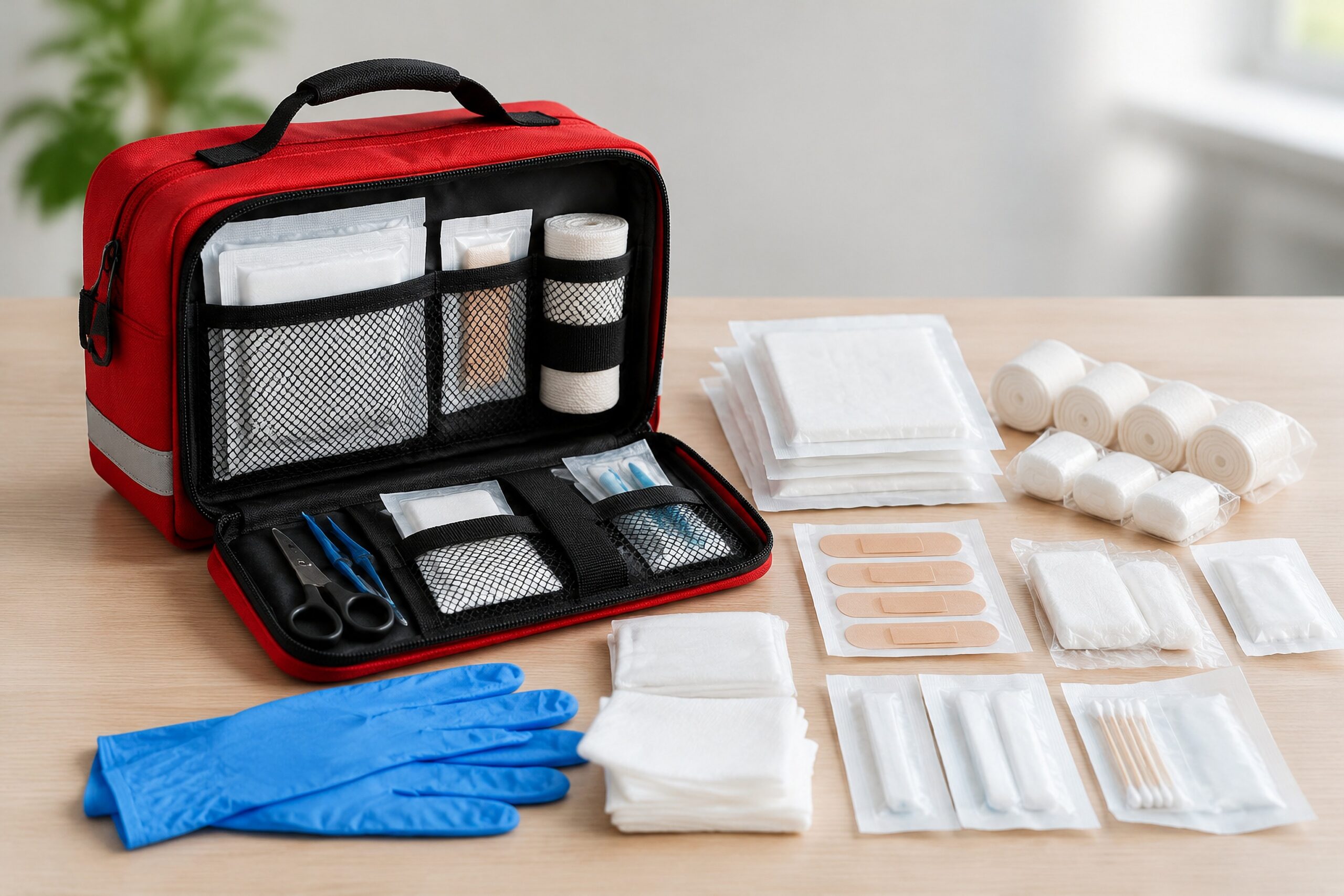
A site kit is designed around a shared location. Somebody notices when it is opened, somebody signs for restocking, and a second person can fetch it while the first one applies pressure to a wound. Remove those three conditions and the design brief changes.
The first change is reach. A kit stored in a van’s rear compartment, behind a bulkhead, is not available at the moment it is needed. Provisioning therefore starts with how the worker moves, not with how many items the box holds. Where the role involves leaving a vehicle repeatedly, a personal kit carried on the body is the only layer certain to be present.
The second change is self-application. A worker using their own kit has one hand free, and often not even that. Pouches that require two hands to unzip, loose items that spill, and packaging that has to be torn with teeth all fail this test. Single-use sachets and a pouch with a wide opening matter more here than the total item count.
The third change is the alarm. A site kit sits inside a system where someone will eventually walk past. A lone worker needs a separate route to help, whether that is a scheduled check-in, a phone with coverage at the work location, or a device that raises an alert when a timer expires. Kit provision and alarm provision are two decisions, and buying one does not deliver the other.
UK HSE guidance for tree work illustrates the standard clearly. It asks operators to carry a personal kit on the person at work, containing at least one or more haemostatic dressings, a tourniquet, a pair of plastic gloves and a resuscitation barrier or similar device. The list is short because the kit is meant to be carried, not stored.
Which rule the destination market actually imposes
Two markets dominate English-language sourcing, and they place the obligation in different places. Neither one publishes a universal contents list that a supplier can simply claim to meet.
In the United Kingdom, the Health and Safety (First-Aid) Regulations 1981 require an employer to provide adequate and appropriate equipment, facilities and personnel. What counts as adequate is decided by a needs assessment, and HSE’s guidance on first aid at work names the factors to weigh, including the needs of travelling, remote and lone workers, how close the site is to emergency medical services, and the history of accidents in the business. The same guidance points buyers toward BS 8599 when choosing a kit, then adds that a kit does not have to meet that standard by law, provided it contains what the assessment identified.
In the United States, OSHA’s medical services and first aid rule at 29 CFR 1910.151 requires adequate first aid supplies to be readily available, without listing contents. Buyers and inspectors commonly work from ANSI/ISEA Z308.1-2021, a voluntary consensus standard that defines Class A and Class B kits and four container types. Class B adds a splint and a tourniquet that Class A does not require, and the 2021 revision added a foil blanket to both classes.
| Question | United Kingdom | United States |
|---|---|---|
| Who decides the contents | Employer, through a first aid needs assessment | Employer, through a hazard assessment |
| What the law states | Adequate and appropriate provision | Adequate supplies, readily available |
| Reference standard | BS 8599, cited as guidance rather than requirement | ANSI/ISEA Z308.1-2021, voluntary consensus |
| What a supplier can state | What the kit contains and how it is packed | Same |
For a distributor, the practical consequence is that contents claims travel poorly across borders. A kit sold as compliant in one market may be a starting point in another. UneedAid supplies to buyer specification and leaves the destination-market determination with the importer, which is the only party able to confirm registration and labelling duties in the country of sale.
How many layers a lone worker first aid kit provision needs
Most under-provisioned programmes fail by buying one layer and calling it done. A lone worker first aid kit programme for field roles usually needs four layers, and each has a different replacement cycle and a different owner.
| Layer | What it is | Typical role | Check owner |
|---|---|---|---|
| Carried | Personal kit on the body or in a belt pouch | Every lone worker, every shift | The worker |
| Vehicle | Kit fixed in the cab or cargo area | Drivers, mobile technicians | Fleet or line manager |
| Base reserve | Sealed replacement stock at depot or home base | Roles with frequent use | Stores or operations |
| Alarm | Check-in schedule, phone coverage test, alert device | Roles with delayed discovery risk | Supervisor |
The layer count sets the order quantity far more than headcount does. Twenty field engineers with a carried kit, a vehicle kit and one reserve unit per five workers generate 44 kit units before any consumable top-up is considered. Splitting the order this way also keeps the consumable lines separate from the durable bag, which matters when the bag outlives several contents cycles.
That arithmetic is the same one that drives MOQ and quantity tier planning on any multi-line order. The difference is that field staff orders are usually placed once and then topped up in small quantities, so the first order has to leave spares in the right place.
Sizing the contents to the role rather than the headcount
A workplace kit is sized by the number of people it serves. A lone worker first aid kit is sized by what the single carrier is exposed to. Two roles with the same headcount can need very different contents.
- Driving and roadside work. Exposure to glass, traffic and distance from help. A compact kit that opens on a seat or tailgate matters more than depth of contents.
- Electrical and mechanical maintenance. Burn exposure and hand injuries in confined spaces. Sachet-based burn items and a small scissors pair earn their place; bulky dressings rarely do.
- Visiting care and support work. Needlestick and sharps exposure, plus infection control for the worker. Sharps-safe disposal and gloves belong in the specification conversation.
- Forestry, utilities and remote sites. Delayed discovery and heavy bleeding risk. This is where the HSE tree work list applies most directly, and where a tourniquet and haemostatic dressing stop being optional extras.
The container question follows the role as well. ANSI/ISEA Z308.1-2021 separates kit classes from container types, and the type is chosen by where the kit lives: a fixed indoor mount, a portable indoor case, a water-resistant portable case, or a case built for rough handling, moisture and impact. A kit that lives in a vehicle through a winter and a summer is a different specification from one that lives in a locker.
Material and construction claims should stay narrow. Where a bag is specified in a particular fabric, that fabric is what the buyer receives, and any change is a specification change rather than a substitution made quietly at production. Buyers who need a specific shell, colour or print should put it in the artwork and specification stage rather than assume it.
Keeping a lone worker first aid kit complete without a supervisor
The failure mode for field kits is not theft or damage. It is slow decay. One plaster used and not replaced, one expiry date passed unnoticed, one sachet removed and never returned. In an office somebody eventually opens the box and sees the gap. In a van nobody does.
Three controls do most of the work:
- Sealed unit packaging. Items packed in individual sealed units make a missing item visible at a glance, which is the least effortful inspection method available to a worker at the end of a shift.
- A contents card inside the lid. The card states what should be present, so the check is a comparison rather than a memory test. It also gives the distributor a document to reprint when the configuration changes.
- A replacement step tied to an existing routine. Restocking works when it is attached to something the worker already does, such as the weekly vehicle check or the shift handover. A separate restocking process with its own reminder usually lapses within a quarter.
Expiry management sits on top of these. Sterile items carry dates, and dates differ by item, so a single annual sweep leaves some items expired for months. A quarterly sweep against the contents card, with the shortest-dated items listed first, keeps the kit inside its dates without adding a new system.
ANSI/ISEA Z308.1-2021 includes an informative appendix on maintaining first aid supplies, and the practice it describes is inspection plus replenishment rather than replacement of the whole kit. That is also the more economical route for a field fleet, where the bag is the durable part.
For roles that combine a vehicle and a lone shift, the check cycle overlaps with fleet emergency kit planning, and the two programmes should share one inspection record rather than run in parallel. Where the worker returns to a fixed site at the end of a shift, the same contents logic feeds the workplace first aid kit configuration checklist that governs the site kit.
Two bag formats carry most of this demand. Belt and waist formats keep the kit on the body during physical work, and waist-worn emergency bags are the usual answer for technicians and inspectors. Where the kit has to hold a broader contents set and still be carried by hand between locations, hand-carry emergency bags give more volume at a weight a single person can manage all shift.
FAQ
Does every lone worker need their own first aid kit?
Not automatically, but the practical answer for most field roles is yes. A shared kit only works when workers meet at a fixed point between shifts, which excludes drivers, visiting staff and remote site workers. The test is whether the carrier can reach the kit within the minutes that matter without leaving the work position. If they cannot, the kit belongs on the person, and that means one unit per worker rather than one per team.
What should a lone worker first aid kit contain?
The contents follow from the needs assessment, so there is no universal list. As a starting point, a personal kit normally carries assorted plasters, sterile wound dressings in two sizes, a sterile eye pad, a triangular bandage, disposable gloves, cleansing wipes, tape and a guidance leaflet. Roles with heavy bleeding risk add a tourniquet and a haemostatic dressing. Roles with burn or sharps exposure add items specific to that hazard, and every addition should be traceable to a hazard the assessment identified.
Is a lone worker legally required to hold a first aid certificate?
In the United Kingdom there is no blanket rule that every lone worker must hold a formal qualification. The duty is that arrangements are adequate and appropriate, and HSE guidance leaves the training decision to the needs assessment. In practice many employers train lone workers in emergency first aid at work, because the carrier may be the only person present. In the United States, OSHA requires trained personnel for first aid response in the absence of an infirmary or clinic nearby, which has a similar practical effect.
Can a lone worker use a site kit instead of a personal one?
Only where the worker stays within reach of that kit for the whole shift. A site kit is a shared resource at a known location, and using it as the primary provision for a mobile role assumes the worker can return to that location while injured. For drivers, inspectors and remote site staff that assumption fails. The reasonable pattern is a personal kit for the carrier plus a site or vehicle kit as the second layer, not one replacing the other.
How often should a lone worker first aid kit be checked?
A monthly inspection is a common baseline, with an additional check after any use and before a long or distant assignment. The more useful question is who performs it. Where the worker self-checks, the check needs to be short enough to survive a busy shift, which is why sealed unit packing and a lid contents card matter. Where a supervisor checks, the interval can be longer but the kit must come back to base, which many field roles do not do.
Provisioning starts with the carrier, not the catalogue
The specification that survives contact with a field team is the one built around a single person’s reach, one hand’s worth of dexterity, and a check that happens without a supervisor watching. Contents come after those three constraints, and the container comes after the contents.
For distributors building a field programme, the sequence is worth repeating on every order: fix the layers, choose the format that the role can actually carry, size the contents to the hazard, then write the check cycle into the shift routine. UneedAid supplies these kits to buyer specification, with configuration and branding discussed against the order type, and with destination-market confirmation left where it belongs, with the importer.
Where the technician works alone for most of the shift, the provisioning logic in field service first aid demand explains how vehicle kits and grab bags divide the load.
Where a lone-worker configuration includes a carried bag rather than a fixed box, the tactical medical bag specification notes set out the harness, compartment and marking decisions that have to be fixed in the brief.