
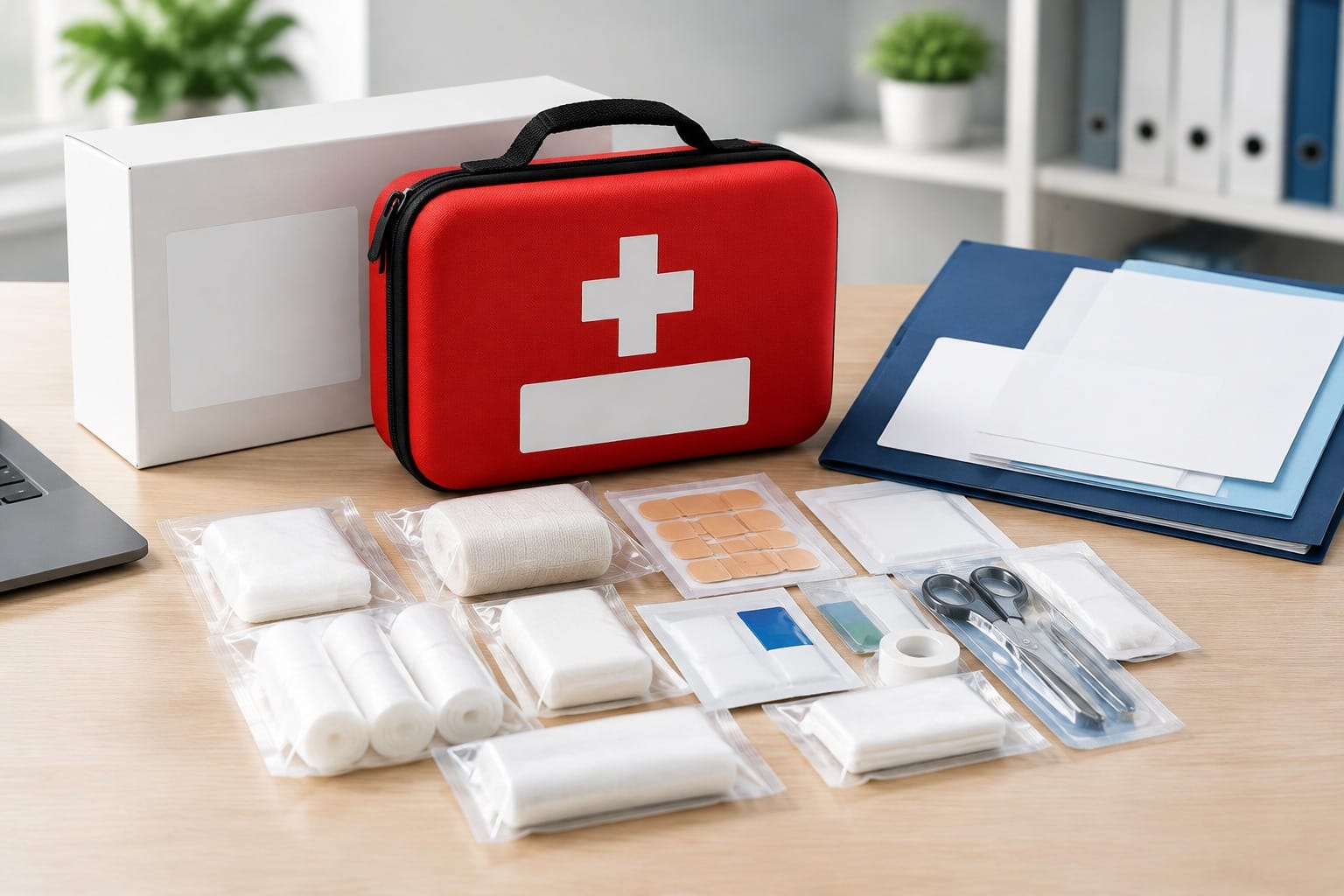
An importer of first aid kits discovers the retention rule the hard way. A customs authority requests the invoice behind an entry from two years ago, the file exists as an email attachment in a mailbox that has since been archived, and nobody can say which classification code was used or why.
Import record keeping medical products is not bookkeeping in the ordinary sense. It is a retrievable file that a customs authority can demand years after the goods cleared, and the useful test is not whether the records exist somewhere but whether they can be produced on request.
This guide covers what belongs in that file, how long the major markets require it, and why first aid products carry a few record types that general import guidance tends to skip.
Import Record Keeping Medical Products: The Four Groups

Most import files are organised by shipment date. That arrangement becomes useless during an audit, because the question asked is rarely “what shipped in March” and usually “why was this product classified this way”. Import record keeping medical products works better in four groups.
| Group | Typical contents | Why it is asked for |
|---|---|---|
| Commercial | Commercial invoice, proforma invoice, purchase order, contract | Establishes the declared value and the transaction the entry rests on |
| Transport | Bill of lading or airway bill, packing list, freight invoice | Connects the goods to the shipment and supports the declared freight |
| Entry | Entry summary, duty calculation worksheet, broker power of attorney | Shows what was declared and by whom |
| Technical | Product specification, component list, labelling artwork, classification rationale | Justifies the code and supports any later challenge |
The first three groups are familiar to anyone who imports regularly. The fourth is the one that gets lost, and it is the one that answers the hardest questions.
A classification rationale is a short internal note recording which code was chosen, which product characteristics drove that choice, and what documentation supported it. It takes ten minutes to write at the time of entry and a week to reconstruct three years later from invoices alone. Keeping the rationale is the single highest-return habit in import record keeping medical products.
The technical group also matters for a specific reason in this category. First aid kits are assembled from many components, and the classification of an assembled kit is not automatically the classification of its parts. A file that holds the component list and the specification sheet alongside the entry gives a reviewer what they need without a rebuild.
How Long Must Import Records Be Kept?

Retention periods differ by market, and the clock usually starts from the end of the year rather than from the import date itself.
In the United States, 19 CFR 163.4 sets a general period of five years from the date of entry for records relating to an entry, or five years from the date of the activity that required the record to be created. The regulation then lists exceptions, and three of them matter to importers: drawback claim records run to the third anniversary of payment, packing lists carry a much shorter period, and a consignee that is not the owner or purchaser and appoints a customs broker keeps records for informal entries for two years.
In the European Union, Article 51 of Regulation (EU) No 952/2013 requires the documents and information needed for customs controls to be kept for at least three years, by any means that the customs authorities can access and accept. That period runs from the end of the year in which the declarations for release for free circulation or export are accepted. Two extensions are written into the same article: where a customs control shows an entry in the accounts must be corrected and the person has been notified, the records must be kept three years beyond that period, and where an appeal or court proceeding has begun, retention continues until it ends. The article text is also published in full by the United Kingdom legislation service.
Two practical rules follow from reading the two regimes side by side.
- Retention is per record, not per company. Each entry starts its own clock, so a business importing continuously is always holding records at several different ages.
- The longest applicable period sets the file policy. Where a company imports into several markets, aligning the whole file to the longest period removes the need to decide record by record.
Three years and five years are minimums set by customs law, and other obligations can extend them. Whichever period applies, the structure of import record keeping medical products does not change; only the age of the file does. Product liability, tax and accounting rules in the destination market may require retention beyond the customs period, and the customs file usually becomes part of that wider archive rather than a separate one.
Which Records Does a Customs Authority Ask For First?
The records tied directly to entry and admissibility. Import record keeping medical products starts with these documents, because they show what the goods were, what they were worth and where they came from, and they are the first set requested in a verification.
A working list drawn from the entry record categories used by customs authorities:
- Commercial and proforma invoices, including any revision that changed the price
- Packing lists for each carton configuration shipped
- Bills of lading and airway bills matching the entry
- Entry summaries and duty calculation worksheets
- Certificates of origin and any preferential duty documentation relied on
- Classification rationale and any binding ruling the entry depended on
- Broker power of attorney and correspondence that amended the declaration
Two structural points about this list. First, records may be held electronically, provided the system can produce legible records on demand without specialised help from the importer, and provided the records are not altered after creation. Second, the obligation attaches to records made or kept in the ordinary course of business, so an invoice that only exists inside a personal mailbox is a weak answer to a formal request.
For first aid importers, one further category belongs on the list. Where a product is subject to import restrictions or additional controls, the authorisation or exemption documentation behind its release belongs in the same file. The record set for restricted items is longer than the record set for a general consumable, and it is worth building that set before the first shipment rather than after the first question.
What Makes a First Aid Record Set Different?
Three features of the category create record types that general import guides underplay, and each one adds a document to the import record keeping medical products file.
Assembled kits have component records. A kit is a bundle of separately classified items. The file needs the component list at the version that was actually shipped, because a supplier may substitute a component between orders and the substitution can change the classification of the assembled product.
Documentation is produced per SKU. Where a supplier issues documentation by item code, the importer’s file should mirror that structure rather than reorganise documents by shipment. A SKU-based file answers a product question in one step, while a shipment-based file requires a search across every consignment that carried the item.
Labelling and language rules generate their own documents. Destination markets impose their own labelling and language expectations, and the artwork actually applied becomes part of the compliance record. The same logic applies to shelf-life and expiry information on consumables, where the date printed on the carton is evidence of what was shipped. Product categories such as the wall-mounted emergency box range and the case-style supply box range illustrate the point: an assembled kit ships with a component list, artwork and packaging specification, and all three belong in the technical group.
Because the assembled product’s status depends on destination rules that the importer is closest to, confirmation of what applies sits with the buyer. The supplier’s role is to hand over the specification, component and packaging documents at the version shipped, and to keep them stable across repeat orders. Where a product falls under import restrictions, the documentation set is wider again, as the restricted items overview sets out, and the record file has to carry the corresponding paperwork. Buyers who need to confirm what a supplier can actually evidence should approach the certification status check as a documentary question rather than a marketing one, and the labelling and language requirements guide covers the artwork side of the same file. Storing a standard supply box configuration as a specification also makes it easier to compare what was ordered against what arrived.
How Should a Small Importer Build This File?
Start with the structure, then backfill. Rebuilding three years of entries from an archive is expensive, but it only has to happen once, and the work shrinks every year afterwards.
- Name the retention owner. One person accountable for the file, not a shared folder nobody owns.
- Adopt the longest applicable retention period. Three years and five years are both in play, so choose the longer and stop deciding case by case.
- Index by SKU as well as by entry. Two indexes over one document store cost almost nothing and answer both types of question.
- Write the classification rationale at entry. It is the only record that cannot be reconstructed from the commercial documents.
- Test retrieval once a year. Pick an entry at random and produce the full requested set within the response window.
The fifth step is the one that converts a policy into a capability. A file that has never been retrieved under time pressure tends to have one gap nobody has noticed, and it is usually the classification rationale.
FAQ
How long do importers have to keep customs records?
It depends on the destination market. In the United States, 19 CFR 163.4 sets a general period of five years from the date of entry, with shorter periods for specific record types. In the European Union, Article 51 of Regulation (EU) No 952/2013 requires documents and information relevant to customs controls to be kept for at least three years, extended by three more years where an entry in the accounts has to be corrected.
Can import records be kept electronically?
Yes, in both the United States and the European Union, provided the system meets the conditions the authority sets. The usual requirements are that the records can be produced in a legible form on demand, that they can be read without specialised assistance from the importer, and that they are not altered after creation. Records held only inside personal email accounts usually fail the retrieval test even when they technically exist.
What is a classification rationale and why does it matter?
It is a short internal note recording which tariff code was applied to a product, which characteristics drove the choice, and which documents supported it. It matters because classification is the question most likely to be challenged years later, and the note cannot be reconstructed from invoices. For assembled first aid kits the note should also record how components were handled, which is why import record keeping medical products counts it as a required record rather than an optional one.
Do first aid kits need extra records compared with other goods?
They need the same core set, plus component-level documentation. Because a kit is assembled from separately classified items, the file should hold the component list at the version actually shipped, together with the specification and artwork. Where a product falls under import restrictions, the authorisation or exemption documentation behind its release belongs in the same file.
Who is responsible for keeping import records, the supplier or the buyer?
The importer of record carries the obligation, which is normally the buyer. Suppliers contribute by issuing the specification, component and packaging documents at the version shipped, and by keeping those documents stable across repeat orders. Responsibility for confirming what the destination market requires remains with the importer, because the rules attach to the market of import rather than to the market of manufacture.
Building the File Before It Is Requested
Import record keeping medical products rewards the same discipline as any other compliance task: decide the structure while the shipment is small, and the file scales without special effort. Decide it after the first verification request, and the cost lands at the worst possible moment.
The practical minimum is one owner, one retention period set to the longest applicable market rule, and one classification note per product written at the point of entry. Everything else in the file can be reconstructed from documents that already exist. The classification note cannot, which is why it is worth writing while the reasoning is still in the room.
Records only exist because a duty created them, and this look at regulatory burden by destination explains which duty generates which record.