
A distributor can fill a catalogue with dozens of first aid SKUs and still miss the products that buyers reorder. The problem is usually mix design, not the size of the catalogue. A workable wholesale first aid products assortment connects one buyer segment to a clear use case, a manageable price ladder, a replenishment item and the documents required for that destination market.
Start with a narrow assortment map. Select a core kit or bag for the channel, add consumables that create repeat orders, then add a small number of optional formats. Keep the product revision, packaging assumptions and destination market visible in the RFQ. This approach gives sales teams a coherent offer and gives procurement teams comparable information when they request samples or quotations.
What should a wholesale first aid products assortment achieve?

An assortment has four jobs. It must be easy for a buyer to understand, feasible for a supplier to quote, suitable for the channel and economical to replenish. A large list without these links creates internal work while leaving the buyer to design the offer themselves.
Use the following test for each proposed SKU:
- Use-case fit: Which workplace, outdoor, vehicle, school, industrial or emergency-response situation does it serve?
- Buyer fit: Which account type is expected to stock it: regional distributor, safety reseller, pharmacy wholesaler or institutional procurement partner?
- Commercial role: Is it an opening-price item, a standard configuration, a premium specification or a repeat consumable?
- Operational fit: Can the product be sampled, documented, packed and replenished on a realistic schedule?
The World Health Organization describes first aid as immediate assistance provided for illness or injury until professional help is available. That broad purpose does not define a commercial SKU. A distributor still needs to specify contents, quantities, format, labeling and intended market. Use the WHO first aid overview for general context, then validate every product claim and destination requirement with the responsible importer.
Which product families belong in the core mix?
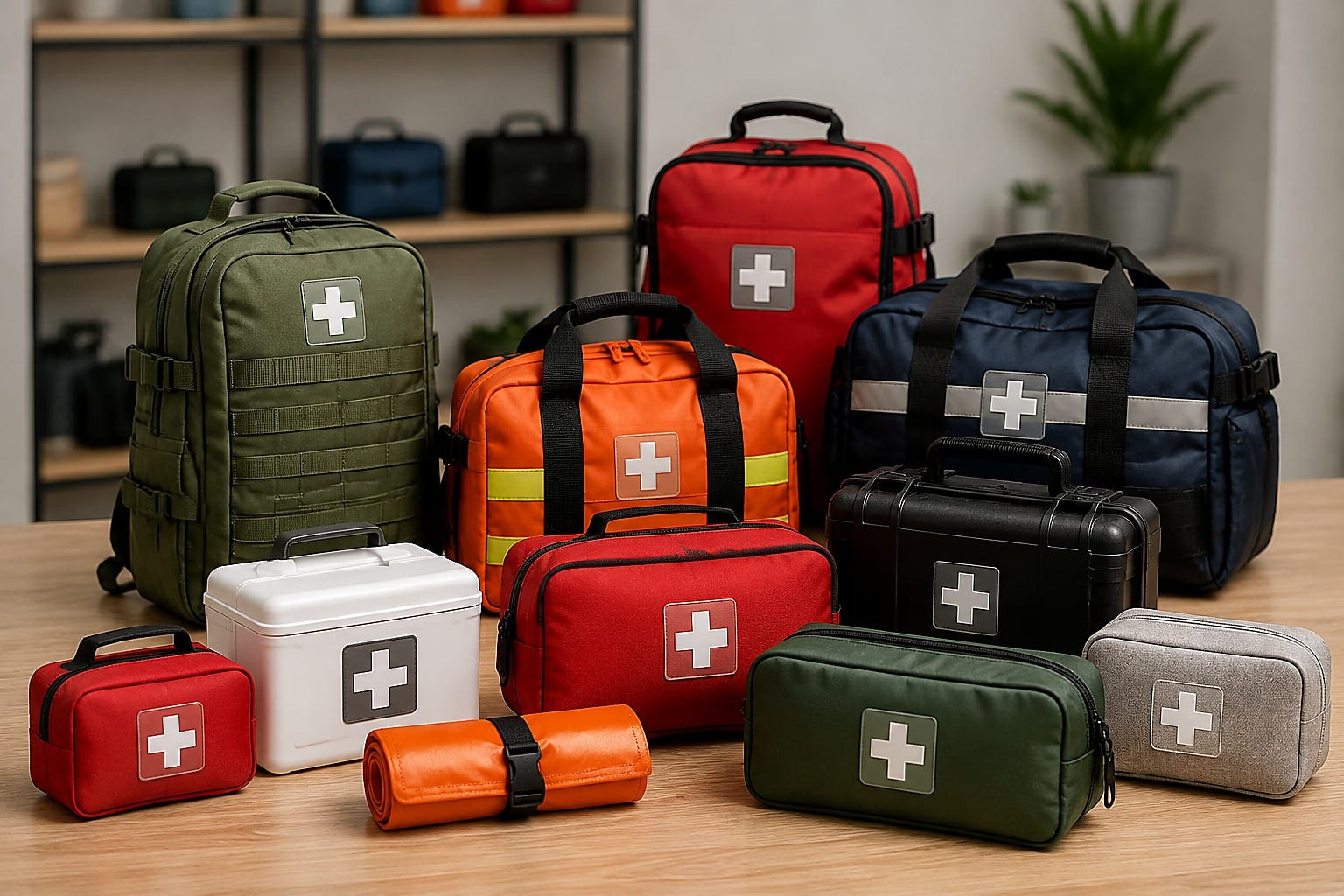
Build the assortment by function rather than by supplier catalogue order. The table below gives a starting architecture for wholesale first aid products. Actual contents and feasibility must be confirmed by SKU.
| Product family | Role in the assortment | Typical buyer question | Replenishment pattern |
|---|---|---|---|
| Equipped first aid kits | Ready-to-stock solution for a defined use case | What is included and for how many users? | Periodic replacement, contract or project order |
| Empty bags and boxes | Lets a distributor add local contents or private-label packs | Can our own BOM and artwork fit the container? | Container reorder plus local component fill |
| Bandages, gauze and dressings | High-frequency consumables that support repeat sales | What sizes, pack counts and sterile status are available? | Regular replenishment by pack or case |
| Gloves and CPR barriers | Adds workplace and responder coverage | Which sizes, materials and packaging are offered? | Replenishment tied to training or workplace use |
| Burn, eye-wash and irrigation items | Use-case extension for industrial or outdoor channels | What documents and shelf-life data accompany the item? | Seasonal, project or scheduled replacement |
| Emergency response tools | Raises order value for specialist channels | Is the tool compatible with the bag and training plan? | Lower frequency, often project-led |
The equipped and customizable first aid kit category can anchor a standard configuration. Use the first aid supplies and consumables category for repeat items, and add an emergency medical bag format when the channel needs portable response equipment. These category pages are starting points for an RFQ, not a statement that every configuration is suitable for every country.
How many SKUs should a distributor launch first?
There is no useful universal SKU count. The right launch size depends on sales coverage, warehouse capacity, buying cycles and documentation workload. A practical first range is a small set that can be explained in one meeting and compared in one quotation sheet.
Separate the range into three layers:
| Layer | Purpose | Selection rule |
|---|---|---|
| Core | The item a sales team leads with | One clear use case, stable specification and defined target buyer |
| Options | Choice without catalogue sprawl | Change one major variable, such as format, pack count or contents |
| Replenishment | Creates a repeat-order path | Components with predictable usage and pack-level pricing |
For example, a workplace reseller might lead with one equipped kit, offer a compact and larger version, and add bandages, gauze and gloves as replenishment lines. A vehicle-safety distributor may need a durable bag and a smaller refill pack instead. The channel determines the sequence.
Avoid launching several versions that differ only in color or minor trim. Those variations consume stock and artwork effort while providing little evidence about buyer demand. Add a new variant after a named account requests it or after a test shows a clear use-case gap.
How should price tiers and pack sizes be designed?
Buyers compare delivered economics, not only unit price. A wholesale first aid products range should show a simple ladder that distinguishes opening quantity, standard order and higher-volume planning. Keep the delivery basis, packaging and one-time charges the same when comparing tiers.
| Tier | Commercial purpose | Information to show |
|---|---|---|
| Sample or evaluation | Confirms specification and workmanship | Sample cost, preparation time, revision code |
| Trial quantity | Tests a channel with controlled exposure | Quantity, packing, delivery basis and review date |
| Standard wholesale | Supports routine distributor replenishment | Unit price, carton details, lead-time assumption |
| Volume project | Covers tenders or seasonal allocations | MOQ driver, capacity check and document plan |
Pack sizes should follow the buyer’s operating unit. A reseller may need inner packs for shelf handling, while an institutional buyer may purchase case quantities. Ask for the intended sales unit, monthly or seasonal volume and target resale band before finalizing the quote. The first aid distribution strategy framework explains how channel economics affect the offer; apply that framework to each SKU rather than averaging unlike products.
Do not use a low headline price to hide freight, artwork, testing or small-lot charges. List those items separately. A transparent quotation helps the distributor decide whether to hold stock, use a drop-ship model or consolidate a purchase across accounts.
What documentation belongs in the assortment file?
Documentation is part of the product offer. For each SKU, keep a controlled file with the product identifier, revision date, component list, material description, packaging, label language, shelf-life information where applicable and available test or conformity documents. State which documents are supplied by the factory and which must be obtained or confirmed by the importer.
Destination rules vary by product type and market. The European Commission medical devices overview and the U.S. FDA medical device guidance hub show why a distributor should not assume that one document set fits every destination. The buyer remains responsible for confirming classification, labeling, registration and import obligations before placing a production order.
Keep the assortment file synchronized with the sample and quotation. If a component, pack count or label changes, issue a new revision. This prevents a buyer from approving one version while procurement prices another.
How can distributors test the mix before scaling?
Run the initial range as a controlled channel test. Choose one buyer segment and one priority market. Present the same product brief, sample images and price basis to each account, then record comparable events. This wholesale first aid products test should use one revision code across the account set.
Track at least:
- qualified replies with company type, destination and target quantity;
- sample requests and specification questions;
- RFQs that include a delivery window or pack requirement;
- trial orders, sell-through feedback and reorder timing; and
- objections grouped by contents, price, format, documentation or lead time.
The distributor demand-testing method gives a structured way to classify these signals. A page visit or general enquiry indicates attention. A sample request or specification review shows stronger intent. A trial purchase and repeat request provide evidence that the mix works for that account, subject to margin and compliance review.
Set the decision rule before outreach. For example, keep a core SKU when several qualified accounts request the same revision and at least one account progresses to a trial order. Revise or remove a SKU when objections repeat and no account accepts the specification after the agreed test period. Record the reason so the next RFQ does not restart the same discussion.
What is the handoff from assortment planning to an RFQ?
Once the mix is coherent, convert it into an RFQ pack. Include a numbered SKU list, approved or requested BOM, pack and carton assumptions, artwork status, target quantities by tier, destination, delivery basis and required documents. Ask the supplier to identify the MOQ driver for every customized line and to separate fixed charges from unit pricing.
Review component continuity before committing to a range. If one bag, insert or consumable is shared across several SKUs, a change to that component can affect every listing. Agree how revisions will be communicated and how repeat orders will reference the approved sample.
Finally, assign ownership. Sales owns account feedback, procurement owns quote comparison, quality or compliance staff own document review, and the importer confirms destination-market obligations. Clear ownership keeps the assortment useful after the first order.
FAQ
What is a wholesale first aid products assortment?
A wholesale first aid products assortment is a planned set of kits, bags, consumables and related tools offered to business buyers through a defined channel. It is organized around buyer use cases and operating units rather than an unfiltered catalogue. A sound assortment identifies the role of each SKU, its target account, pack size, price tier, documentation status and replenishment path. The assortment may include a standard kit, optional formats and refill items, but each variation should have a commercial reason. Product specifications and destination-market requirements still need confirmation by SKU. The term describes a sourcing and merchandising structure; it does not imply that every item has the same regulatory classification or can be sold in every market.
Should a distributor start with kits or individual consumables?
Start with whichever format matches the channel’s buying event, then connect the other format as an extension. A workplace reseller may lead with an equipped kit because the buyer wants a ready configuration, while a pharmacy wholesaler may lead with bandages, gauze or gloves that move as repeat items. Kits can establish the use case and order value. Consumables can create a replenishment path. Test the connection with account feedback instead of assuming that a kit buyer will purchase every refill. Keep the BOM, pack count and label version controlled so the quotation and any sample refer to the same specification.
How can I prevent too many SKUs?
Give every proposed SKU a defined role and a review date. If two items serve the same buyer, use case and price band, combine them unless a documented account requirement supports both. Limit early changes to one major variable, such as contents, pack count or container format. Track inventory exposure, sample effort, artwork revisions and quote frequency alongside sales interest. A SKU that receives views but no specification questions may be a messaging issue, while a SKU that repeatedly receives the same objection may need revision or removal. Review the range after a set pilot period and keep the decision record with the assortment file.
Which documents should be requested before a bulk quote?
Request the product specification, component or BOM list, packaging and label details, available test or conformity documents, shelf-life information where applicable, carton data and the supplier’s revision code. Ask which documents are standard and which require a project request. Then map those documents to the destination market and product classification. The importer or distributor must confirm local obligations, including labeling, registration and language requirements. A document list is not a regulatory conclusion. It is a control sheet that shows what has been received, what is still under review and who owns the next check before production.
How often should a distributor refresh the assortment?
Refresh it when evidence changes, not on a calendar alone. Review reorder data, lost-quote reasons, sample feedback, document changes, supplier continuity and channel strategy at a defined interval. Seasonal channels may need a review before their buying window; institutional channels may require a review after a tender cycle. Keep the core specification stable when it is working, and introduce variants through a separate revision and test. Remove or hold items when the required documents cannot be confirmed, the MOQ no longer fits the channel or repeated buyer feedback shows a mismatch. Record the decision and effective date so sales and procurement use the same range.
Building a wholesale first aid products assortment is a channel exercise before it is a catalogue exercise. Choose a clear buyer, define the use case, connect a core item to replenishment, show transparent tiers and keep documentation tied to each revision. That structure gives a distributor a practical base for sampling, RFQs and repeat orders.
Range decisions only hold up if the lines in the range keep moving, which is why first aid distributor metrics such as sell-through rate and expiry exposure belong in the same review as the assortment plan.
Assortment planning assumes that a reordered line stays the same line, which is why a written component baseline and change notice belong next to the range plan rather than in a quality folder.