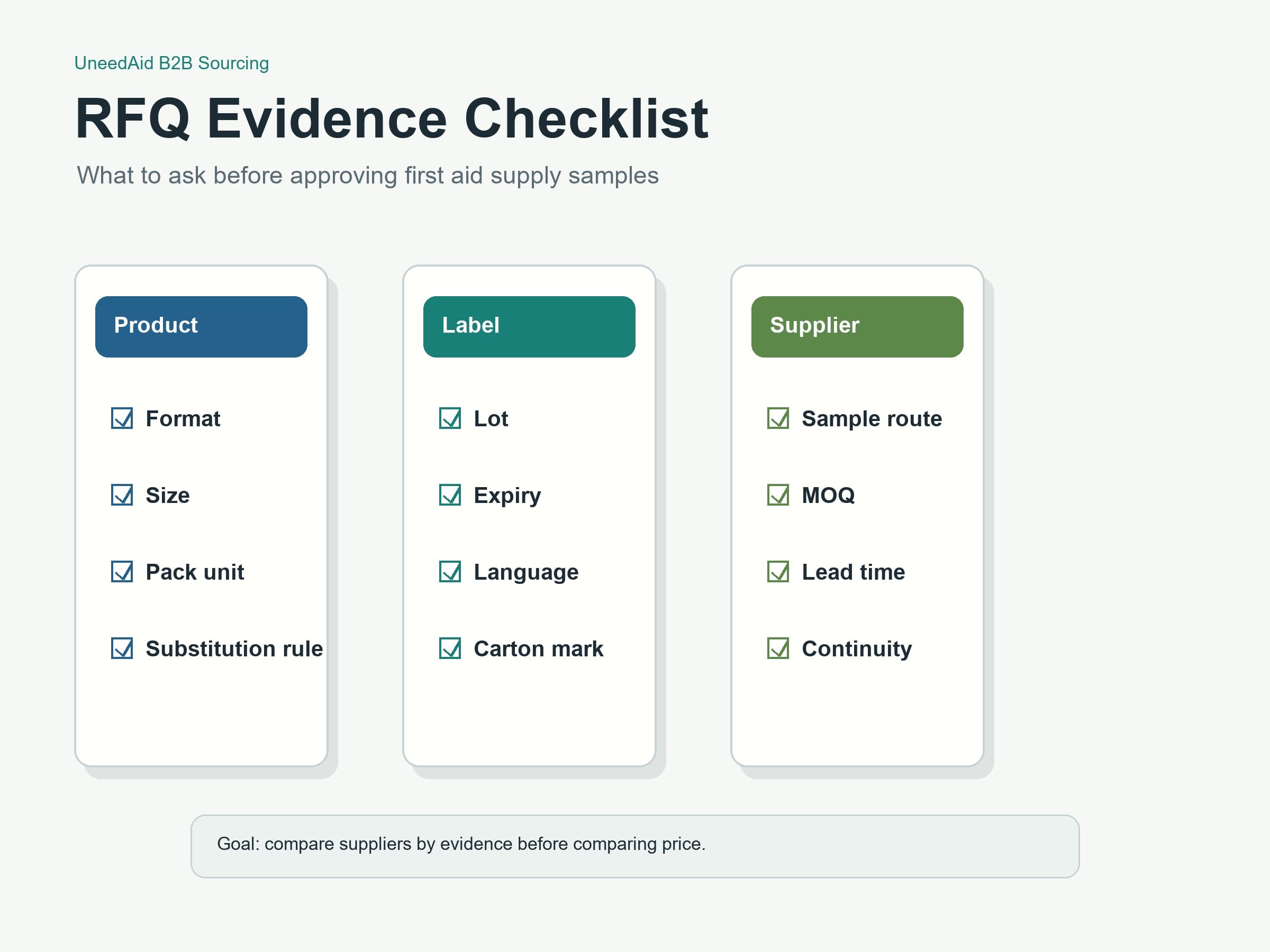
A distributor can receive a first aid supplies quote that looks complete, then discover during sample review that expiry labels, sterile-barrier wording, refill quantities or carton marks are missing. A practical first aid supplies sourcing guide should help B2B buyers compare product formats, documentation, packaging, MOQ, repeat-order continuity and RFQ details before they approve samples or place bulk orders.
For UneedAid buyers, this hub is a procurement checklist. It is not medical guidance, and it does not replace destination-market review. Instead, use this first aid supplies sourcing guide to organize supplier questions for dressings, gauze, eyewash, barriers, hot and cold therapy, kit refills and private-label first aid supply programs.
Start with the buying context, not the product photo. First aid supplies are often quoted as simple consumables, but the actual order may support a workplace kit program, reseller catalog, institutional tender, outdoor kit, vehicle kit, tactical-style assortment or OEM/ODM refill project. Each route changes the checks that matter.
For a first screen, separate the project into six fields:
In practice, this structure keeps the RFQ practical. A supplier can quote the same item in bulk inner packs, retail blister cards, kit refill pouches or private-label cartons. Therefore, the buyer needs to know which route is being quoted before comparing unit cost.
OSHA’s interpretation of 29 CFR 1910.151(b) says adequate first aid supplies should be readily available, and it notes that ANSI/ISEA Z308.1-2021 is often used as guidance rather than an OSHA-adopted mandatory standard for general workplaces. That distinction matters for B2B sourcing: a buyer may ask for ANSI/ISEA Z308.1-2021 alignment, but the importer or end customer still confirms how the kit contents, workplace placement and labels fit the destination market.
A hub-level first aid supplies order usually mixes several product families. First, the buyer should map them before requesting samples, because each family has a different evidence burden.
| Product family | Typical B2B buying question | Evidence to request |
|---|---|---|
| Sterile dressings and pads | Is the size, absorbency, sterile-barrier pack and expiry format clear? | SKU spec sheet, pouch artwork, lot and expiry layout, carton mark |
| Gauze rolls and compressed gauze | Is the weave, fold, compression, packaging and reorder unit consistent? | Material description, dimensions, sample photos, pack unit and carton loading |
| Eyewash bottles and rinse supplies | Is fluid type, volume, shelf life and replacement cycle visible? | Bottle label, fluid documentation, lot record format, carton configuration |
| Gloves and CPR barriers | Is material type, size range, barrier format and unit packaging defined? | Material declaration, size chart, inner box layout, label draft |
| Hot and cold therapy | Is activation method, storage condition and carton packing suitable for the route? | Instruction draft, unit weight, leak-control notes, carton test notes if available |
| Kit refill modules | Does the refill list match the buyer’s installed kit program? | Refill checklist, substitution rule, dated item list, reorder SKU map |
For assortment planning, buyers can use UneedAid’s first aid product categories as the broad entry point, then narrow the review through wound care consumables or eye wash and rinse supplies.
Also, the map keeps product claims in check. A sterile pad, an absorbent dressing and a hemostatic gauze are not interchangeable just because all three sit under wound-care supplies. The supplier should describe what the SKU is, how it is packed and what evidence is available. As a result, the buyer can avoid catalog wording that expands the product role beyond the supplier’s verified specification.
Dressings and pads create hidden variation in B2B orders. Two samples can share the same nominal size but differ in pouch size, folded dimension, absorbent layer, backing material, edge seal, individual pack strength and carton count. Those details affect private-label layout, refill lists and repeat-order consistency.
For dressings, request the following before approving a sample:
FDA labeling guidance is useful as a reference point for documentation discipline. The FDA notes that labels should remain legible through customary distribution, storage and use, and that control numbers or expiration dates, when used, should be checked as part of label control. For B2B buyers, the sourcing takeaway is simple: do not approve artwork only because it looks neat. Instead, check whether lot, expiry, storage wording and product identity remain readable after private-label changes.
The related Israeli emergency bandage sourcing framework goes deeper into pressure bandage format, component continuity and private-label sampling. This hub uses the same logic for general dressings: define the component, verify the pack and document what can be repeated.
Gauze is easy to over-simplify. A buyer may ask for gauze pads, rolls, compressed gauze and hemostatic gauze in one RFQ, but those products serve different catalog roles and need different comparison fields.
Use this split:
| Gauze format | What changes in sourcing | What to confirm before bulk order |
|---|---|---|
| Sterile gauze pad | Size, ply, pouch, sterile-barrier pack, expiry field | Size tolerance, pouch artwork, lot and expiry, carton count |
| Gauze roll | Width, length, stretch, edge finish, pack type | Roll dimension, compression level, inner pack, carton loading |
| Compressed gauze | Fold pattern, compression density, vacuum pack or pouch | Packed size, open length, shelf-life label, reorder unit |
| Hemostatic gauze | Active material route, regulatory status, destination review | Technical file availability, label wording, sample approval process |
The civilian hemostatic gauze sourcing guide explains how buyers can compare kaolin, chitosan-style and plain compressed formats from a procurement perspective. For this hub, the key point is not to benchmark all gauze by price per piece. Price per usable roll, price per packed module, expiry risk and documentation burden may tell a different story.
Buyers should also ask how gauze will be used in refill packs. For example, a distributor may need pads in retail-ready boxes, while a kit assembler may need bulk pouches organized by module. A private-label buyer may need a gauze roll with neutral product text and a custom carton. Those are different SKUs for operations, even when the base product is similar.
Eyewash products often sit between workplace safety, first aid refill and emergency supply categories. The buyer should define whether the RFQ covers small eyewash bottles, sterile saline bottles, rinse solution, portable station refill packs, eye pads, eye shields or complete station programs.
For bottles and refill fluids, confirm:
The eyewash station solution sourcing guide covers fluid type, shelf life and refill economics in more detail. For a broader hub order, eyewash should be tied to replacement planning. If the buyer sells eyewash bottles as kit refills, carton count and expiry rotation may matter more than bottle appearance. However, if the buyer supports workplace eyewash stations, refill interval, inspection label and matching station compatibility become part of the same RFQ.
Future cluster work should reserve clear internal-link space for three topics: portable emergency eyewash stations, eye pads and shields, and ocular dressing modules. Later, those pages should connect back to this hub when they are drafted or updated, because eye-care products need a different checklist from general wound-care consumables.
Documentation does not have to be complex, but it must be tied to the actual SKU. In other words, a buyer cannot rely on a generic product image when the order depends on expiry dates, sterile-barrier wording, importer labels or destination-market files.
Ask for a document pack in this order:
| Document | Why it matters | When to request it |
|---|---|---|
| SKU specification sheet | Confirms size, material, pack unit and intended label route | Before sample dispatch |
| Label artwork or pouch artwork | Shows product identity, lot, expiry and language fields | Before sample approval |
| Carton mark draft | Confirms product name, quantity, gross weight and handling fields | Before bulk order |
| Available test or conformity files | Shows what evidence exists for the SKU or component | Before customer submission |
| Shelf-life or stability statement where applicable | Links expiry dating to storage condition and product route | Before final artwork |
| Sterile-barrier packaging reference where applicable | Confirms what part of the item is sterile and how it is packed | Before private-label approval |
The FDA’s medical-device labeling guidance says labels and user instructions should stay legible during customary distribution, storage and use. In addition, FDA material on recognized consensus standards lists ISO 11607-1 for packaging of terminally sterilized medical devices, which is relevant as a reference point when buyers discuss sterile-barrier packaging. These references do not mean a supplier can promise market clearance for every order. They simply show why document wording, packaging integrity and label control should be checked before the buyer commits to volume.
Therefore, keep one rule in the RFQ: evidence should match the item being quoted. A file for one gauze size should not be treated as evidence for a different format, a different pouch or a private-label version unless the supplier explains the relationship clearly.
A first aid supplies supplier should be evaluated on repeatability, not only on a single sample. At first, the first shipment may pass visual review. However, a distributor’s real problem often appears on the second or third reorder when packaging, pouch material, carton count or refill mix changes without notice.
For sample validation, build a comparison sheet with these fields:
MOQ deserves special attention. A supplier may support low MOQ on standard items but require higher MOQ for private-label pouch printing, custom carton marks or refill-module assembly. Ask the supplier to separate MOQ by operation:
| Operation | Possible MOQ driver | Buyer question |
|---|---|---|
| Stock consumable supply | Existing stock or standard production batch | Can the same SKU code be repeated? |
| Private-label pouch | Printed film or label run | What is the minimum artwork batch? |
| Custom refill module | Assembly labor and component allocation | Can modules be reordered without changing contents? |
| Carton mark customization | Carton printing or label application | Is custom carton marking separate from product MOQ? |
| Mixed-category shipment | Consolidation and export packing | Can wound care, eyewash and barriers ship together? |
For private-label and assortment work, UneedAid’s OEM/ODM project route is the natural path for sample review, artwork discussion and component continuity. Buyers with a ready project brief can submit product format, target quantity and document needs through the B2B portal. Meanwhile, buyers who are still building an assortment can use the catalog center to review category coverage before sending a full RFQ.
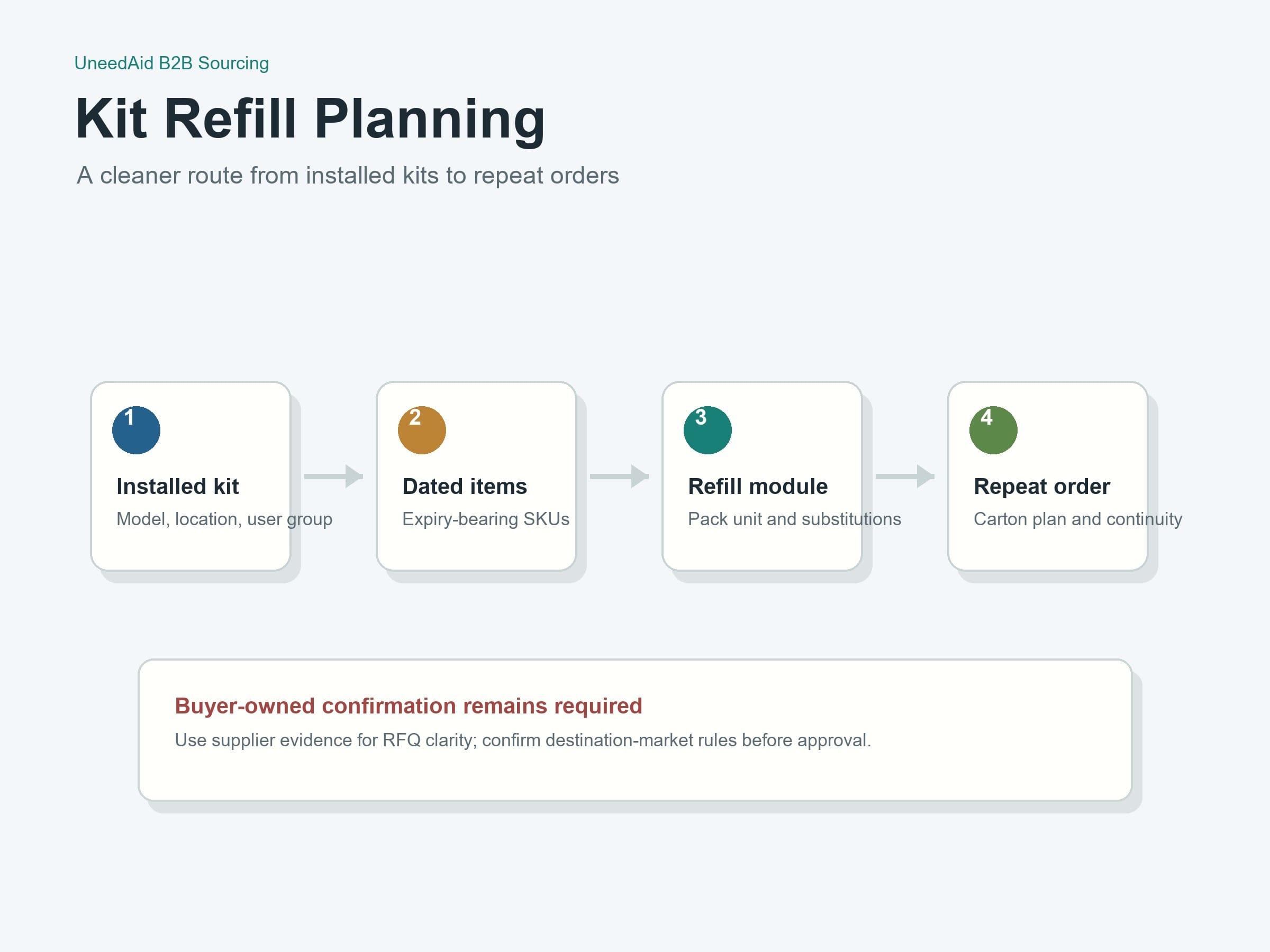
Refill sourcing is different from buying loose supplies. A refill order must match an installed kit population, a distributor catalog or a customer replacement schedule. If the refill list changes casually, the buyer may create downstream confusion for branches, resellers or tender customers.
Use a refill matrix:
| Refill field | What to record | Why it matters |
|---|---|---|
| Original kit model | Buyer kit code, box type or bag type | Keeps refill set tied to the correct installed kit |
| Item list | Product name, size, quantity and pack unit | Reduces missing-item disputes |
| Dated items | Eyewash, sterile pads, gloves or other expiry-bearing items | Supports replacement planning |
| Substitution rule | Allowed equivalent, approval step and label change | Protects repeat-order consistency |
| Module format | Loose pack, refill pouch, inner box or compartment set | Affects assembly and receiving checks |
| Outer packing | Carton quantity, carton mark and pallet plan | Affects landed cost and warehouse receiving |
For workplace-oriented buyers, the OSHA SHMS manual gives a practical example of periodic kit inspection and replacement of expired items in its internal program guidance. A B2B supplier should not present that as a universal rule for every destination. Still, it supports a useful procurement habit: refill SKUs should make inspection and replenishment easier.
Distributors should also define whether they want refill packs by kit size or by supply family. A “25-person refill pack” is simple for catalog buyers but may vary by market. By contrast, a wound-care refill pack, eyewash refill pack or glove-and-barrier refill pack can be easier to adapt across product lines. The choice affects SKU count, inventory and future content planning.
Before sending an RFQ, gather the minimum information that lets a supplier quote correctly. This first aid supplies sourcing guide uses the following fields as the minimum practical set:
Then turn those fields into a short RFQ table:
| RFQ line | Example buyer input | Supplier response needed |
|---|---|---|
| Product family | Sterile gauze pads, eyewash bottles, CPR barriers | Available SKU list and sample route |
| Quantity | 5,000 pieces per SKU or 1,000 refill modules | MOQ, lead time and carton plan |
| Packaging | Neutral pouch plus importer carton mark | Artwork feasibility and extra MOQ |
| Documentation | Spec sheet, label draft, carton mark, shelf-life notes | Files available before sample approval |
| Repeat order | Same components for 12-month refill program | Continuity plan and substitution rule |
This checklist is intentionally plain. It gives procurement teams a way to compare suppliers without turning the article into a medical or regulatory instruction. Ultimately, the buyer still owns destination-market confirmation, but the supplier should be able to provide clean product information, samples, packaging details and available evidence.
A first aid supplies sourcing guide should cover product format, pack unit, shelf-life fields, labeling, documentation, MOQ, sample review and repeat-order continuity. For first aid supplies, the guide should also separate dressings, gauze, eyewash, gloves, barriers and refill modules because each family has a different sourcing risk. The goal is not to decide the final market requirement for the buyer. Instead, the goal is to make RFQs comparable and to catch missing evidence before sample approval.
Not always. OSHA has referred to ANSI Z308.1 as a useful source of guidance for workplace first aid kits. However, OSHA’s interpretation also notes that ANSI Z308.1 was not adopted by OSHA as a mandatory standard for general workplace first aid kits. B2B buyers should use the current ANSI/ISEA listing as a reference point, then confirm the required kit contents, quantities, placement and label wording with the destination market or end customer.
Ask for a SKU specification sheet, pouch artwork, lot and expiry format, carton mark, available test or conformity files, and any sterile-barrier packaging references that apply to the quoted item. The document pack should match the exact SKU, size, pouch and label route. If a private-label version changes artwork, language, material or packaging, then the buyer should request updated files before bulk approval.
Compare bottle volume, closure, fluid description, shelf life, lot and expiry location, carton count, label language and replacement cycle. If the eyewash item is part of a kit refill program, expiry rotation and refill quantity may matter more than bottle appearance. However, if it supports a station program, buyers should also confirm station compatibility, inspection labels and matching refill order quantities.
A refill checklist should tie every replacement item back to the original kit model or buyer code. It should list product name, size, quantity, pack unit, expiry-bearing items, allowed substitutions, module format and carton plan. As a result, distributors can avoid vague refill orders such as “same as last time,” which can hide changes in gauze size, dressing pack, eyewash bottle volume or label fields.
Yes, where product feasibility allows and the buyer approves samples and artwork before bulk production. Private-label work should protect required product identity, lot, expiry, storage and instruction fields. In practice, a logo or brand color should not crowd out information needed for receiving, replenishment or destination-market review. MOQ may differ for stock items, printed pouches, carton marks and assembled refill modules, so those lines should be quoted separately.
This first aid supplies sourcing guide is most useful when buyers compare evidence before price. Define the product family, pack unit, shelf-life fields, label route, document pack, MOQ and repeat-order rule. Then send the RFQ. That order gives distributors and procurement teams a cleaner basis for sample approval, private-label planning and future refill work.
A portable emergency eyewash station is not just a tank with flushing fluid. For B2B buyers, it is a matched set of reservoir capacity, flow duration, refill format, dated fluid, maintenance labeling, spare parts and destination-market documents. If one part is unclear, the buyer may receive a product that looks acceptable in photos but becomes difficult to place, maintain, reorder or document for the end customer.
This guide is written for importers, distributors, workplace supply channels and kit-program buyers comparing portable eye wash kits and emergency eyewash solution options. It is a procurement checklist, not a medical-use instruction. OSHA and ANSI/ISEA Z358.1 are used here as reference points for U.S.-oriented workplace buyers, while the importer remains responsible for confirming the rules, labels and documents required in the destination market.
Portable eyewash stations are often sourced when a buyer cannot rely on plumbing at the final site, needs a movable unit for a temporary work area, or wants a supplemental eyewash option inside a broader emergency supply program. The product looks simple from the outside, but the sourcing decision crosses several categories:
That mix matters because the purchase order is rarely just “one eyewash station.” A distributor may need 300 units for a workplace-safety catalog, then a steady refill stream for the same customers. An institutional buyer may care less about branding and more about reservoir volume, inspection frequency and whether the unit can be maintained by on-site staff. A private-label buyer may need the same station body with custom label fields, carton marks and matching refill bottles.
The sourcing checklist keeps those needs separate. Capacity decides whether the station can support the intended flow duration. Refill format decides future reorder behavior. Documentation decides whether the importer can present the product confidently to local buyers, without making compliance promises that belong to the destination-market review.
Buyers often use the words “portable eyewash” loosely. Before comparing prices, define which product type is being quoted.
| Product type | Typical role | What buyers should confirm |
|---|---|---|
| Portable emergency eyewash station | Self-contained workplace unit where plumbing is unavailable or impractical | Reservoir capacity, flow duration, activation, inspection tag, refill format |
| Personal or small portable eyewash bottle | Immediate personal flushing support, often carried or placed near work areas | Bottle volume, expiry date, packaging, whether it is only supplemental |
| Plumbed primary eyewash station | Fixed facility unit connected to water supply | Installation requirements, water quality, flow performance, maintenance schedule |
| Cartridge-fed portable station | Station body using sealed refill cartridges | Cartridge compatibility, shelf life, replacement availability, MOQ for refills |
The distinction is important. ANSI/ISEA Z358.1 includes emergency eyewashes and also personal wash units, but personal wash units are generally treated as supplemental rather than a replacement for required emergency equipment. For a distributor, this affects catalog wording. For an importer, it affects how the product is classified and what claims should be avoided.
A sourcing request should therefore state the expected use: “self-contained portable station for workplace placement,” “sealed refill cartridge program,” or “small bottle kit for supplemental placement.” The clearer the use case, the less likely the quotation will mix products that should not be compared on price alone.
OSHA’s 29 CFR 1910.151(c) requires suitable facilities for quick drenching or flushing when workers may be exposed to injurious corrosive materials. OSHA interpretation letters also point buyers toward ANSI eyewash and shower standards for detailed equipment criteria. In sourcing terms, this means buyers should not rely on reservoir size alone. They should ask how the unit performs over time.
For a portable emergency eyewash station, ask these questions before approving a sample:
Many U.S.-oriented buyers will ask about 15-minute continuous flushing and a flow reference around 0.4 gallons per minute for eyewash equipment. Do not turn that into a blanket claim in a quote. Use it as a confirmation checklist. The supplier should provide the spec sheet, and the buyer or importer should verify how that information maps to the applicable market.
Weight also belongs in this section. A larger tank may support a longer flow duration, but it changes freight cost, pallet count, handling and wall-bracket feasibility. Buyers comparing 9-gallon and 16-gallon formats should calculate the landed cost of filled and unfilled shipping separately. In some programs, shipping the station empty and sourcing approved fluid locally is more practical. In others, sealed refill cartridges create cleaner repeat orders.
The fluid plan often decides whether a portable eyewash program is easy to maintain. A low hardware price can become less attractive if the refill cycle is short, if preservatives are unclear, or if expiry dating is not visible at the unit level.
There are several common fluid approaches:
| Fluid or refill approach | Procurement impact | Maintenance question |
|---|---|---|
| Potable water filled locally | Lower shipped product weight; maintenance depends on site practice | How often must the tank be drained, cleaned and refilled? |
| Preservative added to water | Supports a longer in-station refill cycle than plain water | Is the additive supplied, labeled and documented per unit or per case? |
| Preserved buffered saline bottle | Easier to stock as a dated consumable | What is the shelf life, lot number format and expiry label position? |
| Sealed sterile saline cartridge | Cleaner replacement process for cartridge-fed units | Is the cartridge proprietary, and can repeat supply be maintained? |
The related eyewash station solution sourcing guide covers fluid types, shelf life and refill economics in more detail. For this station-level checklist, the main point is simple: confirm the refill cycle before comparing the station price.
Maintenance tags should also be discussed at the RFQ stage. A practical portable station often needs a visible inspection card, space for last-service date, and instructions for replacement fluid. For private-label orders, these fields should remain clear after branding is applied. A logo should not crowd out lot, expiry or inspection information.
Portable eyewash stations are bulky compared with small first-aid consumables. Packaging therefore has a direct effect on landed cost.
A buyer should request carton dimensions, gross weight, net weight and pallet loading before making a price comparison. Two units with the same ex-works price can behave differently once packed. A wider base, stronger bracket or pre-filled reservoir may improve the product offer, but it can also reduce pallet efficiency. That trade-off is not visible in a product photo.
Replacement parts should be included in the same discussion. Ask whether the supplier can provide:
For distributors, these parts affect after-sales continuity. For institutional buyers, they affect site maintenance. For OEM/ODM programs, they affect whether a custom station can be repeated order after order without changing small components.
MOQ should be split by item type. A factory may offer one MOQ for the station body, another MOQ for custom labels, and a separate MOQ for refill bottles or spare parts. Combining all of them into one line can hide the real reorder burden. A cleaner RFQ separates hardware, refill fluid, private-label packaging and spare parts.
Buyers comparing portable eyewash stations alongside other emergency supplies can use the broader first aid product categories to map where the item fits in a workplace emergency-care assortment.
A portable emergency eyewash station can move through different markets, and the documentation package should match the buyer’s route. The supplier can prepare available product information, but the importer or distributor confirms the regulatory status, language, registration need and workplace-use requirements for the destination.
Request the following documents before bulk production:
For U.S.-oriented buyers, review OSHA’s official page for 29 CFR 1910.151(c) and the current ANSI/ISEA Z358.1 reference with the buyer’s EHS or compliance team. For other markets, use the same discipline but confirm against the local rule set. A supplier can support document preparation; it should not replace the importer’s market-specific review.
This is also where language control matters. Avoid catalog phrases that imply the product is automatically compliant everywhere. Better wording is specific: “spec sheet available for buyer review,” “destination-market documentation can be discussed by order type,” and “importer should confirm local workplace requirements before placement.”
A clear RFQ reduces back-and-forth and keeps the quotation comparable. Use this structure:
| RFQ field | What to specify | Why it matters |
|---|---|---|
| Product type | Portable station, cartridge-fed station, refill bottle, or supplemental bottle kit | Prevents mismatched quotations |
| Capacity target | Reservoir volume and expected flow duration | Links tank size to workplace-use expectation |
| Refill format | Water plus additive, preserved saline, cartridge, or buyer-supplied fluid | Controls future reorder model |
| Maintenance label | Inspection tag, expiry date, lot number and refill instruction | Supports end-user maintenance |
| Branding need | Neutral stock, private label, carton mark, instruction sheet | Separates decoration from required data fields |
| MOQ and split order | Station body, refill, spare parts and packaging MOQ | Shows real reorder burden |
| Documents | Spec sheet, label draft, carton mark, available test files | Allows importer review before bulk order |
| Shipment plan | Filled or unfilled, carton size, pallet load | Affects landed cost and handling |
If the project involves private-label work, align the station, refill and carton design before sampling. The OEM/ODM workflow explains how a buyer can move from feasibility review to sample confirmation and bulk order planning. If the project is already at RFQ stage, the B2B portal is the right place to organize capacity, label and documentation questions in one request. Buyers preparing a broader product program can also use the catalog center to review adjacent emergency-care categories before finalizing the assortment.
It is used when a buyer needs a self-contained eyewash unit for placement where plumbing may be unavailable or impractical. In sourcing, the important questions are capacity, flow duration, refill format, maintenance labeling and documents. The product should be evaluated as a station plus refill program, not only as a plastic tank.
No. Small bottles or personal wash units are usually supplemental. They can support immediate access near a work area, but buyers should not assume they replace required emergency eyewash equipment. The buyer or importer should confirm the intended role against the applicable workplace requirements in the destination market.
Capacity should be tied to the expected flow duration and relevant equipment standard. Many U.S.-oriented buyers ask about 15-minute continuous flushing and eyewash flow performance, but the supplier should provide the actual spec sheet for the SKU. Buyers should also calculate filled weight, carton size and pallet loading because larger reservoirs affect freight and handling.
It depends on the program. Filled units or sealed cartridges can simplify deployment and refill planning, but they add weight and may need fluid-specific documents. Empty stations can reduce freight burden and allow local fluid sourcing, but the end user must manage filling and maintenance correctly. Compare both options before committing to volume.
Yes, where product feasibility allows. The practical limits are label space, inspection fields, expiry and lot data, instruction language and carton marks. A private label should not make maintenance information harder to read. Buyers should confirm artwork, sample appearance and document wording before bulk production.
Portable eyewash sourcing works most reliably when buyers separate the hardware decision from the refill and maintenance decision. Confirm the station type, capacity, refill cycle, packaging and documents first. Then compare unit price. That order gives distributors and procurement teams a cleaner basis for repeat orders, private-label planning and destination-market review.
A distributor adding hemostatic gauze to a civilian first aid line runs into a fork almost immediately: kaolin, chitosan, or plain compressed gauze with no active agent. The three look similar in a product photo and sit in the same kit slot, but they carry different unit costs, different shelf-life logic, and different documentation burdens at the border. For a buyer sourcing for civilian and distribution channels rather than military contracts, picking the wrong one shows up as either a margin problem or a compliance problem on the reorder.
This guide works through the sourcing decision from a B2B angle: what each gauze type is, how the cost and MOQ math differs, what documentation to request per SKU, and where the importer’s responsibility starts. It assumes the buyer is comparing several Asia-based manufacturers, which is the dominant supply cluster for civilian-grade hemostatic gauze, and wants an evaluation framework rather than a single quote.

Hemostatic gauze is a wound dressing designed to speed up clotting at the point of bleeding. The gauze substrate is usually a rayon or rayon-polyester blend, and what makes it “hemostatic” is either a mineral or polymer agent bonded to the fibers, or in some products, the compression and absorbency of the gauze itself with no active agent at all.
The word “civilian” in the search term matters more than most suppliers acknowledge. Military and tactical procurement usually specifies a named CoTCCC-referenced product and a documentation trail to match. Civilian and distribution buyers are sourcing for workplace kits, vehicle kits, outdoor and EDC channels, and general retail, where the priorities are consistent quality, honest labeling, a defensible shelf life, and a landed cost that leaves channel margin. That shifts the sourcing question from “which branded product” to “which agent type, from which supplier, with what documentation.”
Two facts drive the rest of the decision:
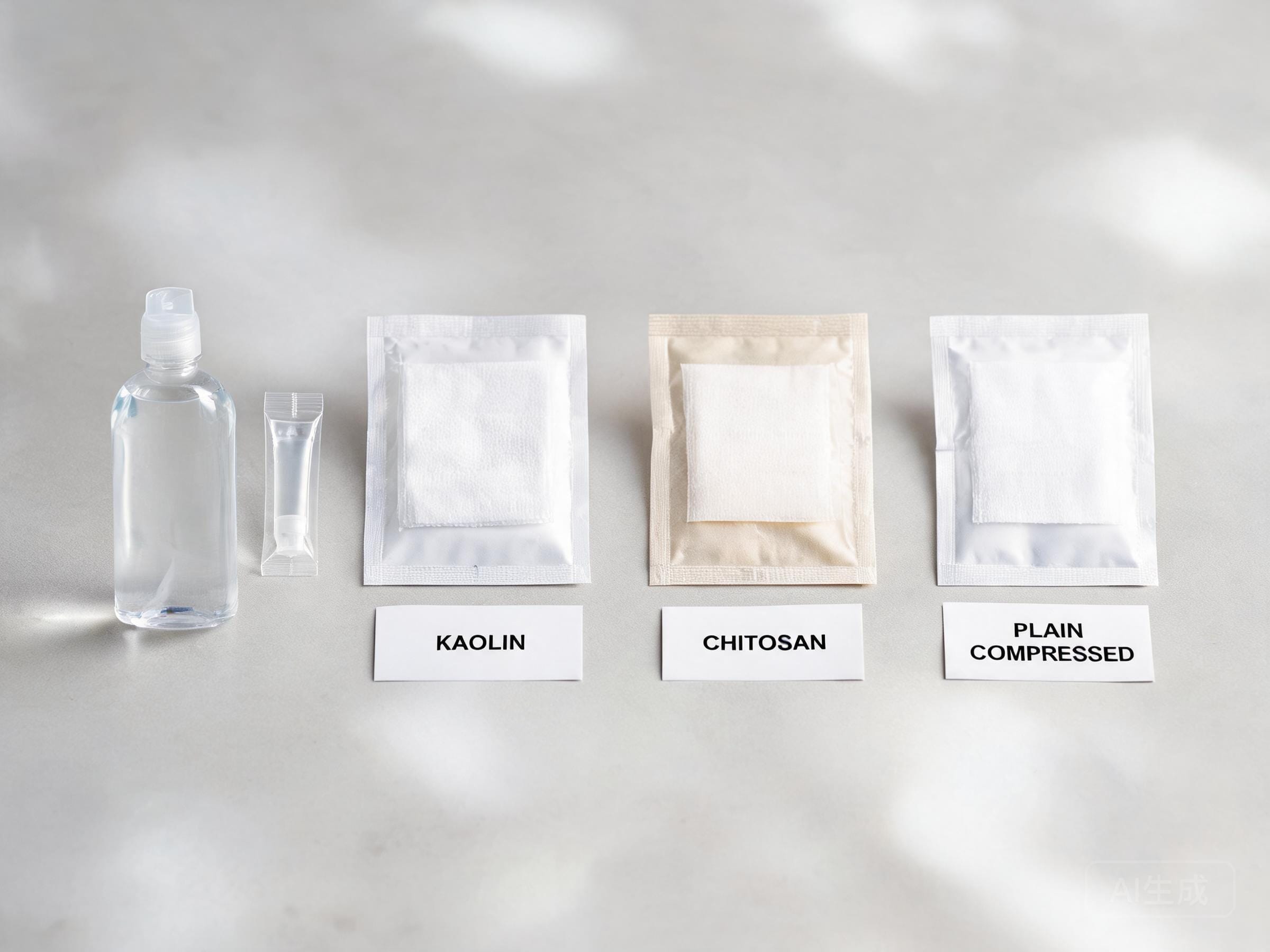
The three categories are not interchangeable, and the mechanism explains why the cost and handling differ.
Kaolin-based gauze. Kaolin is an inert aluminosilicate mineral. It works by activating Factor XII in the clotting cascade, which accelerates the body’s own clot formation at the contact surface. Because kaolin is inert and does not react with blood chemistry to swell, it is stable across a wide temperature range and typically carries a long shelf life. It is the mineral agent most civilian buyers recognize because the most widely known branded product in this class uses it.
Chitosan-based gauze. Chitosan is a polymer derived from crustacean shells (chitin). It works differently from kaolin: it is mucoadhesive and positively charged, so it binds to red blood cells and forms a seal largely independent of the body’s clotting cascade. That mechanism matters for one practical reason a buyer should understand — chitosan can work even where a patient’s own clotting is impaired. The trade-off is that chitosan products can be more sensitive to humidity in storage and often carry a shorter validated shelf life than kaolin.
Plain compressed gauze (no active agent). This is high-absorbency rolled or Z-folded gauze with no hemostatic agent. It relies on packing and direct pressure. It is the lowest-cost option, has the simplest regulatory profile in many markets, and is often the honest answer for a general first aid line where the channel does not require an active hemostatic claim. Selling plain compressed gauze as “hemostatic” is the single most common mislabel in this category, and it is a compliance exposure the importer inherits.
| Type | Mechanism | Shelf-life tendency | Relative unit cost | Typical civilian channel fit |
|---|---|---|---|---|
| Kaolin | Activates Factor XII, speeds native clotting | Longer, temperature-stable | Mid | Workplace trauma, vehicle, outdoor/EDC, tactical-civilian kits |
| Chitosan | Binds red cells, seals independent of clotting cascade | Shorter, humidity-sensitive | Mid-to-high | Outdoor, marine, kits where storage is controlled |
| Plain compressed | Absorbency plus direct pressure | Longest, simplest | Lowest | General first aid, budget kits, markets that do not need an active claim |
A buyer serving mixed channels often stocks kaolin as the default hemostatic line and plain compressed as the budget consumable, and keeps chitosan as a specialty add. The kaolin hemostatic gauze category is a useful reference point for how the mineral-agent format is packaged for bulk, and the broader hemostasis and bandaging range shows how it sits next to trauma bandages and dressings that share the same dating and documentation logic.
The gap between a supplier’s website claim and what they can document per SKU is the biggest source of post-shipment problems in this category. A practical evaluation framework has five checkpoints.
1. Agent identity and loading, in writing. Confirm which agent the gauze uses and, for kaolin or chitosan, that the agent is actually bonded to the substrate rather than dusted on. Ask for the agent type on the spec sheet, not just “hemostatic” as a marketing word. A supplier that cannot name the agent is selling either plain compressed gauze or an unverified formulation.
2. Sterility and shelf-life validation. Every lot should ship with a sterilization certificate (EO gas is common for this category), a lot number, a manufacturing date, and a printed expiration date. The critical check: shelf life is bounded by the sterile-barrier film and the agent stability, whichever is shorter. A 5-year claim on a chitosan product deserves the validation report before you believe it.
3. Quality system registration. ISO 13485 (medical device quality management) is the reference point most North American and European buyers cite. A supplier holding ISO 13485 sits in a different risk category from one holding only ISO 9001. ISO 9001 is not disqualifying, but it signals that medical-device-specific controls are outside the certified scope. Ask for the certificate number and verify it.
4. MOQ and reorder cadence. The headline MOQ on a website is rarely the flexible first-order MOQ a buyer can negotiate. Ask, in writing, for the lowest MOQ per SKU on a first order and the reorder MOQ for a repeat. The gap between the two tells you how the supplier scales and whether a refill program is realistic.
5. Packaging and labeling control. For a private-label program, the supplier holds the print files for the buyer’s brand and keeps them continuous across reorders. Component continuity — same substrate, same agent loading, same lot-coding format — is what makes a repeat line work. A supplier that changes the substrate or agent loading silently between orders breaks the buyer’s channel and the buyer’s shelf-life assumptions at the same time.
Pricing on hemostatic gauze is spec-sensitive and order-size-sensitive. A few structural points a buyer should hold going into an RFQ:
A low-risk sequencing for a buyer scoping a new hemostatic line: start with the stock kaolin format at a low first-order MOQ, validate it through a sample cycle, confirm the documentation clears the destination market, then move into custom packaging or a second agent type on reorder.
Hemostatic gauze is regulated as a medical device in most markets, and the classification is often higher than plain first aid gauze because of the hemostatic function claim. The supplier provides the documentation they hold; the importer confirms whether it is sufficient for the destination.
The consistent pattern: the supplier holds ISO 13485, sterilization reports, biocompatibility data on the agent and substrate, and a technical file; the importer or distributor confirms sufficiency for the destination market. A supplier that promises destination-market regulatory endorsement for the buyer’s specific use is overstating. Those are buyer-side filings, not supplier-side endorsements. Note also that hemostatic performance claims are tightly scrutinized in most markets, so a buyer should keep marketing language qualified and let the documentation carry the technical claim.
These checks are not unique to hemostatic gauze. They are the same set any sterile first aid consumable line should clear before bulk commitment, and they line up with the framework a buyer would apply to trauma bandages and other dressings in the same kit.
Civilian hemostatic gauze is a sterile, single-use wound dressing designed to speed up clotting, sourced for civilian and distribution channels rather than military contracts. It is usually a rayon or rayon-blend gauze carrying an active agent — kaolin or chitosan — or, in the plain compressed version, no agent at all. Civilian sourcing prioritizes consistent quality, honest labeling, a defensible shelf life, and a landed cost that leaves channel margin, which shifts the decision toward agent type and supplier documentation rather than a single branded product.
Kaolin is an inert mineral that activates Factor XII to speed the body’s own clotting cascade; it is temperature-stable and usually carries a longer shelf life. Chitosan is a polymer from crustacean shells that binds red blood cells and seals largely independent of the clotting cascade, which means it can work where a patient’s own clotting is impaired. Chitosan tends to be more humidity-sensitive in storage and often carries a shorter validated shelf life, and it usually prices higher than kaolin at the same size.
No. Plain compressed gauze has no active hemostatic agent; it relies on packing and direct pressure, and it is the lowest-cost option with the simplest regulatory profile in many markets. Selling plain compressed gauze as “hemostatic” is the most common mislabel in the category and a compliance exposure the importer inherits. For a general first aid line that does not require an active hemostatic claim, plain compressed gauze can be the honest and correct choice — as long as it is labeled as what it is.
MOQs vary by supplier, agent type, and spec. A practical approach is to ask in writing for the lowest MOQ per SKU on a first order and the reorder MOQ for a repeat. Many Asia-based B2B suppliers will negotiate a first-order MOQ below the headline website figure, with a higher reorder tier once the program is validated. Starting with a stock kaolin format at a low first-order MOQ and moving to custom packaging on reorder keeps first-order risk low.
Request and verify, in writing: the agent identity and loading on the spec sheet, an ISO 13485 certificate (verify the number and scope), the sterilization validation report (commonly EO gas), a shelf-life validation report, per-unit lot dating, and biocompatibility data on the agent and substrate. Then confirm with your own regulatory advisor whether that documentation satisfies the destination market’s device classification. The supplier provides documentation; destination-market registration and listing are the importer’s responsibility.
No. ISO 13485 confirms the manufacturer runs a medical-device quality management system, which is a supplier-side quality signal. It is not a market approval. FDA registration and listing in the United States, CE marking under MDR in the EU, and UKCA marking in the UK are importer-side filings specific to the destination. A supplier can hold ISO 13485 and have no standing in a given market. Confirm what the certificate actually covers and what your own jurisdiction requires before you rely on it.
A buyer moving from this framework to a quote typically confirms agent type, sterile-barrier format, MOQ tier, private-label scope, and destination-market documentation, then validates a sample before committing to volume. The same checkpoints apply whether the order is 1,000 units or 50,000 — only the reorder cadence and the per-tier unit cost change. For buyers building a full hemorrhage-control line, hemostatic gauze usually sits alongside a pressure dressing, and the Israeli emergency bandage sourcing framework covers the companion product in the same kit slot.
For a broader category view, this first aid supplies sourcing guide shows how hemostatic gauze fits beside dressings, eyewash, kit refills, supplier evidence and packaging checks.
A distributor sourcing an Israeli emergency bandage for the first time usually does not start with the bandage. They start with a question that decides the order before a single spec is compared: what should the supplier be able to show before we wire a deposit? The Israeli bandage — pressure dressing with an integrated closure bar, designed to stop bleeding and stay on with one hand — is technically straightforward, but the B2B decision is layered. Spec size, sterile barrier, packaging format, MOQ, private-label feasibility, and the destination-market compliance call all sit between the buyer’s RFQ and the bulk shipment.
This guide works through those layers from a sourcing angle. It assumes the buyer is comparing multiple Chinese or Asia-based B2B suppliers (the dominant cluster of manufacturers for this category) and is trying to build an evaluation framework, not a one-off quote. The compliance call stays with the importer, who confirms what their own jurisdiction requires.

The product most buyers call an “Israeli bandage” is a pressure dressing designed for emergency hemorrhage control on an extremity. It combines an absorbent sterile pad, an elasticized wrap, and a plastic pressure applicator (often called a “closure bar”) that lets a responder tension the wrap and lock it with one hand. The design originated with the Israeli Defense Forces medical corps and entered global civilian and tactical first aid kits in the 1990s.
Two structural facts drive every B2B sourcing decision that follows:
Once those two facts are set, the rest of the buyer’s decision is about size, packaging, supplier quality systems, and the destination market.

The three widths that dominate B2B inquiries are 4-inch, 6-inch, and the rarer 8-inch. The right pick is determined by the wound location and the channel the buyer is serving.
| Width | Typical use | Channel fit |
|---|---|---|
| 4-inch (also 4″ / 10 cm) | Hands, forearms, smaller extremity wounds; standard IFAK consumable | Tactical/outdoor kits, individual first aid kits, civilian EDC, light workplace kits |
| 6-inch (also 6″ / 15 cm) | Thighs, shoulders, larger extremity wounds; kit-internal trauma component | Workplace trauma kits, EMS/tactical responder kits, larger IFAK configurations |
| 8-inch (also 8″ / 20 cm) | Abdominal and very large-area emergency wrap; less common | Specialty trauma kits, military bulk; usually stocked as a backup, not the everyday width |
Buyers frequently quote the 4-inch version as their baseline, because it is the most common width in IFAK and tactical kit configurations. A B2B catalog that lists only one width is rarely the right supplier for a buyer serving mixed channels; a second width is often what closes a kit-level RFQ.
Packaging is the other variable inside the size decision. Most bulk orders ship in vacuum-sealed foil pouches (sterile barrier) inside a printed outer pouch, then case-packed. Some private-label programs ship a thicker retail-style box per unit, which adds shipping cube and unit cost. Confirm the per-unit format before sizing the inner pack of a kit.
The single biggest source of post-shipment problems in this category is not the bandage itself; it is the gap between what a supplier claims on a website and what they can document per SKU. A practical evaluation framework has five checkpoints:
1. Sterility and shelf-life documentation. Every lot should ship with a sterilization certificate (commonly EO gas for this category), a lot number, a manufacturing date, and a printed expiration date. Confirm expiration dating is per unit, not per case. A buyer running FIFO inventory needs per-unit dating to make rotation auditable.
2. Material and tensile data. The elastic wrap and closure bar are the working parts. Ask for tensile strength on the wrap and a confirmation that the closure bar holds under load. A supplier that can produce a third-party lab test report — or will commission one against the buyer’s destination-market requirement — is materially stronger than one that cannot.
3. Quality system registration. ISO 13485 (medical device quality management) is the standard reference point most North American and European buyers cite. A supplier that holds ISO 13485 is in a different risk category from one that holds only ISO 9001, though ISO 9001 is not disqualifying — it just signals that medical-device specific controls are not in the certified scope. Ask for the certificate number and verify it.
4. MOQ and reorder cadence. MOQs in this category vary widely, and the headline MOQ on a website is rarely the actual flexible MOQ a buyer can negotiate at first order. A practical approach is to ask the supplier, in writing, what the lowest MOQ is per SKU for a first order and what the reorder MOQ is for a repeat. The gap between the two tells you how the supplier scales.
5. Packaging and labeling control. For a private-label program, the supplier needs to hold the print plates or packaging files for the buyer’s brand, and to keep them continuous across reorders. Component continuity — same wrap, same pad, same bar, same lot-coding format — is what makes a refill line work. A supplier that changes a component silently between orders breaks the buyer’s channel.
For a buyer organizing the full consumables range around these checkpoints, the broader first aid product range is a useful cross-reference for how bandages and dressings sit next to gauze, antiseptics, and irrigation items that share similar dating and documentation logic.
Israeli bandages fall under different regulatory paths depending on where the buyer is shipping. A few common destination markets, with the call the buyer makes:
A consistent pattern: the supplier provides the documentation they hold (ISO 13485 certificate, sterilization reports, technical files, biocompatibility data on the materials), and the importer or distributor confirms whether that documentation is sufficient for the destination market. A supplier that promises destination-market regulatory endorsement for the buyer’s specific use case is overstating; those are buyer-side regulatory filings, not supplier-side endorsements.
Pricing on this category is highly order-size and spec-sensitive. A few structural points:
A practical approach for a buyer scoping a private-label program is to start with the stock-format Israeli bandage at a low first-order MOQ, validate it through a sample cycle, then move into custom packaging on reorder. That sequencing keeps the first-order risk low while it confirms the supplier can hold quality across a custom build.
A few patterns come up repeatedly in this category:
These checks are not unique to Israeli bandages; they are the same set any first-aid consumable line should clear before bulk commitment. The same logic applies to hemostatic gauze, dressings, and antiseptics that share the dating and sterility framework.
An Israeli emergency bandage is a sterile, single-use pressure dressing that combines an absorbent pad, an elasticized wrap, and a plastic pressure applicator (closure bar) that lets a responder tension the wrap and lock it with one hand. It is used for emergency hemorrhage control on extremities. The design originated with the Israeli Defense Forces medical corps and is now standard in civilian, tactical, and workplace first aid kits globally.
The three widths that dominate B2B sourcing are 4-inch, 6-inch, and 8-inch. The 4-inch version is the most common IFAK and tactical kit consumable; the 6-inch version is typical for workplace trauma and larger IFAK configurations; the 8-inch version is a specialty width used less frequently. Buyers serving mixed channels usually stock more than one width.
MOQs vary by supplier and by spec. A practical approach is to ask, in writing, what the lowest MOQ is per SKU for the first order and what the reorder MOQ is. Many Asia-based B2B suppliers in this category will negotiate a first-order MOQ meaningfully below the headline website figure, with a higher reorder tier once the program is validated.
Usually not. FDA establishment registration, device listing, and 510(k) assessment are importer-side filings in the United States. CE marking under MDR is importer-side in the EU, with an EU Responsible Person required if the manufacturer is not EU-based. The supplier can hold ISO 13485 and provide documentation, but the destination-market regulatory filing is the importer’s responsibility. Confirm what the supplier’s certificate actually covers and what your own jurisdiction requires.
Yes, where product feasibility allows. A first private-label run typically carries a one-time print-plate or tooling fee plus a per-unit uplift for branded inner pouches or retail boxes. The reorder economics compress as the tooling amortizes over volume. The constraints are practical: the closure bar and sterile-barrier packaging have to stay continuous across reorders, and any change to pad, wrap, bar, or film requires written notice and buyer approval.
Request and verify the following in writing: ISO 13485 certificate (verify the certificate number and scope), sterilization validation report (commonly EO gas), per-unit lot dating, third-party tensile and absorbency test reports on the wrap and pad, and a component-change approval clause. A supplier that produces these documents in a structured format is in a different risk category from one that produces marketing collateral instead.
No. An Israeli bandage is a pressure dressing with a mechanical closure bar; a hemostatic dressing is coated or impregnated with an agent (kaolin, chitosan, or other) that accelerates clotting. They are sometimes used together in the same kit, but they are different products with different regulatory classifications. A buyer sourcing a hemorrhage-control kit typically carries both, sized to the channel.
To move from framework to a quote, a buyer typically confirms width, sterile-barrier format, MOQ tier, private-label scope, and destination-market documentation, then validates a sample before committing to volume. The same five-checkpoint framework above applies whether the order is 1,000 units or 50,000 — only the reorder cadence and the per-tier unit cost change. For buyers building the companion hemostatic layer of the same kit, a civilian hemostatic gauze sourcing guide walks through the kaolin, chitosan, and plain compressed decision on the same documentation-first framework.
Buyers comparing pressure bandages inside a wider consumables assortment can use this first aid supplies sourcing guide to align dressings, gauze, eyewash, labels, MOQ and refill documentation before placing an RFQ.
A buyer asks for a quote on 500 portable eyewash stations, then asks the question that decides the whole order: how long does the fluid last on a warehouse shelf before it has to be thrown out? The eyewash station solution inside each unit, not the housing, is what drives reorder frequency, storage planning, and the real per-year cost a distributor carries. There are four flushing fluid types in common B2B circulation: potable water, bacteriostatically preserved water, preserved buffered saline, and sealed sterile saline cartridges. Each one carries a different shelf life, a different replacement cadence, and a different fit for the destination market a buyer is supplying.
This guide compares those fluid types from a sourcing angle: what they are, how long they hold, and how that shelf life shapes bulk ordering and inventory turnover. ANSI/ISEA Z358.1 is the reference point most North American buyers cite, so it appears here as background. Where it matters, the destination-market compliance call stays with the importer, who confirms what their own jurisdiction requires.

“Solution” in this category does not mean a single product. ANSI/ISEA Z358.1 defines flushing fluid broadly: potable water, preserved water, preserved buffered saline, sterile buffered saline, or another medically acceptable solution. That definition gives buyers room, and it also means a quote for “eyewash solution” can describe four physically different products at four different price points.
The distinction that matters most for sourcing is preservation. Plain water left standing grows microorganisms, so any fluid that sits sealed in a portable unit for months has to either be replaced on a schedule or dosed with an additive to slow microbial growth. That single requirement splits the category:
The cheaper the fluid per liter, the more often someone has to touch it. That trade-off is the spine of the sourcing decision.

Shelf life is not a product spec a buyer files away. It sets the reorder clock, and the reorder clock sets how much inventory a distributor can safely hold.
Consider two distributors who each move 1,000 portable eyewash units a year. The one stocking sterile saline cartridges with a 24-month dated shelf life can hold a deeper buffer of refills without writing off expired stock, which means fewer purchase orders and better freight consolidation. The one stocking bacteriostatic-preserved water refills, rated near six months, has to order in tighter, more frequent batches or risk discarding fluid that timed out in the warehouse. Same end use, very different working-capital profile.
A few sourcing implications follow directly from shelf life:
For buyers organizing this kind of recurring consumable line alongside other wound-care and irrigation items, mapping the full consumables range early helps set realistic reorder cadences across the catalog rather than per-SKU. The wider first aid consumables grouping in the first aid product range shows how irrigation fluids sit next to dressings and antiseptics that share similar dating logic. When the same kit program also includes hemorrhage-control consumables, the civilian hemostatic gauze sourcing guide covers the gauze-side documentation, agent, and shelf-life questions buyers should review before bulk order.
Fluid chemistry is half the picture. The other half is how the station delivers it, because a station that holds compliant fluid but delivers it wrong still fails its purpose in the markets that audit for it.
ANSI/ISEA Z358.1 sets reference targets that buyers supplying North American sites are routinely asked to meet:
These are the figures a buyer’s own EHS or procurement team will check against a spec sheet. The sourcing job is to confirm them per SKU before bulk commitment, because reservoir size and flow behavior vary across portable formats. Buyers who need help reading a spec sheet against an order plan can route those questions through a B2B sourcing channel rather than guessing from a product photo.
| Fluid type | Typical shelf life | Reorder cadence | Per-unit cost | Suited sourcing scenario |
|---|---|---|---|---|
| Potable water (unpreserved) | Refill cycle, not shelf life | Drain/refill every 90–180 days | Lowest fluid cost, highest labor | Sites with on-site maintenance staff and reliable potable supply |
| Bacteriostatic-preserved water | ~6 months sealed | Frequent, tighter batches | Low–moderate | Buyers prioritizing low landed cost who can manage faster turnover |
| Preserved / sterile buffered saline | 24 months, some to 36 | Infrequent, deeper buffer | Moderate–higher | Distributors building a stable dated-refill line with FIFO rotation |
| Sealed sterile saline cartridge | ~24 months sealed | Infrequent | Higher | Cartridge-fed portable stations; low-maintenance end sites |
The pattern reads cleanly: cost per liter rises as maintenance burden falls. Buffered saline sits where most B2B refill programs land because its dating supports a buffer stock without write-offs, and its pH profile suits the end use. The right pick still depends on who maintains the unit at the destination and how fast the channel actually turns the product.
Eyewash solution is a consumable that lends itself to private-label programs, because the refill is what a buyer’s customer reorders again and again. A few points come up repeatedly in OEM/ODM discussions:
Where product feasibility allows, these elements can be discussed according to order type and volume. Buyers scoping a branded refill line can review the OEM and private-label workflow to see how sampling and feasibility review run before a bulk order is placed.
Saline eyewash solution is buffered toward the pH of human tears and is preserved or supplied sterile, which gives it a dated shelf life, commonly 24 months. Plain potable water has no preservation, so it must be drained and refilled on a fixed cycle rather than stored. For B2B inventory planning, saline behaves like a dated product you can stock; unpreserved water behaves like a maintenance task you have to schedule.
It depends on the fluid type. Bacteriostatically preserved water in a sealed portable unit is typically rated around six months. Preserved and sterile buffered saline refills commonly carry 24-month shelf lives, with some sterile-saline products rated up to 36 months. Sealed sterile cartridges sit around 24 months. Always confirm the dated shelf life per SKU, since it sets your reorder cadence.
Match the fluid to turnover and to who maintains the station, not to the lowest unit price. Buffered saline suits distributors building a stable dated-refill line because its longer shelf life supports a deeper buffer stock without write-offs. Bacteriostatic-preserved water can lower landed cost for buyers who can manage faster, tighter reorder cycles. Potable water fits only sites with on-site staff to handle scheduled refills.
Z358.1 is a US-referenced standard for emergency eyewash and shower equipment. It is widely cited in North American B2B sourcing, but it is not automatically the governing requirement everywhere. The importer or distributor confirms what their own destination market requires for certification, labeling, and registration. Read Z358.1 figures here as a sourcing reference, not as a compliance ruling for your jurisdiction.
Yes, where product feasibility allows. The refill is a natural private-label item because it drives repeat orders. The constraints are practical: the bottle or cartridge format has to fit the target station, the label has to keep lot and expiration fields legible, and the fluid spec has to stay continuous across reorders. These can be discussed according to order type and volume.
To move from comparison to a quote, a buyer typically confirms fluid type, format, target shelf life, and destination-market requirements, then validates a sample before committing to volume. Working through those four points in order keeps a bulk eyewash refill program from expiring on the shelf or stalling at customs.
Buyers comparing refill fluid as part of a complete station program should also review this portable emergency eyewash station sourcing checklist, which connects capacity, refill format, packaging and maintenance labels before an RFQ is placed.
For buyers building a wider refill and consumables program, this first aid supplies sourcing guide connects eyewash fluids with dressings, gauze, refill checks, packaging and RFQ preparation.